Unlike “M,” it was difficult for me to disregard the second OE definition of “precious.” When Annette articulated our signment in class, the combination of the words “precious” and “paper” immediately led my mind to money. The U.S. dollar is intimately tied to the materiality of paper. The word “dollar” itself carries with it an implicit second noun (“bill”), which in turn carries with it another qualifier (“paper”). This is not the case for all currency, as anyone who has been startled by the vastly different material experience of the “pound” or the “yen” can attest. The idea that a value as high as $5 can be contained in or represented by a coin is surprisingly disorienting to an American and certainly requires reconsideration in one’s choice of wallet.
However—and this revelation may seem fairly obvious—following this train of thought regarding paper bills has led me to a fairly interesting place when combined with M’s definitions. Arguably, there is nothing materially precious about paper, at least according to the OE. Materially precious seems to be equated with monetary or trade value in the dictionary definition, and paper is notoriously cheap, taken for granted within our society (until it isn’t). Yet, the idea of monetary value itself has become collapsed into paper. When I “see” money in my mind’s eye, I see paper. In a similar way, a citizen of Great Britain or Japan might see a round metal object, but the metal will not actually be a precious metal, according to official classifications. These materials are not actually precious at all, and yet my instinct was to claim them as precious. I am sure this says something about the state of global economics and trade and the credit system or whatever and I could say “Marx”! However, what I ended up thinking about was how underutilized bills themselves are as writing surfaces. We pass money to other human beings more consistently than any other paper product, perhaps with the exception of receipts. As debit and credit cards take over many transactions, this passing of paper primarily occurs within the service industry. (Well, illegal industries too.) The service industry is the last stand in the tradition of a representation of the dollar via a material that lends itself easily to writing. It’s quite difficult and suspicious to write on the plastic of a card. It’s easy to write on a paper bill, and it doesn’t actually degrade the monetary value as long as you keep your writing to the margins.
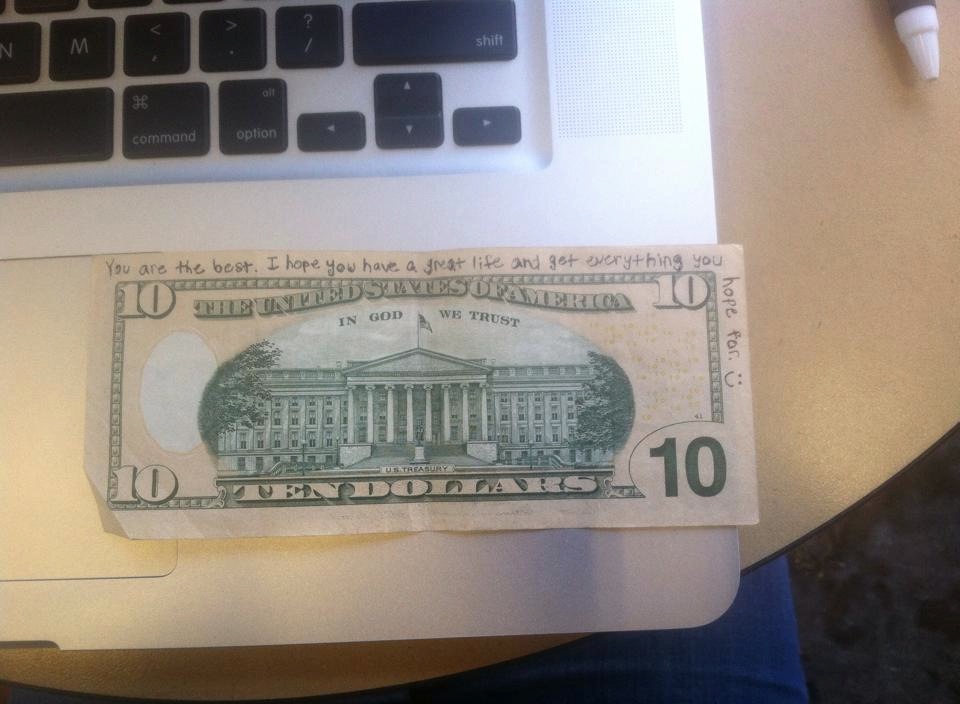
So, since it seems that the value of a bill is both material and immaterial at the same time (since the actual materials have been divorced from use value or availability of the material itself), I decided to return something like use value to the material of a $10 bill. In returning this use value, I am also adding a layer of immaterial value by making the paper bill an unexpected medium of communication. We might say that due to the amount of human to human sharing involved in the life of a bill, the medium already always afforded this function and waited to be realized. Or, that bills carry their symbolic nature around with them (Look, I framed the first dollar my company ever made! etc.), and that writing on the bill simply adds or emphasizes its inherently symbolic nature (as something precious). Or that I have gone all Haley Joel Osment on this signment and simply done something cheesy by translating something so impersonal and inhuman into a tool for personal, human-to-human communication. Either way, I wrote something nice on this bill. Now, I’m going to tip someone with it.

One Response to Precious Paper (Anna)