Michelle and I were considering writing in her old journals. Of which there are many. They are very important to her: every now and again she pulls them out to remind herself (I think) of before. To look at how different her life is now. Which is a simplified version of what is really going on, but I’m not sure even I understand completely.
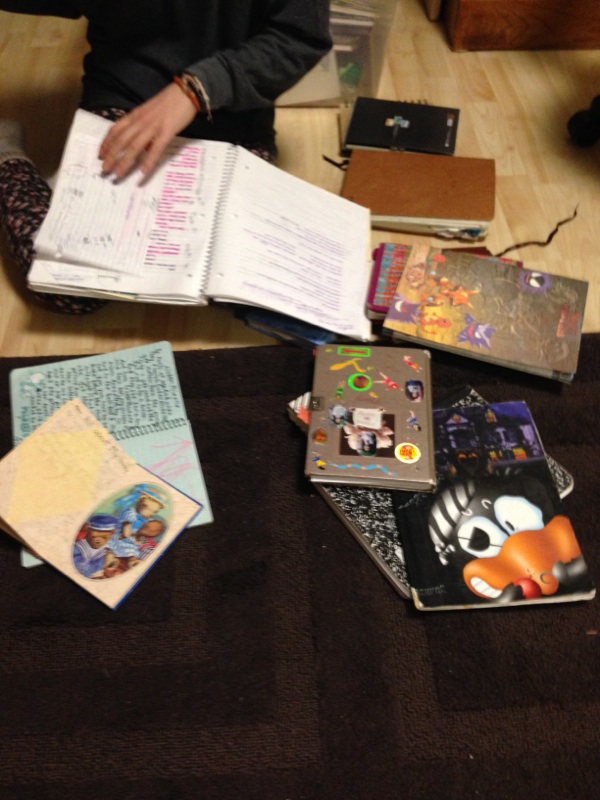
I know, for me, it is difficult to return to the past. My former selves stare back at me from the page, pushing back against my ego, destroying my illusory self-permanence. Yet Michelle ritually takes part in this destructive act.
I often think that the present is how it has always been and always will be; I am constantly believing in this fallacy. And it takes a greater awareness of the present and the past to overcome this, an awareness that is difficult for me to procure under most default/daily/normal circumstances.
(The way her life was before. I am using language that avoids the subject, because the subject matter is difficult, and I do not wish to interrogate the subject deeply.)
So this is why I have chosen not to use Michelle’s journals. I do not feel comfortable, myself, with the content of her past. It makes me feel guilty; scared. The temporality of it throws me for a loop. Is the writing of her past the writing of her present if I am reading it in the now? Each time I revisit the past, it becomes new again. New, and scary, and lurking, somehow, beneath my consciousness, this remote history that only she has access to. My only point of entry is to be with her in the present.
(In some ways, the girl who wrote these entries is right there waiting to talk to me about them. In some ways, she is gone completely.)
In this instance, writing in her journals feels like more than an act of production, of artistry, or even defacement. It is an act of ownership. Perhaps because we live in a literate society, because we live in a capitalist society, because we believe in things like free speech and private property, when I write on something, I feel like I am making it my own. Even those who are illiterate, those who are physically unable to write can put their mark on a contract. There is something significant in the act of writing, something permanent, something you can’t undo. When you sign something, you take full responsibility of all the consequences of that signature.
(Is it defacement? Am I destroying value? Is this what I am scared of? Am I changing it? How am I measuring value in this case? How is she? How do you?)
I do not want to write on Michelle’s journals because they are not mine to own. Especially not when it is difficult for her to own them in the first place.
What I’ve decided to write on is something that my friend gave me as we began our undergrad careers apart from each other for the first time. We’d had a strange slightly-more-than-friends-but-not-really kind of relationship, and so this object meant a lot to me at the time. It is a small paper towel tube that she painted black and coded with various symbols that pertained to our interests at the time: a queen of spades, a piano, a ticket, a sword, a dragon.
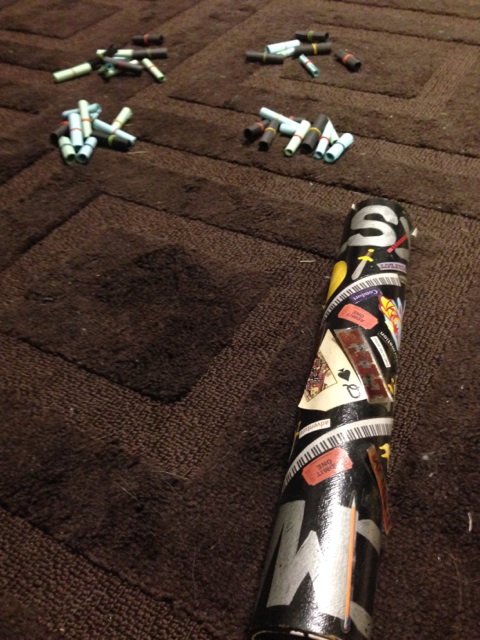
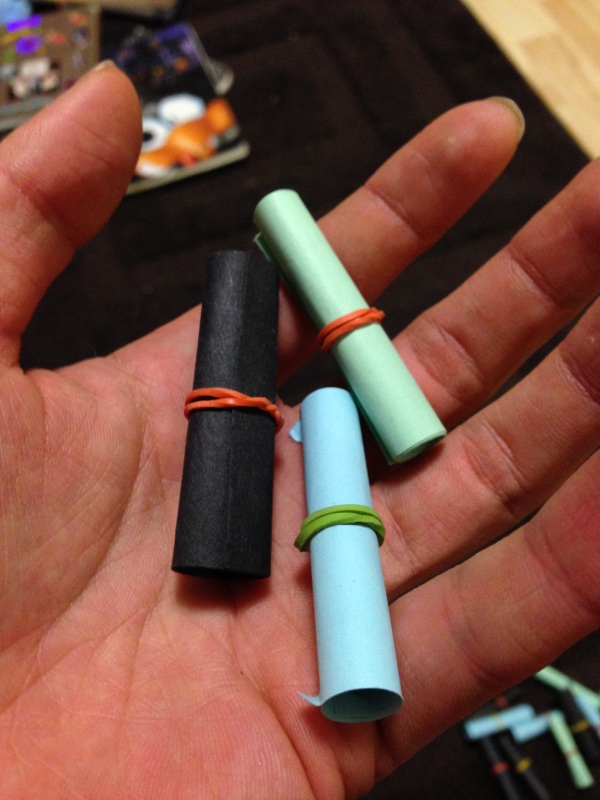
And on the inside of the tube, she sealed 37 small, rolled-up pieces of paper, each with a different quote on it from people that she thought were inspirational.
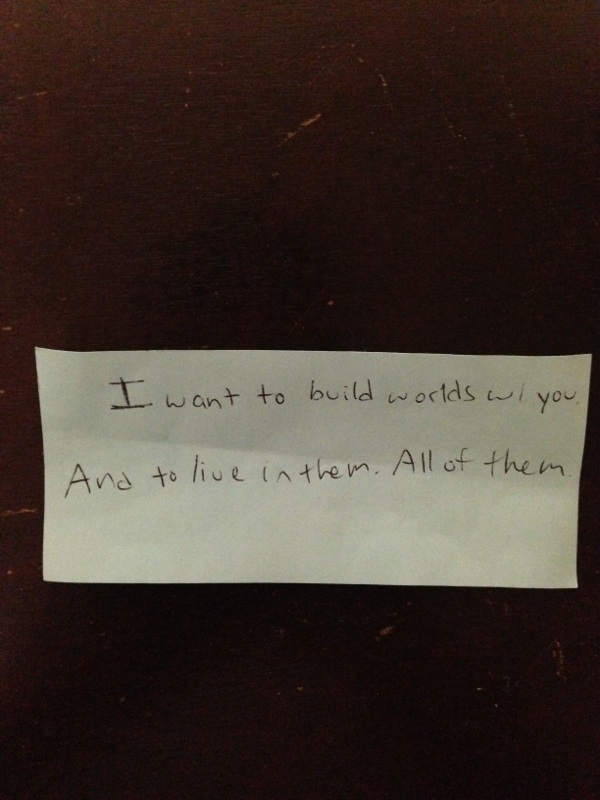
An example:
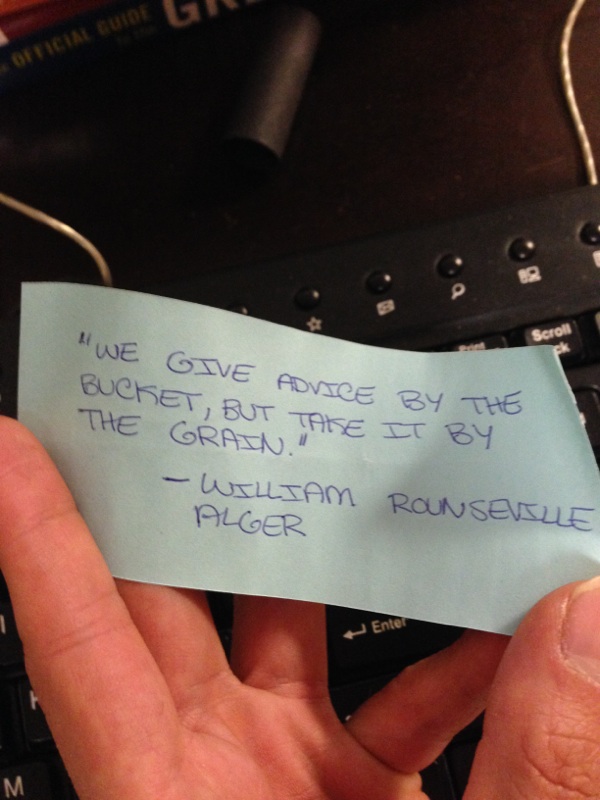
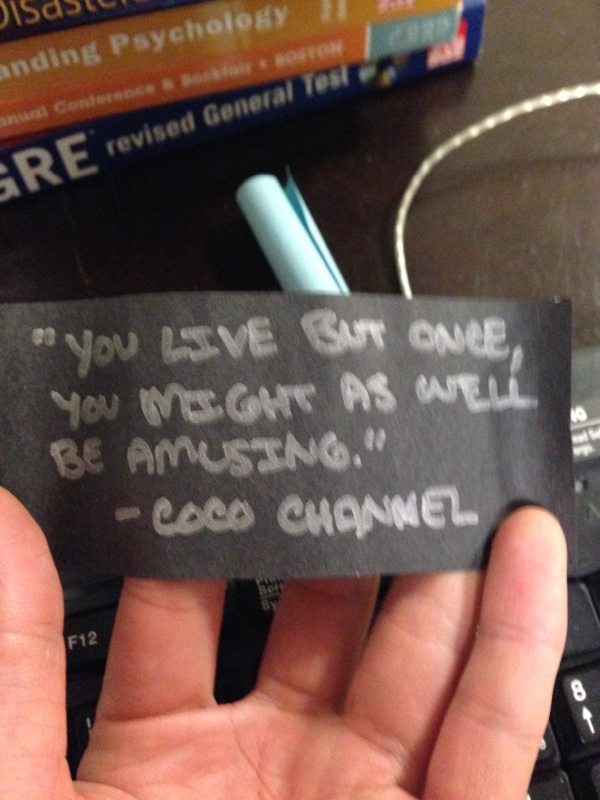
This is my own history. Or, our history. It is something that has been given to me. And so I feel justified in writing on it. The destructive quality is lessened; I am not an outsider, entering into sacred historical space. I belong in this history; the object is my own.
The quotes that she included in this gift were never meaningful to me in the way that they were to her; even as a college freshman, I thought they were sort of cheesy. But I understand the impulse: how do you create meaning in the face of meaninglessness? In the face of departure/instability/loneliness? Often it is easier to defer to others to create that meaning for you. But what is important, ultimately, is not the “content” of the sheets of paper: it is the act of making that takes precedence. In the absence of “content,” the “formal” qualities take precedence.
So I’ve been thinking about this a lot. And what I think I want to do is I want to bring these pieces of paper to class. And I want everyone in class to write on one themselves.
I want you to do this with me. To write something, anything, on the piece of paper. And give it to someone you love. Because I think that is no longer a taking ownership. This is what I want to avoid. I do not want to possess what I write on. I want writing to be a selfless act. I do not want to take. I want to give.
This is why I cannot write on Michelle’s journals. I cannot take that complicated history and reduce it to something of my own creation. I cannot do justice to her story. There is too much for me to accurately convey to others, to myself, back to her. There is too much to own.
It is not enough to write on a piece of paper and give it to someone. I know this. We cannot ease the suffering of others, not in the way that we want to. This is what I feel in the face of the past. We can never write enough, never learn enough, never say enough.
The only thing to do is to continue to give these little pieces of paper with writing on them. To give and give and give again. And in that conscious giving, we can try to understand.