In her introduction to the facsimile edition of Emily Dickinson’s envelope poems, The Gorgeous Nothings, Jen Bervin suggests that Dickinson’s collection of poems written on reused envelopes “convey[s] a sense of New England thrift and her relationship to the larger household economy of paper.” Bervin tells us that The Frugal Housewife, a book that Dickinson’s mother received from her father on the occasion of her birth, opens with this advice: “The true economy of housekeeping is simply the art of gathering up all the fragments, so that nothing is lost. I mean fragments of time as well as materials” (9). I had Bervin’s introduction—the idea of household economy, of saving and reuse—loosely in mind when I made the quick decision while cleaning out the fridge to save the mesh backings of from two bags of oranges and use them in this week’s signment. And I thought: one thing a piece of writing that “highlights its materials” might look like is a piece of writing that comes into being on and through unconventional writing materials.
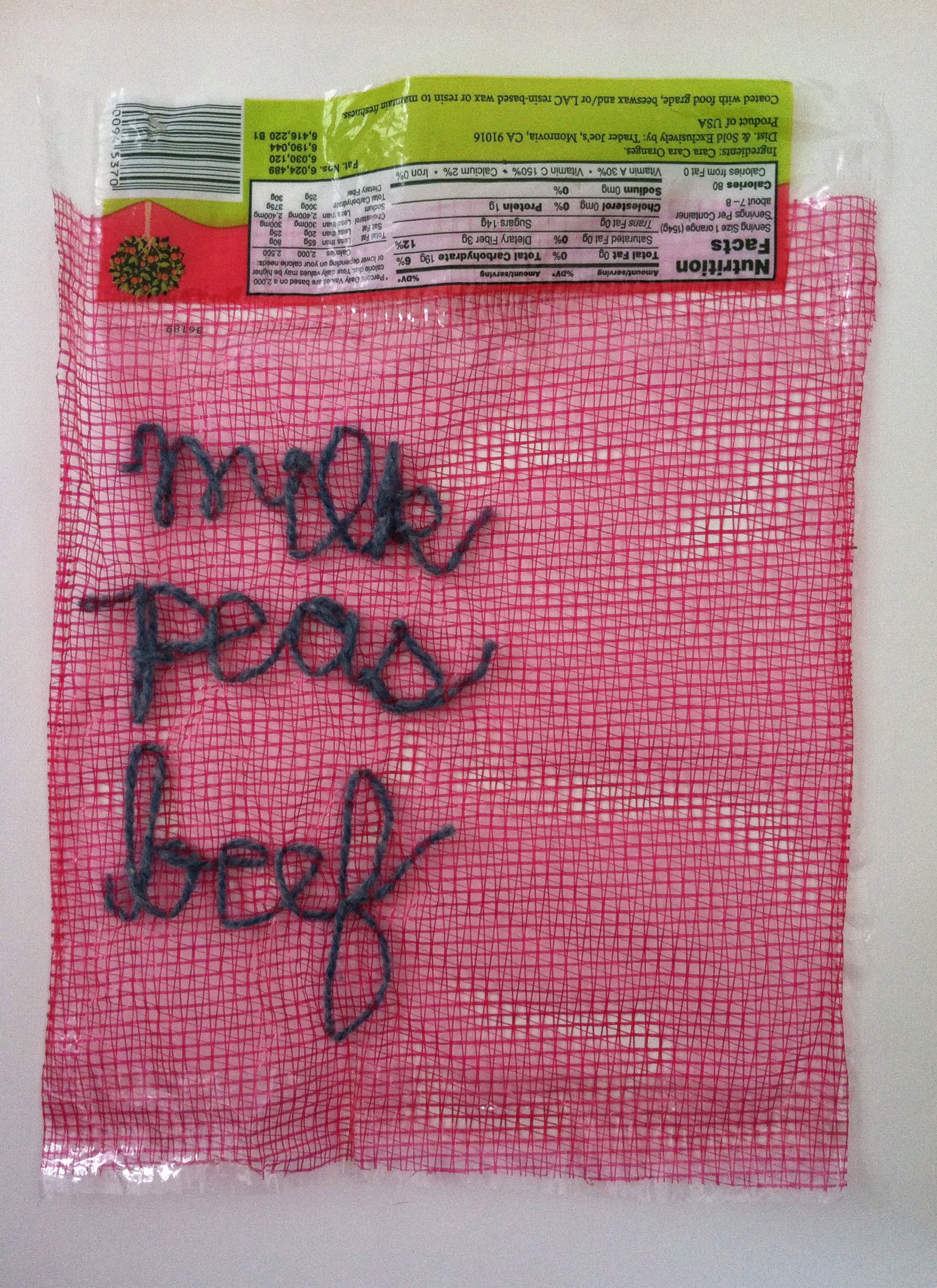
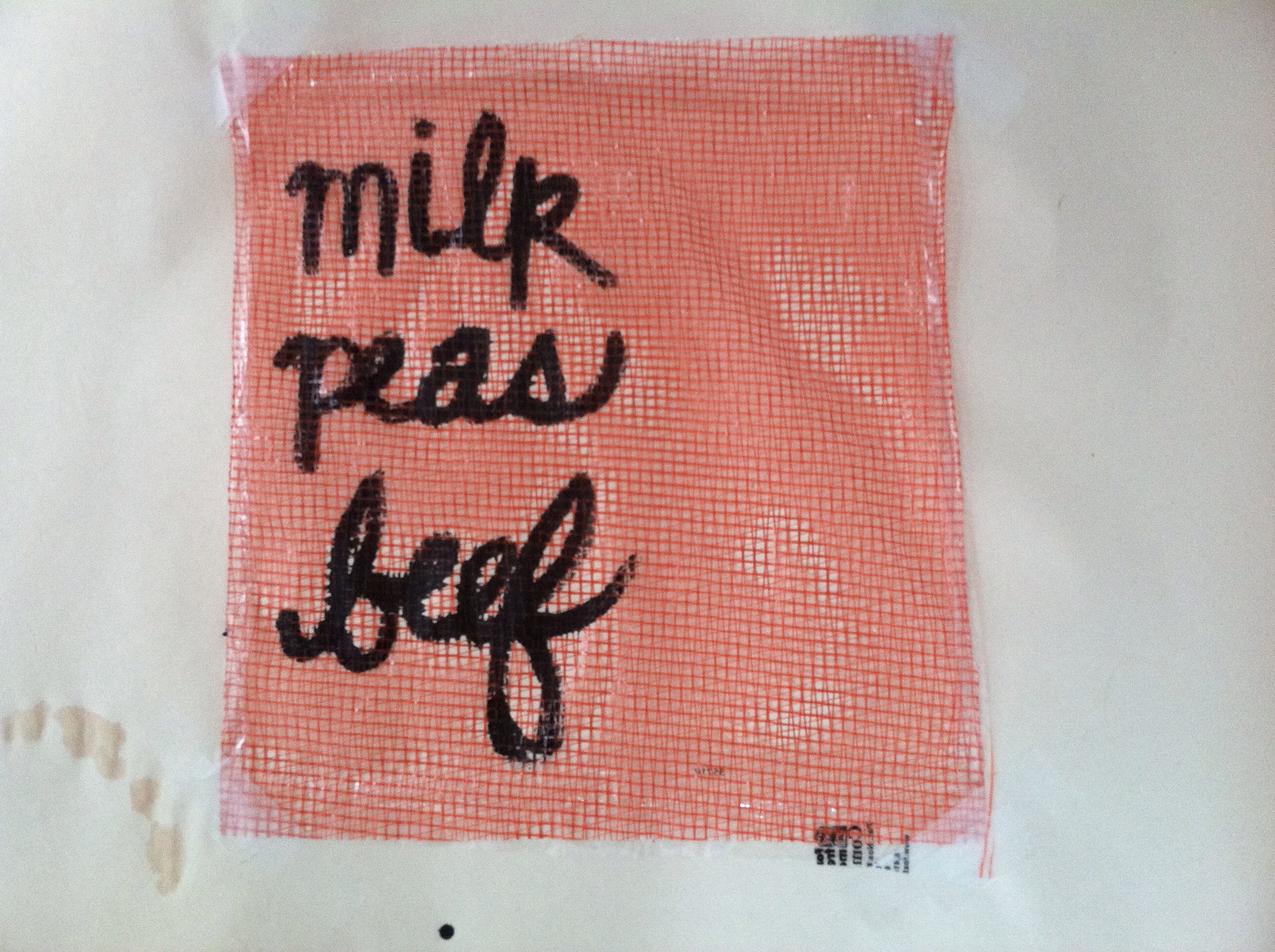
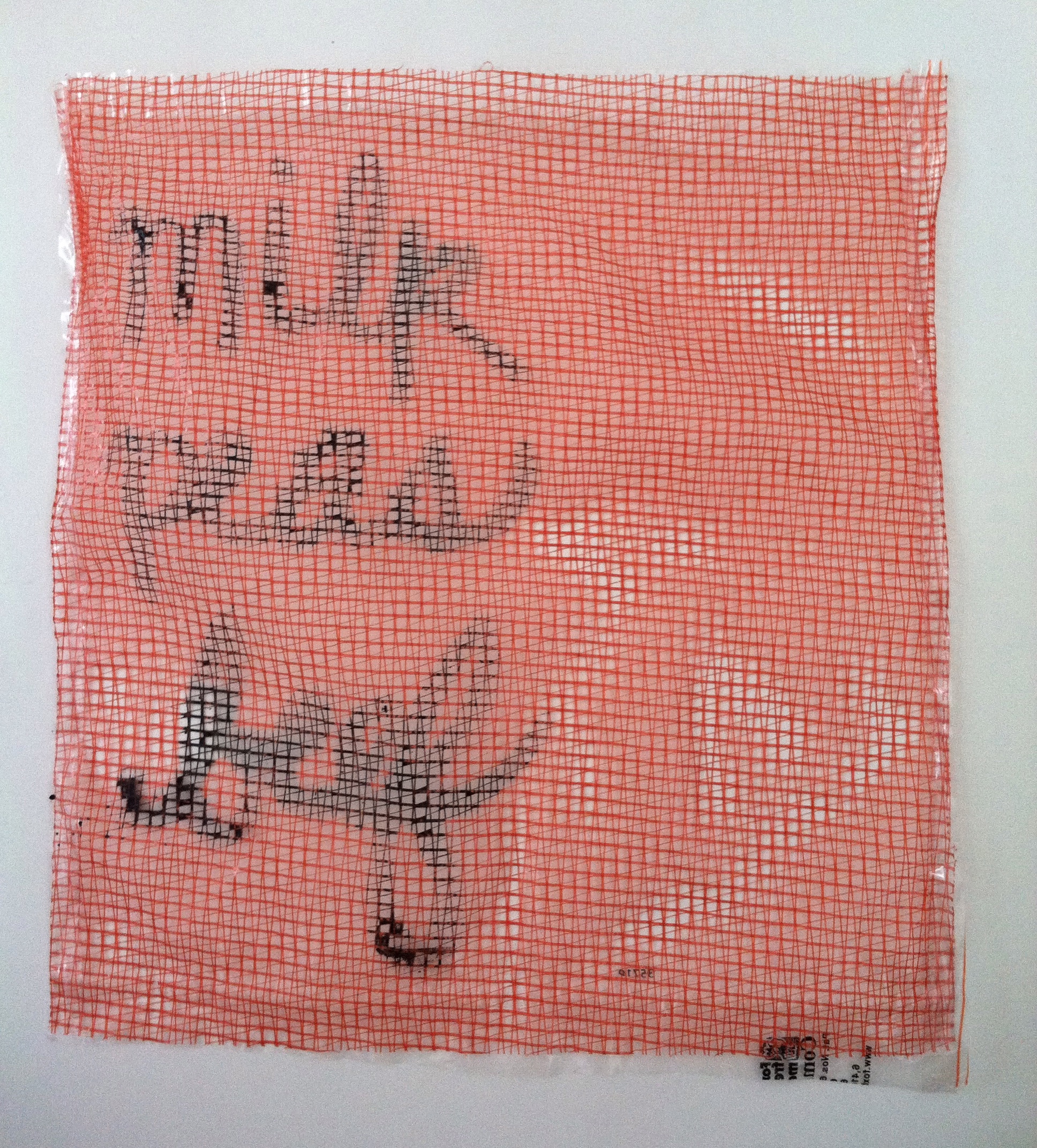
It goes without saying that my objects are nowhere near as elegant and provocative (not to mention interesting) as Emily Dickinson’s—but I’m something of a self-deprecator, so I’m saying it. I wondered what it would take to get a grocery list onto these mesh rectangles—what kind of labor and methods and with what differing results. The first of these was done with yarn and needle drawn through the mesh’s holes to negotiate a kind of stitched cursive. The second was done with black acrylic. In case you were wondering, I hardly every buy peas or beef, but I like four-letter words. They’re so very English. I wanted also sage and salt, but I did the yarn version of this list first, and I quickly grew tired of making words. I can at least say for certain that these pieces of writing highlighted their materials to me, for quickly in my process of working with mesh, yarn, and paint did I have to think about how to use these materials in order to render legible writings, something I almost never have to do with pen and paper. (Apparently I decided that writing and legibility had to go together on this one.)
I’m trying to be better about saving things. Thinking of potential discards in terms of surfaces, inks, tools for marking, making, writing—this demands a re-visioning of my household economy. I’ve been exploring the world of artists’ books and book arts lately, and I’m often jealous of these beautiful projects that make use of high quality, professional materials and masterful skills. Yet I have a deep appreciation for what we can do with the things we have on hand—that is, what materials we’ve culled from the discards of our daily lives and what we know how to do with our hands at a given moment. Learn as you go: learn from the materials: imperatives that inform the projects I ask my students to do, as well as my own.
I want to end with a swerve toward some questions: what might be a piece of writing that doesn’t highlight its materials? Would an e-book be one such thing? If we think of highlighting as “making visually prominent” (as my dictionary thinks of it), as willfully emphasizing, does a paper book maybe not highlight its materials, either? (Might this actually be how its design works?)

2 Responses to Highlights. Economy. Household.