Over the summer I acquired a black tin cash box of my paternal great-grandmother’s effects—interesting word—that had been sitting under a pile of scrapbooks in a closet in my grandparents’ house for decades. At some point in the box’s life, someone had pried open its lock, so that the lip of its lid protrudes, misshapen. The box houses a collection of what Gitelman calls “vernacular documents”: legal papers, newspaper clippings, cards, various scrips, bills, insurance correspondence, a handwritten note about a woman of ill-repute, and, among many other things, this Western Union Telegram:
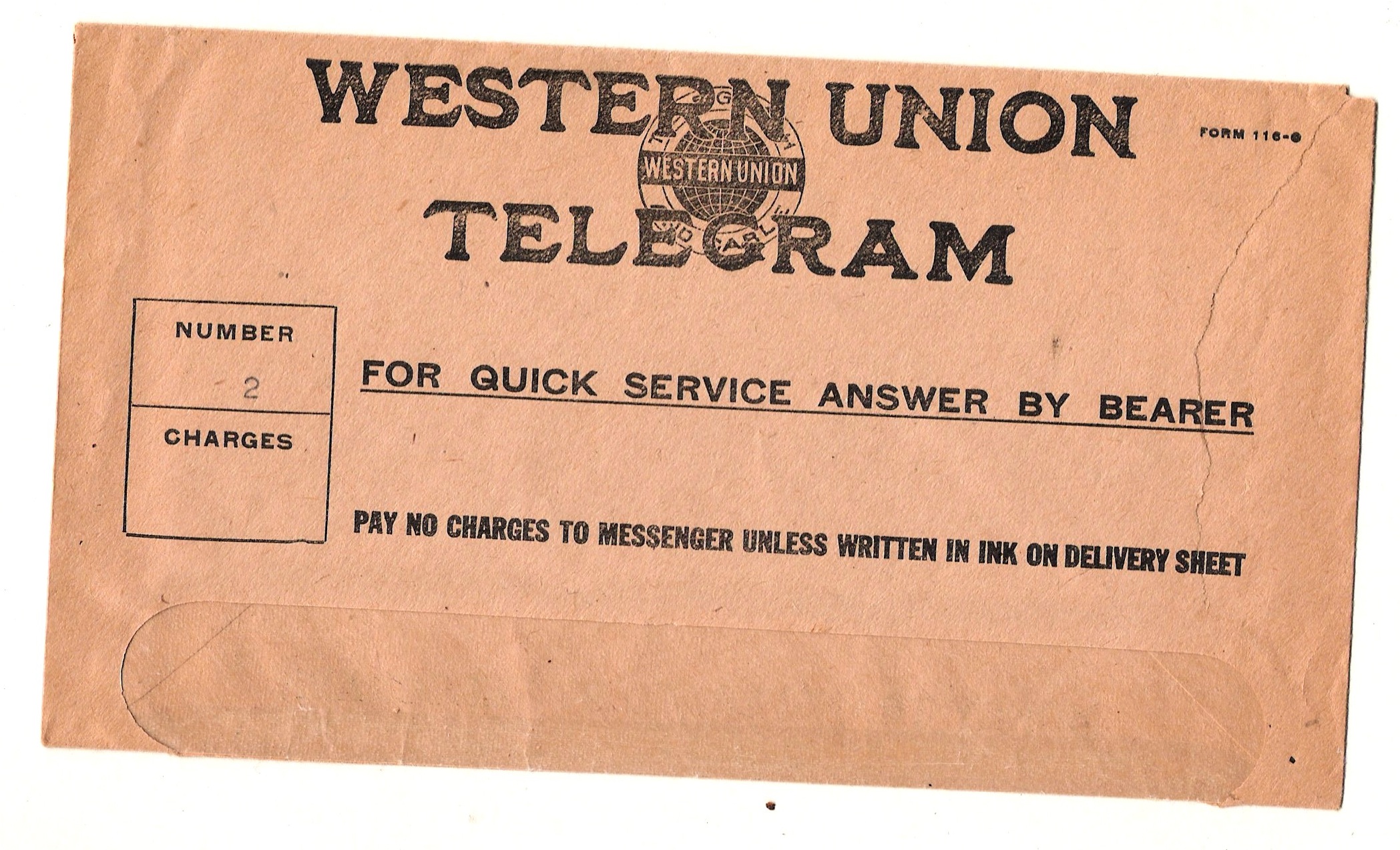
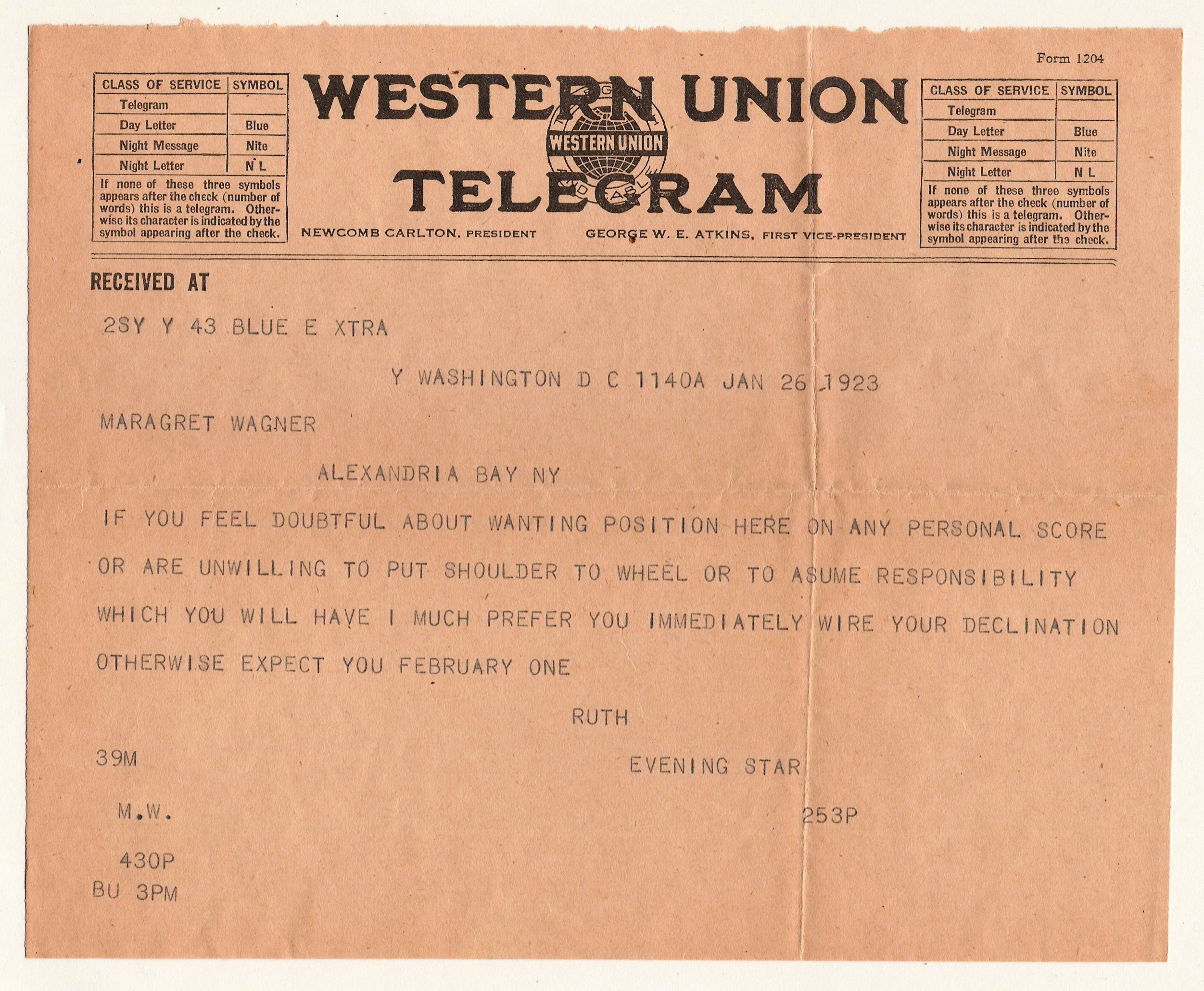
Well, actually—and to my disappointment—it’s not a telegram. In the upper corners of the sheet (which is hand torn at the top) there are boxes indicating “class of service” and corresponding “symbol”; “blue,” seen in the first line of the message after the number 43—what the box calls the “check (number of words)”—indicates that this is a Day Letter, rather than a telegram. If instead there had been the word “nite,” this would identify the text as a Night Message. I like to think that the choice to use “blue” for Day Letter, rather than “day” or “d l”—akin to the symbol for Night Letter—has something to do with the daytime sky, but I imagine a little research, which I have not done yet, would reveal otherwise. (Also: the difference between a message and a letter? Are messages strictly nighttime things?)
As for the text, it has many additional symbols—letters, numbers—which I can’t make sense of without researching the format of the Western Union Day Letter. I can tell you, however, that my great-grandmother’s name is spelled wrong—both first and last—and that the Evening Star was a now-defunct DC newspaper. But Margaret wasn’t a journalist—she was a dental hygienist, and the Evening Star apparently hired her for in-house healthcare. She did go to Washington and was there for two or so years; at some point she met my great-grandfather, a dentist, in New York City, married and left her job, and had her only baby around thirty. But this is where the history grows dark: they divorced when my grandfather was a couple years old, and to this day, he’s not very keen on talking about Carleton. Margaret died of liver cancer at fifty, and I wonder how much anyone really knew of the life she lived in her twenties, the one evidenced by these documents. Certainly no one still alive knows much or is willing to say much at all.
If you feel doubtful about wanting position here on any personal score or are unwilling to put shoulder to wheel or to asume responsibility which you will have…. I can’t comprehend the tone of this letter. That is, I’ve read it several times now, and each time I still feel a visceral response to this defensive opening, and I’m still surprised when it ends with an ambivalent job offer. It’s an offer with admonishment, and part of that admonishment is delivered through the curt style of the form: there’s so much to be said for the warmth that punctuation and pronouns can lend to tone. But phrases like unwilling to put shoulder to wheel remain assumptive to me—is it that Margaret’s a woman? And a woman who is not local, but lives in a small town 500 miles north of Washington? Does the tone, the idiom, become stranger when one realizes the sender is also a woman? I read this Day Letter, and I feel entirely outside this genre of communication, its demands upon professional etiquette and business courtesy.
Perhaps, also, it’s the way the Day Letter echoes with stories that, in January 1923, haven’t happened yet. Unwilling to put shoulder to wheel or to asume responsibility is language that bears the same assumptions as legal correspondence from the 1930s regarding Carleton’s unwillingness—and, in fact, his utter silence regarding requests—to provide financial support for my grandfather’s “maintenance” following the divorce.
Gitelman defines artifacts that are “other than codex” as “material experienced (in the moment) and then associated (in hindsight) with impermanence or ephemerality rather than with permanence or preservation.” She goes on: “Noncodex print artifacts are more transitory than they are archival, one might say, more transactional than accumulative, and the meanings that they embody and convey are thus more accelerative than inertial” (187). Perhaps the Western Union Day Letter is a richer, more storied, more historical, example of the ephemera that fill Margaret’s box, but what I love about both this and the pale pink banking stubs buried somewhere in there, is the nature of their existence and accumulation: that, despite the ephemerality inherent in their forms, their transactional purposes, someone saved them and they are, in a sense, archived. As an assemblage they lend themselves to the construction of a narrative, but this narrative renders itself in very different ways than the ones we so often see in codices.
And yet I keep finding myself treating the box like it is a codex, like its contents exist in bound order, trying to hold the layers of artifacts in place as I thumb through in an effort to preserve their order as I found them. I assume that no one’s rummaged through the box since Margaret, though this probably isn’t true. I can’t help thinking it’s the design imparted by her hands that’s ephemeral; it’s traces like these that are so difficult to preserve.
