As I was reading Jessica Isaac’s piece about adolescent editors and “editresses,” I found myself experiencing some very weird déjà vu. And then I realized what I was thinking of.
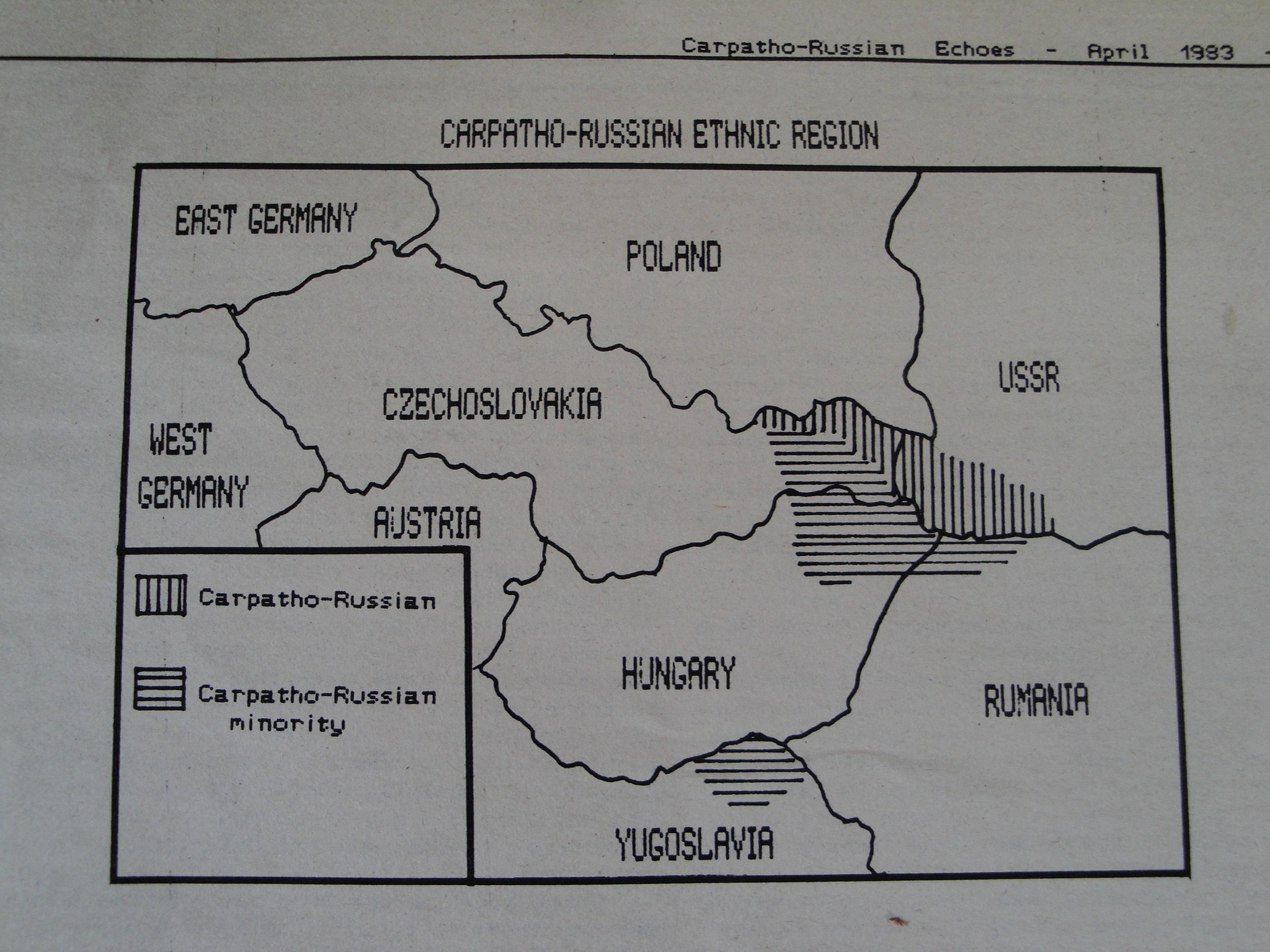
This is a map from Carpatho-Russian Echoes, an independent paper that my dad, uncle, and grandfather published for about ten years. It began around 1983, the year of this issue, in South Florida, and ended when I was too young to remember much about it.
So here’s the thing: as you might notice from the map, there is no country called Carpatho-Russia. It’s not even contained within what is present-day Russia. (Check those vintage country names: East AND West Germany, Yugoslavia, the USSR.) The reason for that is that Carpatho-Russians are a self-identified ethnic group never formally acknowledged by the Russian Empire or the countries that followed it. It’s a complicated history. I made a Powerpoint about it once.
My own family, by the way, is Carpatho-Russian – if you ask my dad. Or Ukrainian, if you ask me. And in our respective systems of logic, we’re both right. That’s how these three men ended up writing and editing a decade’s worth of articles on the subject, printed on my dad’s dot-matrix printer on rolls of computer paper. The front page was usually a poem or hymn, printed in Cyrillic, transliterated English, and translated English. My dad did the translation. He also made the font. And at the height of CRE‘s run, about three thousand people were reading.
I don’t remember the context of this map; I took the photo a few years ago, when I was trying to explain part of this whole story to someone. So let’s treat it as a found object, like Levy’s receipt (never mind my own connection to its authors). Here’s a map of a semi-imaginary country, printed on smooth, plant-based paper that has yellowed more significantly than this photo shows – a recently-made thing. When I say “printed,” I mean that the letters were inked on by impact, sort of like a typewriter, except that the shapes of the letters and countries were stored in a dot matrix. Digital. So it isn’t just the ink and the paper, it’s also the computer that was programmed to reproduce the contours of Romania and then translate this into an electrical impulse that a machine could understand.
And here’s another layer: the men who did the printing were doing their best to preserve a history that had existed in the Old World but had fallen victim to the kind of things that befall the documents of peasants. Fire, mostly. My family was serfs, and serfs don’t really have book-preservation techniques. You need capital for that.
Also, the audience? Mostly also descendants of serfs, who were generally not literate or were, at best, only literate in the most marginal way. The poems and hymns mostly survived through oral transmission until they made it to my dad’s office in 1983.
There’s a lot to say about that, not least because the politics are still incredibly touchy. But then, the politics of printing are always touchy. I’m thinking of Libbie Adams and her affidavits, or the shots fired by Truax and Pynes. I’m stopping here, though, just to avoid writing a novel. So here’s my contribution to our minor printing display: proof that history isn’t just written by the victors, it’s rewritten by the printers.
