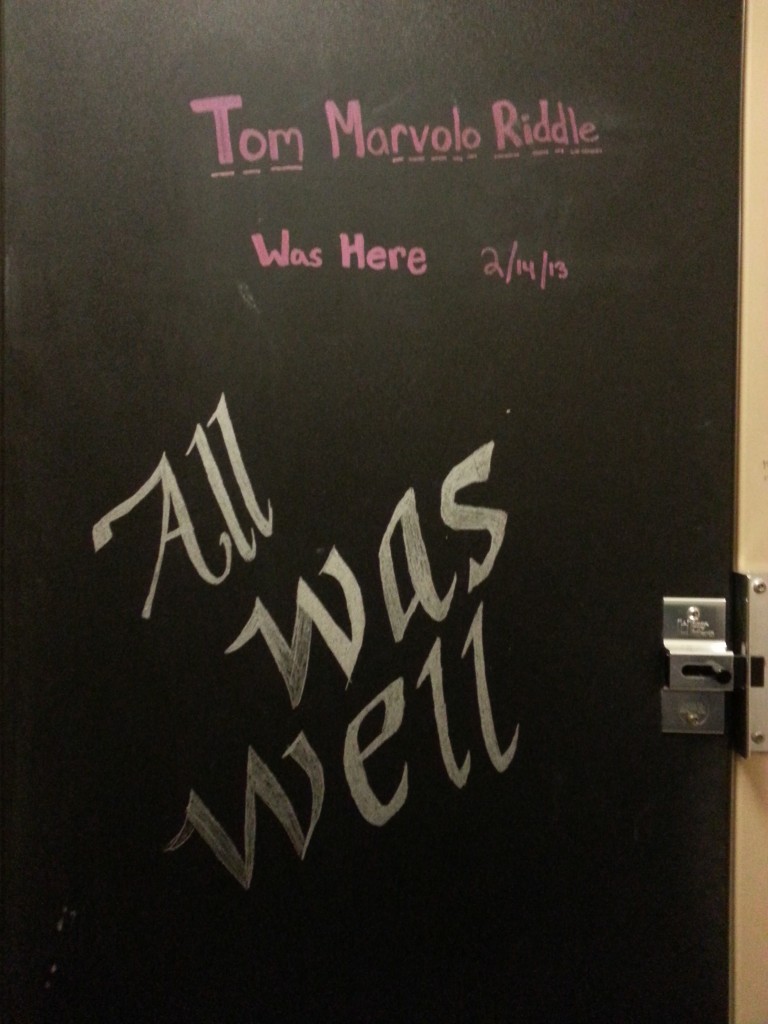
 As perhaps only the women in this class may be aware, the women’s bathroom on the third floor of the Cathedral of Learning has a stall filled with Harry Potter graffiti, and/or (I’ll argue later) marginalia — so, mixed genre “unwelcomed” text(s). We know at this point that the generation of undergraduates attending college at this moment were raised on the Harry Potter books, and the graffiti shows a fierce attachment to the books, and also seem to represent some kind of solidarity amongst the writers. The writers hold the first ethical precept of graffiti writers Joe Austin outlines in Taking the Train (55): out of respect, no writer writes over the others’ work. The disrespectful writing in this mural of quotation and symbolism from the Potter books is present, but minimal. There is also, of course, the occasional intrusion of non-Potter related graffiti, which also remains unaltered, but is generally ignored by the other markers.
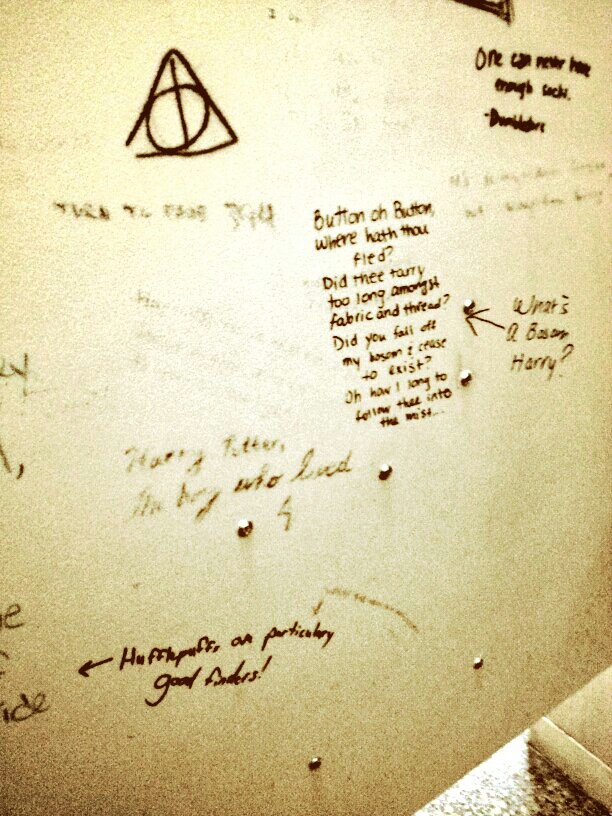
The style and individuality of the marks (as per Austin’s second ethical precept), is not a factor for these writers. What is of value, instead, is their relation to one another. The collaborative work. For several of the writers, they draw arrows to other people’s writings, not unlike the hand symbol Sherman discusses in his discussion of Renaissance marginalia. It offers the writer opportunities to respond in turn or in kind, either with other quotations or individual marks of relation. I only read the Harry Potter Books once (I believe as “escape” reading after my MFA applications, right when the last book came out?) so I’m sure I am missing interesting points of connection — but it’s the collaborative approach to this graffiti that is so interesting. It is so very unlike the politically charged graffiti of the 1970s and so much more like the marginalia of Sherman’s Renaissance.
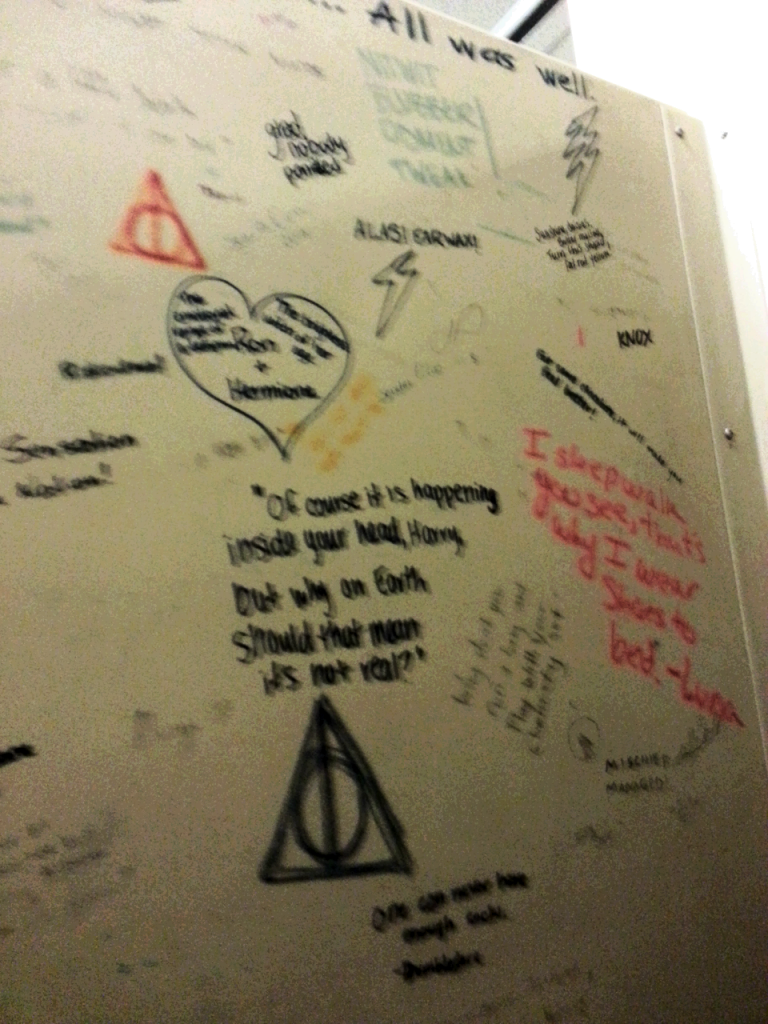
It’s like the idea of the “et amicorum” (with friends) with the signatures of book owners, the stall “radically customized” as a new locale of intertextual relationships. I can’t help but think of this stall as a displaced margin — a white space where dialogue happens with the original text and with other readers. I think of retweets and literary tattoos in the same sense — displaced marginalia — a materialization of one’s process of reading, a way that lets a text come with you, or as archived in an alternative place than the pages of a book. A space that lets others engage in turn. Even if primarily through requotation, those texts as appropriated, adequately cited with their original proclaimers or not, acquire new and/or sustained lives on the bathroom stall walls. It’s the stall I go to every time — not only to have something to read, but to relish in the vibrant material and textual relationship happening in this space.
p.s. most of my definition titles come from the OED… this one was clearly made up.

One Response to Marginaffiti (n): marginalia graffiti