…their traces struck me not as desecration but as potential sources of evidence.
—William Sherman (Books & Readers in Early Modern England 123)
1
For this first story, I have nothing to show you. This is a memory, brought round by Joe Austin’s Taking the Trains, and it’s been about twenty years since the place remembered existed as such.
Route 12 is the highway I took to go to church, youth group, dance lessons, my dad’s office, the bank, the grocery store, the drive-in, ice cream in the summer, public skating in the winter, a series of despised summer jobs waiting tables, and various inane local “festivals” that usually involved sloppy drunks clothed in pirate costume and, when I was older, anxious encounters with frenemies and former boyfriends. Though by then, the graffiti was already long gone. The portion of highway that I’m thinking of—two lanes connecting Alexandria Bay to Route 37 in Morristown—was dynamited into the bedrock running along the St. Lawrence River sometime when my dad was a kid, and along this length of highway, one drives through pine woods and marsh and descends into rock cuts that make the radio crackle.
When I was very young, these rock cuts were covered in graffiti: I remember the neon pinks and blues and yellows against matte brown rock. I remember the enigmatic initials and symbols and how it was the placing of the declaration of forever-love on rocks at a precarious height that made it seem like a promise Bob and Jackie were still keeping.
Like Joe Austin’s urban graffiti, the general public considered this rural graffiti a blight; there must have been movements to clean up rocks and crack down on painters, though I don’t know for sure. As a kid, I was largely outside of that conversation, busy mentally transforming certain graffiti into personal landmarks on the ride home from Alexandria Bay. There was a Daffy Duck, perhaps ten feet tall, on a wide, flat rock-face that I thought the epitome of artistry. When I saw it, I knew we were only a minute or so from home. Daffy held out for a while after all the promises, curses, and affirmations vanished, and then he, too, faded into the rock, lightest colors first. I mostly don’t notice the rock now, but sometimes I do, and for a moment I think I might still see him there, like the shadow-traces that decayed leaves impress on sidewalks.
2
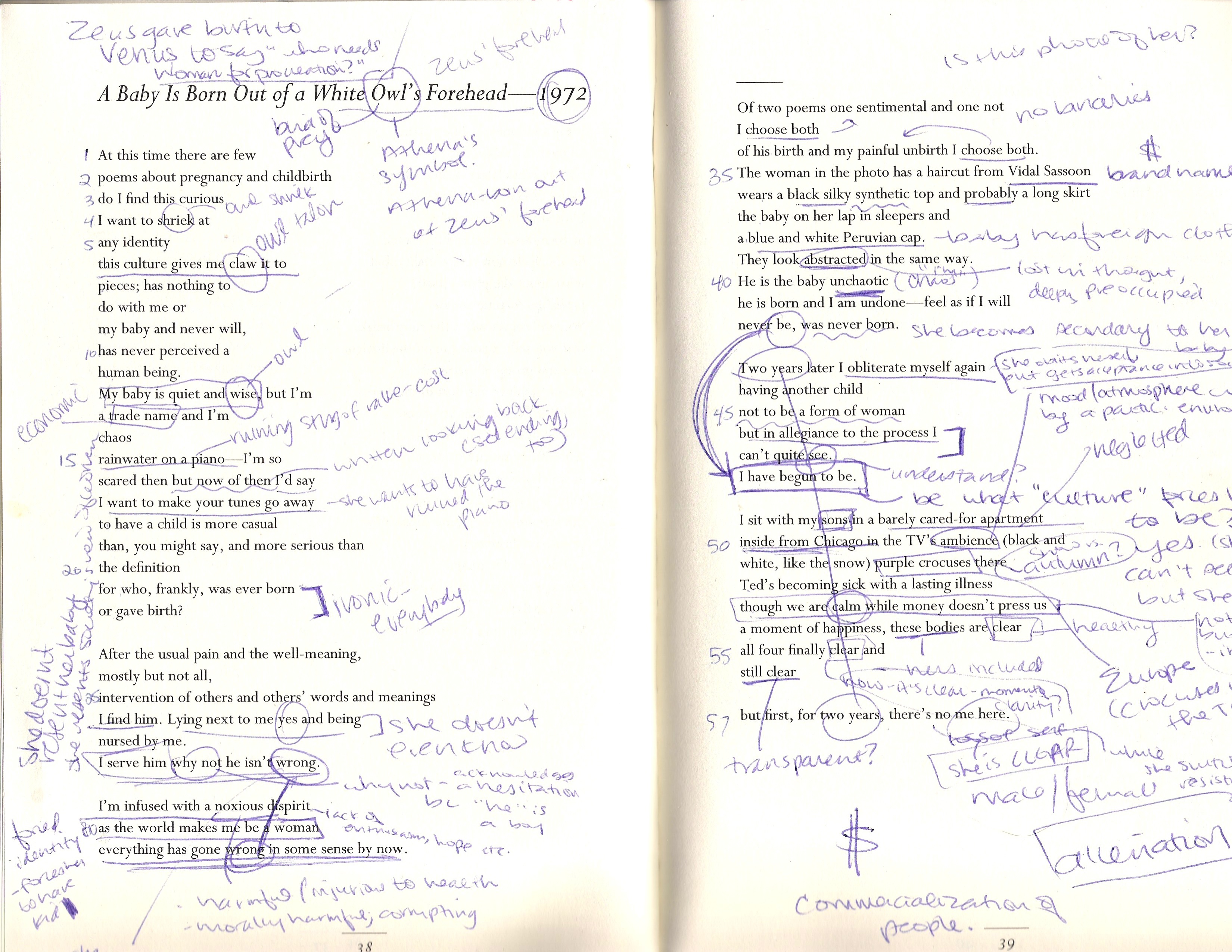
This is the book that broke the camel’s back. I mean: this is the last book I bought from Amazon under the personal policy of buying the cheapest used copy available. I bought Alice Notley’s Mysteries of Small Houses precisely for this poem, “A Baby Is Born Out of a White Owl’s Forehead—1972,” and this is what the poem looked like—only this poem and one other—when the book came in the mail.
It’s not just about the unreadableness of the poem, or the sloppy handwriting, or the cheap ballpoint (although, yes, clearly, it is very much about these things), but it’s also about the way this marginalia exists in relationship to the poem. It’s about the kind of reading this marginalia evidences: as if, by writing extensive analytical notes in the style of a New Critics parody, the reader might come to “Understand” the poem. Capital-U Understand. And Understand in order to write a terrible, sterile analytical essay or pass a pop quiz, which, frankly, pains me.
Obviously, I have a special animosity reserved for the unknown reader of this piece. But it kills me that anyone would read a poem this way, or instruct someone else to read a poem this way, especially a poem like Notley’s: experimental, conversational, both lyric and prosaic, in the business of sifting through the syntactical layers of reminiscence. Notley writes, “to have a child is more casual / than, you might say, and more serious than / the definition / for who, frankly, was ever born / or gave birth?” And the reader responds, as one might to a question for which one has entirely missed the point, the pain, the wonder: ironic—everybody.
I found it impossible to inhabit this book the way I wanted to—even the other poems on which there was nothing written. I can’t exactly articulate why: I realize there’s no good reason for my outrage or for the fact that I never finished this book (a wonderful book) and never picked it up again until today, to scan these two “desecrated” pages. I don’t even think books are sacred spaces; nor do I think poems are sacred. But I do think poems deserve—demand—a certain kind of reading engagement—maybe they ask us to approach them with more generosity and intuition than we would approach another kind of text—and the approach inherent in this marginalia, with all of its relentless semantic connection-making, is not it. Not it.
