I had a little problem when I began drafting this signment. See, the thing is, I did the readings and suddenly there was marginalia everywhere I looked. And I wanted to write about it all. It doesn’t help that I compulsively photograph these things anyway.
I’ve decided that attempting to write about every aspect of everything ever is a poor plan which would result in an ungodly-long blog post, so this is what I’ve chosen to focus on instead.
I am a writer of fiction. Austin’s introduction discusses writers of trains. Medieval texts were written on one side of the page, so as to allow room for later writers of commentaries. Even spam is written, even if its writer is unidentified, or if that identity is so murky as to be beside the point. But the text that is produced speaks, and it doesn’t necessarily speak in the same voice – acts of public writing are often acts of ventriloquism, too.
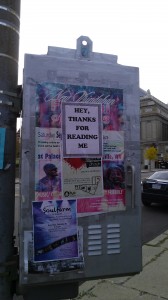
The thing that I love about marginalia and graffiti and “illegitimate” authorship is that it’s so clever so much of the time. Its existence is self-justifying – however it’s written is how it exists in the world. And things get very self-aware very quickly. What happens then is something I’ve spent hours talking about in workshops: the author takes on a narrative voice. I’m trying to think of a better way to put that. How about this: marginalia is both relatively anonymous and very personal. Even a graffitied tag is different from a signature in that way. We’ve already talked about how speech and text do not align precisely, but these things have an even more uncertain relationship to the oral world.
Figure 1: a signboard near the Cathedral last year that has gained sentience.
Figure 2: a mailbox in Shadyside that wants you to feel better.
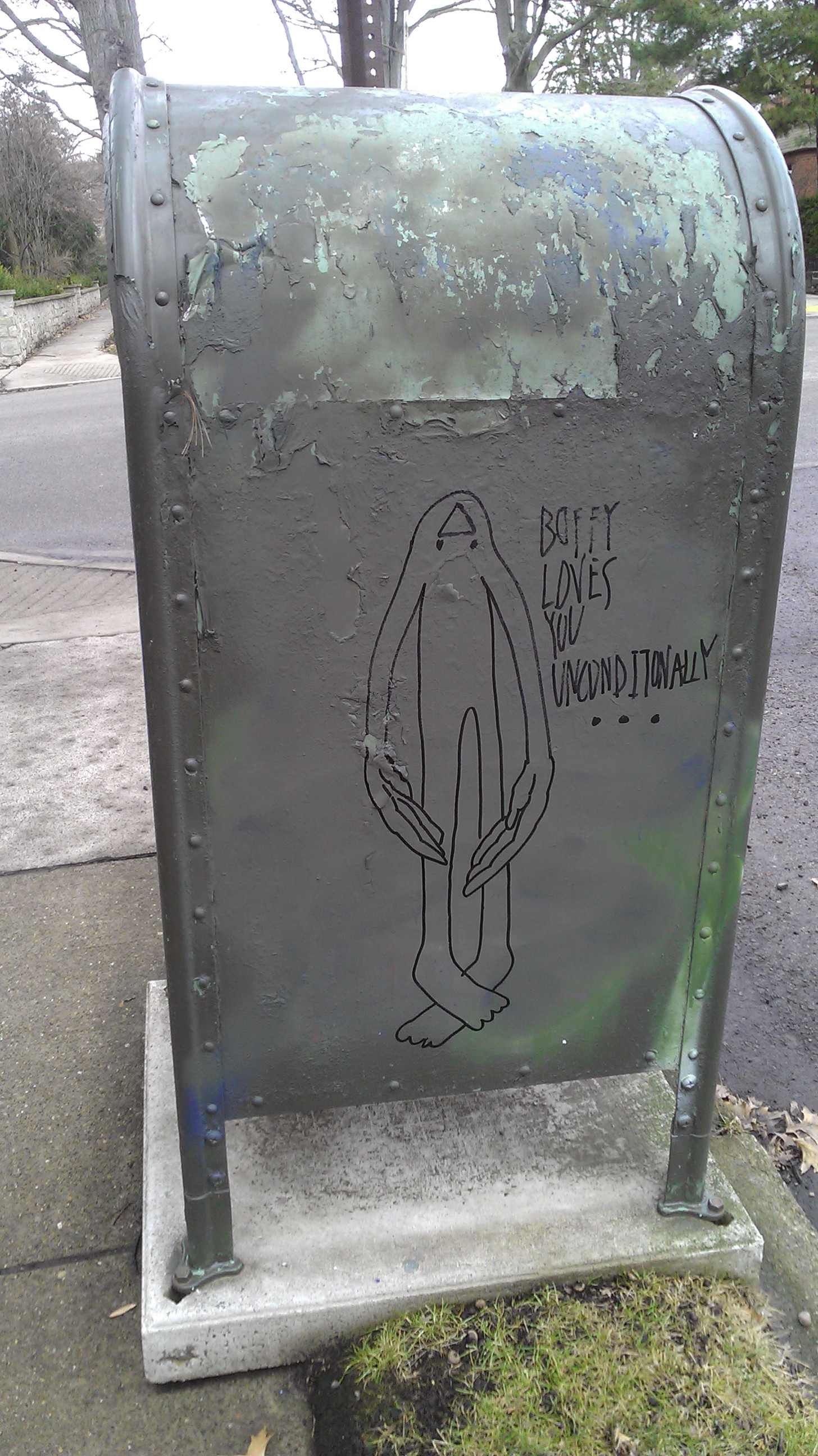
I’m being flippant here, of course. Someone – God bless them – stood at this mailbox and drew Boffy with a pen held in a hand. Someone designed and printed a flyer and taped it over twenty over designed-and-printed flyers. The mode of production isn’t mysterious here. But the fact of production is. I found both of these greetings from the wi(l)der world while out on walks. Like the hilariously indignant anti-Papist sentiments written in your average Renaissance-era Bible, these writings modify an already-existing object. But they don’t comment on it. “This mailbox sucks” or “these posters use fonts that are offensive to my eye” are commentaries. This is a signboard pointing out that it’s a signboard. Or, even more surreally, a mailbox insisting that it’s actually a mythical creature. Not commentaries but alterations.
(I am thinking at this moment of the pasted-together books that Sherman describes briefly, and I want to say before I forget that the other place I’ve heard of such a thing is in Soviet Russia. (I make everything about Soviet Russia.) Commissars who had fallen out of favor were erased from photographs, with acid and markers and scissors; many, if not most, of the official photographs from Stalin’s era are composites. Again, not a commentary – something stickier.)
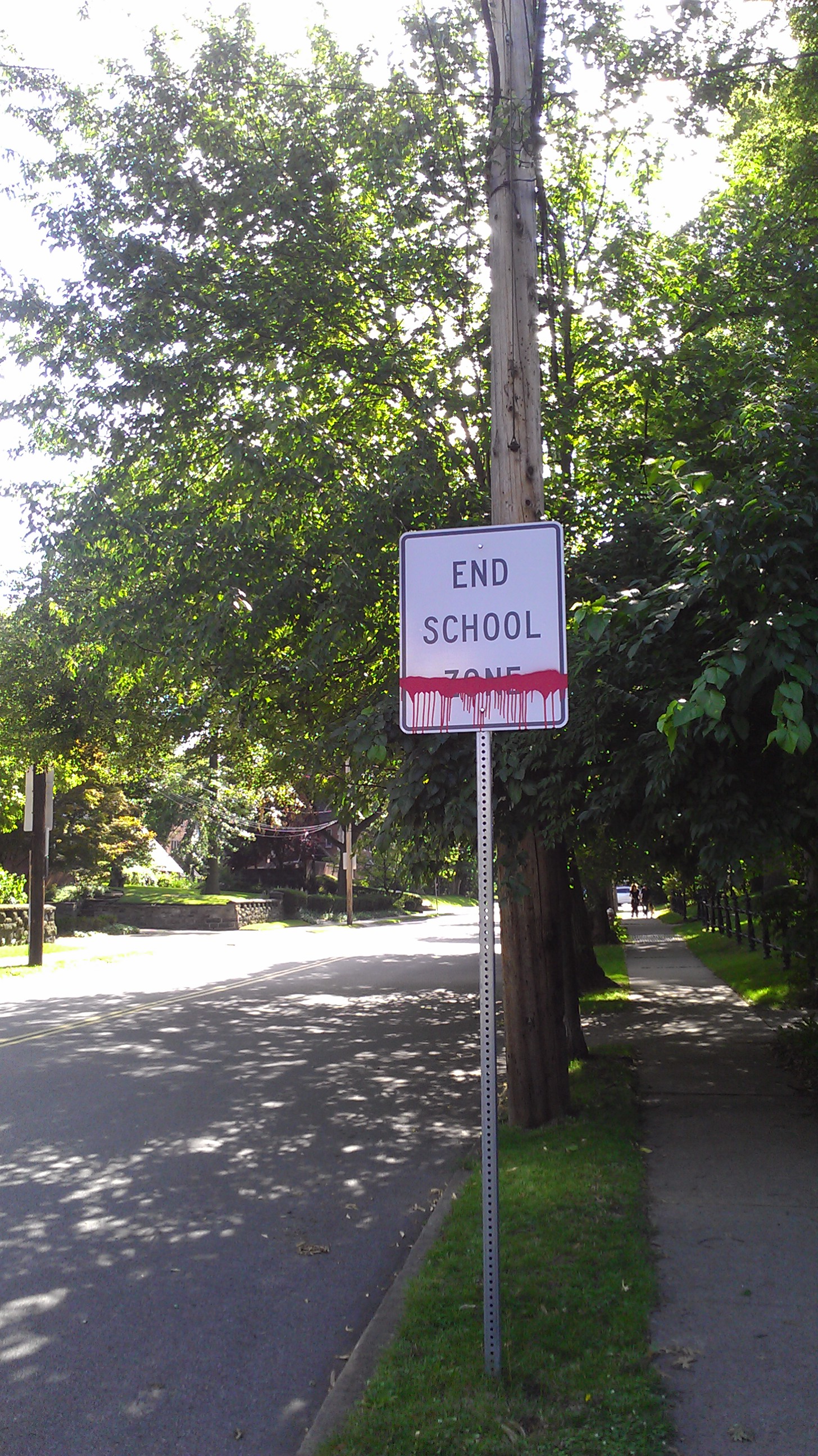 Subtraction can have a flavor, too. Here’s a lavishly defaced street sign, also in Shadyside. What makes me laugh about this photo isn’t the oh-so-seventh-grade deletion that turns this unremarkable object into a rallying cry – it’s the way the deletion is done. Look at that red paint, applied just so; it’s the campiest blood I’ve seen in a long time. Even though this is a more direct engagement with the text that’s being amended, it’s still self-consciously done. This sign is now something besides a sign.
What I’m trying to say – probably very unclearly – is that we’ve been talking about the writer writing and the reader reading, but what marginalia affords is the opportunity to talk about the reader writing. Texts aren’t sacrosanct. Duchamp drew a mustache on the Mona Lisa, and he’s in the art textbooks too.
That, and it’s just sort of wonderful to think about objects existing beyond us. We author things and then must let them go – and then what?
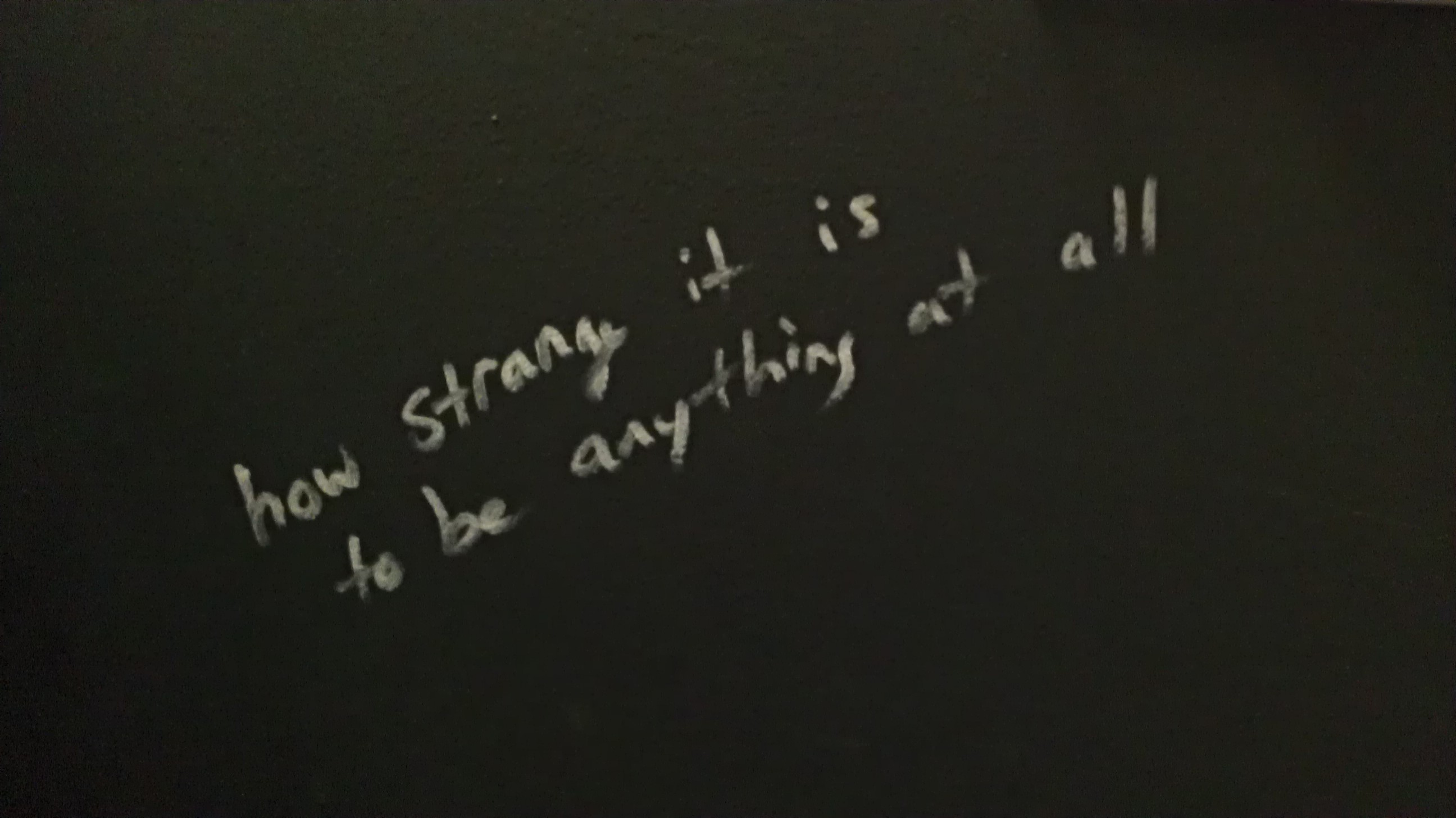
In the words of Jeff Mangum, and in the pen of a visitor to the Rex Theater in Southside: