I write in stages. Each stage has a different set of materials and takes place in a slightly different orientation of the materials within my space, or takes place within a difference space entirely. These stages do not necessarily occur in a series… as Marshall McLuhan reminds us, via mention of Hume: “[T]there is no principle of causality in a mere sequence. That one thing follows another accounts for nothing. Nothing follows from following, except change” (12). My series or sequence changes and/or is reciprocal in nature. I often have to go back in order to go forward.
Reading Stage
I cannot account for my materials of writing without also accounting for my materials of reading. When I read I also write, both in the margins (digitally with a stylus on my tablet computer, or by hand in pencil) and in a commonplace book where I record passages that seem particularly interesting or relevant to me. My marginalia largely consists of short phrases glossing important passages, stars, check marks (for claims I concur with or find interesting), x-es or question marks (for passages I disagree with or question), and too-frequent underlining. I put boxes around passages that seem particularly relevant. This marginalia becomes an important material for me as I return to these markings, which behave like signposts, as I attempt to recall a writer’s approach and my initial reactions to it when I move to write in turn.
The passages I put boxes around are generally the passages I record in my commonplace book. The act of doing something with another’s text allows me to make more of a thing out of particular moments. The act of writing long-hand in a notebook allows me to slow down, register a writer’s cadence and syntax, and to more fully ingest what has been written. I feel there is a power to duplicating someone else’s language in a slightly different mode or media. It’s helpful for my mind, but I’m also certain the process of writing things helps me internalize (or, even, practice) a writer’s moves.
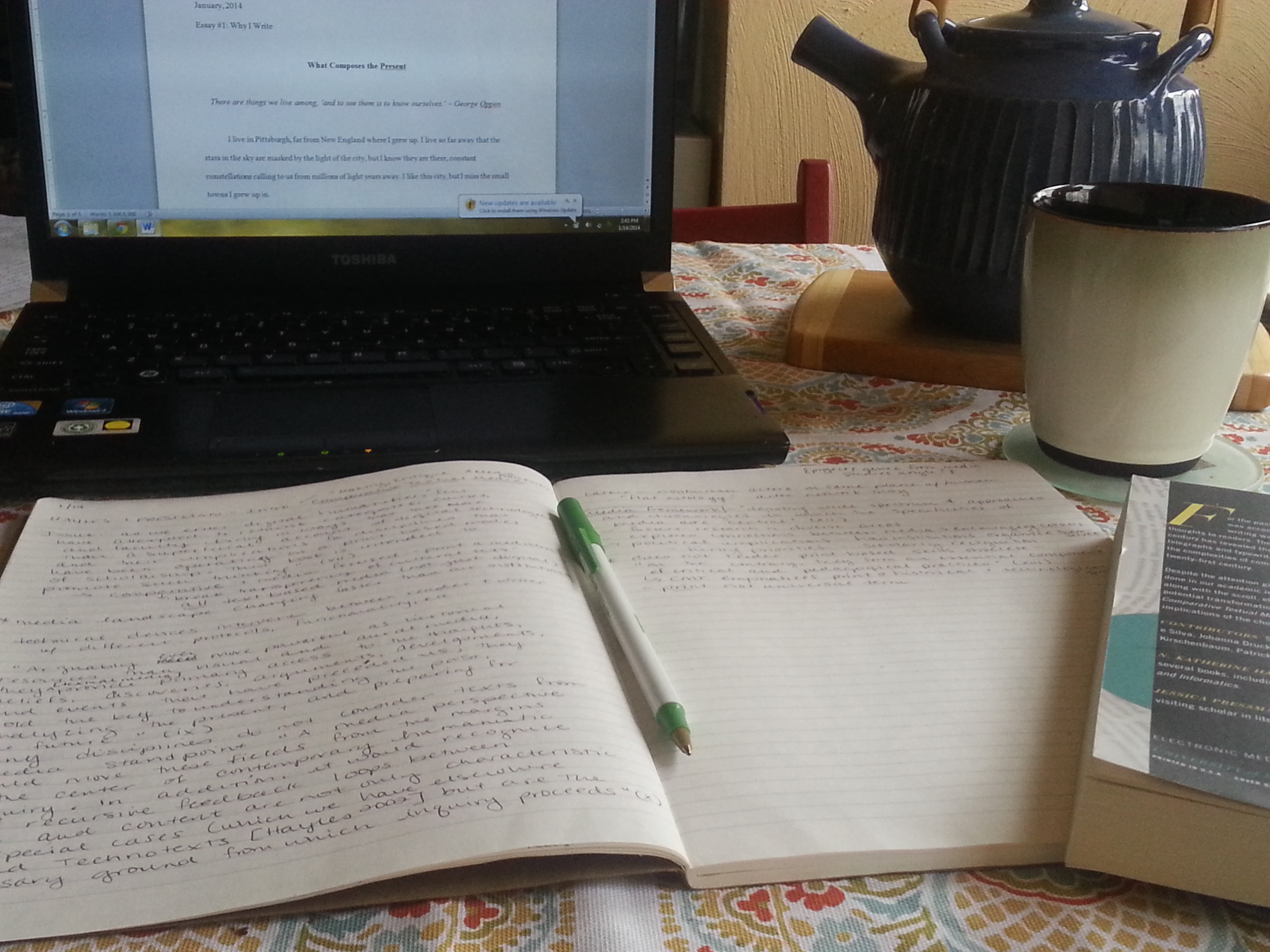
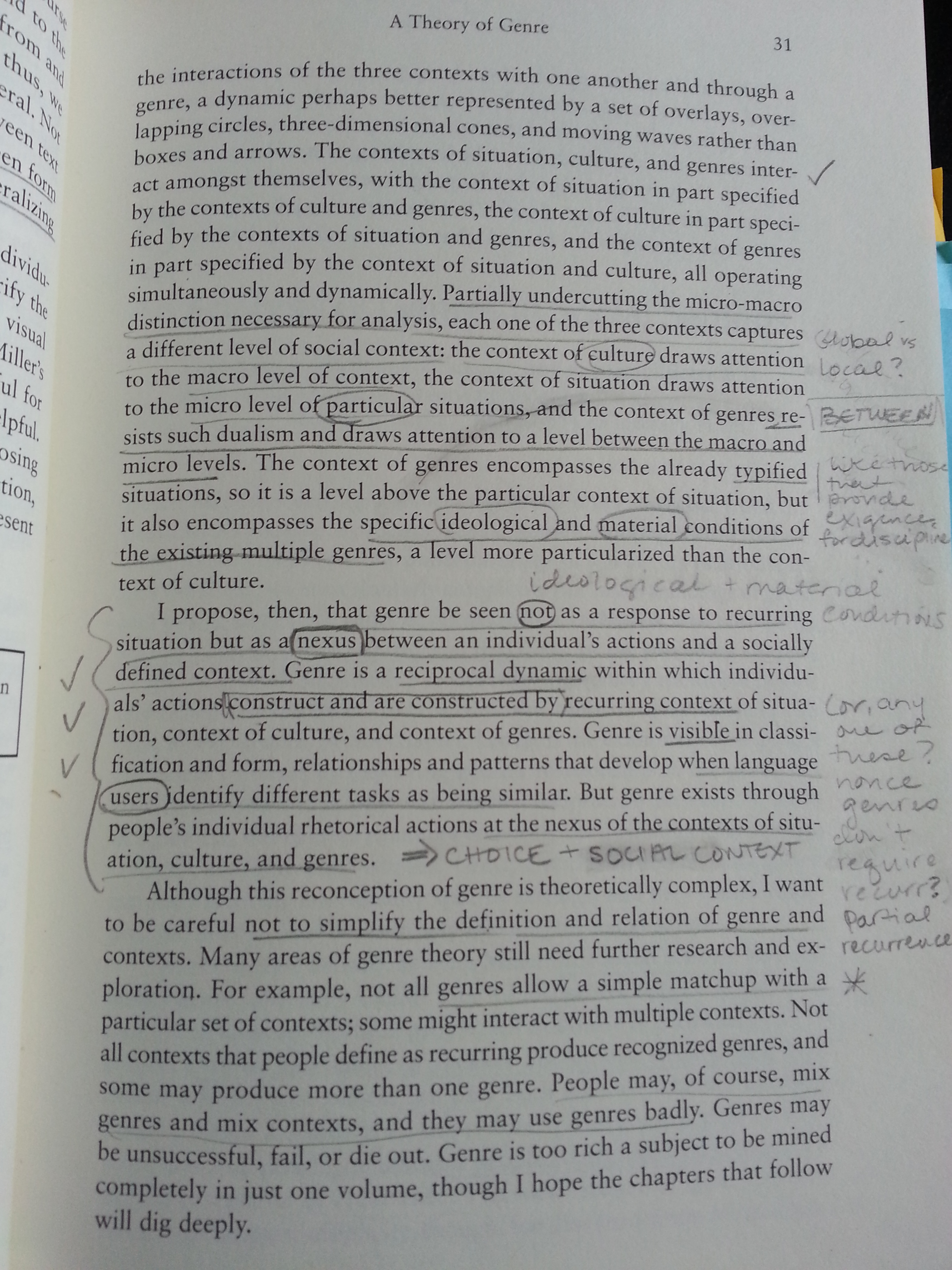
my marginalia on Amy Devitt’s Writing Genres
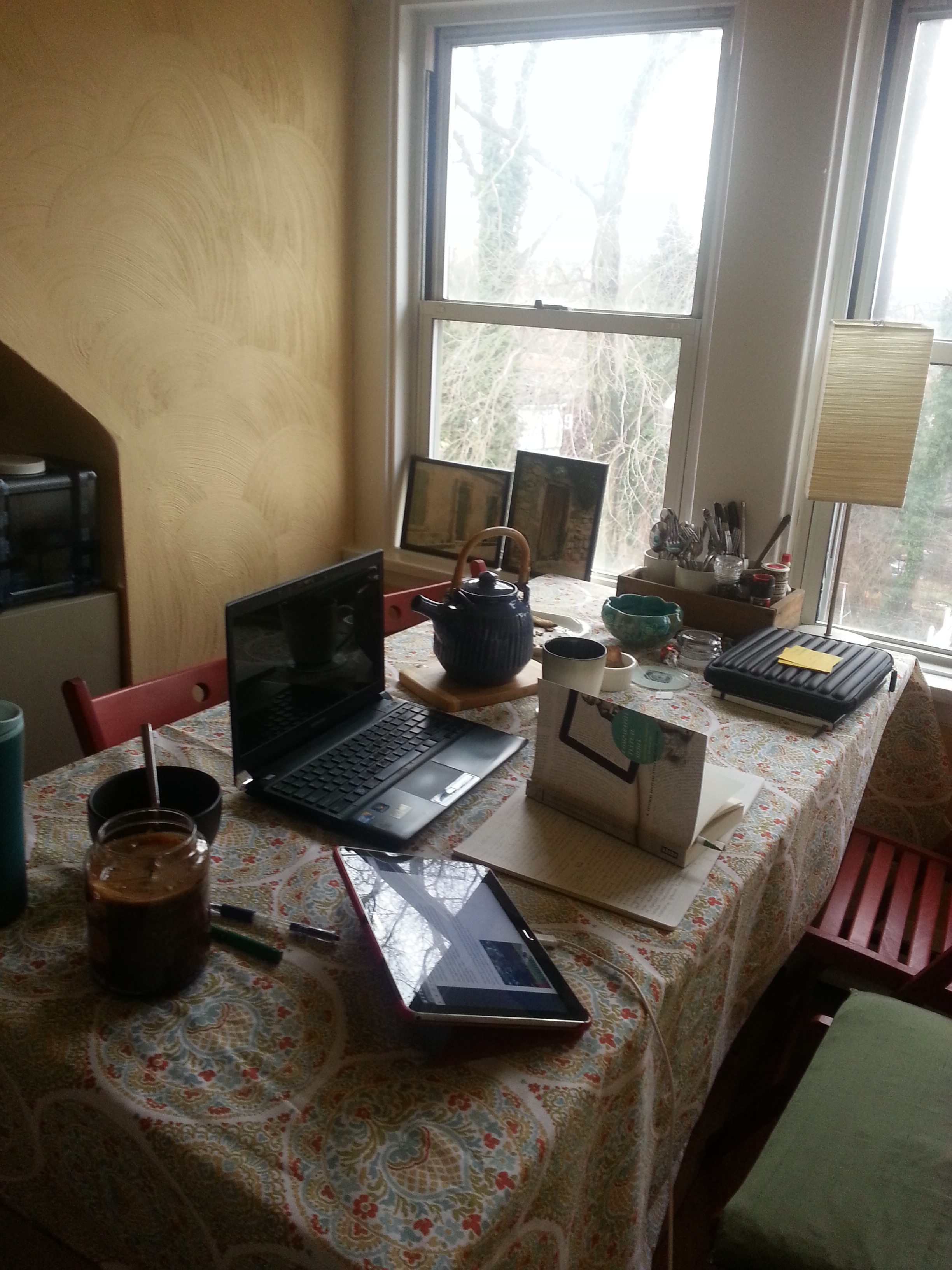
It is during the reading stage that I have the most things around me, which become my materials of writing insofar as they support my process, affect my environment and thus my mood. The top photo is of my kitchen table as it appears today. It is where I do almost all of my reading and initial writing/note-taking. The light is consistent for most of the day because it’s on the southern side of my apartment, which isn’t great for writing on a screen, but works just fine for reading on a tablet and writing long-hand.
In the morning, I have a mug of coffee I inevitably let cool as I get going and forget it. In the afternoon, the equally forgotten tea. I take sips when I need to pause — I know the reading or writing is going well if I am ignoring my beverages. When I’m particularly contemplative I am also well-hydrated. By the end of the day the dishes from my meals remain, crumbs or last bites stay on the plates until I am done and can do other household things. My kitchen is generally the cleanest place in my apartment — so I am not generally distracted by all the other things (like dirty laundry) I might see elsewhere (I live in a loft-ish 3rd floor converted attic space, but my kitchen is separated from the living/sleeping space).
Developing a Clearer Sense of the Project
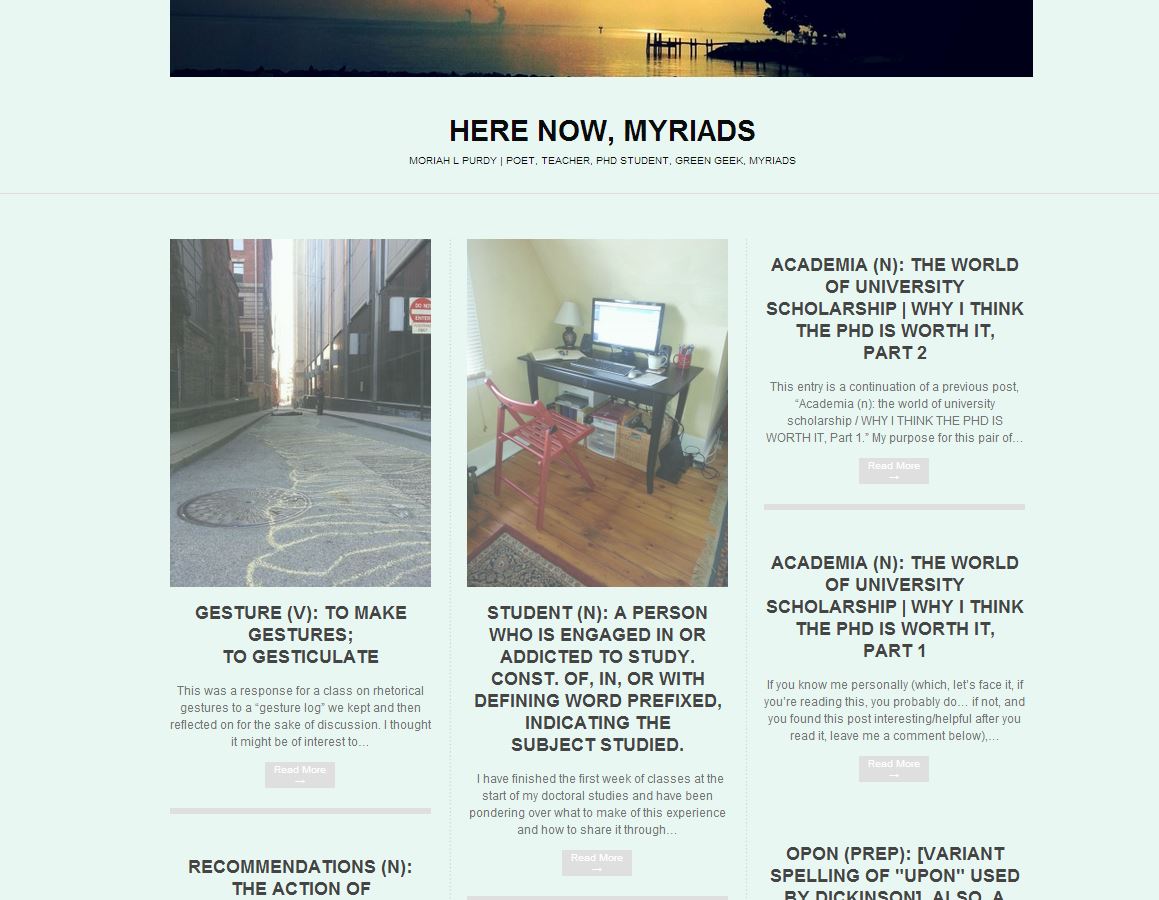
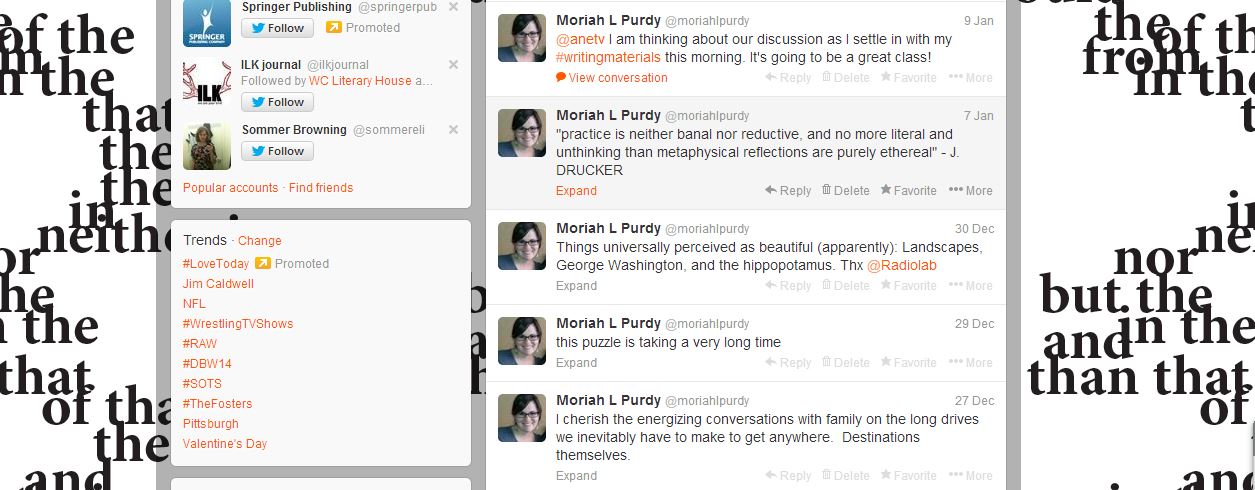
When I’m ready to stake a claim to a point of inquiry, I’ll often up the ante and “go public” with my thinking. I’ll work up a post for my blog (though I haven’t quite figured out how to find time to blog while I’m also preparing for my classes… this course is helping me realize that I could post my reading responses as blog posts, but I also don’t want to limit it to that… I miss this stage in my process, and need to return to it in some way this semester), or, if I have less time, I’ll post a line or two to Twitter (http://twitter.com/moriahlpurdy). These spaces are for the early thinking, for working things out. To see how I frame the blog entries, feel free to visit my “about.me.and.this.thing” page. In short, these spaces are for beginnings.
Without the blog or Twitter posts I wouldn’t have a sense of the public stakes. When our exchanges are primarily between professor and student, it’s hard to conceive of stakes with any kind of clarity. I know, however, that this is a public space, and that my blog and Twitter are, as well. While I can offer the disclaimer that the thinking I put down is early and messy, it still has to have reached a place of urgency when it desires to be made known. This helps me round the corner to a more complete and more complex project.
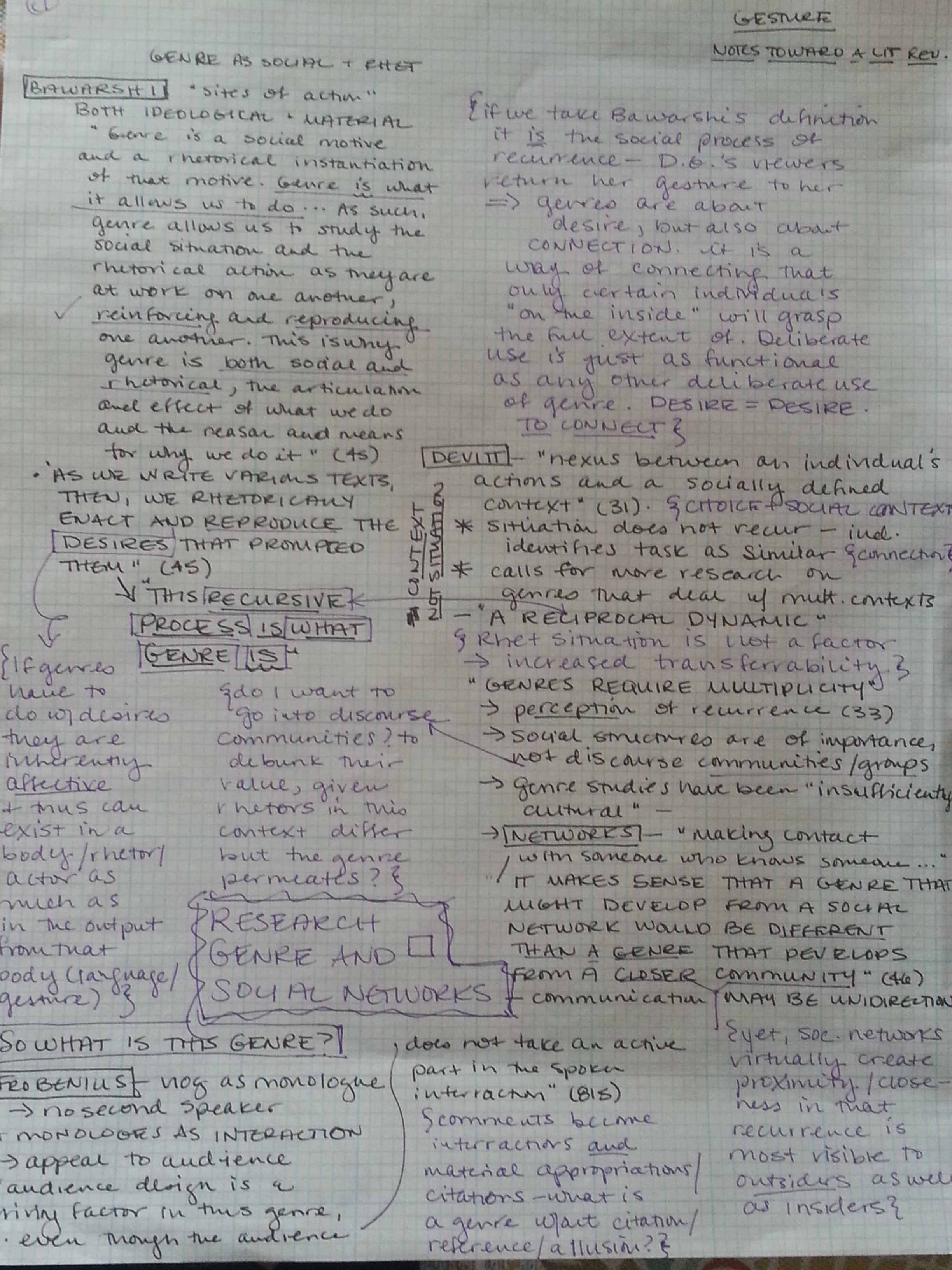
It is also at this time that I might go to graph paper and attempt to visualize the connections and questions I want to work through in a particular writing project. Apart from writing in the commonplace notebook, handwritten works at this point come after substantial digital composition. I write on the graph paper after I’ve written almost everywhere else, but often before I reach the depths of the process of working through the thing I’m “preparing” to compose.
Drafting and Re-Drafting Stage
When all of the early work of thinking something through is done, I transition from my kitchen table to the desk in my other space, which is considerably more minimal. If my mind is cluttered my space needs to be clear and organized.There is a coaster for my tea, if I have any left over from the morning routine, or if I start here in the morning. There is also the graph paper for hand-written notes if I need to slow down.
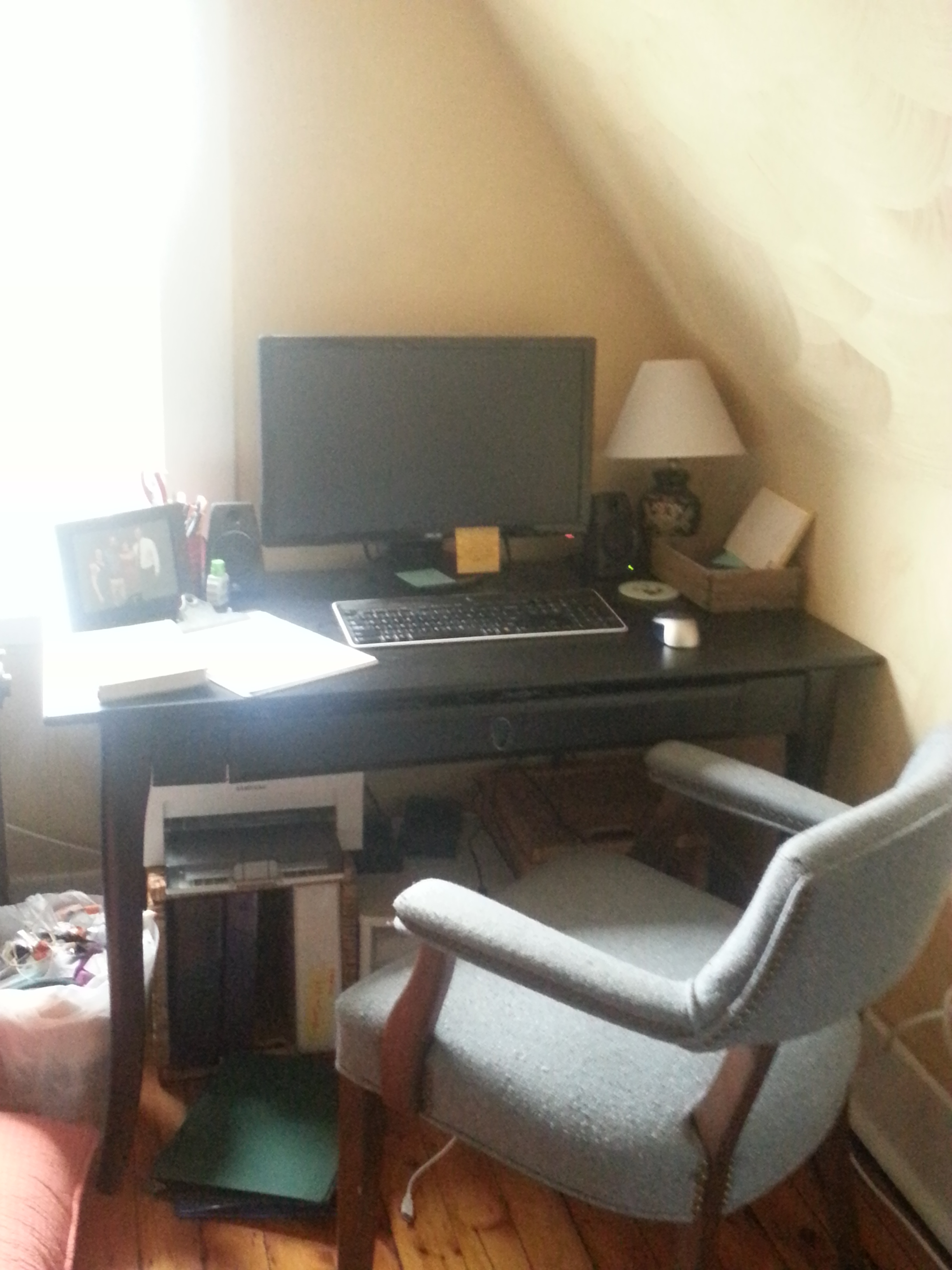
Mostly I put together all of the passages I imagine I might use in a paper, or otherwise, into a messy Word document and call it “quotation dump” and the project for the file name. This file is generally open next to my drafting Word document. I find the screen real estate is incredibly helpful for me as I’m trying to take in and conceptualize big-picture (so to speak) concepts I want to work with. The larger screen helps me see things (quotations, working claims) next to other things (ephemeral language, questions driving the project, assignment prompt language, language that reminds me what is at stake, why I’m writing the thing, what it is I want to find out). Sometimes I’ll separate something out and write it on a Post-It note. Most of the time these things just stay in this working document, the place where I cut-and-paste things.
I date and number all of my drafts, so these become material, too. But mostly I work in those two original documents until I’m about “finished.” This split-screen mode on my computer (Windows 7) which allows me to move documents to each side in equal sizes also helps me when I’m finalizing my writing. I tend to transition the “draft” to the left-hand side of the screen and open a new, blank document. Just as I rewrite the language of others to make it material during my reading stage, I retype my own writing to re-encounter it materially as I’m polishing phrasing, organization, visual elements, and so forth. Ideally by this point I work down all of my writing “material” to the one document. Ideally by this point everything is much clearer and I need less “support” from the materials that comfort me in the early stages.
A Few Final Thoughts
It should come as no surprise to me that my writing materials say a lot about my writing process. Although I am aware of these stages and the ways in which the various materials assist me along the way, it’s taken a long time to arrive at these patterns of working. It has been a constant process of trial and error. The reading process used to be entirely in print, for example — but now that is changing. I used to print my final drafts while polishing, but I no longer find the need to do that (now that I can see everything more clearly on the “big screen”). Everything else about my materials of writing is about intimacy and comfort. Even if my tea cools I can warm it up. Even if I feel exhausted I can look out the window at the cardinals and blue jays that love the trees behind my building. I like to think that, eventually, when this work finds its way to a reader that the reader has a window to peer out of, too. I think my mind works best when I feel as though my materials are working for me, that I am taking full advantage of the ways in which they change my process and the language as it appears on the page. That while at one point I might have considered what they would do for me, I stop registering them as technologies and simply put them to work.
