I am currently sitting in a coffee shop called Espresso a mano, which is located in the neighborhood of Lawrenceville, trying to write (or compose?) this reflection on the materiality of writing, or rather, the materials that inform what I might conceptualize as my writing. Whether this materiality is best considered alongside something like a final product or object (i.e. my “finished” blog post, a piece of writing that others will read) or alongside something like a writing process (i.e. the material things I need and do in order to enact something like writing) is a matter to which the solution currently eludes me. However, I have noticed that the already published posts seem to follow a trend. Most of the writers in our class have considered the question (“What are your materials of wrting?”) from the angle of writing as process, gesture, act, an act that is unique, individualized, specialized in the case of each writer. In other words, writing is being described as a highly personal and personalizable act, and a single person’s materials of writing (and the choices or involuntary obsessions surrounding such materials) seem to be one way in which this process can be owned and talked about in the first person.
Perhaps this has something to do with the MIT example. Perhaps it is less interesting to talk about he materiality of our pieces of writing following their submission, because at this point, a certain material standardization occurs. The processes and relatively disparate materials that informed the construction and production of the different pieces of writing are lost, to an extent. Some posts have pictures, some have links, and, in the case of Carrie’s post, some have scans that visually refer to and enforce the existence of other materials elsewhere. However, in order to appear legible within a WordPress blog, all of these other materials must be translated via the material of code, must conform to the formatting conditions set out by those who created and maintain WordPress. We compose or write with the final format of WordPress in mind, but I would wager that hardly any of us enact our writing process within the material space of WordPress, or using the limited, final materials available within this online space as our primary, processual tools. A post may refer to or recall other materials, other stages of the writing process. Yet, it seems interesting to ask if Noel’s personal artifacts or Carrie’s slips of paper are actually, materially present in the final product (although also in-process, waiting for future posts) of the blog. Does this matter? Must writing as final, published, easily and widely accessible and legible object always undergo this sort of “de-processing,” and does this explain our need to assert our processes and their materials rather than explore the materiality of our writing as object, in its various, relatively “finalized” resting homes and formats? Another way of asking this, via McLuhan: do the material “mediums” that inform our writing process finally “matter” in the same way as the material medium by which they are finally transmitted to and read by others? And does the presence of the possessive “your” in the signment question invite us to assert a certain individuality and ownership over the materials of the world that could be associated and utilized in writing, even if some of these materials could not possibly be only ours, due to their wide scale availability and marketing towards a purpose called writing?
Thinking back to the example of “my materiality of writing” that I brought to class on the first day, the current location of my material body within the material space of this particular coffee spot seemed incredibly important. Like Annette, I too live a block away from that Crazy Mocha which is basically one big window. However, I tend to only gravitate towards this coffee shop on days when I feel less stressed out, like my work is more manageable or requires less attention. This is due to the fact that many Pitt students and faculty seem to work in this spot, and the presence of people with whom I am acquainted distracts me. I feel obligated to make small talk, I am immediately more aware of myself and of my actions, of how my body is occupying the space. However, at Espresso a mano, this material self-awareness fades, to an extent. I have grown to recognize familiar faces here over time, but not quite as regularly. Additionally, they seem to exist as familiar faces that I can ignore more easily as I work, because they have always existed as faces that I ignore as I work (to me, when I am confronted by them, ONLY in this coffee shop).
Right now, I am wearing earphones, which are playing New Order just load enough that I can drown out conversational voices around me and make their words indistinguishable and thus not distracting. Unless I can hear the conversations within my brain and between my brain and the typing easily, I cannot write. I also need coffee to write, a material and chemical factor. Sometimes I do indeed start to feel like I own this time and these actions and the specific conditions under which I confront them because I have a considerable amount of anxiety and obsessiveness wrapped up in the process of writing, as it sounds like we all do. Nonetheless, sometimes I post pictures of my coffee or books on Instagram (bringing it back to the phone). I tag my location, so I can keep a photomap of my body’s material locations over time. When I follow the location hyperlink, I see hundreds of the same picture, again and again—of a coffee mug, or a laptop, of notebooks.
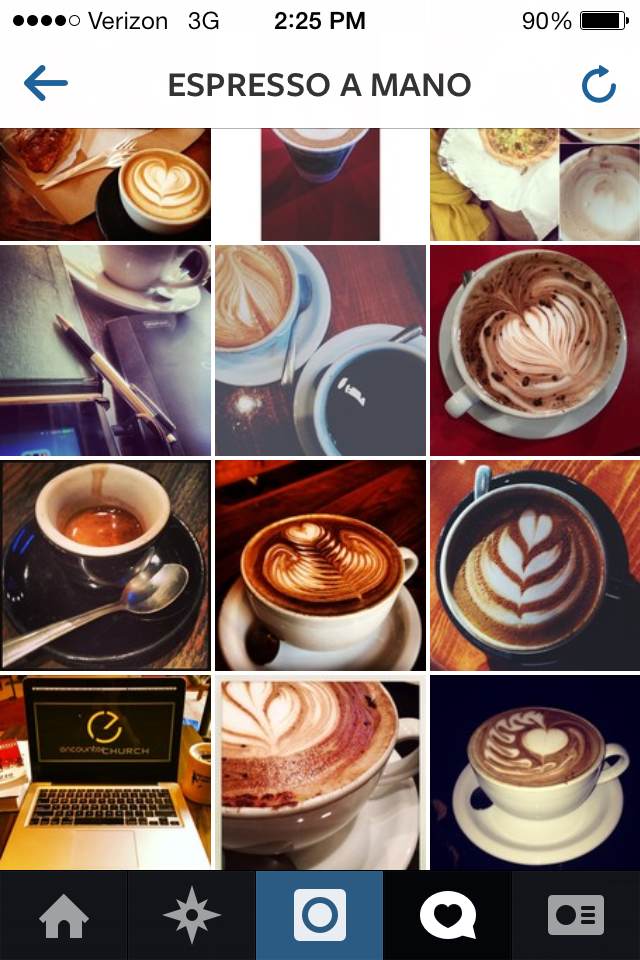
I begin to realize how many people within Pittsburgh come to this particular coffee shop every day to write, who perform their own, very similar rituals, using the same or similar material tools. They all take pictures to mark themselves and this ritual somehow, to create some material evidence of what they are doing, of what they’ve done. Mostly for themselves? Yet, something like Instagram does not only allow an individual to keep a localized and personal record through their own profile and followers. It does do this, somewhat in the manner of a scrapbook. But it also is capable of confronting the individual “writer” (if we choose to call taking photos part of the material process of writing) with the widespread and general nature of what they do and how they do it, even if the what and how are motivated by the personal and the local, feel like the personal and the local.
McLuhan writes, “it is the medium that shapes and controls the scale and form of human association and action” (9). Whatever the materials through which we approach the process of writing, the patterns of writing and “publication” at this moment in time seem to impose a final say in our writing’s materiality as an object. How does writing with an intention toward blog posting or network-sharing affect how we conceive of our (individual of collective) materials of writing? How do blogs and networks as storage and sharing centers for writing affect how we might conceptualize/locate patterns or place emphases on our materials of writing?
