“[I]f publishers don’t seem to fit into the other-than-codex world of job printing, neither exactly do readers. Who ever really reads receipts, bills, tickets, bonds, or certificates? …Notably, whatever reading is entailed by genres like bills of lading and stock transfers, it is not reading that has anything to do with the sort of readerly subjectivity that came to such especial prominence in the course of later eighteenth and nineteenth centures, the subjectivities of literature in general and the novel in particular” ~ Lisa Gitelman, “Print Culture (Other than Codex)
“A document–be it a book or a cash register receipt–is something that preserves someone’s thoughts or ideas, or some bit of information that would otherwise be carried away by the river of time” ~ David Levy, “Scrolling Forward: Making Sense of Documents in the Digital Age”
As seems to be the case in this course, when we are tasked with identifying a material to compose or read I have to sit on the task for several days before I decide what to write on. For this task of “reading” a non-codex document I went through my junk mail, browsed my email spam folder, and pulled out receipts from my wallet… but I couldn’t get Levy’s insistence on the stories these documents tell out of my head. I couldn’t help but consider the way such documents gather personal stories that makes these otherwise ephemeral or inconsequential documents meaningful in someone’s life. I couldn’t help but think of the ways in which such documents can actually be read subjectively, the way Gitelman suggests they cannot. It all depends on the story being told, and who is telling it — the object itself, or the person whose lived experiences can illuminate its otherwise more mundane details?
In short, I was wondering about the distinctions between our “precious” materials and these other documents, as what determines “precious” is less about the material itself but the story behind it. So when I was riffling through my wallet for forgotten documents I came across a ticket stub from show on November 22, 2013. Here are images of the ticket:
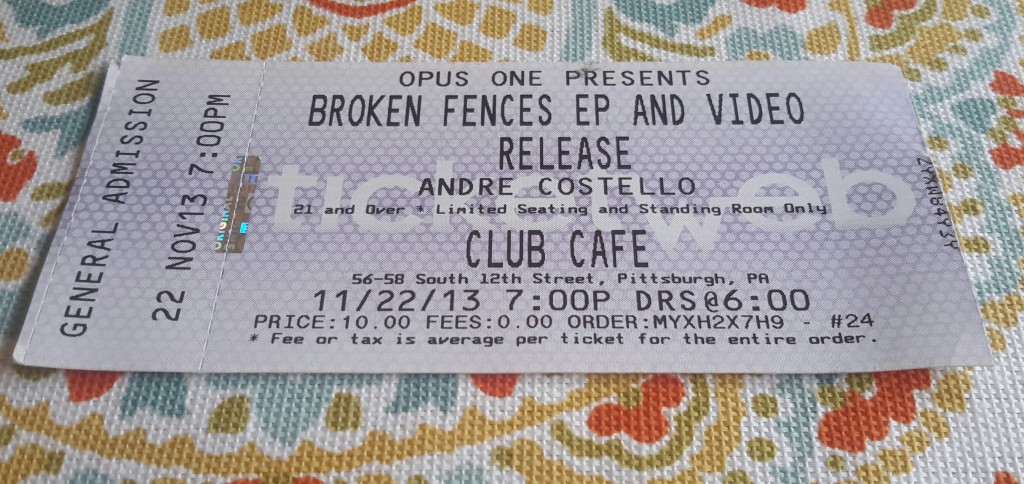
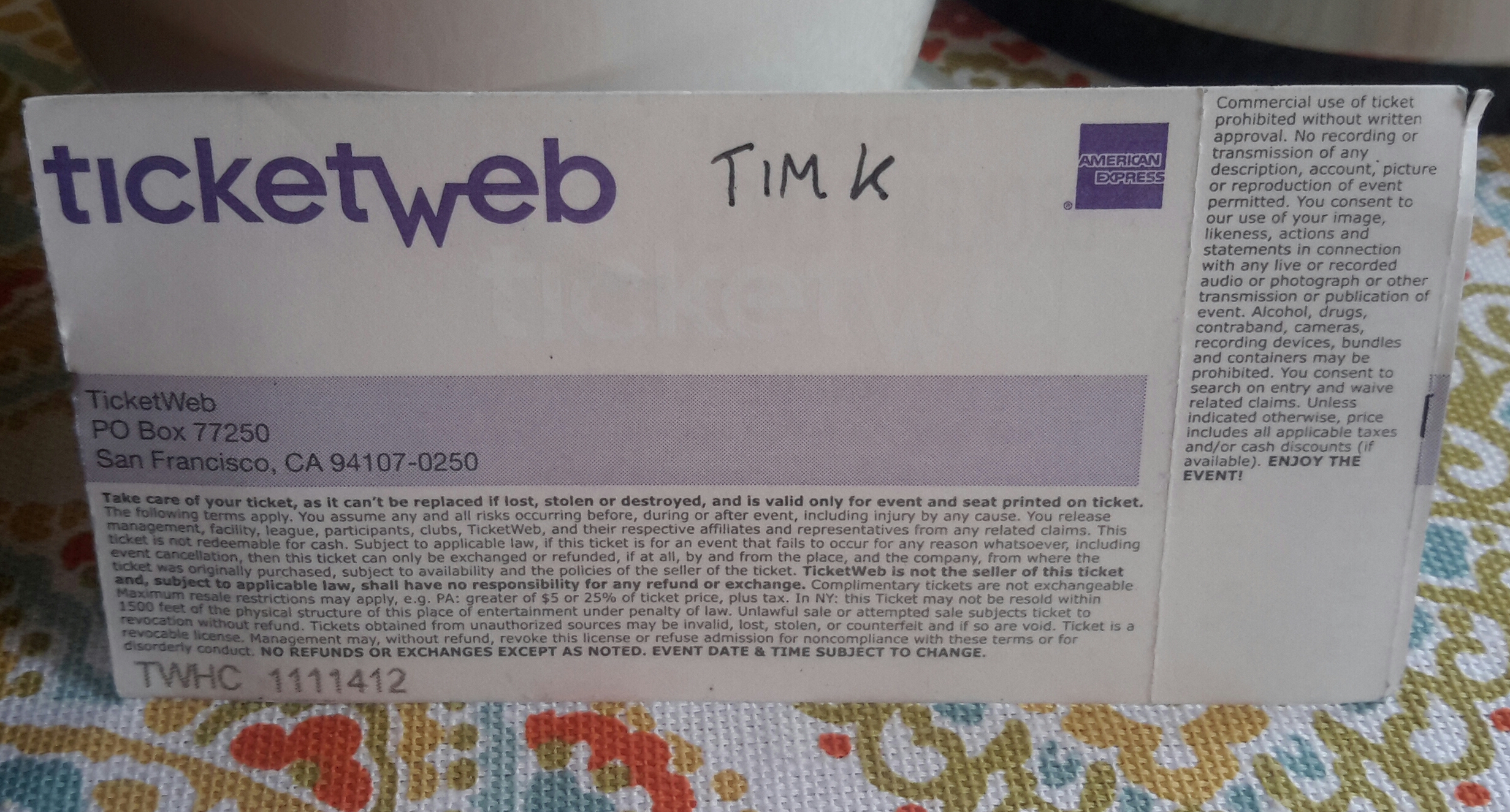
There are a lot of details on the ticket that certify it as authentic. Presumably the various watermarks and codes on the ticket all perform this task as well as identify something of the purchase and publication of the ticket. These materials simultaneously certify the document as legitimate and add legitimacy to the event and the venue. I’ve been to plenty of shows where they simply ask for your money and stamp your hand, but this was not that kind of show. The venue, however, is small and mostly standing room only (as printed on the ticket, seating is limited), and fits less than a hundred people, but you wouldn’t know it just from looking at this document. Because of this, the questions you can ask of it seem more interesting. Who is this band, and who is presenting them? What is this venue like, beyond its limited seating and over-21 age requirement?
There is only two indicators of the personal narrative attached to this particular ticket. One is the wear and tear on its corners, which is evidence of it sitting in my wallet for an extended period of time. The second indicator is the name “Tim K” on the back of the ticket. With a little detective work, one could ask the club owners who this person could be. It might be discovered, then, that this is how they hold tickets for will-call, and it must have been someone who had a ticket set aside for him. It is not clear, however, that there were two tickets set aside under this name, nor is it clear that it was a member of the band that was playing who asked for the ticket to be set aside in this name.
While it might seem, at first, that Tim (my date) and I are the only ones who could provide the “authentic” story of this ticket, these details could be sussed out with some detective work. The fact that neither of us purchased the tickets online or with a credit card limits the so-called “paper trail” (trails of authenticating documents, I might add), but if one were to discover who this person was that the ticket was set aside for, that there were indeed two tickets reserved, etc. etc. etc. one might get closer. But its subjective meaning for me (an artifact from a particularly fun date night early in my current relationship) is quite far down the line of these authenticating facts. The fuller narrative cannot be determined (though it can be speculated) just from the document at hand.
I suppose this is all to suggest that the stories our non-codex documents tell is not mere authenticating facts of the perhaps banal habits of everday life (though, they might also be such), but their stories also have subjective registers to them, and that subjectivity happens as soon as a person is attached to the document. It becomes an event on the timeline of someone’s life.
