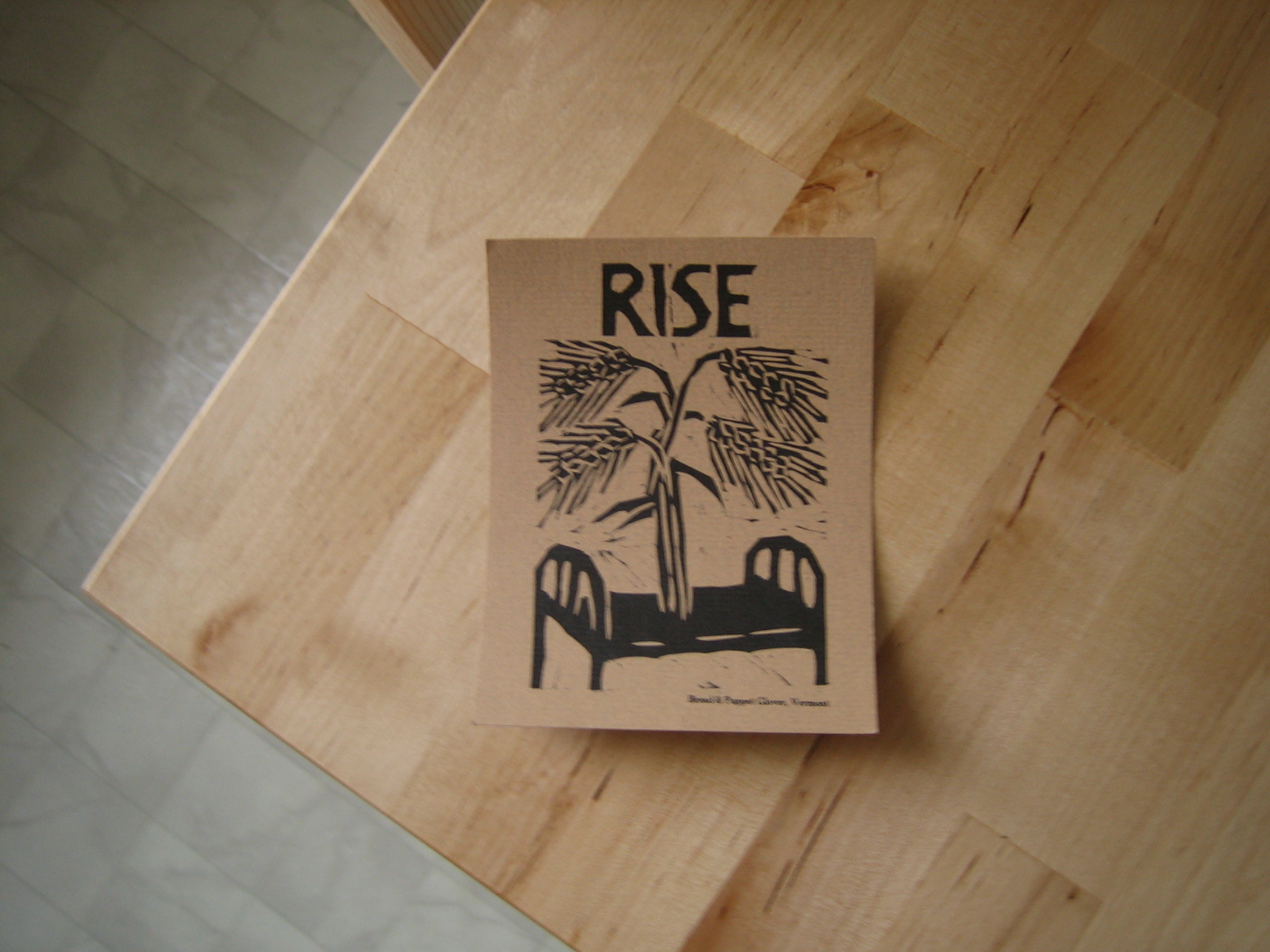
This is a postcard, bought rather informally at the Bread and Puppet Museum in Glover, Vermont, last summer.
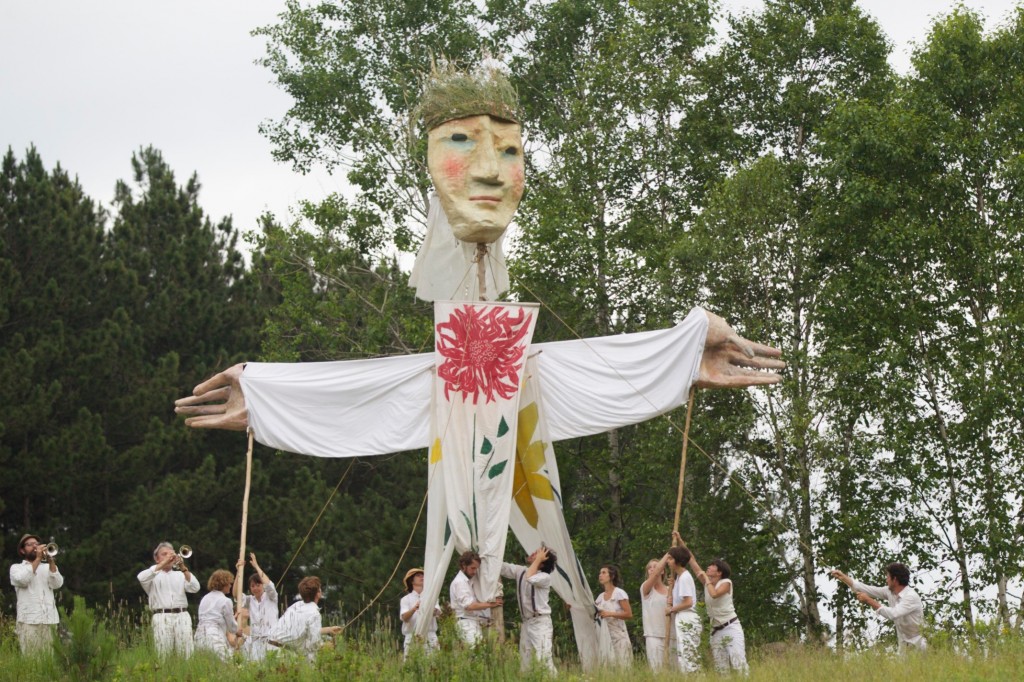
The Bread and Puppet Theater started in the ‘60’s in New York, but I associate it (as do most) with the unfussy houses and winding backroads of Vermont’s Northeast Kingdom. Bread and Puppet tours the country with politically radical, low-tech shows involving larger-than-life-sized puppets and youthful performers who sing, dance, play a motley assortment of instruments, and urge viewers to reconsider their capitalist and government-driven lives.
The folks behind Bread and Puppet also have a correspondingly irreverent art practice outside of their huge, whimsical, sometimes alarming puppets—they make flags, banners, posters, postcards, small batches of illustrated chapbooks, calendars, and comics, among other things. The connecting thread is cheapness, themes of self-reliance (read: anti-government), and a blocky print style. This is what their website says about it:
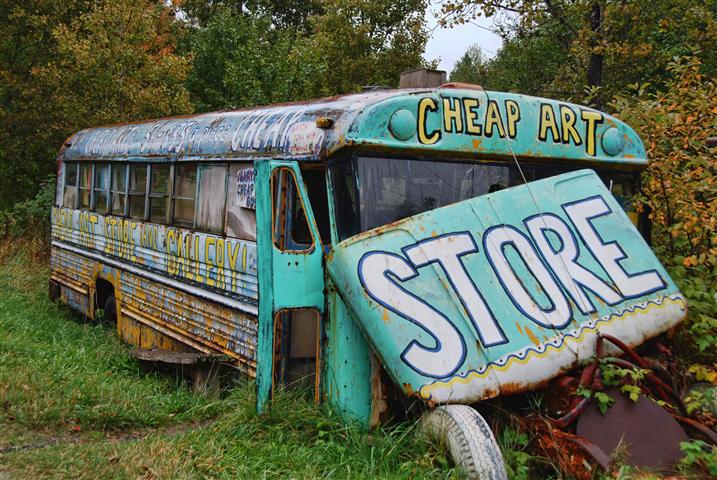
“Bread and Puppet’s Cheap Art Philosophy and production was born in 1979 when Peter Schumann and his company and friends filled their old schoolbus with hundreds of small pictures painted on scraps of masonite, cardboard and newspaper, painted slogans and statements about art and Cheap Art, and hung them on the outside of the bus. Then they drove it to neighboring towns and sold the stuff for 10 cents to 10 dollars. Today Cheap Art is practiced by all kinds of artists and puppeteers all over, and continues to cry out: Art is Not Business! Art Is Food! Art Soothes Pain! Art Wakes Up Sleepers! Art Is Cheap! Hurrah!”
In August of 2006, I arrived, by surprise really, at the Bread and Puppet Museum, which quietly sleeps off Route 122. In New Jersey, where I grew up, “routes” are big scary legit ROADS where you could hurt yourself. Route 122, or at least this part of it, is a gentle pastoral jaunt through some hills surrounded by (what are in the summer) sprawling green fields of unmown grasses. I stumbled into the museum, which is a massive, converted hay barn, and wandered through the huge, dusty exhibits of retired puppets.
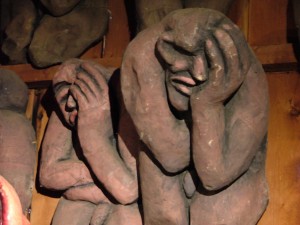
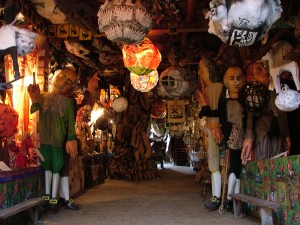
These pictures come from the Bread and Puppet Museum Photo Gallery. Click here for more (it’s well worth it): http://breadandpuppet.org/about-bread-and-puppet/photo-gallery/museum-images
This “museum” is loosely curated and unguarded: some people may have been tending the gardens out back, but I never saw them. In the store, below, I rounded up a bunch of their posters, chapbooks, and postcards, and looked to pay. By the door I found a locked wooden box with a slit in the top that said, roughly, that we could pay whatever we saw fit for whatever we planned to take. This piece of minor printing, then, was not acquired through a traditional financial transaction, where a set price is paid for a product. I think I stuffed $15 into the box for my handful of things. Bread and Puppet operates under a kind of honor code that abhors the “supremacy of money,” a phrase I take from one of their posters.
The Bread and Puppet printshop often uses images like the grain on this postcard as a shorthand for subsistence, local farming, and anti-capitalism. A Danish woman I spoke to afterwards about the Bread and Puppet printing aesthetic (who visited the museum with me this past summer) told me she didn’t like it too much—it reminded her of a kind of Russian graphic style that smacked of propaganda. As for the text, B&P often relies on in-your-face, one-word cries like “AWAKE,” “GOOD MORNING,” “COURAGE,” or “AH!”
Here’s what their website says about the production process:
“The production mainly takes place in a modest printshop on the Bread and Puppet farm, where we hand-burnish masonite-cuts and also use a vandercook sp20 letterpress. Fully embracing Bread and Puppet’s Cheap Art Philosophy, we indulge in unorthodox printing methods, inexpensive materials, and enjoy the participation of neighbors and friends in the work. Our emphasis is on the utilitarian uses of art for such vital activities as celebration, decoration, argumentation, rumination, and puppetry!”
I don’t know about the paper the postcard is printed on, but it would be safe to say that it’s probably recycled, and it’s probably cheap. The postcard also doesn’t bear the other usual markers of postcards—no handy address lines on the back, no pre-printed square to tell you where to put the stamp. Bread and Puppet is low-maintenance, it seems, in their shows, their art, and their printing.
