Inscription is a form of intervention, into which new machinery continues to interpose. Ink is imposed on paper, while pens and keyboards intrude into the posture of hands. Grooves are incised into phonograph records, while sound echoes in our ears. The genealogies of inscription allow what anthropologist Michael Taussig calls “particular” histories of the senses, as different media and varied forms, genres, and style of representation act as brokers among accultured practices of seeing, hearing, speaking, and writing.
—Lisa Gitelman, Scripts, Grooves, and Writing Machines
For the making of an object of inscription upon a precious surface, I chose a surface that had already been inscribed: a letter, written by my great-great-great-grandmother to her mother in May 1909 on the occasion of the death of her baby. I chose this surface because it is indeed precious, but also stubbornly distant, mysterious. I thought if I could write Lizzie’s words, in the shape of her own hand, I might learn something about the act of writing that letter.
Technically the sheets of trace paper I placed on top of Lizzie’s letter constitute my surface; across several sheets I re-inscribed different portions of the letter, always starting with the word enough as a way to anchor the sheets to each other. I anticipated the effects of my intervention upon Lizzie’s letter; the assemblage of the sheets in the window is the final (for now) product of a process of selection and erasure, emergence and recession. (I photographed the sheet-by-sheet assemblage, but I won’t post all of those here.)
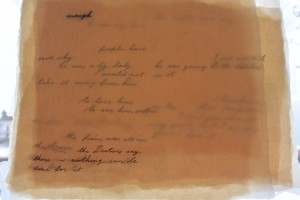
But Lizzie’s handwriting also enacted its own interventions: the size and formation of letters, their minute inconsistencies, determining the shape and logic of my own hand. There were moments in which it felt entirely comfortable to write inside her writing, as if in the words of her letter there were spaces to be occupied. But it was also easy to slip out of Lizzie’s rhythms, to add my own habitual flourishes, or to correct her—to dot the undotted i, or remake pitcure into picture (as my word processor does automatically).
There’s much more I could say about the intimate materiality of this process, especially in light of this post’s epigraph—the nuances between interposition and imposition; Gitelman’s use of the word genealogy; her gesture toward Taussig’s “‘particular’ histories of the senses,” etc. But I’ll keep it brief and let this writing, and its accompanying objects, serve as notes for an ongoing meditation-inquiry.
