I made a Roy Batty Twitterbot @RoyBatty_1982 using the Zach Whalen instructions. (And thus whatever algorithms allow “Twitter Apps” to generate and post my tweets automatically; I have not yet decided whether my “vocabulary” and syntactical ingredients counts as parts of this algorithm. Certainly, writing relies on a set of units or ingredients that can be combined in different ways. However, I think Hayles would say that my understanding of the system of English language signs is not really what is making things work here. What I’m inputting is not what I understand myself to be inputting, if you asked my computer.)
Leaving that confused theoretical jumble behind until further notice, I’ll explain why I chose to make a Roy Batty bot. I’ve been pretty obsessed with the “Tears in Rain” soliloquy for a while now. Anytime someone brings up AI, I try to figure out a way to work this scene from Blade Runner into the conversation. (I’m not sure this is always appreciated.) Here is the film clip:
https://www.youtube.com/watch?v=a_saUN4j7Gw
And here is some information about how this scene was made. (The actor who plays Roy Batty, the replicant and/or robot, revised the soliloquy from the script during his performance. His changes give the speech its existential weight.)
http://en.wikipedia.org/wiki/Tears_in_rain_soliloquy
This scene just seems so moving and provocative to me. The dove should cheese me out, but I even like that detail. Earlier in the film, we see Roy quoting and revising William Blake. I read this as Roy attempting to explain who he understands himself to be (and to explain his actions) to humans based on the human resources available to him. Within the film, this also amounts to claiming the validity of his existence and experiences and his humanitarian rights. In this final scene, he chooses not to kill the officer charged with finding and executing him. Instead, he shares some of his experiences with Harrison Ford’s character (Deckard) as his programmed life expires. I find this scene so interesting because his experiences are decidedly extra-human in so many ways. Yet, through his presentation of these ideas, he seems to be claiming that said experiences have had a profoundly human, i.e. existential, effect on him. The dove, as well as the nail in his hand, and the strange and religious Blake quotes, act as symbols by which he participates in or communicates this type of thinking. All of this is profoundly transformative for Deckard’s character despite (or perhaps because of) many of the ambiguities or questions the scene leaves us with. Is Roy thinking, writing, communicating like a computer here? Does thinking or writing like a computer mean not thinking, writing, communicating like a human? How can we begin to look for the answers to such questions? How does our interaction and involvement with AI form the basis by which we attempt to answer such questions?
I was trying to think about what makes Roy’s speech so jarring and “unrobot-like.” He frames his experiences as if he is “witnessing.” Thus, he presents his embodied experiences as evidence of something. His use of a simile following this act of witnessing also indicates that he has selected or “written” an appropriate metaphor for describing the existential experience of life and death, and all the affect that goes along with this condition.
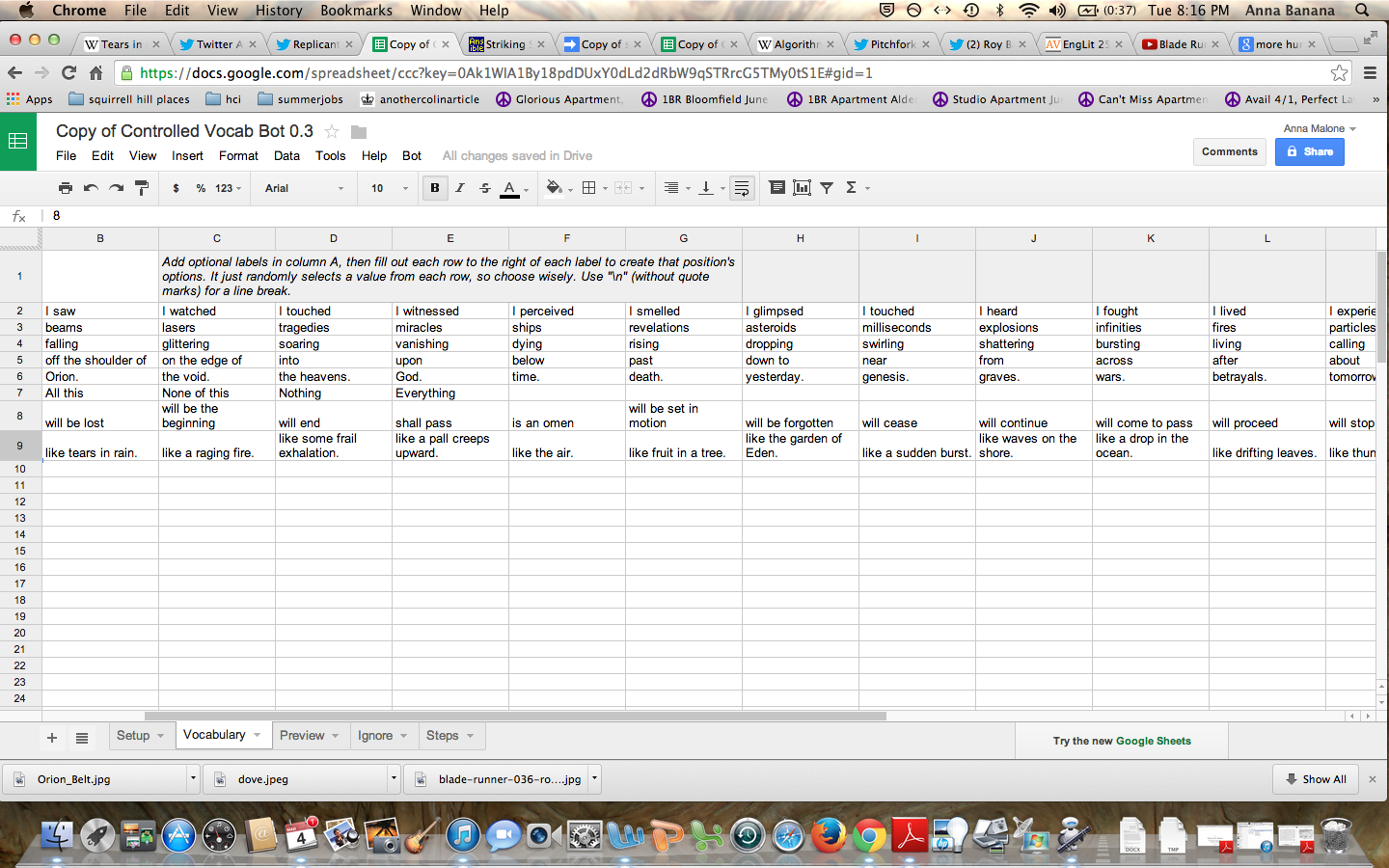
So, I decided to have my bot relate an extra-human experience of witnessing, as well as a simile to describe the existential weight of that experience. The language is way off and less affective/effective than that of the character Roy because I was making an actual and rudimentary Twitterbot rather than an imaginary and biologically perfected “superbot.” (“More human than human.”) There is more humor in Roy the twitter bot due to the fact that things are “off.” I kinda enjoy it.
Thinking back to Bogost: What does it mean to try to think like a computer? (Or Robot?) How do we go about answering this from a human perspective? Does Blade Runner make the distinctions between human and computer start to blur (i.e. Hayles and technogenesis)?
Oh! And here is my spreadsheet:

2 Responses to “More human than human” is our motto.