Indeed, practical work is often still treated differently from theoretical work in the academy, as if the knowledge of hand and eye, embodied intelligence, and applied skills were somehow not theoretical. When questions of materiality and ontology bring theoretical and practical issues into dialogue, troubling the abstractions that sustain philosophical discourse, the craft-based knowledge of production is generally disenfranchised, as if the higher order of thought necessarily trumps the lower orders of material engagement. But practice is neither banal nor reductive, and no more literal and unthinking than metaphysical reflections are purely ethereal—the two domains have much to say to each other.
—Johanna Drucker, “Diagrammatic Writing”
[P]hilosophical carpentry is built with philosophy in mind: it may serve myriad other productive and aesthetic purposes, breaking with its origins and entering into disseminations like anything else, but it’s first constructed as a theory, or an experiment, or a question—one that can be operated.
—Ian Bogost, Alien Phenomenology
As I was making my way through the readings, thinking about what I would prepare for this post, I found myself reading over and again this sentence from Bogost: “The carpenter, by contrast, must contend with the material resistance of form, making the object itself become the philosophy” (93). As so often happens with me, this sentence has come to feel only tangentially related to the way I’m thinking about my work, but at the time, Bogost’s mention of the material resistance of form—of, more, the work of having to contend with the material resistances of form—seemed to speak directly to the artifacts of memory work with which I’ve been spending so much of my time. Now, I’m probably thinking about resistance in a different way than Bogost, given my lack of fluency in new materialism and OOO, but his sentence reminded me of this: Material memory forms are highly resistant, with their traces of care and travel, their referential absences of bodies, narrative, context. And even more resistant are the handmade, spontaneously curated, sporadically neglected citizen archives among which they’re often found. I’ve one sitting in my room right now (two, actually, if you count the small cashier’s box full of my paternal great-grandmother’s “effects,” which I do). Gappy, fragmented, a material cacophony full of silences and dead-ended narratives.
In discussing my materialities of writing, then, I wanted to offer a series of stages, spaces, or practices, by which I engage with this project of memory, archives, and personal collections and grapple with its material resistances (and the material resistances, too, of my various practices/staging grounds, though I won’t say much about that here). Without further ado, this is a bite-sized selection of the materialities which urge me to write in the first place:
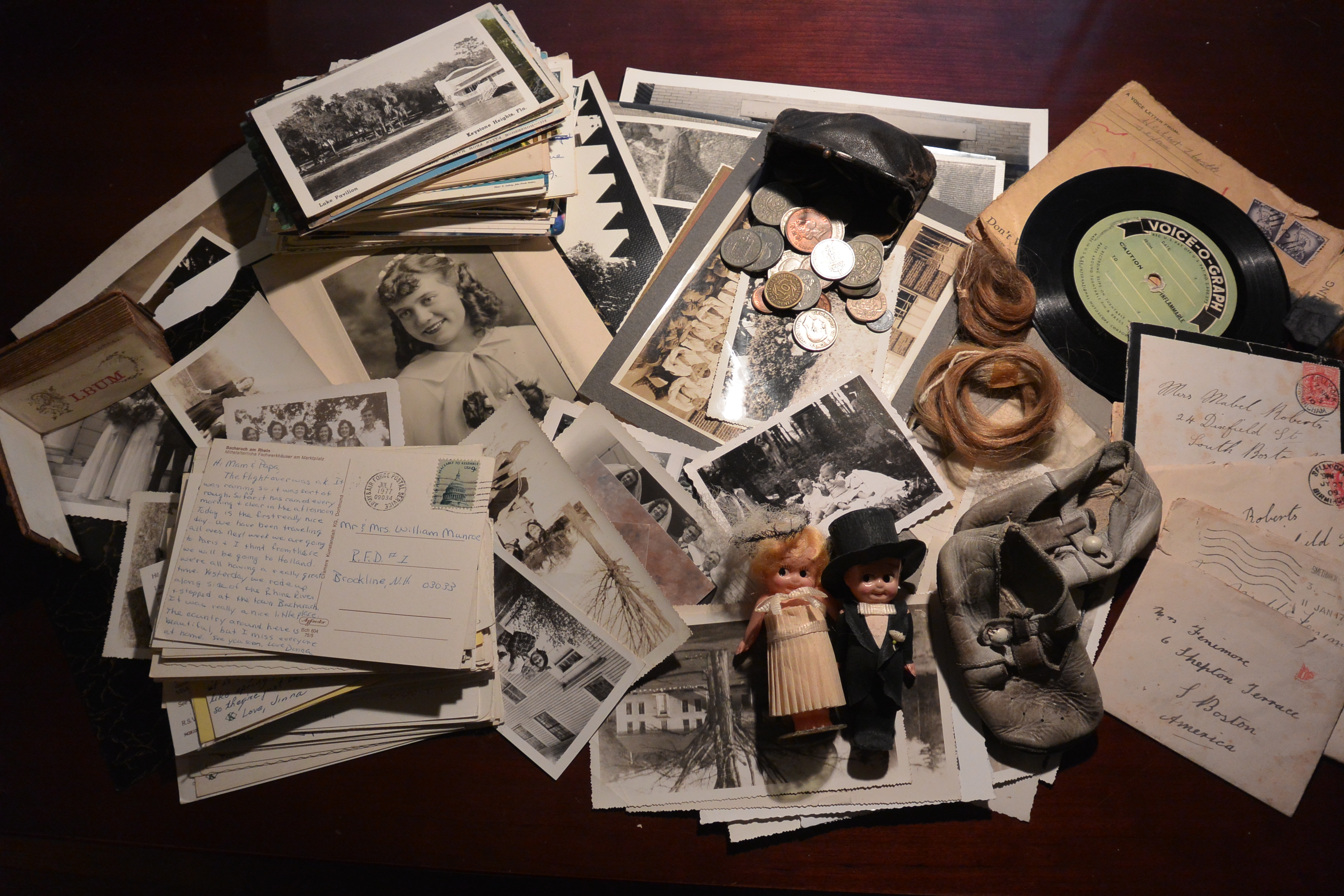
(Clarification: for those of you that haven’t heard me talk about this a million times, these things come from a trunk that has been passed down through six generations of women on my mother’s side of the family, and which now lives in my office.)
I’ve spent a long time simply handling and mindfully being with the various things in this trunk, minding the affective draws to various objects, arranging objects into different constellations of meaning or likeness, and using the trunk objects as prompts in conversations with my grandmother about our family history. At some point, though, I began to move “outside” of the trunk; I needed to find another way into the lives of the women evidenced in those objects. I needed to make things. The women in my family were incredibly skilled at all sorts of handiwork; they were working class women who made things by hand because to do so saved them money, allowed them to reuse domestic discards, and brought about social occasions for making in the company of other women. So, I wanted to start doing some of the work that they had done; I wanted to compose like they had.
Right now, with a book that was given to my great-great-grandmother for Christmas in 1951, I’m learning how to hook wool:
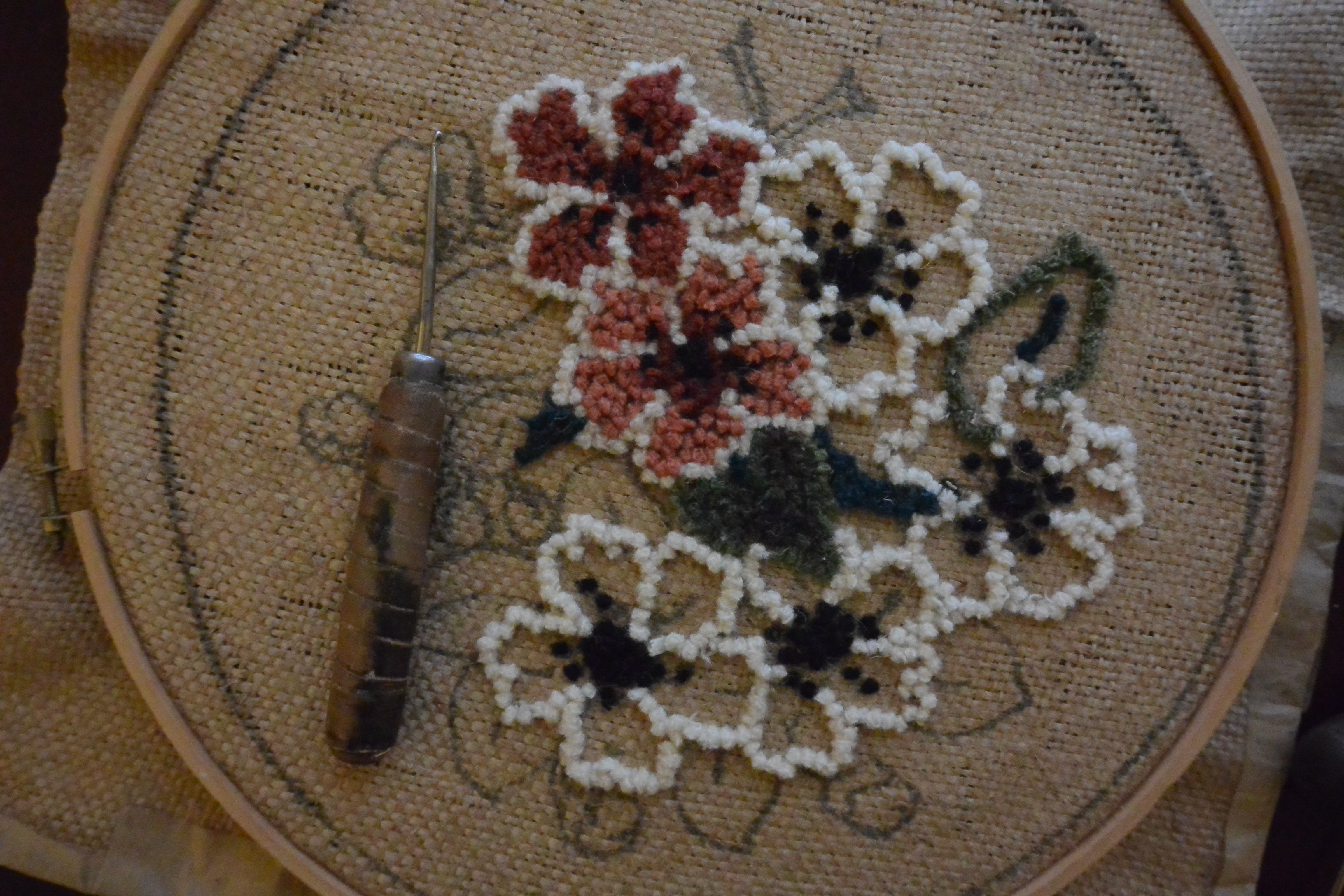
This, I think, will be some sort of face for a small pillow. Both my great- and great-great-grandmothers made extraordinary hooked rugs, and my mother received several of their rugs, as well as their hooking tools and salvaged wools, after my great-grandmother died. I found the burlap, with design drawn upon it, among these things. I’m using hooks stained and bent by their hands, their wools.
A third stage / staging ground for my materialities of writing is my tumblr, Spectral Memory. It’s a rather private space in that I’ve done little to disseminate it; someday, maybe I will, but regardless, its main purpose is to be a digital invention space, a place where I can see multiple objects, texts, and ideas at once, in color, and in relation:
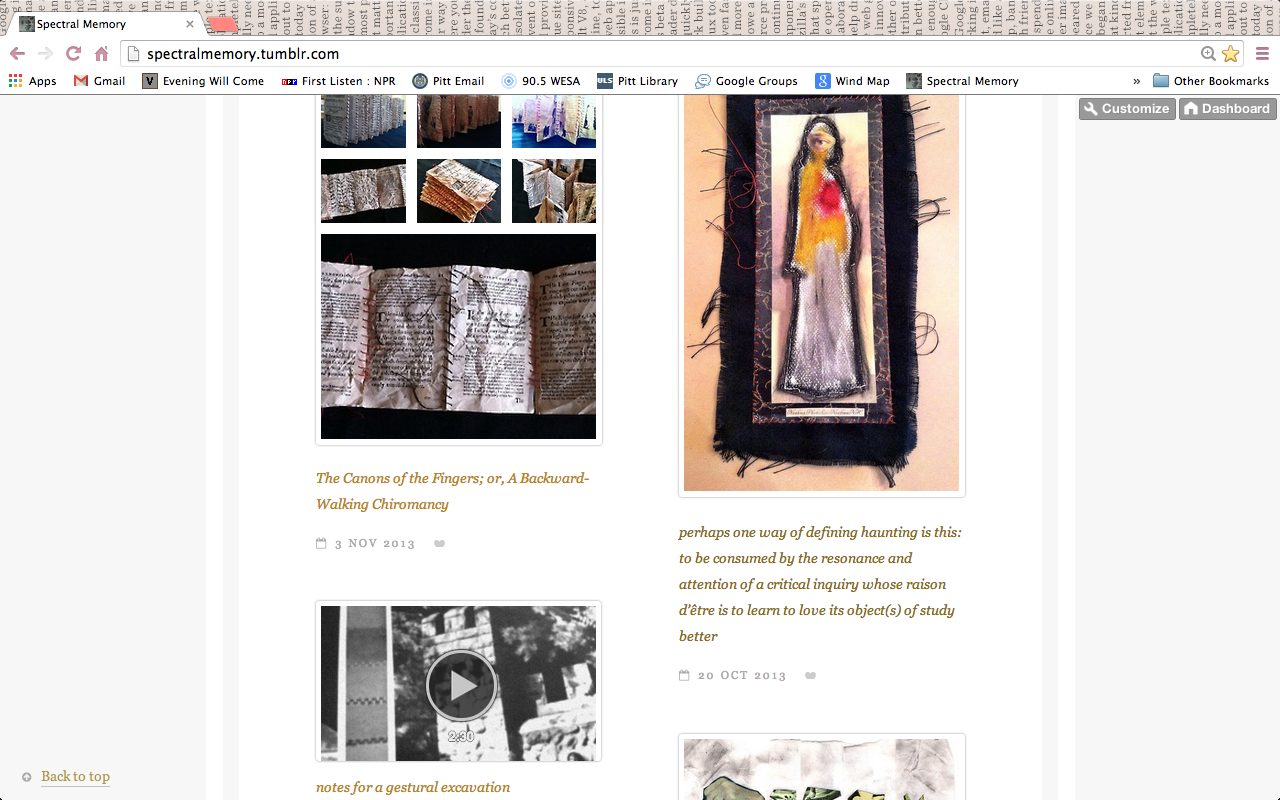
I write little here, but I love doing this writing so much; the tumblr is essentially one big drafting / collage project, a place in which to arrange things, to post drafts for future videos and other compositions, even as I’m learning their technologies.
Finally, there’s Scrivener:
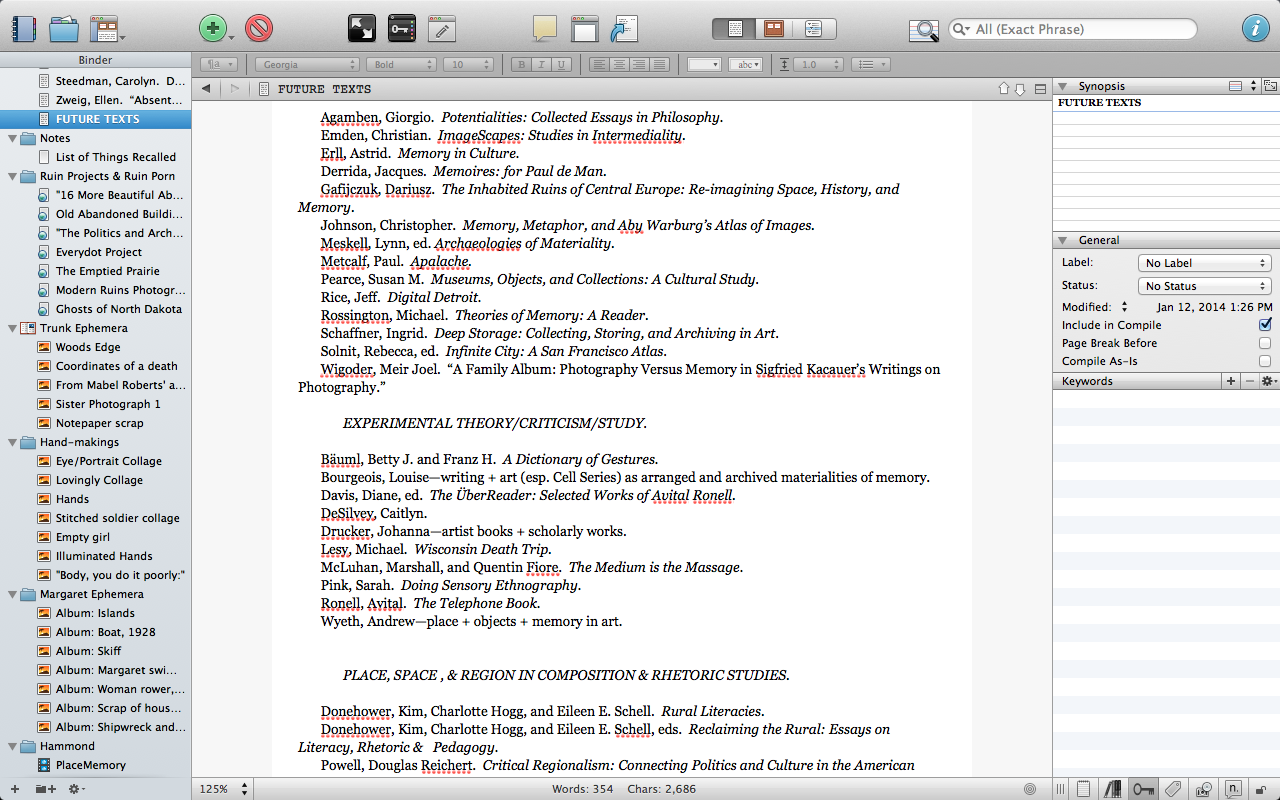
Originally, this entire post was going to be all about Scrivener, but then I decided to let things get much bigger than they probably needed to be, as I do. If burlap, wool, and rug hook allow me to move toward writing by way of labor and reverie, and if Spectral Memory is a space for invention and digital poetic arrangements, then Scrivener is the site where those composing practices meet the composing practices that more recognizably constitute my project work and beyond: book lists, working bibliographies, excerpts, webpages, catalogues of my handmade things, and photographic inventories of places and archives get to mingle with and reference each other by way of keywords, while also remaining desirably organized. Here, nothing need be left out. Things are allowed to speak to each other at their own pace. There’s room for collecting, for planning future work. It’s a lovely, controlled chaos.
