Proceeding to Define “Precious”

Definition 1a of the Oxford English Dictionary holds “Precious” as something “Of great moral, spiritual, or other non-material value; beloved, held in high esteem.” The emphasis on non-material is obviously my own, though my personal choice of precious surface reflects only the second clause of definition 1a. It was easy to ignore definition 2, “Of great monetary value; expensive, costly,” which counters the first with heavy material consequence.

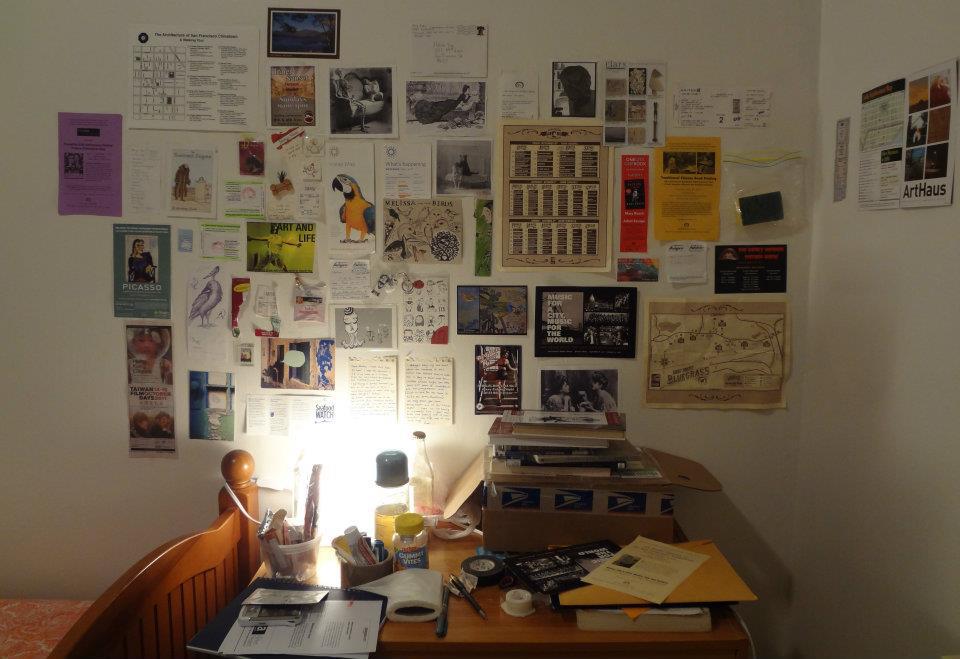
Those who know me well know I treasure trash. My idea of cleaning my room is taping what I find on the floor to my walls. I have accumulated a box solely containing scraps (mostly of paper) that have graced the walls in one of my many bedrooms (seven in the last two years?). With each move, I begin decorating with pieces from the box, and add slowly as I begin to live in the room – my walls and this box became the obvious first places to seek a precious surface on which to compose.

To keep this short, I will let a wall talk. This is a small section from my first apartment:

mywall_1

Things attached to the wall include (sweeping from left to right): library announcements, a dog biscuit, list of movies to see, newspaper clippings, museum brochures, love notes, postcards, bookmarks, a sponge in a ziplock bag, and more. Each arrives on my wall with its own story, but as the room becomes lived in, the items often become more precious to me.

Choosing one item to compose on was difficult — deciding what is worth composing on it is even more so.

Posted in Uncategorized | Comments Off on Proceeding to Define “Precious”

Inscriptions / Interventions.

Inscription is a form of intervention, into which new machinery continues to interpose.  Ink is imposed on paper, while pens and keyboards intrude into the posture of hands.  Grooves are incised into phonograph records, while sound echoes in our ears.  The genealogies of inscription allow what anthropologist Michael Taussig calls “particular” histories of the senses, as different media and varied forms, genres, and style of representation act as brokers among accultured practices of seeing, hearing, speaking, and writing.

—Lisa Gitelman, Scripts, Grooves, and Writing Machines

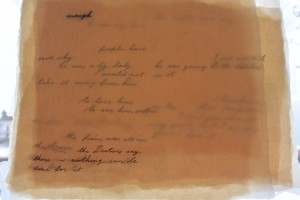
For the making of an object of inscription upon a precious surface, I chose a surface that had already been inscribed: a letter, written by my great-great-great-grandmother to her mother in May 1909 on the occasion of the death of her baby.  I chose this surface because it is indeed precious, but also stubbornly distant, mysterious.  I thought if I could write Lizzie’s words, in the shape of her own hand, I might learn something about the act of writing that letter.

Technically the sheets of trace paper I placed on top of Lizzie’s letter constitute my surface; across several sheets I re-inscribed different portions of the letter, always starting with the word enough as a way to anchor the sheets to each other.  I anticipated the effects of my intervention upon Lizzie’s letter; the assemblage of the sheets in the window is the final (for now) product of a process of selection and erasure, emergence and recession.  (I photographed the sheet-by-sheet assemblage, but I won’t post all of those here.)

DSC_0163

But Lizzie’s handwriting also enacted its own interventions: the size and formation of letters, their minute inconsistencies, determining the shape and logic of my own hand.  There were moments in which it felt entirely comfortable to write inside her writing, as if in the words of her letter there were spaces to be occupied.  But it was also easy to slip out of Lizzie’s rhythms, to add my own habitual flourishes, or to correct her—to dot the undotted i, or remake pitcure into picture (as my word processor does automatically).

There’s much more I could say about the intimate materiality of this process, especially in light of this post’s epigraph—the nuances between interposition and imposition; Gitelman’s use of the word genealogy; her gesture toward Taussig’s “‘particular’ histories of the senses,” etc.  But I’ll keep it brief and let this writing, and its accompanying objects, serve as notes for an ongoing meditation-inquiry.

Posted in Uncategorized | Comments Off on Inscriptions / Interventions.

Poor, poor riddle.

Here’s my cryptic addition to this week’s signment re: gilt edge, etc.

A riddle to what my material for the writing will be:

“What has a spine, a face, a back, and thoughts; has tremendous weight, yet when dropped, isn’t harmed?”

KW

Posted in Uncategorized | Comments Off on Poor, poor riddle.

Foucault: “Death of the Author”

Here’s something Foucault wrote (or said and then edited):

Even when an individual has been accepted as an author, we must still ask whether everything that he wrote, said, or left behind is part of his work. The problem is both theoretical and technical. When undertaking the publication of Nietzsche’s works, for example, where should one stop? Surely everything must be published, but what is “everything”? Everything that Nietzsche himself published, certainly. And what about the rough drafts for his works? Obviously. The plans for his aphorisms? Yes. The deleted passages and the notes at the bottom of the page? Yes. What if, within a workbook filled with aphorisms, one finds a reference, the notation of a meeting or of an address, or a laundry list: is it a work, or not? Why not? And so on, ad infinitum. How can one define a work amid the millions of traces left by someone after his death? A theory of the work does not exist, and the empirical task of those who naively undertake the editing of works often suffers in the absence of such a theory.

*This essay is the text of a lecture presented to the Societé Francais de philosophie on 22 February 1969 (Foucault gave a modified form of the lecture in the United States in 1970). This translation by Josué V. Harari has been slightly modified.

Posted in Uncategorized | Comments Off on Foucault: “Death of the Author”

A book is a technology.

What are our materials of reading, and what difference does it make?

“People forget that a book or codex is a technology,” reminded ambient lit artist Tan Lin in a 2012 interview in the new media art publication Rhizome (so named after Deleuze and Guattari’s “image of thought” concept). Literary types privilege the book as the ultimate form for reading. To privilege the book as reading, though—to forget that it is a technology—is analogous to forgetting one has a body (something lit types are also wont to do), and to forget one has a body is to let it soften and lay to waste. When you recognize the book as technology, you realize that print and screen, like body and mind, are not mutually exclusive mediums, but that they are increasingly mutually influencing.

From here: http://www.randomhouse.ca/hazlitt/feature/internet-killed-books-save-reading

Posted in Uncategorized | Comments Off on A book is a technology.

WHAT’S IN THE BOX????

To get to my materials of writing, I have to draw a distinction in my writing itself. This distinction is crude, but it is honest.

I distinguish between writing that matters and writing that doesn’t matter. (I didn’t necessarily know that I did this until I started trying to come up with a list of materials.) What defines what matters and doesn’t matter, for me, has very little to do with content, and everything to do with form. Apparently — and this is hard to admit, given that one of my academic interests is digital stuff — I place a heavier value on physical artifacts of writing (journals, cards, letters, notes) than I do on digital “artifacts” of writing (emails, online articles, blog posts (!)). This is maybe a relatively common thought among some people, but I don’t know. Anyway, I can determine what writing “matters” based on two totally ridiculous and arbitrary tests:

1. The Zombie Apocalypse Test. Imagine a world (as I often do) that fundamentally and irreversibly stops functioning in the ways to which we’ve grown accustomed. Some sort of cataclysmic, apocalyptic game-changer. No electricity, no Internet, no useful fictions like money or governments. The zombie apocalypse. The writing that survives — that is, the writing that continues to exist — following the sudden and irreversible shift from our world to this post-apocalyptic world, that is the only writing that, for me, has any possibility of mattering. So all my writing done in the cloud, or even on computers, it is eliminated simply by virtue of the fact that it cannot survive the zombie apocalypse. Now, even writing that does survive the zombie apocalypse won’t necessarily “matter.” But this test is a way of narrowing the field, so to speak, of revealing the writing that could matter. So, as far as tests go, the zombie apocalypse test is a necessary condition for determining whether or not I think a piece of my writing “matters,” but it is not a sufficient condition. Which brings me to the second test.

2. The Footlocker Test. (Incidentally, there is (or was) a real footlocker on which this test is based, so it is definitely one of my “materials” of writing). So once the first test eliminates all cloud-computing and digital writing, all text messages and emails, blog posts, online articles and encyclopedia entries I’ve ever written, I still have a massive amount of writing out in the world. I possess some of it, and some of it I don’t. The second cull happens when I think whether or not the physical artifact of writing is something worth storing in a footlocker that my children or grandchildren might stumble upon sometime in the (postapocalyptic) future (it doesn’t need to be a postapocalyptic future). And honestly, this gets weird(er). Because essays I’ve written and of which I have a physical copy, or important notes, sometimes they don’t make it because they’re contextless, or I think they’re something that my children or grandchildren wouldn’t get a kick out of discovering and reading. Maybe they’re too esoteric or they’re too long. Maybe I’m not particularly interested in them anymore, so I figure my kids and grandkids wouldn’t be interested in them. But then, contextlessness and strangeness are sometimes the very criteria by which other things make it into this footlocker. A strange and cryptic note that my wife gave me when we started dating. A weird fortune cookie fortune. A napkin on which I drew a picture of a bat playing quarterback. All of these things are in the footlocker, and I have no idea what my kids or grandkids might make of them if/when they find this footlocker. Maybe they’ll move quickly past them to get at the lengthy, esoteric hard copies of seminar essays that weasel their way in there, I don’t know.

The tests to distinguish between writing that matters and writing that doesn’t matter help me to identify the materials of my writing. In no particular order, they are most often things like: PAPER-Y materials: notebooks (specifically the old Mead-style Composition books — love these), lineless drawing paper, crudely handmade journals that are never finished, small Moleskine books in which I’ve written things like “Gift Ideas” or “Recipes” or “Great First Lines,” Post-It Notes, particularly notes from people, postcards, Christmas cards, Fortune cookie fortunes, cuttings from newspapers or magazines, pictures of my relatives’ kids, workout journals, typing paper (as in from an electric typewriter and unused…I never use this, I only think about what kind of writing-that-mattered I might write on it, but never do), really nice stationery (see typing paper), notecards (see typing paper and really nice stationery); WRITING-Y materials: golf pencils, astronaut pen (just the one, an artifact from a time capsule my dad and I made, buried, and dug up the year we found out he had cancer), Varsity disposable ink fountain pens (the best kind of pen around, I tells ya), Bic mechanical pencils, Roseart drawing pencils, Sharpie markers; EFFLUVIA materials: my grandfather’s letter opener, my grandmother’s letter/pen holder, a lockbox filled with sewing supplies, rubber bands, one of those plastic eggs filled with silly putty.

Really, bricabracy stuff, stuff that might also go into the footlocker with any and all of my writing-that-mattered.

Posted in Uncategorized | Comments Off on WHAT’S IN THE BOX????

Stage (n): One of a series of layers or shelves of any material.

Kitchen table, by south-facing windows.

I write in stages. Each stage has a different set of materials and takes place in a slightly different orientation of the materials within my space, or takes place within a difference space entirely. These stages do not necessarily occur in a series… as Marshall McLuhan reminds us, via mention of Hume: “[T]there is no principle of causality in a mere sequence. That one thing follows another accounts for nothing. Nothing follows from following, except change” (12). My series or sequence changes and/or is reciprocal in nature. I often have to go back in order to go forward.

Reading Stage

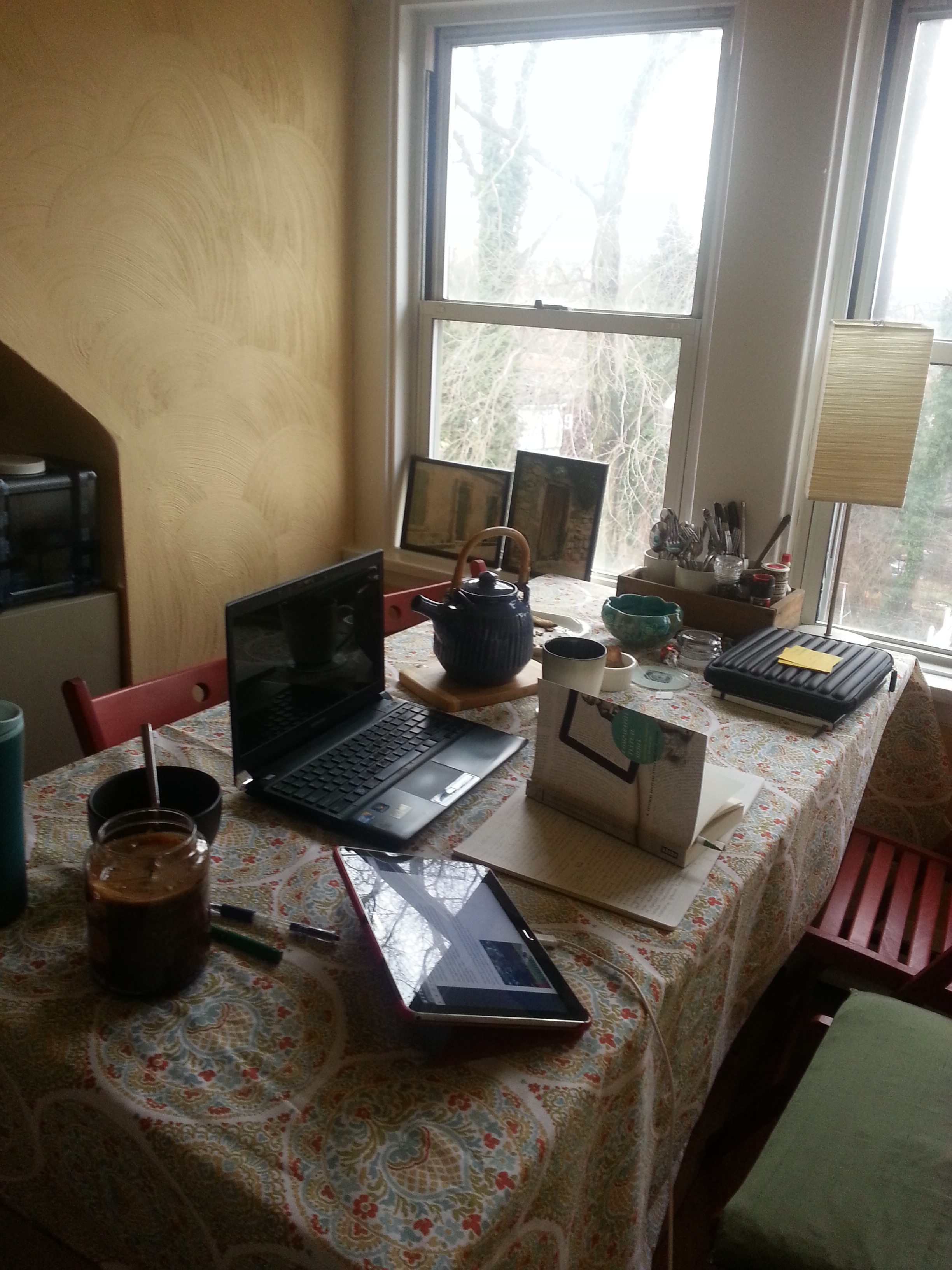
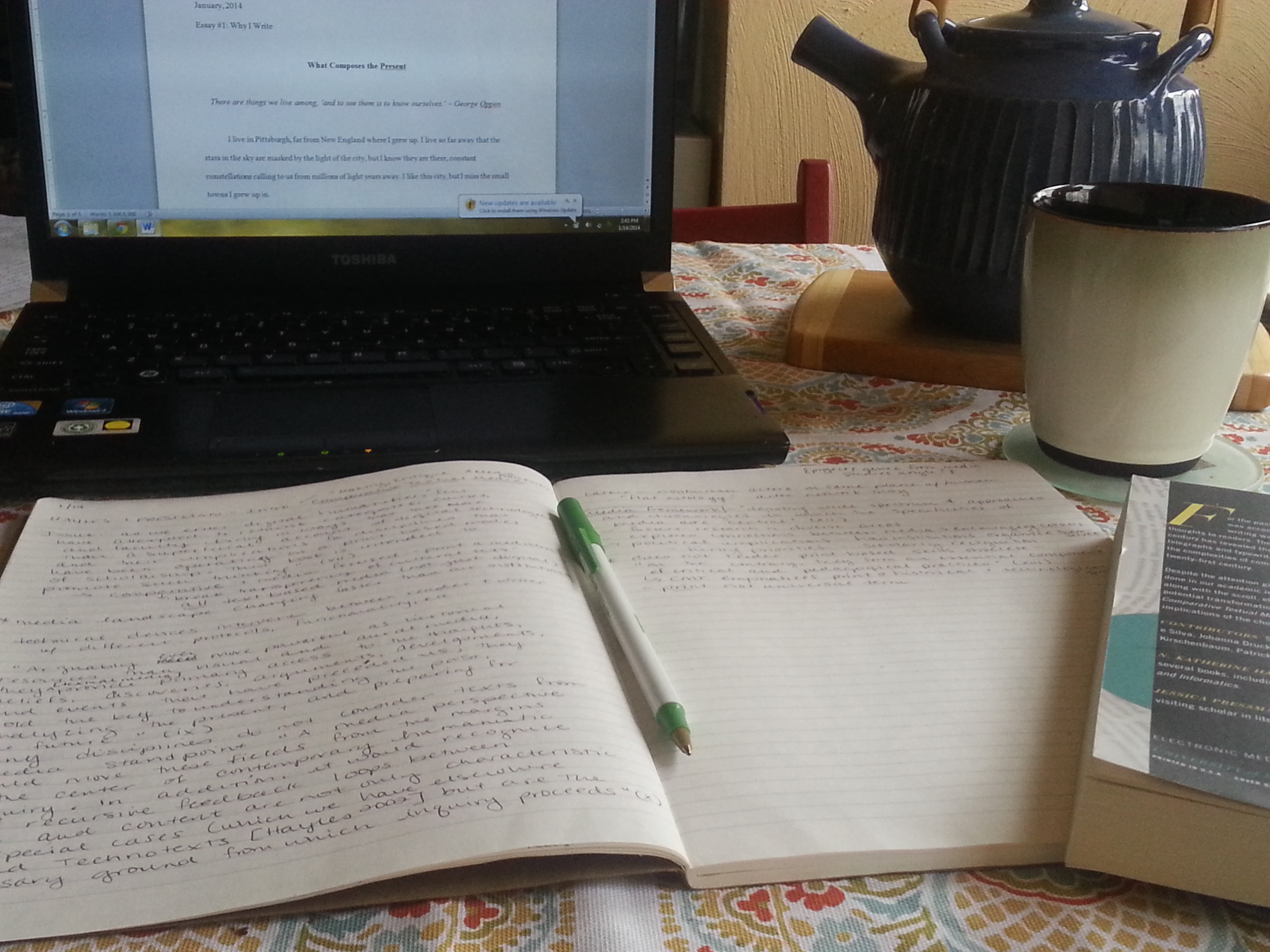
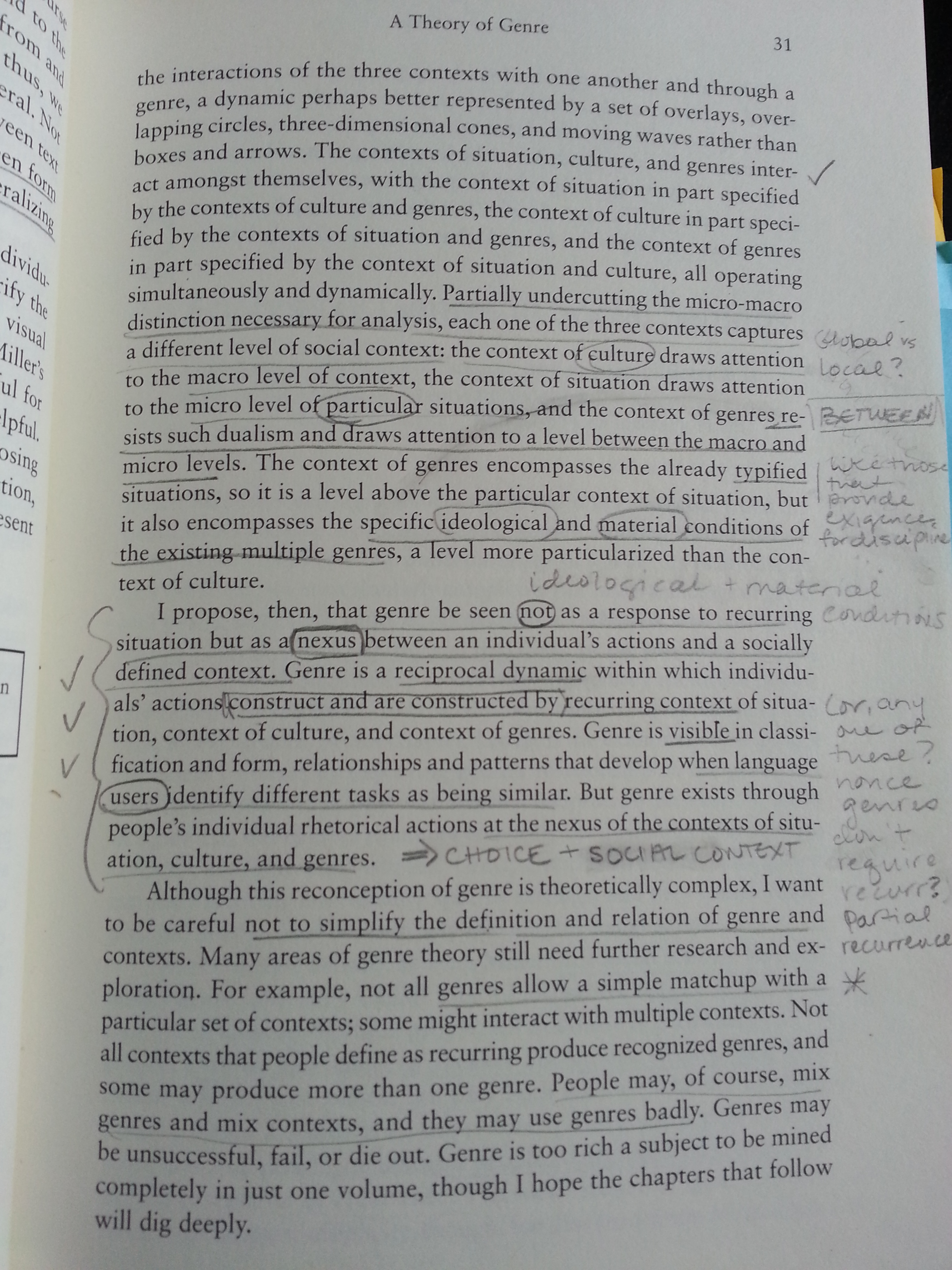
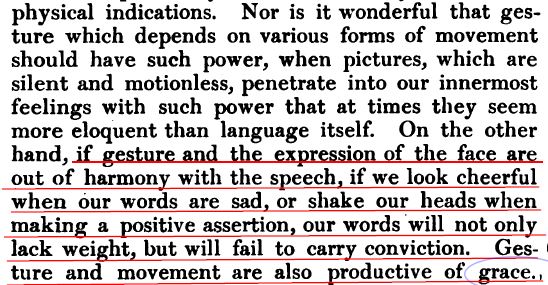
I cannot account for my materials of writing without also accounting for my materials of reading. When I read I also write, both in the margins (digitally with a stylus on my tablet computer, or by hand in pencil) and in a commonplace book where I record passages that seem particularly interesting or relevant to me. My marginalia largely consists of short phrases glossing important passages, stars, check marks (for claims I concur with or find interesting), x-es or question marks (for passages I disagree with or question), and too-frequent underlining. I put boxes around passages that seem particularly relevant. This marginalia becomes an important material for me as I return to these markings, which behave like signposts, as I attempt to recall a writer’s approach and my initial reactions to it when I move to write in turn.

The passages I put boxes around are generally the passages I record in my commonplace book. The act of doing something with another’s text allows me to make more of a thing out of particular moments. The act of writing long-hand in a notebook allows me to slow down, register a writer’s cadence and syntax, and to more fully ingest what has been written. I feel there is a power to duplicating someone else’s language in a slightly different mode or media. It’s helpful for my mind, but I’m also certain the process of writing things helps me internalize (or, even, practice) a writer’s moves.

Commonplace notebook (I have a different one for each class… it is also where I record notes from class discussions)

my marginalia on Amy Devitt's Writing Genres

my marginalia on Amy Devitt’s Writing Genres

From Quintillian
Quintillian. Underlining with a stylus via the PDF reader and annotator app RepliGo Reader on my tablet.

It is during the reading stage that I have the most things around me, which become my materials of writing insofar as they support my process, affect my environment and thus my mood. The top photo is of my kitchen table as it appears today. It is where I do almost all of my reading and initial writing/note-taking. The light is consistent for most of the day because it’s on the southern side of my apartment, which isn’t great for writing on a screen, but works just fine for reading on a tablet and writing long-hand.

In the morning, I have a mug of coffee I inevitably let cool as I get going and forget it. In the afternoon, the equally forgotten tea. I take sips when I need to pause — I know the reading or writing is going well if I am ignoring my beverages. When I’m particularly contemplative I am also well-hydrated. By the end of the day the dishes from my meals remain, crumbs or last bites stay on the plates until I am done and can do other household things. My kitchen is generally the cleanest place in my apartment — so I am not generally distracted by all the other things (like dirty laundry) I might see elsewhere (I live in a loft-ish 3rd floor converted attic space, but my kitchen is separated from the living/sleeping space). 

Developing a Clearer Sense of the Project 

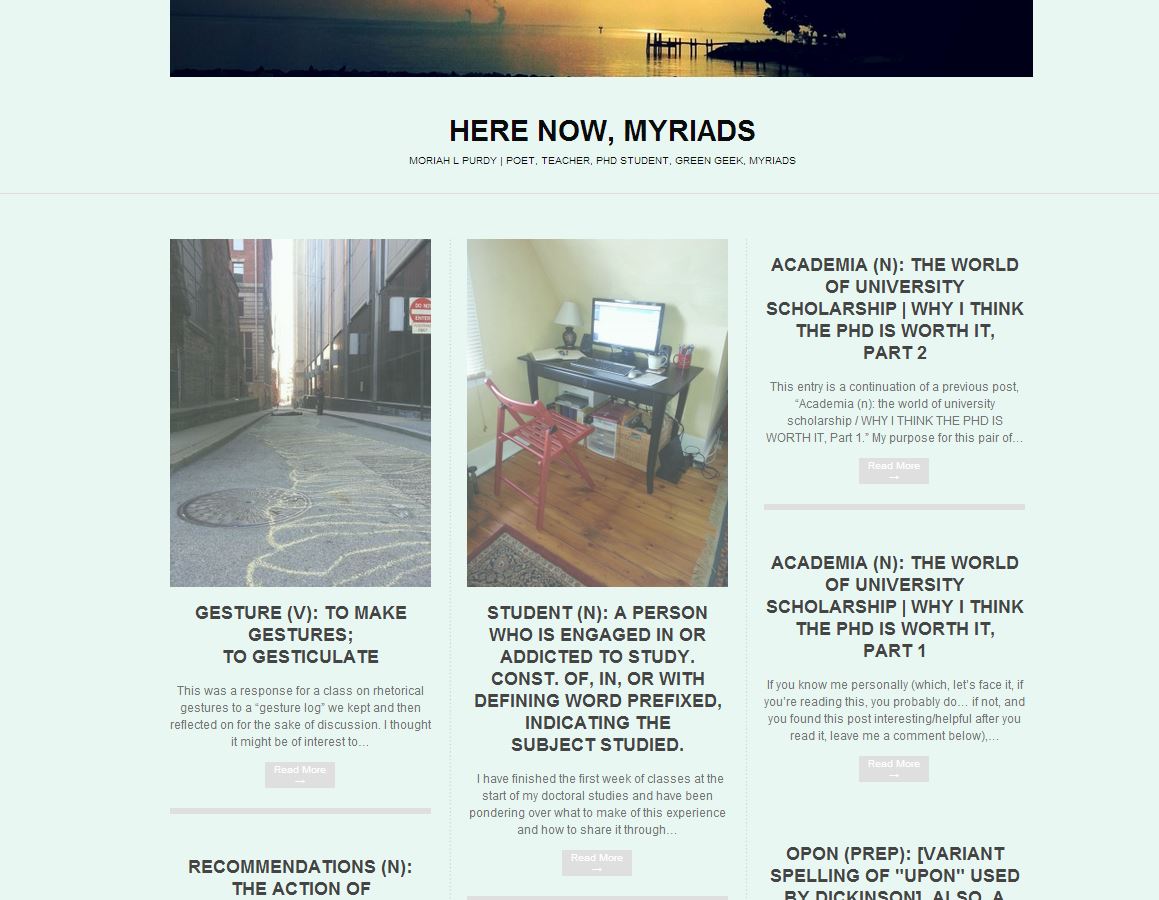
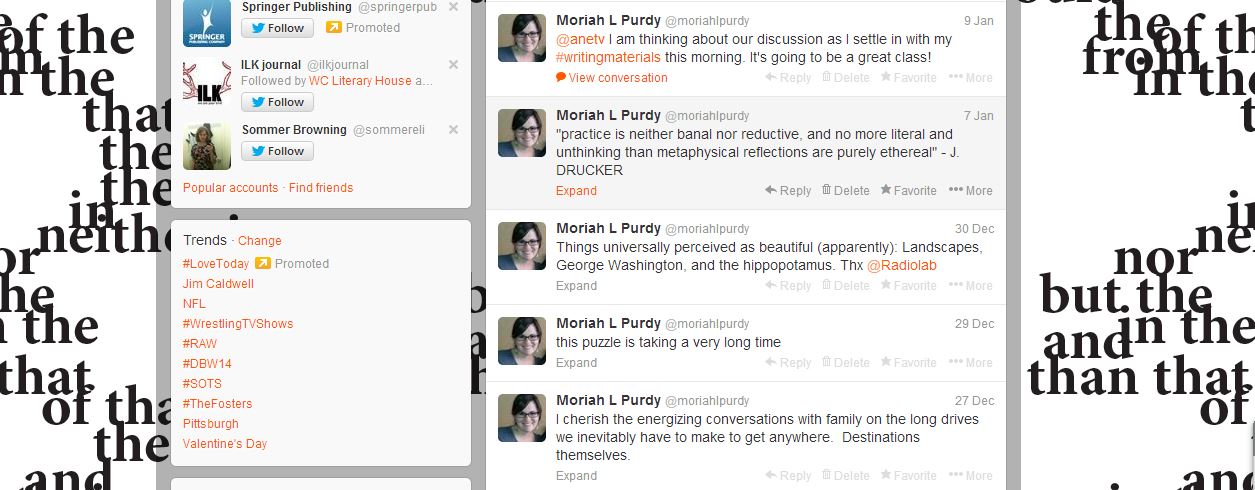
When I’m ready to stake a claim to a point of inquiry, I’ll often up the ante and “go public” with my thinking. I’ll work up a post for my blog (though I haven’t quite figured out how to find time to blog while I’m also preparing for my classes… this course is helping me realize that I could post my reading responses as blog posts, but I also don’t want to limit it to that… I miss this stage in my process, and need to return to it in some way this semester), or, if I have less time, I’ll post a line or two to Twitter (http://twitter.com/moriahlpurdy). These spaces are for the early thinking, for working things out. To see how I frame the blog entries, feel free to visit my “about.me.and.this.thing” page. In short, these spaces are for beginnings.

Without the blog or Twitter posts I wouldn’t have a sense of the public stakes. When our exchanges are primarily between professor and student, it’s hard to conceive of stakes with any kind of clarity. I know, however, that this is a public space, and that my blog and Twitter are, as well. While I can offer the disclaimer that the thinking I put down is early and messy, it still has to have reached a place of urgency when it desires to be made known. This helps me round the corner to a more complete and more complex project.

http://moriahlpurdy.wordpress.com
http://twitter.com/moriahlpurdy

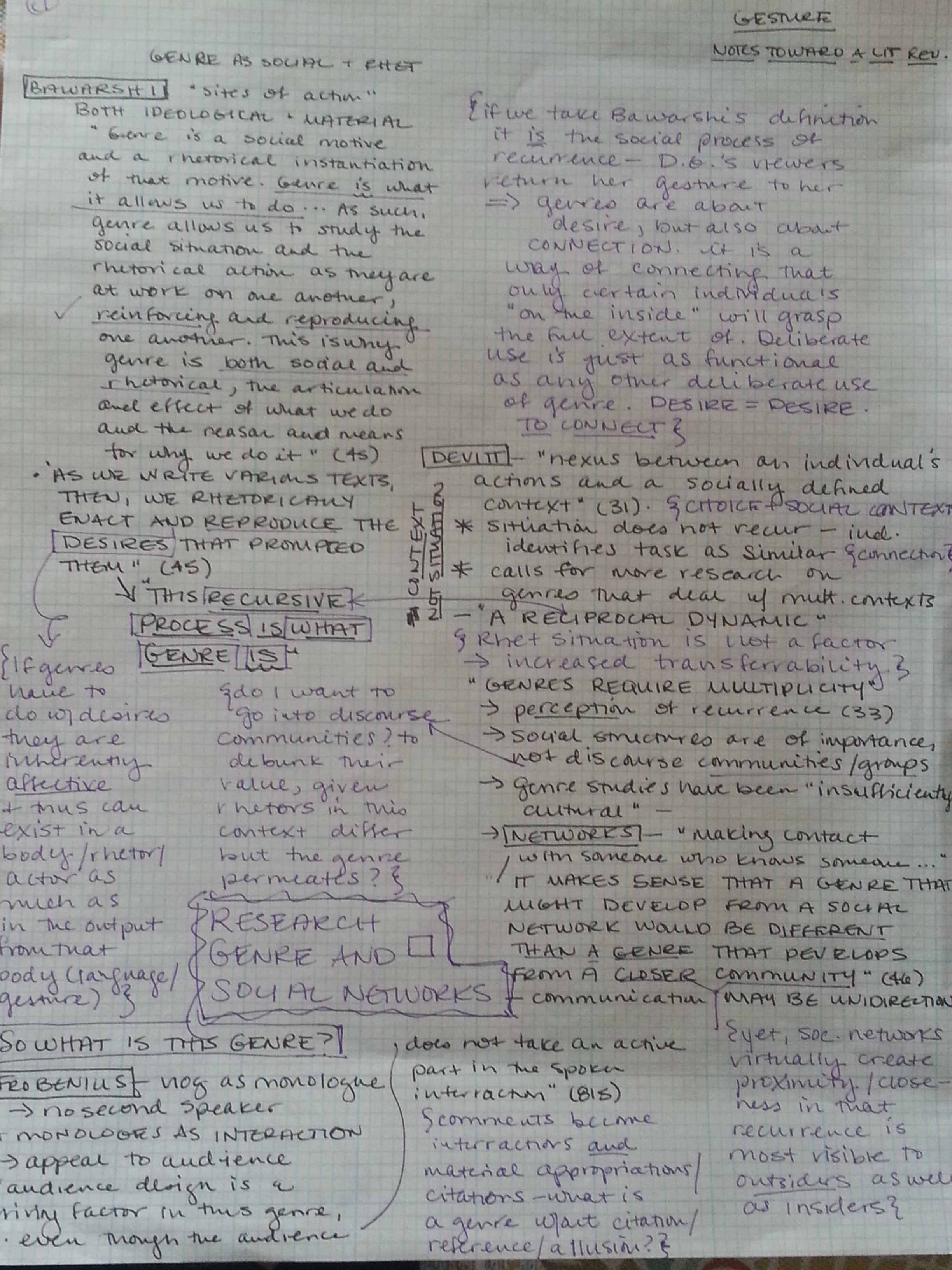
It is also at this time that I might go to graph paper and attempt to visualize the connections and questions I want to work through in a particular writing project. Apart from writing in the commonplace notebook, handwritten works at this point come after substantial digital composition. I write on the graph paper after I’ve written almost everywhere else, but often before I reach the depths of the process of working through the thing I’m “preparing” to compose. 

Graph paper conceptualizing.

Drafting and Re-Drafting Stage

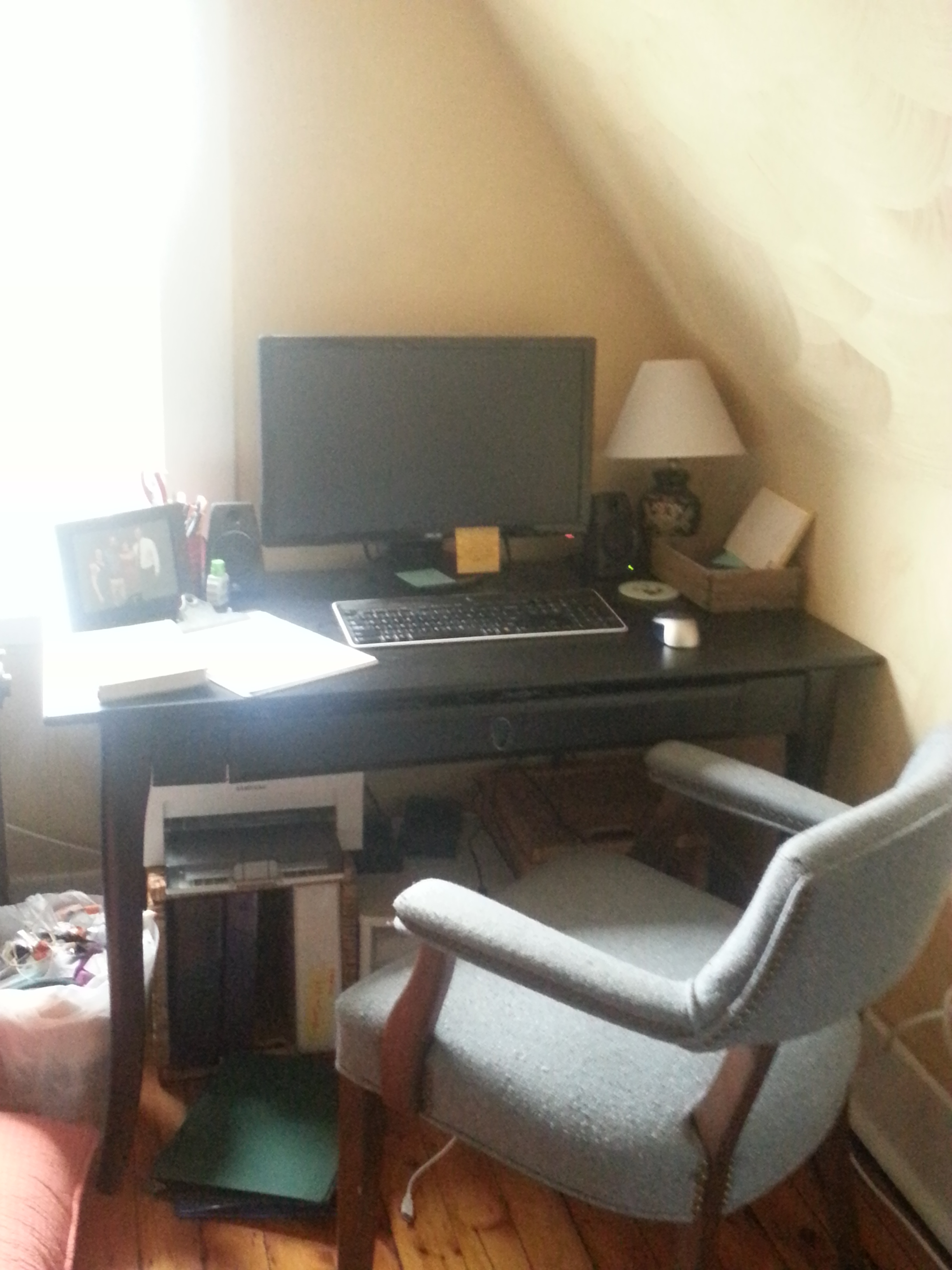
When all of the early work of thinking something through is done, I transition from my kitchen table to the desk in my other space, which is considerably more minimal. If my mind is cluttered my space needs to be clear and organized.There is a coaster for my tea, if I have any left over from the morning routine, or if I start here in the morning. There is also the graph paper for hand-written notes if I need to slow down.

My "real" desk -- comfortable chair purchased for $15 at a thrift store, solar wireless keyboard (an investment, but so worth it), and most importantly, the external 23" monitor.
My “real” desk — comfortable chair purchased for $15 at a thrift store, solar wireless keyboard (an investment, but so worth it), and most importantly, the external 23″ monitor.

Mostly I put together all of the passages I imagine I might use in a paper, or otherwise, into a messy Word document and call it “quotation dump” and the project for the file name. This file is generally open next to my drafting Word document. I find the screen real estate is incredibly helpful for me as I’m trying to take in and conceptualize big-picture (so to speak) concepts I want to work with. The larger screen helps me see things (quotations, working claims) next to other things (ephemeral language, questions driving the project, assignment prompt language, language that reminds me what is at stake, why I’m writing the thing, what it is I want to find out). Sometimes I’ll separate something out and write it on a Post-It note. Most of the time these things just stay in this working document, the place where I cut-and-paste things.

I date and number all of my drafts, so these become material, too. But mostly I work in those two original documents until I’m about “finished.” This split-screen mode on my computer (Windows 7) which allows me to move documents to each side in equal sizes also helps me when I’m finalizing my writing. I tend to transition the “draft” to the left-hand side of the screen and open a new, blank document. Just as I rewrite the language of others to make it material during my reading stage, I retype my own writing to re-encounter it materially as I’m polishing phrasing, organization, visual elements, and so forth. Ideally by this point I work down all of my writing “material” to the one document. Ideally by this point everything is much clearer and I need less “support” from the materials that comfort me in the early stages.

A Few Final Thoughts

It should come as no surprise to me that my writing materials say a lot about my writing process. Although I am aware of these stages and the ways in which the various materials assist me along the way, it’s taken a long time to arrive at these patterns of working. It has been a constant process of trial and error. The reading process used to be entirely in print, for example — but now that is changing. I used to print my final drafts while polishing, but I no longer find the need to do that (now that I can see everything more clearly on the “big screen”). Everything else about my materials of writing is about intimacy and comfort. Even if my tea cools I can warm it up. Even if I feel exhausted I can look out the window at the cardinals and blue jays that love the trees behind my building. I like to think that, eventually, when this work finds its way to a reader that the reader has a window to peer out of, too. I think my mind works best when I feel as though my materials are working for me, that I am taking full advantage of the ways in which they change my process and the language as it appears on the page. That while at one point I might have considered what they would do for me, I stop registering them as technologies and simply put them to work. 


Posted in Uncategorized | Comments Off on Stage (n): One of a series of layers or shelves of any material.

Materials

I write, as I said in class, both by hand and on computer.  When writing by hand, I usually use loose leaf paper, college ruled.  I prefer lately to use pen, I use Uni-Ball fine point rollerball pens in black ink.  I write in cursive.  I would call my handwriting a materiality of my writing, and the cursive nature of it is part of that materiality.  There is a smoothness to it that I think is important, and a speed.  I generally write in cursive for non-creative things also.  I don’t when I am writing letters (my cursive writing is hard to read for other people) and sometimes when writing notes for class (I’d link that to impersonal nature of note-taking, for me).  I have written two stories in the little notebook that I brought in to class, although that is mostly a place for throwing in random ideas.  I group the related ideas together.  The notebook is lined, but for the idea sections I write both straight and on an angle.  I have a macbook and use Microsoft Word, Times New Roman, whatever margins they automatically give you, size 12 or size 11 and single-spaced.  At night, when I’ve shut off my computer, if I am struck with a new paragraph, I’ll write that down in the notebook.  There’s no reason as to whether I write a story by hand or on the computer or in the notebook, I just go with what feels right.  I’ll often switch from handwriting to typing at around the 3/4 mark, which means I’ll type up what I have already and then continue on typing the rest of the story.

My folder organization in Microsoft is key for me.  There is the general writing folder, within that folder there is other, personals, poetry, and prose folders.  I am primarily a prose fiction writer.  I used to have within that writer folders that organized stories by what I felt their quality was.  It got to be that that was a little harsh on myself, so I switched it to Finished, In Progress, stories written in college courses (within that folder are folders for the different courses), and then Unfinished (Open-ended).  Changing the “badorIdontknow” folder to the “Unfinished (Open-ended)” folder has been more productive in allowing me to go back to first pages I wrote three years ago and finishing those stories, something I did last semester.  With the first word being “bad” I tended to avoid that folder and think of everything in there as poor quality

I’m also part of the has-a-desk-just-to-not-use-it crew.  I write at my kitchen table, or on my couch or on my bed.  Sometimes at the library.  I have one of those laptop pads for when I’m on my couch or bed.  I love it, I just wish it had a cup holder.  Similar to Nina, I write in silence.

When I’ve gone too long without writing (sometimes it’s months), I need outside resources to push along my desire to write.  Fiction books (novels or short story collections), movies, fashion magazines.  I think of these things as good for my soul.  I love fashion and collect fashion magazines, so a really good magazine–either in its editorials or articles–can really excite me into wanting to be creative.  I enjoy television but it rarely excites my creativity the way movies do.

–Amanda

Posted in Uncategorized | Comments Off on Materials

My first post! :)

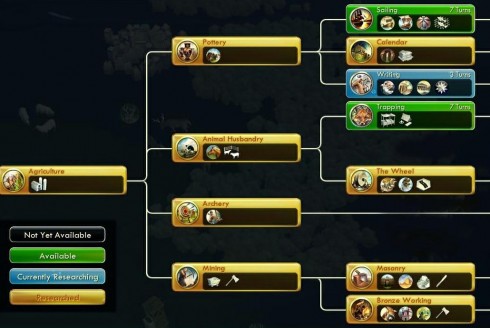
In the computer game Civilization V, you start the game as the leader of one of many civilizations all positioned at the beginning of agriculture, and you have to lead this civilization throughout the industrial age and the modern era and all that. Part of this process involves researching technologies. And one of the technologies that you can research is Writing.
Civ5tree-490x328
One of the main benefits that researching writing allows you is the ability to sign open border agreements with neighboring leaders. These agreements, in addition to granting each signee free passage through the others’ country, allows you, if you produce more “great works” of art than your opponent, to then force your culture down the throats of the leader who signed the treaty with you. If you do this hardcore enough, you can come away with a “cultural victory” at the end of the game.

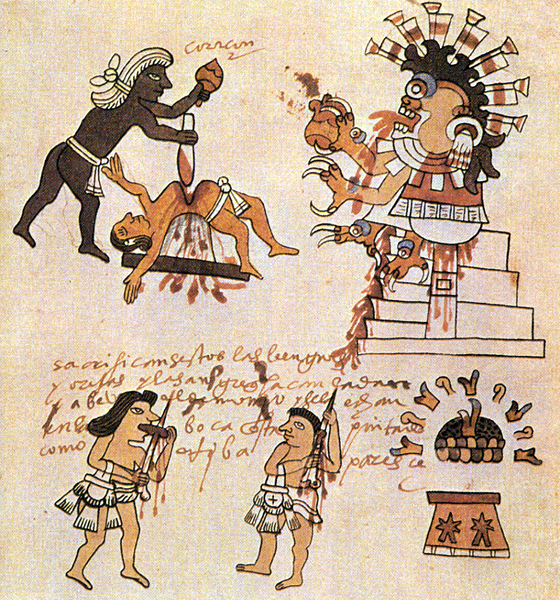
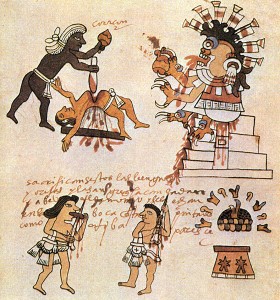
Basically, cultural hegemony=win the game. It’s pretty fun to take the Aztecs and spread Aztec culture everywhere. I imagine sacrifices taking place in front of Parliament and laugh sadistically. ^_^
Kodeks_tudela_21

Anyway, the reason I bring this up is because writing in Civ, and the open borders agreement, is simply the first step toward a cultural victory: eventually you research the printing press, and mass media communications become available, and you have to continue to invest in these things to push your culture onto others.

But even before the materiality of the printing press comes into play, the materiality of free movement between various territories must be in place.

Annette, the first day of class, shared her shoes as the materiality of her writing. And while this is a very personal connection, I think it also has these broader political connections as well: in which way does writing walk across borders?

If we are to consider the body as a materiality of writing, we must also consider the place in which the body is located, the place the body has been born, the place through which the body travels. I think of the long line to get from Tijuana to San Diego — a two to three hour process, all days of the week. And how easy it is to simply walk into Tijuana. A revolving iron gate that moves only in one direction. This movement is material. If bodies are writing, then this is more than just a metaphor. If we are to consider the body as materiality, we must consider the ways that the body is limited, or imprisoned, we must consider the ways the body is seen by others, the racialized body, the gendered body.

SanYsidroBorderCrossing
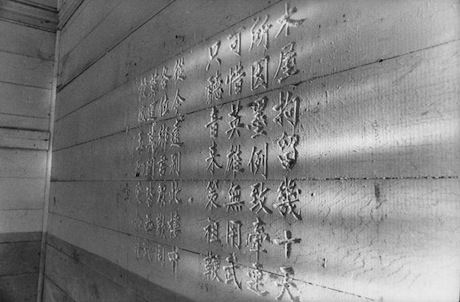
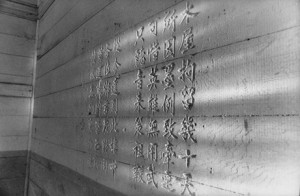
On Angel Island, there are poems that Chinese immigrants carved into the walls. Walls and walls of poems, people expressing feelings of betrayal, people longing to return to China, longing to enter America, to see their families, to be treated with dignity, respect. These poems are painted over in white, erased from ever having existed. And on top of this erasure, more poetry, more longing.
08chinesecharacterwalldetail

^From Poetry Foundation.

In the American South, if a slave were ever caught reading or writing, they would be whipped, beaten. Today, there are young girls who have to check their well for poison each day before school, because the society they live in does not believe that women should read or write, and there are those that will use violence to reinforce their privilege.

We are incredibly privileged to be able to speak freely about whether we enjoy writing with a computer or by hand. We must remember this fact in any discussion of materiality, in any discussion of bodies.

In class, I cautioned against our exclusion of certain kinds of writing as being defined as writing. I believe that this exclusion is dangerous. This is especially apparent in ESL classes, where the ability to write in one’s own language is not considered literacy, and no aid is given to student who might want to pursue this task. I believe that if you can write in one language, you also possess the skills you need to translate this writing to another language. In many cases, these two languages are not even that distinct in the child’s mind.

My mother’s friend has a four-year-old daughter. Sometimes, when asked to speak English, she simply repeats the same phrase in Spanish, but v e r y   s l o w l y. While working at an after-school program, I often had kids talking to me in both English and Spanish, without even noticing that they were speaking in two languages: Mr. K, I have an ache in my panza. So, if literacy is the goal, perhaps the goal should not be writing and reading English, first and foremost, but writing and reading, period.

(Perhaps the definition of what writing is is not ours to define. Perhaps that definition belongs to those who feel they have had writing taken away from them. Or, at least, our definition must remain conscious of those that do not have access to this privilege. To say that those without a written language can write feels a little oppressive to me.)

My mom currently works for our school district as a researcher. They’ve started to implement this push for literacy at all levels of education. They’ve been trying to figure out how to help underperforming kids learn to read better, or learn to read at all. They’ve been trying to figure out how to help kids stuck in ESL classes, trying to “fix” all of these things. And they’re been working especially hard to get parents involved, asking everyone to make their kids read for thirty minutes every night.

stock-photo-child-reading-the-bible-70445761

Here is a stock photo of a racially ambiguous kid reading.

But this must be incredibly difficult if the texts your children are assigned are not even produced in the same cultural contexts, let alone the language context, that you are familiar with.

I think it’s important to see the production of texts as taught in school as being this continuing legacy of the printing press — the stakes here are that a 21st century curriculum should not merely relocate this legacy to a digital environment, but thoroughly innovate the way in which texts in school are consumed, given the broad scope of available “texts” on the Internet (yes, the Internet is mostly colonized by straight white English-speaking men, but, you know, a skilled Interneter should be able to circumvent these problems).

In this way, the consumption of texts can be better fitted to each classroom’s particular cultural context, with the aim of enabling students to produce their own texts.

(Why do we focus so much on reading as literacy? Why not writing?)

In my classes that I teach at Pitt, and in most of the writing classes I’ve taken at the undergrad and graduate level, the emphasis is always on reading to help you write better. In secondary school, the focus is always that you have to learn to write to communicate what it is that you read. Communicate your level of consumption. And only those who can demonstrate an adequate level of consumption are allowed to then, finally, graduate and join the conversation.

This really is what I’ve been thinking about most in these readings: text as cultural capital, and the production and consumption of, as well as the body as positioned in society, the body in border spaces, and the transmission of body-as-materiality and texts across borders.
Posted in Uncategorized | Comments Off on My first post! :)

Anna’s Signment

I am currently sitting in a coffee shop called Espresso a mano, which is located in the neighborhood of Lawrenceville, trying to write (or compose?) this reflection on the materiality of writing, or rather, the materials that inform what I might conceptualize as my writing. Whether this materiality is best considered alongside something like a final product or object (i.e. my “finished” blog post, a piece of writing that others will read) or alongside something like a writing process (i.e. the material things I need and do in order to enact something like writing) is a matter to which the solution currently eludes me. However, I have noticed that the already published posts seem to follow a trend. Most of the writers in our class have considered the question (“What are your materials of wrting?”) from the angle of writing as process, gesture, act, an act that is unique, individualized, specialized in the case of each writer. In other words, writing is being described as a highly personal and personalizable act, and a single person’s materials of writing (and the choices or involuntary obsessions surrounding such materials) seem to be one way in which this process can be owned and talked about in the first person.

Perhaps this has something to do with the MIT example. Perhaps it is less interesting to talk about he materiality of our pieces of writing following their submission, because at this point, a certain material standardization occurs. The processes and relatively disparate materials that informed the construction and production of the different pieces of writing are lost, to an extent. Some posts have pictures, some have links, and, in the case of Carrie’s post, some have scans that visually refer to and enforce the existence of other materials elsewhere. However, in order to appear legible within a WordPress blog, all of these other materials must be translated via the material of code, must conform to the formatting conditions set out by those who created and maintain WordPress. We compose or write with the final format of WordPress in mind, but I would wager that hardly any of us enact our writing process within the material space of WordPress, or using the limited, final materials available within this online space as our primary, processual tools. A post may refer to or recall other materials, other stages of the writing process. Yet, it seems interesting to ask if Noel’s personal artifacts or Carrie’s slips of paper are actually, materially present in the final product (although also in-process, waiting for future posts) of the blog. Does this matter? Must writing as final, published, easily and widely accessible and legible object always undergo this sort of “de-processing,” and does this explain our need to assert our processes and their materials rather than explore the materiality of our writing as object, in its various, relatively “finalized” resting homes and formats? Another way of asking this, via McLuhan: do the material “mediums” that inform our writing process finally “matter” in the same way as the material medium by which they are finally transmitted to and read by others? And does the presence of the possessive “your” in the signment question invite us to assert a certain individuality and ownership over the materials of the world that could be associated and utilized in writing, even if some of these materials could not possibly be only ours, due to their wide scale availability and marketing towards a purpose called writing?

Thinking back to the example of “my materiality of writing” that I brought to class on the first day, the current location of my material body within the material space of this particular coffee spot seemed incredibly important. Like Annette, I too live a block away from that Crazy Mocha which is basically one big window. However, I tend to only gravitate towards this coffee shop on days when I feel less stressed out, like my work is more manageable or requires less attention. This is due to the fact that many Pitt students and faculty seem to work in this spot, and the presence of people with whom I am acquainted distracts me. I feel obligated to make small talk, I am immediately more aware of myself and of my actions, of how my body is occupying the space. However, at Espresso a mano, this material self-awareness fades, to an extent. I have grown to recognize familiar faces here over time, but not quite as regularly. Additionally, they seem to exist as familiar faces that I can ignore more easily as I work, because they have always existed as faces that I ignore as I work (to me, when I am confronted by them, ONLY in this coffee shop).

Right now, I am wearing earphones, which are playing New Order just load enough that I can drown out conversational voices around me and make their words indistinguishable and thus not distracting. Unless I can hear the conversations within my brain and between my brain and the typing easily, I cannot write. I also need coffee to write, a material and chemical factor. Sometimes I do indeed start to feel like I own this time and these actions and the specific conditions under which I confront them because I have a considerable amount of anxiety and obsessiveness wrapped up in the process of writing, as it sounds like we all do. Nonetheless, sometimes I post pictures of my coffee or books on Instagram (bringing it back to the phone). I tag my location, so I can keep a photomap of my body’s material locations over time. When I follow the location hyperlink, I see hundreds of the same picture, again and again—of a coffee mug, or a laptop, of notebooks.

espressoamano

I begin to realize how many people within Pittsburgh come to this particular coffee shop every day to write, who perform their own, very similar rituals, using the same or similar material tools. They all take pictures to mark themselves and this ritual somehow, to create some material evidence of what they are doing, of what they’ve done. Mostly for themselves? Yet, something like Instagram does not only allow an individual to keep a localized and personal record through their own profile and followers. It does do this, somewhat in the manner of a scrapbook. But it also is capable of confronting the individual “writer” (if we choose to call taking photos part of the material process of writing) with the widespread and general nature of what they do and how they do it, even if the what and how are motivated by the personal and the local, feel like the personal and the local.

McLuhan writes, “it is the medium that shapes and controls the scale and form of human association and action” (9). Whatever the materials through which we approach the process of writing, the patterns of writing and “publication” at this moment in time seem to impose a final say in our writing’s materiality as an object. How does writing with an intention toward blog posting or network-sharing affect how we conceive of our (individual of collective) materials of writing? How do blogs and networks as storage and sharing centers for writing affect how we might conceptualize/locate patterns or place emphases on our materials of writing?

Posted in Uncategorized | Comments Off on Anna’s Signment