Signment– Carrie

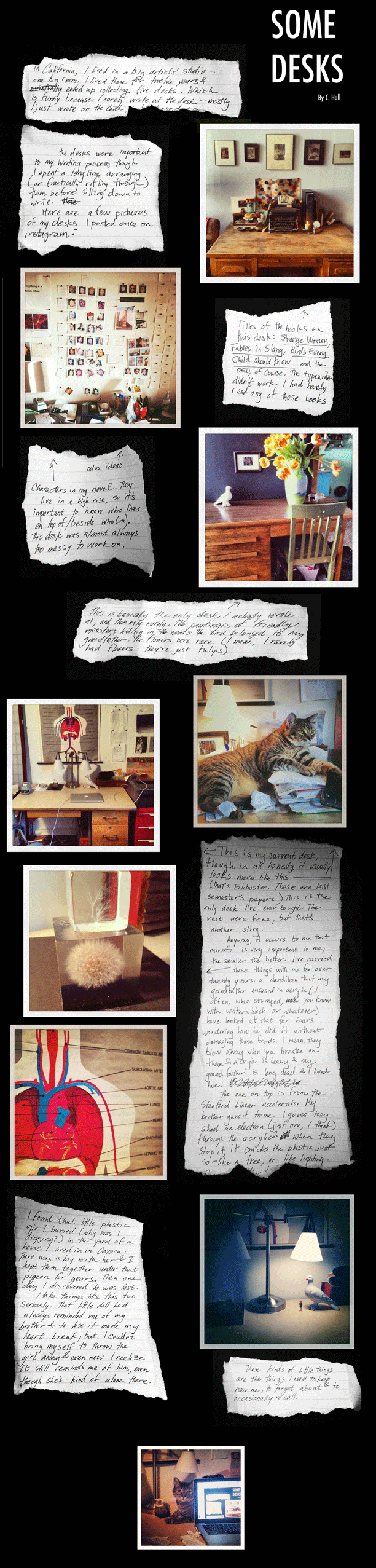
I think I put this in the wrong spot before, so I’m reposting it here.  For reasons I can’t explain, I felt the need to write my response by hand, which then meant I had to make a jpg of it (a large one) that I can’t figure out how to post properly (when I do, it looks like this:) desks2


so here is a link to it:  http://postimg.org/image/odki2ovsv/  It’s about my desks and the things on my desks.

Posted in Uncategorized | 1 Comment

M.’s Writing Materials

I try to keep a small notepad and few working pens with me at all times, but prefer to make use of whatever materials are available at hand when I feel the urge to write. This might include crayons on napkins at a restaurant, collected company-logo pens on miscellaneous ephemera, and so forth. Splurging on nice writing materials gives me great anxiety, as I can never decide what writing projects deserve to be composed on more expensive materials. When I write on found objects or freebies, I feel less wasteful, more flexible. When I spot an irresistibly well-made diary or unique pen I cannot pass up, I might buy it as a gift for someone else. If I purchase it for myself, I end up treating it as art to be admired from afar, and never actually use it for writing. This is also true of books I bind myself. It makes more sense to simply take pictures of these things. This also helps because I lose things. This was a book I was fashioning out of scrap materials from a larger project — but I’ve since lost it entirely.


A camera is an absolutely mandatory material for writing — I switch between a Canon DSLR, a beat-up Sony point-and-shoot, the camera on my Android phone, and my HP’s webcam in moments of desperation. I am not organized enough to keep track of each napkin scrap on which I scribble, so creating digital archives helps ascertain the survival of my notes (not that I keep great track of those, either). I also take reference photos to remind myself of things I want to write about, and better-composed images for reasons unrelated to my faulty memory.

I enjoy writing on different textures, and trying different pens.  Given a choice, I prefer ballpoint fine-tipped pens, and almost always prefer pens to pencils. If a pencil is necessary, a 0.5 size lead mechanical one is requested, with a thin grip and good eraser. I used to make it a point to write small enough that the person sitting next to me in class could not read my notes. This was before my handwriting deteriorated from disuse. Now I write so illegibly I can hardly decipher my own notes. I found these from high school, when I could still sort of read my own handwriting (realistically detailed centaurs, indeed):

I blame this on my computer. Like most people these days, I often type instead of write. I take class notes by habit, but when composing original materials, my laptop is what I need in order to write — a laptop with a good warranty. I gravitate towards PCs, and burned through three computers in my four years of college.

On my laptop, I write with whatever is available. I will occasionally start a project in Microsoft Word, then copy it into Google Drive, and move back and forth (ineffectively, on whim), but I almost always end in Microsoft Word. When I finish an essay, I also enjoy proofreading it in PDF form. When I write, I only allow the word processor to take up half the screen — the other is reserved for a document of notes and scraps cut out of a draft.

The only time I consistently used a desk to write was in senior year of college. The women of Mount Holyoke started lining up on much-anticipated carrel selection day before 7am that Sunday morning. I got in line while it was still short for the sole purpose of signing up for a desk in the library to call my own.

Hard at work on a final in my carrel, with the important materiality of snacks:

If I wrote in my room, I wrote in bed — often surrounded by notebooks.

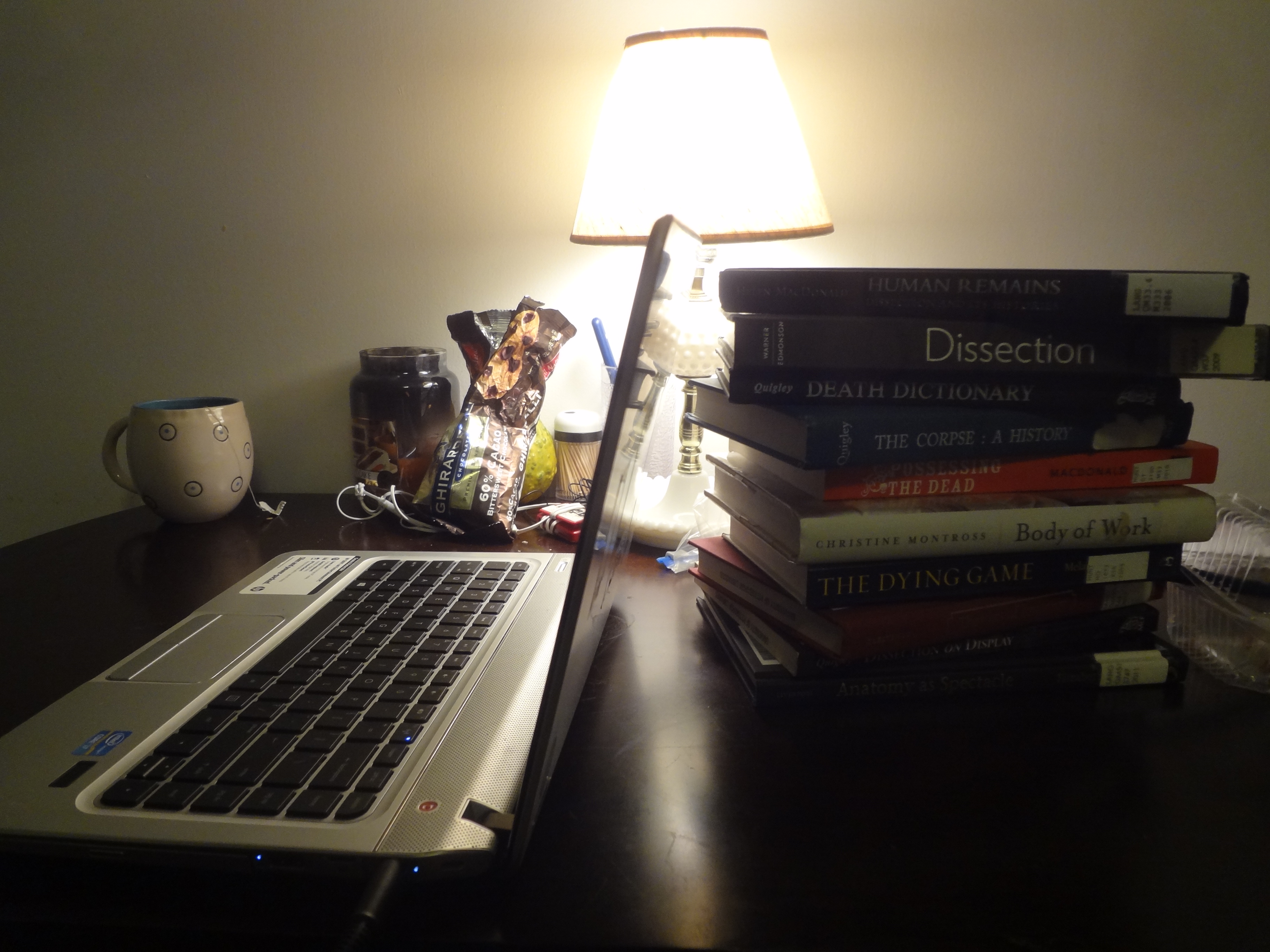
My current workspace resembles this greatly — with different sheets and a new laptop.
After I literally melted my last computer (not realizing the fan broke), I acquired a helpful Targus cooling pad. At home, I also rotate workstations between my roommates’ unmatched couches, my bed, and the tall kitchen table which is the perfect height for a standing desk. It also has the benefit of holding snacks and tea.

DSC00800
Occasionally I try to work in libraries and cafes. I like working in the presence of others.
I have never acquired my own desk, but have been pondering whether it is worth the splurge since September. Eventually, I think I’ll have to.

Posted in Uncategorized | 1 Comment

Material girl

This signment went from a fun thought experiment to a less-fun reality this weekend; my housing situation fell apart and I’m currently couch-surfing. (All should be resolved very soon, so I’m not angling for pity or anything.) I did have to think pretty carefully about what I absolutely needed when I was packing, and a solid 40% of what I brought with me is writing-related. That seems relevant to mention.

So I can tell you with absolute certainty that my desk isn’t actually that essential. My laptop is, though. As is Microsoft Word, with 12-point Georgia set as the default font and 1″ margins. I’m the one who writes on her hands, but there isn’t really an intermediary for me between skin and screen. I’ve got my notebook with me too, but I’ve only used it for notes and fragments; if you flip back far enough, you can see both titles of poems I was considering writing three years ago and my grocery list from last weekend. It’s a mess, frankly, with basically no organizational principle to speak of, and that’s important to me. Clean notebooks are terrifying. The one Moleskine I’ve ever had was dated and everything, and I could not write a word in it without wanting to revise.

(I did use Sharpie pen in that one. I partially retract my stance on Sharpie pens.)

My notebook functions less as a medium for drafting and more like a scrapbook. I like things to be in flux. That’s why I’ve ended up doing my actual writing almost exclusively via computer; the type is movable, and my ideas are too. What I was trying to say when I talked about pens last week wasn’t that I dislike pens but that the idea of having to choose one location (one! singular!) freaks me out.

Hand, pen, paper, laptop – those are all pretty self-explanatory. The actual process of writing has to be pretty specific too, though. There can only be total silence or ambient noise; other people talking distinctly doesn’t work. Ideally, I’d be at my desk, facing a wall, playing music so quietly that I could only make out the bassline, sitting with my legs tucked under me. That last part is very important for some reason; it’s one reason I generally write in my room. When I work in coffee shops or friends’ houses, I like to be near but not close to a TV or radio, maybe across the room from a conversation, just generally listening to something that is recognizable but not identifiable. Like: this is a voice, this is a song, these are places where words could go. And then I write.

Posted in Uncategorized | Comments Off on Material girl

My Materialities of Writing.

Indeed, practical work is often still treated differently from theoretical work in the academy, as if the knowledge of hand and eye, embodied intelligence, and applied skills were somehow not theoretical.  When questions of materiality and ontology bring theoretical and practical issues into dialogue, troubling the abstractions that sustain philosophical discourse, the craft-based knowledge of production is generally disenfranchised, as if the higher order of thought necessarily trumps the lower orders of material engagement.  But practice is neither banal nor reductive, and no more literal and unthinking than metaphysical reflections are purely ethereal—the two domains have much to say to each other.

Johanna Drucker, “Diagrammatic Writing”

[P]hilosophical carpentry is built with philosophy in mind: it may serve myriad other productive and aesthetic purposes, breaking with its origins and entering into disseminations like anything else, but it’s first constructed as a theory, or an experiment, or a question—one that can be operated.

Ian Bogost, Alien Phenomenology

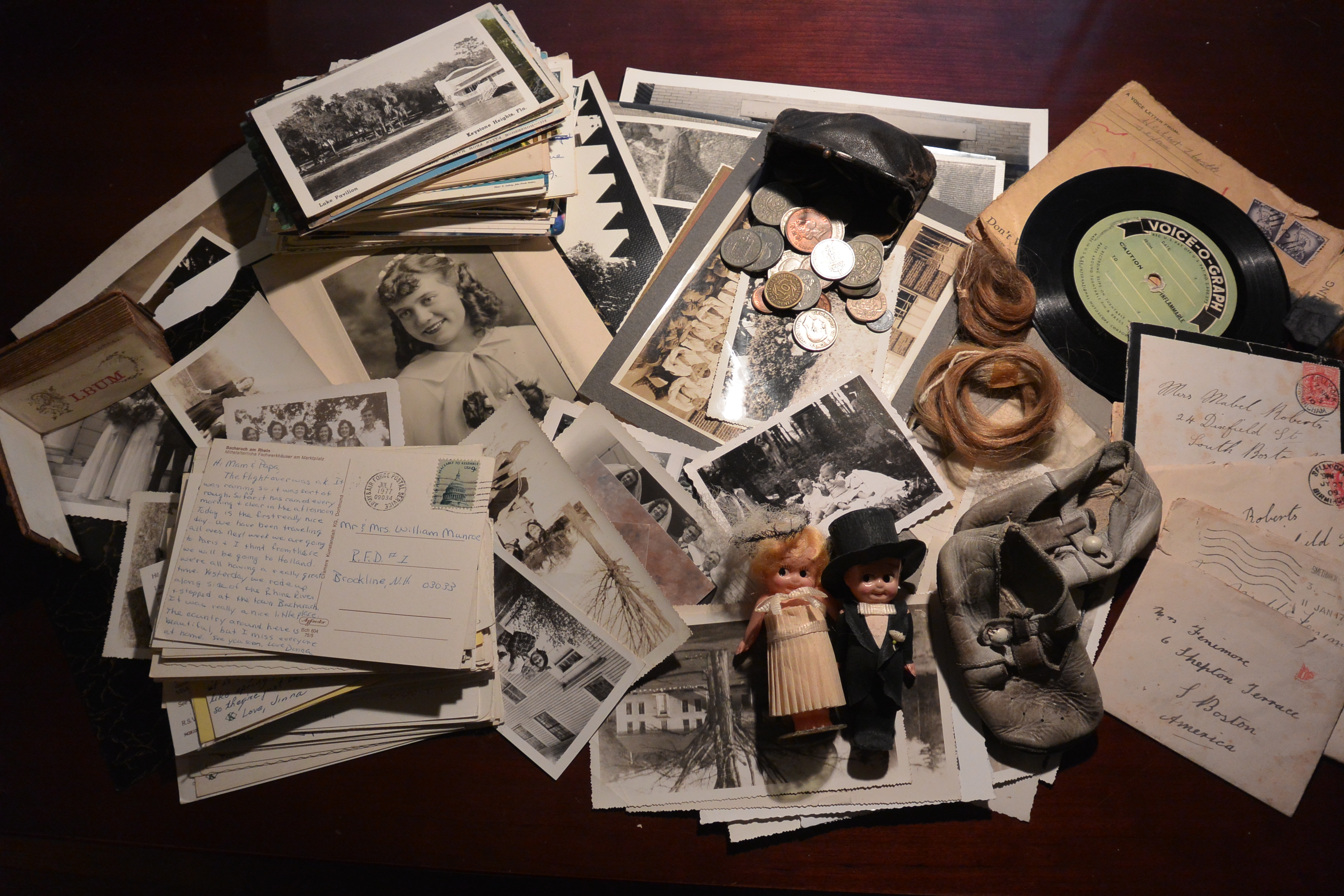
As I was making my way through the readings, thinking about what I would prepare for this post, I found myself reading over and again this sentence from Bogost: “The carpenter, by contrast, must contend with the material resistance of form, making the object itself become the philosophy” (93).  As so often happens with me, this sentence has come to feel only tangentially related to the way I’m thinking about my work, but at the time, Bogost’s mention of the material resistance of form—of, more, the work of having to contend with the material resistances of form—seemed to speak directly to the artifacts of memory work with which I’ve been spending so much of my time.  Now, I’m probably thinking about resistance in a different way than Bogost, given my lack of fluency in new materialism and OOO, but his sentence reminded me of this: Material memory forms are highly resistant, with their traces of care and travel, their referential absences of bodies, narrative, context.  And even more resistant are the handmade, spontaneously curated, sporadically neglected citizen archives among which they’re often found.  I’ve one sitting in my room right now (two, actually, if you count the small cashier’s box full of my paternal great-grandmother’s “effects,” which I do).  Gappy, fragmented, a material cacophony full of silences and dead-ended narratives.

In discussing my materialities of writing, then, I wanted to offer a series of stages, spaces, or practices, by which I engage with this project of memory, archives, and personal collections and grapple with its material resistances (and the material resistances, too, of my various practices/staging grounds, though I won’t say much about that here).  Without further ado, this is a bite-sized selection of the materialities which urge me to write in the first place:
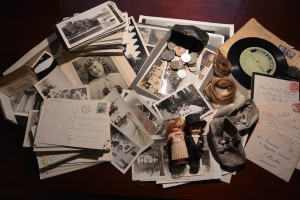
DSC_0125

(Clarification: for those of you that haven’t heard me talk about this a million times, these things come from a trunk that has been passed down through six generations of women on my mother’s side of the family, and which now lives in my office.)

I’ve spent a long time simply handling and mindfully being with the various things in this trunk, minding the affective draws to various objects, arranging objects into different constellations of meaning or likeness, and using the trunk objects as prompts in conversations with my grandmother about our family history.  At some point, though, I began to move “outside” of the trunk; I needed to find another way into the lives of the women evidenced in those objects.  I needed to make things.  The women in my family were incredibly skilled at all sorts of handiwork; they were working class women who made things by hand because to do so saved them money, allowed them to reuse domestic discards, and brought about social occasions for making in the company of other women.  So, I wanted to start doing some of the work that they had done; I wanted to compose like they had.

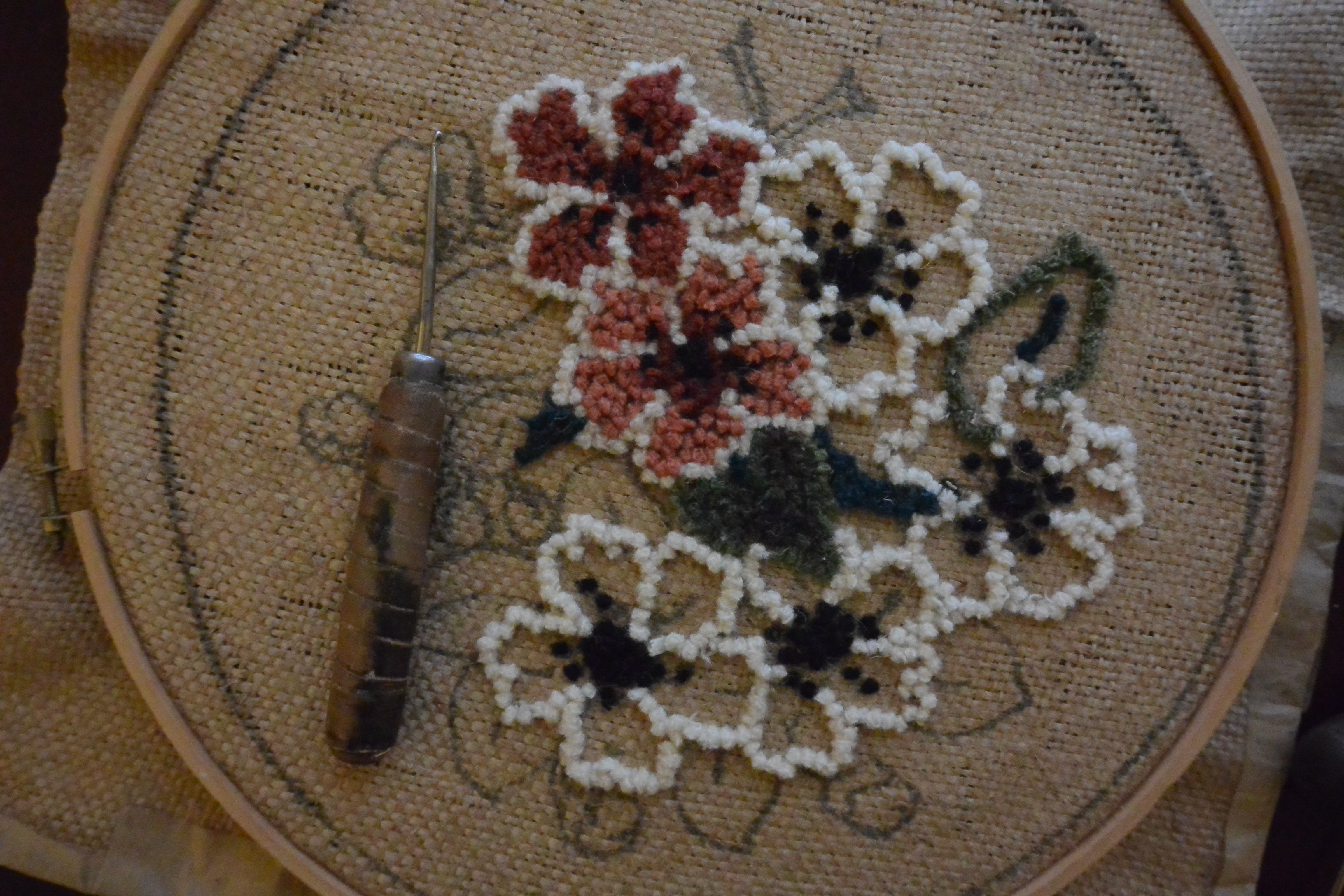
Right now, with a book that was given to my great-great-grandmother for Christmas in 1951, I’m learning how to hook wool:
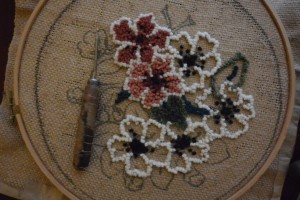
DSC_0137

This, I think, will be some sort of face for a small pillow.  Both my great- and great-great-grandmothers made extraordinary hooked rugs, and my mother received several of their rugs, as well as their hooking tools and salvaged wools, after my great-grandmother died.  I found the burlap, with design drawn upon it, among these things.  I’m using hooks stained and bent by their hands, their wools.

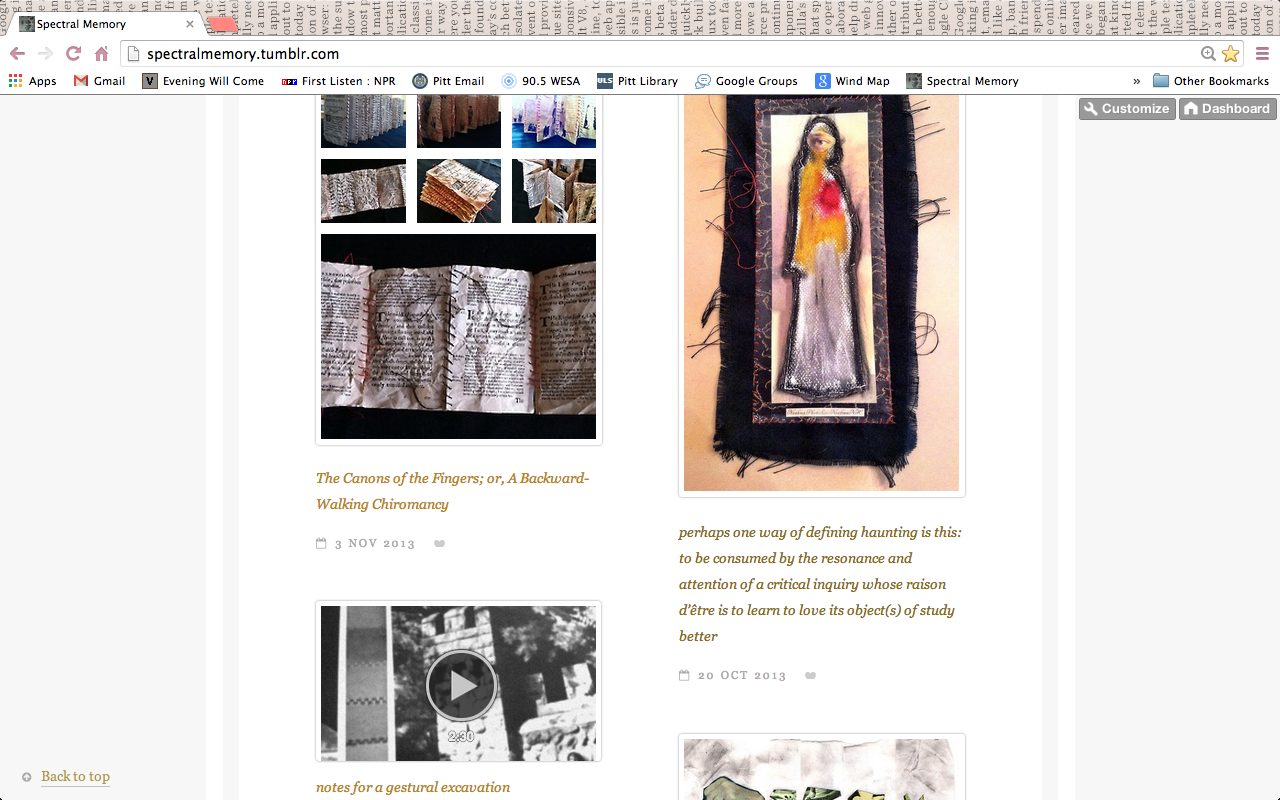
A third stage / staging ground for my materialities of writing is my tumblr, Spectral Memory.  It’s a rather private space in that I’ve done little to disseminate it; someday, maybe I will, but regardless, its main purpose is to be a digital invention space, a place where I can see multiple objects, texts, and ideas at once, in color, and in relation:
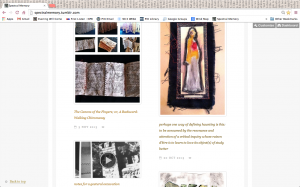
Screen Shot 2014-01-13 at 4.40.13 PM

I write little here, but I love doing this writing so much; the tumblr is essentially one big drafting / collage project, a place in which to arrange things, to post drafts for future videos and other compositions, even as I’m learning their technologies.

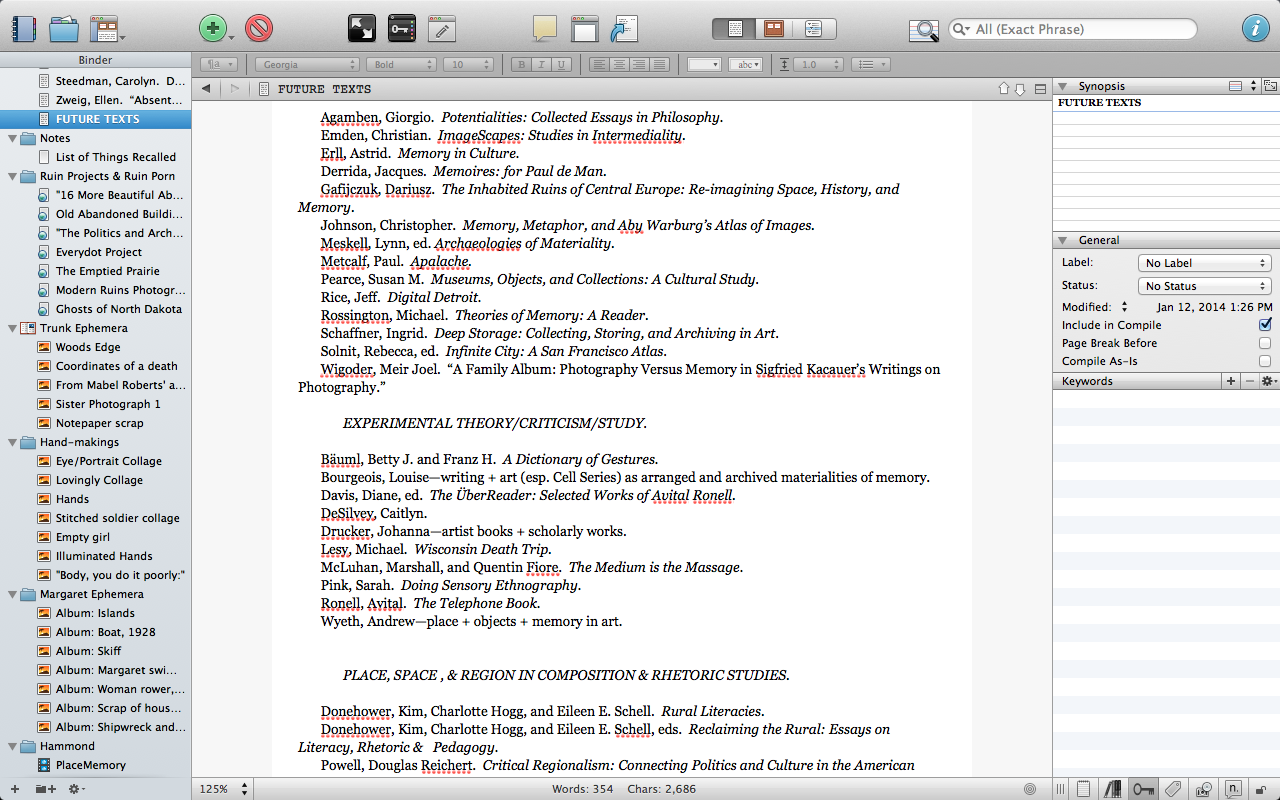
Finally, there’s Scrivener:
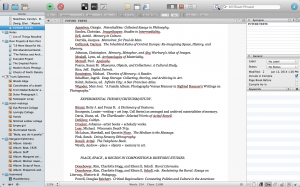
Screen Shot 2014-01-13 at 4.44.13 PM

Originally, this entire post was going to be all about Scrivener, but then I decided to let things get much bigger than they probably needed to be, as I do.  If burlap, wool, and rug hook allow me to move toward writing by way of labor and reverie, and if Spectral Memory is a space for invention and digital poetic arrangements, then Scrivener is the site where those composing practices meet the composing practices that more recognizably constitute my project work and beyond: book lists, working bibliographies, excerpts, webpages, catalogues of my handmade things, and photographic inventories of places and archives get to mingle with and reference each other by way of keywords, while also remaining desirably organized.  Here, nothing need be left out.  Things are allowed to speak to each other at their own pace.  There’s room for collecting, for planning future work.  It’s a lovely, controlled chaos.
Posted in Uncategorized | Comments Off on My Materialities of Writing.

Materialish.

I am a peripatetic. I have to move. To take the bus is lovely, but ultimately unrewarding in a world where my transport is built onto my torso in the form of usable legs.

Wait. I thought this post was about the materials of your writing? 

It is. Be patient. *Ahem* So, walking. Yes. I walk. A lot. And during walking, I “figure stuff out.” I don’t write; my aim isn’t to compose, or arrange, or organize. No. My main goal is to let my brain do what my whole body is doing: be a flaneur. Roam. Etc.

Walking is important to my creative being. For some reason, walking allows me to think differently, to absorb the world into my obsessions, and for me to react back into the world, letting my obsessions and interests permeate it. At the end of all this walking, more often than not, I have a more tightly wound piece of jute to weave. If I can’t write/think past a particularly fraying bit of a story, paper, whatever, I’ll go out and amble. If nothing else, I get my exercise in.

Walking wears out materials. Especially jeans and shoes. Perspicacious fellows will notice embarrassing holes in the upper interior thigh areas of my pants. Lots of thigh friction in my thought-building. [Thus, I bought new jeans today. Yay.] And feet need love just as thighs/legs do, so it’s important to have good shoes. I recently got a new pair of walking shoes after 8 years. And this was only because my wife politely asked if I could retire them. And because they started to emit a fetid stench so subterranean that even certain soft cheeses asked me to leave off. These shoes, they were–quite plainly–deliquescing.

And so the bedrock of my whole procedure as a writer starts with basic clothing, really. Shod feet, durable denim. We could be ridiculous and say that all of this is material in the sense that food sustains our bodies, and thus we write. But I start from where it seems most applicable.


Posted in Uncategorized | 3 Comments

Materials

First of all, I’m not exactly sure where I’m supposed to put any/ everything on this page. Is this the place for the response to Weds class? Also, this is Carrie.

Second of all, I’m sorry I’m late to this party. My sixteen year old cat is dying. I’m distraught and more absent-minded than usual.

But anyhow, I have been thinking about what writing is/ isn’t kind of a lot these days, and wondering, too, if it matters. Of course, once you get down to it, everything is impossible to define, words are approximations and sometimes bad ones and my definition of writing and yours are probably not the same. That said, it can be helpful to have a working definition, so I’ve been wondering– what am *I* doing when *I* write? I feel like I need to define that before I get started with defining the big capital “W” writing as a whole. What is writing, the verb, to me? (The noun strikes me as even harder to define– an artifact after the fact– perhaps proof that writing has been done, but there’s so much we don’t know about the space between act and object.)

Anyway, I realized that the one thing I need need to write is my hands. I suppose that if I lost both of them, I might find some way to write anyway, but as it stands, I can’t write on voice recognition or google glasses. So I suppose the point I’m trying to make is that, for me, writing is tactile. For me, writing is making words, or the mark of words with my hands. There’s more to it, I suppose, like “making sense” or stringing together ideas, but I don’t know, if I type the word “potato” for no reason, I’m still writing, I think. Of course, we can problematize this (as we can problematize anything) further by asking “what are words?” But this mark-making definition gives me great pleasure, because I like making THINGS. I studied sculpture. I like to build. I like to have something to hold. I want, more than anything, for writing to be physical, which might be why I got that standing desk. I like books as objects as much as I like books as thoughts, maybe more. I like to hold things and to touch things and so I like stories as records of physical activity– the object arising from the act.

What’s my question? I don’t know. I suppose my question is why we need to define writing, knowing full well that we never will? The question isn’t meant to be petulant– I like this kind of conversation as much as anyone, but I wonder at our need to at once narrow down a definition and destroy that definition with the same hand. There actually might be something here about writing as a simultaneous act of building and destroying, but I don’t know.

Posted in Uncategorized | Comments Off on Materials

Thoughts on changing definitions, and words and design

After our conversation in class, I found myself thinking about two main things.  First, the evolution of the definition of writing.  In my definition of writing, I wouldn’t call Homer reciting the Odyssey writing.  It is crafting, and storytelling, but not writing.  For me, it would not be writing until it was physically marked down.  So for me, words put down via the Google glasses is more “writing” than Homer reciting the Odyssey.  When I think of my own writing, I do sometimes put together sentences in my head (as someone else in class was talking about), switching around words and sentence order while say I’m switching my laundry to the dryer.  This sort of crafting I am more inclined to say is a part of the writing process than writing on its own, because it is a first step before I run upstairs and jot down the sentences that I just crafted.  But at the time that Homer was alive, I am willing to consider his reciting his work as the writing of its time.  “What was writing before writing?”  But maybe it doesn’t even have to be the writing of its time.  I’m struggling on how to phrase my question, but basically, did there have to be a “writing” before writing?

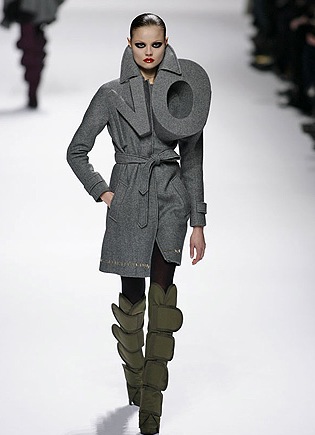
So my second batch of thoughts were a continuation of the On Such A Full Sea with the 3-D printer cover.  I was in the “no it isn’t writing” camp on that one.  Some people were arguing “but there are letters, there are words.”  It made me think of this Viktor & Rolf fashion show (their fall 2008 show fyi).  Again, I do not consider the big “no”s here writing, and it is recognizably a full word, recognizably letters.  Just because something has words, does not make it for me writing.  I keep shifting through my definition of writing, now partially: words on a surface communicating a certain thing.  So, the Full Sea altered words, while still letters and parts of words, isn’t really about communicating but altering for an aesthetic look.  Although the Viktor & Rolf, while definitely an aesthetic look, is also attempting to communicate something with the “No”s and the “Dream on”s.  I feel more inclined to think of the makeup for that show as writing.  I am not sure why just yet.  As I was driving home after class, of course I was looking at license plates and the B, M, and W over the circle thinking “Is this writing??”

–Amanda

Posted in Uncategorized | 2 Comments

A praxis/theory split.

No, the title of this post isn’t a philosophical dessert. Rather, it is a long-standing debate in philosophical and educational circles. Briefly: that praxis-action is different from theoria-thinking. That’s crudely reductive, but there we have it.

So here’s my observation. Flusser (with no to-do!) states on pg. 15 that

To think is a praxis which changes the words to fit problems [the world we live in], and the problems to fit words, and the distinction between “objective” and “subjective” thinking is one of degree, not of essence.

I anticipated that more people would pluck this out as interesting/provocative. Especially because one issue we discussed in class was whether thinking was writing. I don’t know where we came down on that issue, but it seems that there are significant arguments on either side. To help me get thru this, I consider the title of our class, “Materialities of Writing,” not “Writing is Materiality” or something like that. The title, it seems, implies that there are non-material aspects to writing. I should like to know both sides of this dichotomy. I guess with reference to above, I tend to think of theory as ineffable and praxis as material, but if Flusser claims that thinking is praxis–and my definition stands–then where are we? Does it matter?

From this, I have a two-pronged question:

(1) How vital is it to this seminar, going forward, to clarify our many meanings of “writing” or “composition” or “thinking”? Will we quickly sink into a semantic quagmire? Would the class be willing to define terms and/or create new ones to help us delineate the multiplicity of meanings?

(2) What in the world is “objective thinking”? This greatly baffles me and seems on the edge of not making sense. Any takers?

One stab: Could “objective thinking” be what computers do? Is anyone else willing to jump into that skiff with me?

KW

Posted in Uncategorized | 13 Comments

Blog posts for Jan 8 & 15

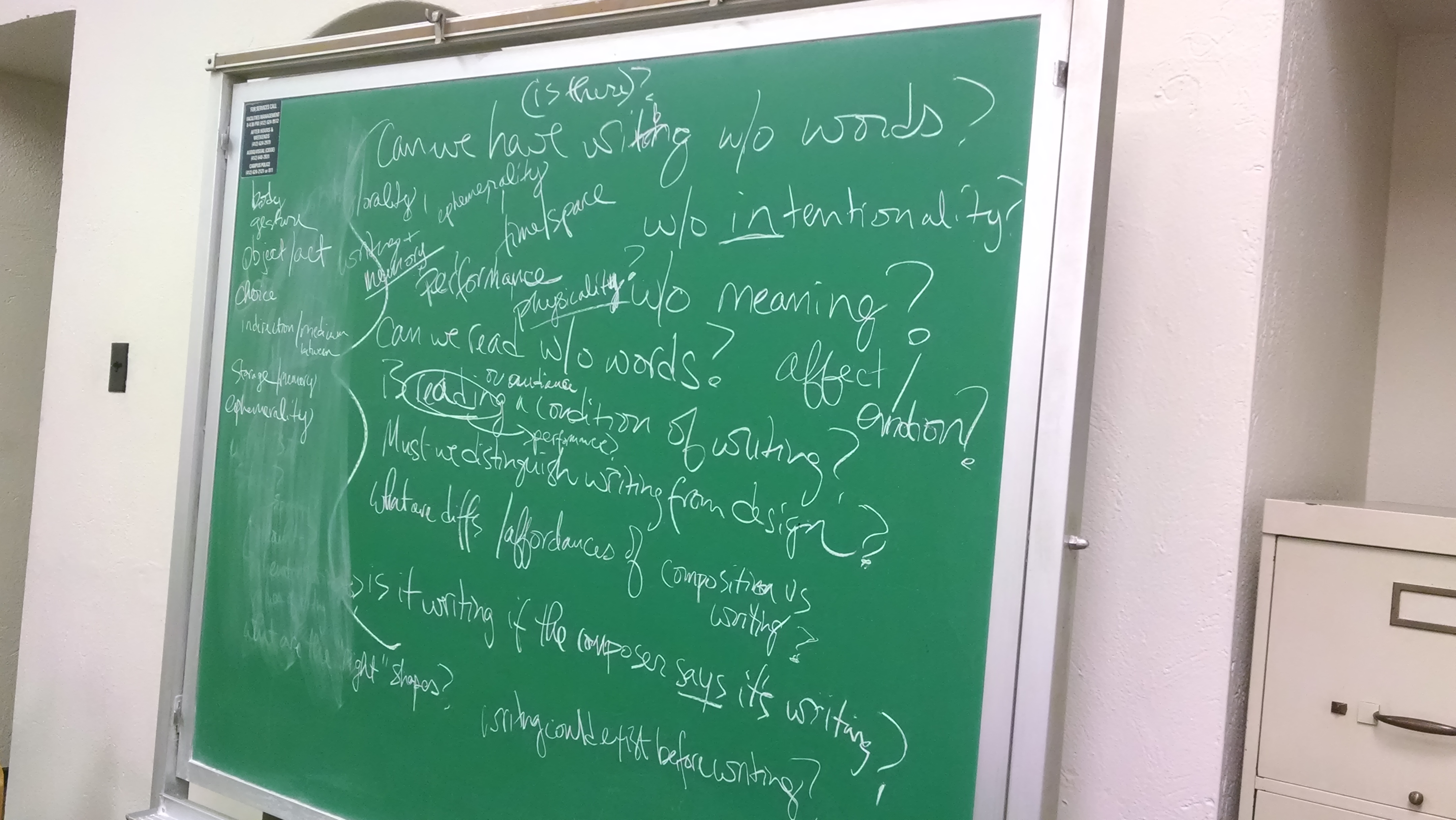
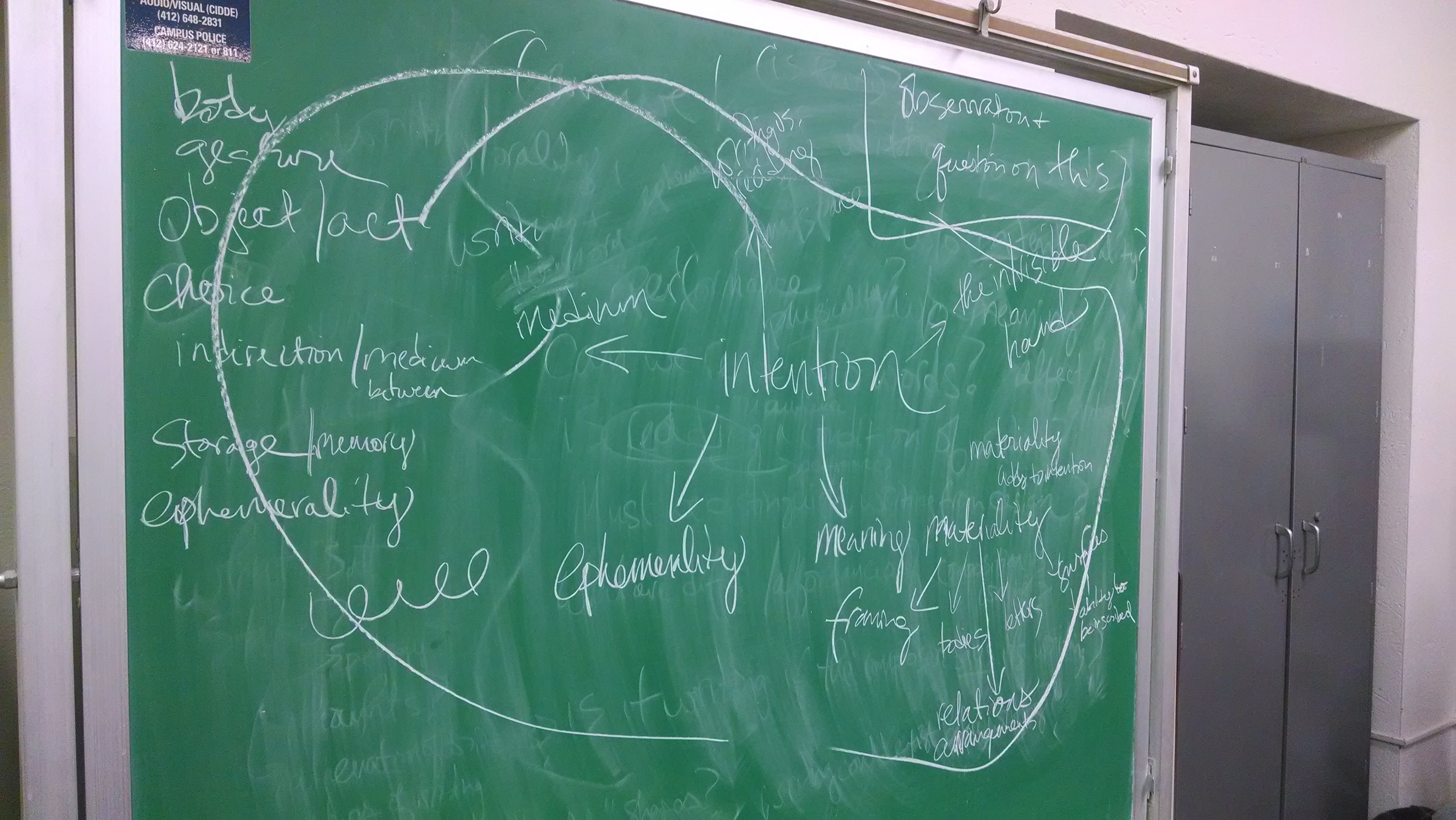
As a follow-up to class today, I’d like you to post an observation and a question about this….Jan8_Chalkboard_430pmJan8_Chalkboard_450pm

You can start a new post; alternatively, you can comment on another person’s post with your observation and question, if you see connections between your ideas and theirs. Please do this in the next few days (by this weekend, if possible).

And when you’ve completed a critical mass of the readings, then post about your materialities of writing. You may find this a helpful model, although I’m not expecting something so detailed. Please write this post by midnight on Tues, before class.

Lovely to see/meet you all today! I’m looking forward to a great class.

Posted in Uncategorized | Comments Off on Blog posts for Jan 8 & 15

Welcome!

Whether or not you’re a member of the class, welcome to the site! You can check out the syllabus for the course. Many readings are available online and are linked. Scans of books are password-protected to respect copyright.

Email me (Annette Vee) with questions or comments. You can find my website and contact info on my website.

If you’re a member of the class, hurray! You’ll use this site to blog weekly, and to share resources and links. If you’d like to tweet links, use the hashtag #writingmaterials and your tweet will show up in the widget on the right.

Happy writing!

Posted in Uncategorized | Comments Off on Welcome!