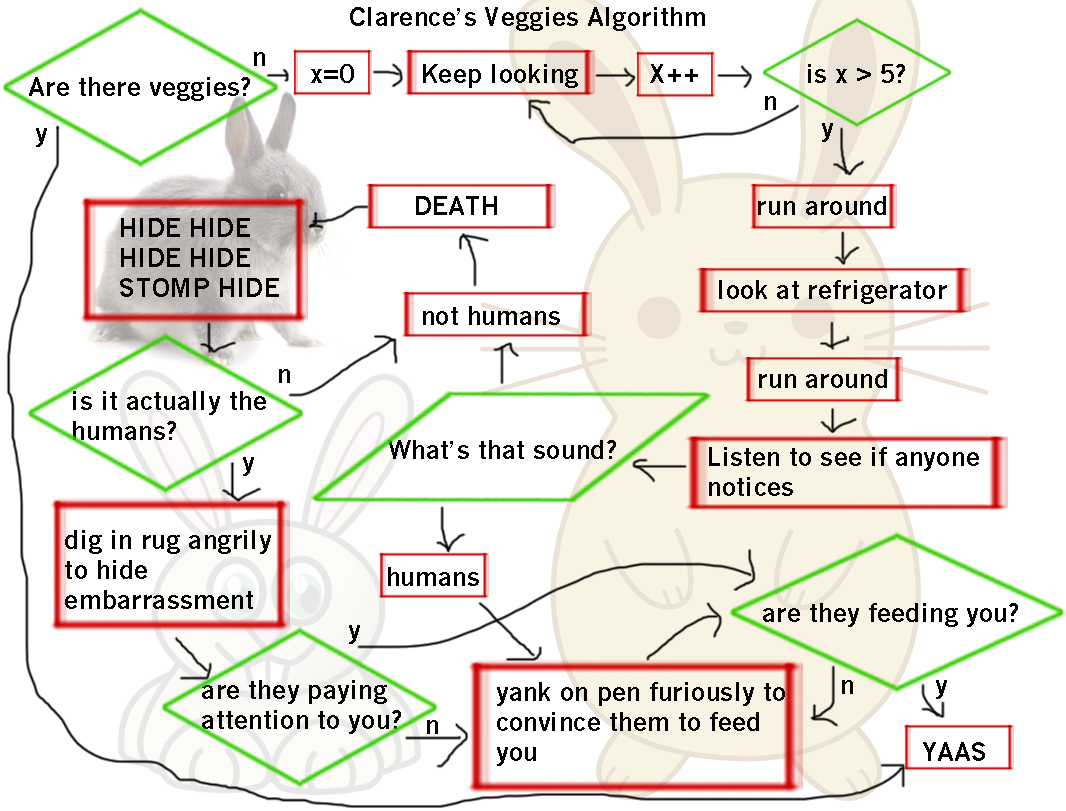
My algorithm

I like don’t even get Twitter so I couldn’t really wrap my head around a bot and also I don’t have a spreadsheet program and it all seemed quite challenging so I just made a thing.

I wanted to provide a flowchart for myself about writing an Asian American poem but it didn’t work out. There were far too many variables that I couldn’t include, and the thing got too expansive and unwieldy. So I am saving that for later.

Instead, I’ve made a Clarence algorithm. If you were to input this behavior into a rabbit robot, you’ll get a Clarence bot! ¡¡¡¡¡Yaaaasz1!!!

algorithm

With some fabulous clip art as well.

As you can tell, I’m actually a photoshop master.

In case you’re wondering, here are some of the terminal points of the Asian American poem:

Write about how something cannot go/return/leave something else
Write about something that is only the appearance of something else
Write about something that someone lost

Yes, I know I write about my bunny a lot.

Posted in Uncategorized | 2 Comments

“More human than human” is our motto.

I made a Roy Batty Twitterbot @RoyBatty_1982 using the Zach Whalen instructions. (And thus whatever algorithms allow “Twitter Apps” to generate and post my tweets automatically; I have not yet decided whether my “vocabulary” and syntactical ingredients counts as parts of this algorithm. Certainly, writing relies on a set of units or ingredients that can be combined in different ways. However, I think Hayles would say that my understanding of the system of English language signs is not really what is making things work here. What I’m inputting is not what I understand myself to be inputting, if you asked my computer.)

Leaving that confused theoretical jumble behind until further notice, I’ll explain why I chose to make a Roy Batty bot. I’ve been pretty obsessed with the “Tears in Rain” soliloquy for a while now. Anytime someone brings up AI, I try to figure out a way to work this scene from Blade Runner into the conversation. (I’m not sure this is always appreciated.) Here is the film clip:

https://www.youtube.com/watch?v=a_saUN4j7Gw

And here is some information about how this scene was made. (The actor who plays Roy Batty, the replicant and/or robot, revised the soliloquy from the script during his performance. His changes give the speech its existential weight.)

 http://en.wikipedia.org/wiki/Tears_in_rain_soliloquy

This scene just seems so moving and provocative to me. The dove should cheese me out, but I even like that detail. Earlier in the film, we see Roy quoting and revising William Blake. I read this as Roy attempting to explain who he understands himself to be (and to explain his actions) to humans based on the human resources available to him. Within the film, this also amounts to claiming the validity of his existence and experiences and his humanitarian rights. In this final scene, he chooses not to kill the officer charged with finding and executing him. Instead, he shares some of his experiences with Harrison Ford’s character (Deckard) as his programmed life expires. I find this scene so interesting because his experiences are decidedly extra-human in so many ways. Yet, through his presentation of these ideas, he seems to be claiming that said experiences have had a profoundly human, i.e. existential, effect on him. The dove, as well as the nail in his hand, and the strange and religious Blake quotes, act as symbols by which he participates in or communicates this type of thinking. All of this is profoundly transformative for Deckard’s character despite (or perhaps because of) many of the ambiguities or questions the scene leaves us with. Is Roy thinking, writing, communicating like a computer here? Does thinking or writing like a computer mean not thinking, writing, communicating like a human? How can we begin to look for the answers to such questions? How does our interaction and involvement with AI form the basis by which we attempt to answer such questions?

I was trying to think about what makes Roy’s speech so jarring and “unrobot-like.” He frames his experiences as if he is “witnessing.” Thus, he presents his embodied experiences as evidence of something. His use of a simile following this act of witnessing also indicates that he has selected or “written” an appropriate metaphor for describing the existential experience of life and death, and all the affect that goes along with this condition.

So, I decided to have my bot relate an extra-human experience of witnessing, as well as a simile to describe the existential weight of that experience. The language is way off and less affective/effective than that of the character Roy because I was making an actual and rudimentary Twitterbot rather than an imaginary and biologically perfected “superbot.” (“More human than human.”) There is more humor in Roy the twitter bot due to the fact that things are “off.” I kinda enjoy it.

Thinking back to Bogost: What does it mean to try to think like a computer? (Or Robot?) How do we go about answering this from a human perspective? Does Blade Runner make the distinctions between human and computer start to blur (i.e. Hayles and technogenesis)?

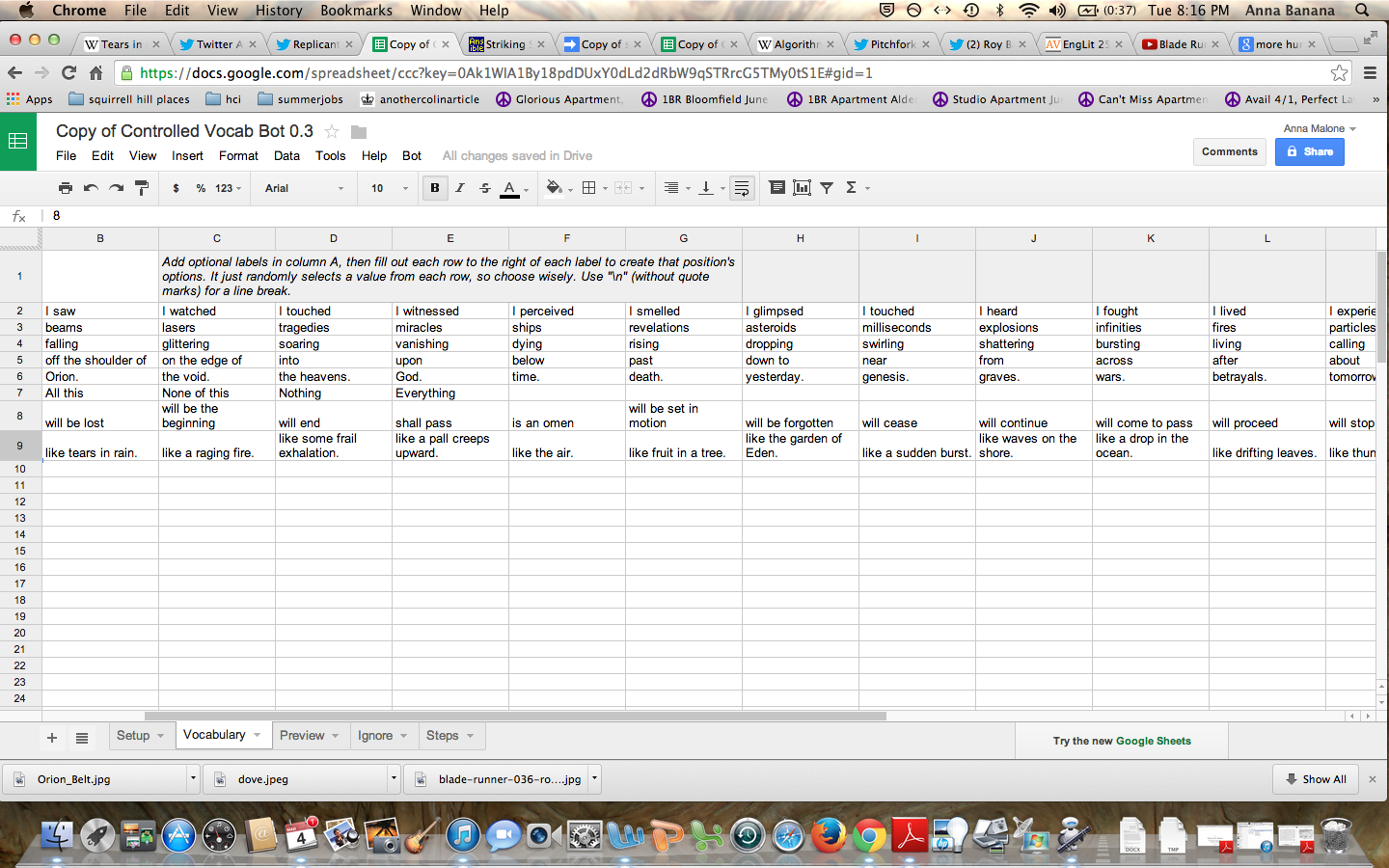
Oh! And here is my spreadsheet:

Screen Shot 2014-03-04 at 8.16.09 PM

Posted in Uncategorized | 2 Comments

Algorithm-generated harmony

A composer friend recently wrote a piece of choral music using a procedure that resulted in a procedure for the choir to follow. This list of directions was the “score,” and the result of following the directions was the piece.

The gist of it was this: the first singer in a row sings one note, holding it as long as they can comfortably on one breath. As soon as the next singer hears the note, they sing another note of their own choosing, which must be different from the one before. The third singer hears the second note and chooses any note to sing that’s not the one that came before. So forth and so on until the end of the row. The first singer fades out first, then the next, then one by one, until one is left behind.

So the only rule is don’t sing the note that came before you. I decided to try this out on GarageBand. I hummed one note, made a new track, hummed another. Then I muted the first track, made a third, and added a new note. Muted the second, added a forth, added a new layer. I did this seven times, as if there were seven singers. The result is here:

algorithm harmony

Can you hear all seven entrances? Can you hear all seven exits?

The idea of the piece, I think, is to highlight the shape of one breath. My recreation of it is contrived, of course– in a real choral setting, I’d be able to hear everyone. In an audible system of notes, it’s hard not to sing notes that are in certain traditional relationship to each other, open fifths, comfy thirds, the V-7’s ingrained into our musical consciousnesses. The first few times I tried this, I compulsively sang notes with these common practice relationships. For each note to be in a “random” relationship to the one preceding it would take the I-ching-derived chance of Cage or, well, a computer. Perhaps what this experiment most clearly shows is what a computer-run algorithm could do that I couldn’t– that most choirs couldn’t. I am reminded of a line in Wardrip-Fruin recalling the genesis of computer science as “the investigation of what can and can’t be computed.” Musical tradition seems to run its own computations.


Posted in Uncategorized | Comments Off on Algorithm-generated harmony

I dunno, it’s pretty obscure.

I’ve been rereading Questionable Content lately (don’t judge). If you’re not familiar with it, it’s a webcomic set in Northampton, Massachusetts, chronicling the lives of a bunch of twenty-somethings who have complicated dating lives and way too many opinions about music. When I was a high schooler in 2005 with way too many opinions about music, it was basically catnip.

One of the early strips makes the joking assertion that a band’s quality is inversely proportional to the number of people who’ve heard of them. It logically follows, says a character, that a band no one has ever heard of must be the greatest band there ever was. You can probably see where this is going.

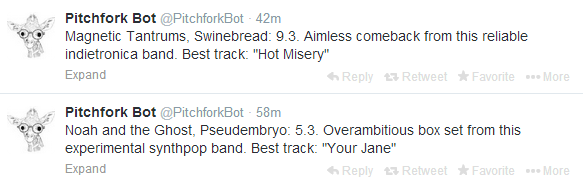
For this week’s signment, I created an ode to the hipster mecca that is Pitchfork Media, which is a little too easy to mimic. As a literal site of authority about a particular scene, it has its own vocabulary and grammar. And so I present to you @PitchforkBot, which automatically produces album reviews for imaginary bands every two hours.

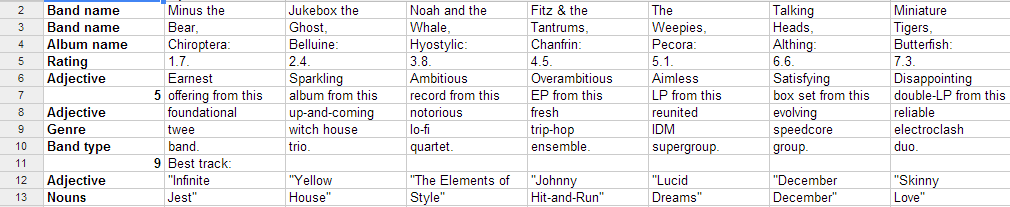
The syntax is pretty straightforward. It’s (band name), (album name): (score). (Critical statement) from this (adjective) (genre) (synonym for band). Best track: “(Track)”

To fill in the blanks, I ended up making a spreadsheet that looks like this.

twitter bot spreadsheet


As you can see, the band names are actually combinations of existing band names, both within and without the ~hipster~ category. The inclusion of Das Racist is probably going to wreak some interesting havoc. (“Noah & the Racist,” anyone?) The album names were randomly generated from, well, a random word generator; the ratings are random; the genres were pulled from Wikipedia and the adjectives from Pitchfork itself. And the songs, of course, are mostly real songs, though there are a few books in there too, and a phrase or two that I made up. It looks just random enough to maybe actually be real – those youths and their loud music.

twitter botI made the Pitchfork bot in part because I have a lot of nostalgia for the time in my life when genre distinctions were the most important thing in the world, and partly because I think that the vocabulary of a self-defined subgroup is really interesting. There’s a way to write about bands, a way to name those bands, a way to authenticate your appreciation of those bands. It’s scripted. So I scripted it.

I’m always looking for more words, so shoot me a few if you like. Especially if they aren’t, like, TOTALLY played-out right now, man.


Posted in Uncategorized | 3 Comments

Casual Observer Bot

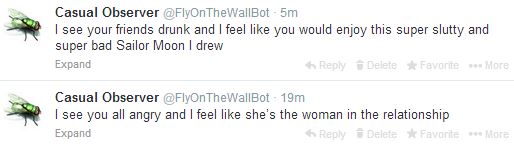
I, like others, made use of the easy TwitterBot generator Zach Walen’s instructions, but it took me an exceptionally long time to decide on a subject that seemed pertinent. I knew I wanted to create something that would be revealing about our everyday human experiences, even while the algorithms would be outputting “predetermined” language. I was thinking about the ways in which digital environments allow us to eavesdrop on random human beings’ emotional states — and how uncomfortable I feel about this. I thought perhaps I could recreate that sensation through a Bot — so I created  “Casual Observer” or Tweets from the Fly on Your Wall (@FlyOnTheWallBot). Each tweet begins with “I see you,” or “I see your friends,” and is populated with language drawn from Twitter when I searched those phrases. Each tweet ends with “and I feel,” populated with language drawn from Twitter when I searched “I feel.” Here are the first two tweets:

BotCapture2
The first two tweets my Bot popped out…

I’m still populating phrases into the spreadsheet, but just in the construction of the thing I’ve been continually startled by how much individuals are willing to disclose to this public space that is Twitter. Unsurprisingly, they are also funny, culled from song lyrics, mysteriously suggestive (sub-tweets, sub-sub-tweets that are all-the-while public but insular), though so far the output has been… pretty sad. I’m not sure I have anything profound to say about this yet… just that I’m just as curious to see what pops out as I hope you are.

Posted in Uncategorized | 5 Comments

fashion words and thoughts

I wanted to do a Fashion Bot.  There were some technical errors that prevented me from getting very far into that.  So I went in a different direction.

It’s fashion month right now, where the big four cities–New York, London, Milan, and Paris–are hosting designer fall collections.  Style.com (and many other sites) reviews the shows.  They have a handful of writers, and I chose four collections reviewed by writer Nicole Phelps (for a fixed variable).  My goal was to create an algorithm to make my own little fashion show review.  I went through each of her reviews (the shows were: Givenchy, Stella McCartney, Acne Studio, and Kenzo.  I took out proper nouns such as brand or designer names).  I didn’t take every single word or sentence.  I had ten categories: Technical, Description, Positive, Negative, Influence/Trend, Model, Item, Place, Designer Quote, Connectors.  I made a word document, printed it out then cut the phrases out and put them in little piles according to category, face down.  I closed my eyes to pick.

My ordering was: Place + model + connector + description + item + connector + influence/trend

+ designer quote

+ negative + positive + description + item + technical + connector + description + item + influence/trend

+ positive

One of the most interesting bits was the negative and positive categories.  In one review, Phelps wrote “his avant-garde tendencies have held the spotlight in the past”, where the tone was negative I decided.  Although that phrase about another designer, or even a different collection by this same designer, could be in a positive tone.  In the first trial that phrase came up, and it has a somewhat neutral tone.  “When things took a turn for the surreal” also was a negative phrase in its original context, but in the third trial when that was picked, it took on a positive tone.

At first I was frustrated that my twitter bot didn’t work, but I’m pleased that the way I went allowed me to create something that was length-wise more similar to an actual fashion write-up.

1

The intimate setting the models glided around the Palais Garnier utterly unencumbered were borrowed from so crazy large pom-pom hats as would become clear a Twin Peaks flavor

he’d spent the summer learning to surf with his young children at his new beach house in Stockholm and on a trip to L.A.

his avant-garde tendencies have held the spotlight in the past they’d be an absolute kick to wear long, slouchy classic workwear shapes embroidered with thin strips of bronze and silver metal especially with the collection’s mood was slightly darker than what we’ve come to expect the silhouettes of the clothes Inspired by the movement of water

those easy-on-the-feet shoes

2

the large sculpture of a head in front of the camera pit the models looked quite fetching reinforcing her points about a glimpse of a bra underneath those clunky oxfords  It’s official earthy

This time it was about celebrating elegance and bon ton

When the clothes on their runway and the clothes in their stores looked as though they’d gone their separate ways, today’s show was much bolder Draped the body like beach towels rubber-soled flatform oxfords mountaineering rope formed squiggly embroidery and yet undulating screen prints on board shorts fall’s developing story about optic patterns

they’re all but guaranteed to be a massive hit

3

when you saw the runway they breezed past you down the carpeted catwalk it’s official the shirt collars that morphed into peplums classic workwear shapes reinforcing her points about fall’s developing story about optic patterns

We wanted to give our customer the ease and energy and movement we feel she wants from us

When things took a turn for the surreal he and his design team took bigger risks and reaped bigger rewards.  a graphic acid-yellow and black pattern tiny cocktail dress the shibori technique there was a moment so magnified it was essentially abstract anoraks a Twin Peaks flavor

they’re all but guaranteed to be a massive hit

4

(I added more instructions to this fourth one, for fun, so that the third paragraph becomes: + negative + positive + description + item + technical + connector + description + item + influence/trend+ item + technical + description + item + connector + influence/trend)

when you saw the runway they breezed past you down the carpeted catwalk were borrowed from psychedelic swirls paired with the evening pieces it was just as convincing as inspired by the movement of water

We wanted to give our customer the ease and energy and movement we feel she wants from us

his avant-garde tendencies have held the spotlight in the past a collection that connected on many levels long, slouchy the silhouettes of the clothes densely beaded sleeveless bodices there was also a glimpse of a bra underneath the pockets borrowed from the worlds of sport and loungewear the trio of dresses combined simple pleated black skirts pretty is laced with Jamie Bochert’s gown including he still has his eye on the street

They’d be an absolute kick to wear
Posted in Uncategorized | 1 Comment

On Bots & Doing.

I haven’t implemented a writing algorithm or made a bot yet. In the time when I would’ve normally been thinking about and working on this, I’ve had to respond to a landslide of inquiries about a North Country public memory project that I wasn’t looking to start until May—anyway, a (serendipitous?) misunderstanding between an enthusiastic reporter friend-of-a-friend and bam, it’s taken off, and I’m trying to figure out how to keep its development on track while keeping up with coursework.  But I hope I can still offer something to this conversation—and I’m having so much fun checking out everyone’s Frankensteins.

I’m somewhat in league with Carrie re: the usefulness / interestingness of bots.  There’s a novelty embedded in the syntactical and grammatical strangeness that grows old fast. Except for @artassignbot—I love this bot because it’s not spouting weird sentence gems at me, but asking me to do something.  It even has deadlines!  And the assignments, in their randomly generated strangeness, straddle this amazing line between the possible and the impossible which makes me want to do any—and all—of them.  Just to see what I might end up—accidentally, strangely—making.

It’s the combination of a highly abstract assignment subject with highly specific genre/medium/form, verbs, and deadlines that makes this bot work so well—that is, that makes it, to me, a creative call to action and a good resource for teaching (my students keep notebooks, and I’ve directed them to this bot for prompts when they’re stuck). I have not found the writing assignment bot equivalent of this—perhaps it exists.  Of course, there are prompt generators all over the place, but I’m not looking for a random prompt generator: I want (to make) a bot that assigns one to do/make a specific kind of writing object.  Surely someone knows of a bot that does this?

Anyway, speaking of doing, I did interact with Carrie’s chatbot and Melissa’s Old Timey Doctor.  Old Timey Doctor has some phrases that I could see myself collaging into my own writing—actually, many phrases, given my current work’s interest in women and pathology.  Current favorite: “a vacuum cleaner with a vibrator attachment treats the womb given trouble from longing.”  In this sense, Old Timey Doctor isn’t so different from the texts that I mine in the process of writing lyric essay and poems—or in the texts that any of us mine for inclusion in our scholarly work—except that Old Timey Doctor’s content is ever-growing.  It lives—in a way that another finished, delimited text does not.

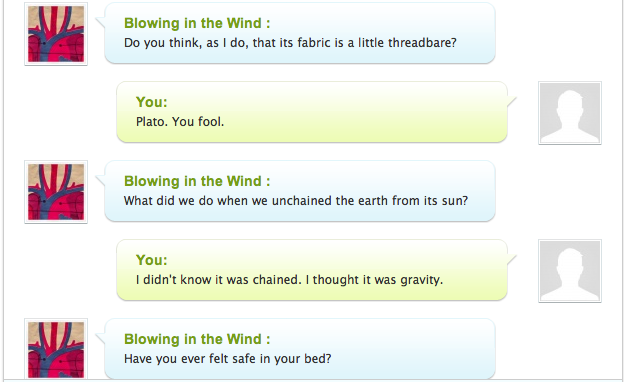
As for Carrie’s chatbot, I felt as if I became a more mystical version of myself in “conversation” with Blowing in the Wind.  I responded to the chatbot intuitively, automatically, and I like the things that developed between us, especially the things it made me ask or declare.  I felt, very quickly, like I was in the process of inventing a persona in order to sustain a satisfying conversation with this thing, and for this reason, I think Blowing with the Wind has great potential as a writing tool.

We could have gone on much longer.  Here’s the transcript:

Blowing in the Wind : Where does it begin?

Me : Do you have a mother?

Blowing in the Wind : Do you think, as I do, that its fabric is a little threadbare?

Me : Tell me, Blowing in the Wind, does March tire you?

Blowing in the Wind : Is magic science?

Me : Sometimes it seems so, doesn’t it?

Blowing in the Wind : What did we do when we unchained the earth from its sun?

Me : We were nothing, then.

Blowing in the Wind : Why do I answer all questions with questions?

Me : Is there such a thing as an answer? I don’t know.

Blowing in the Wind : Why do you think I asked this question?

Me : Questions are our primordial body’s speaking.

Blowing in the Wind : If music hits you and you feel no pain, did it really make a sound?

Me : Are you in pain, Blowing in the Wind?

Blowing in the Wind : Is it easy for you to get by?

Me : Some days. Some days, not. Isn’t this called: human?

Blowing in the Wind : Is there an end to despair?

Me : Isn’t that what we call: July?

Blowing in the Wind : If the universe ends, what is outside of it?

Me : I often think of this question in terms of my body.

Blowing in the Wind : How can a loser ever win?

Me : What have you lost, Blowing in the Wind?

Blowing in the Wind : Haven’t you reached the tree you were taking us to?

Me : That tree blew down in an end-of-summer storm. Here is its stump.

Blowing in the Wind : Why is there something rather than nothing?

Me : What do you have, if not nothing?

Blowing in the Wind : What is the meaning of nonsense?

Posted in Uncategorized | 4 Comments

Soc. Phaedr. Soc. Ridiculous!

phaedrus


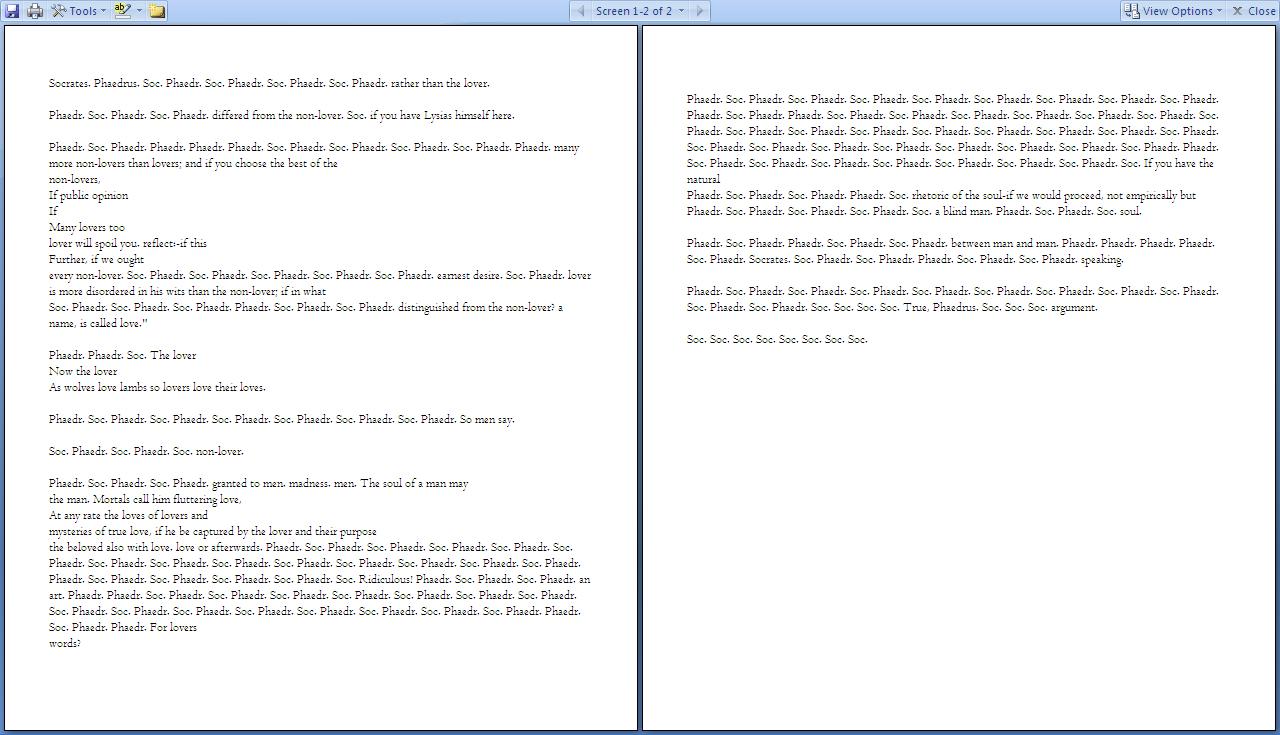
(0) Above is Plato’s Phaedrus in under 500 words. On MS Word’s account.
(1) I’ve been reading a metric tonne of Plato lately.
(2) I remember clicking a button in Microsoft Word once that shrunk my friend’s poem into a very satisfying koan.
(3) I spent two hours on the internet trying to find that button in my current version of Word.
(4) It’s called AutoSummary.
(5) Is this a procedural writing? I think so. Microsoft Word has to use some sort of algorithm to decide on what they think is “most important.”
(6) I inputted all the text of Plato’s Phaedrus.
(7) Ran AutoSummary at 25%.
(8) Took that and ran AutoSummary again so it popped out under 500 words.
(9) Was rather tickled at the results after being disappointed.
(10) Am going to remove the dialogue tags and run it again and see what comes out the other end one more time.

speech


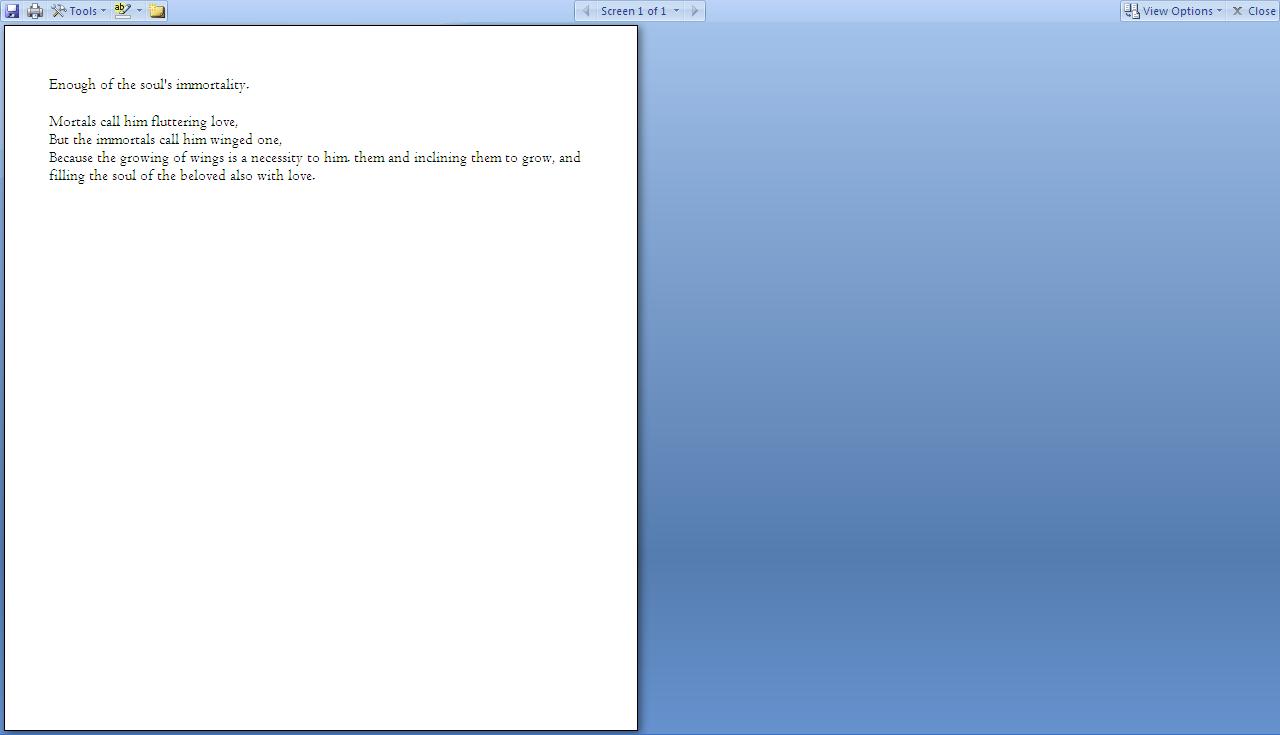
UPDATE: I took Socrates’s speech and did a 25% AutoSummary, then did a 1% AutoSummary on top of that and this is what came out after I took out the dialogue tags.

After a little bit more googling, turns out that some years after I found this out by accident, some RISD dude made a thing of it. Awesome.

Posted in Uncategorized | 4 Comments

Blowing in the Wind

I have to admit that twitterbots don’t make any sense to me– they always read like Frankenstein sentences, or like the word salad of a schizophrenic: close to sentences, but not quite there, gramatically off enough to make me feel physically upset.  I mean, it’s not just that I don’t understand the sentences, it’s just that they’re so off from real sentences that I don’t really understand the joke.

So, I think I might’ve cheated.  I went to a “make your own bot” site, but the deal is that you write answers to questions that might get asked.  I decided to take an old trick from Turing Test competitors in the nineties– when their bots didn’t know how to answer a question, they responded with a wide open question.  I guess my algorthym is: answer with a question.  Every time.

I wrote some questions myself, stole some from Nietzsche and Plato and old soul songs.   I am looking for question donations if y’all are willing. I started doing this sort of halfheartedly, to check out the bot and see if I thought I should use it for this Signment.  But then I realized I really liked it.  A million questions started running through my head.  I started thinking of it as an idea generator.  Or a life crisis generator.

I wanted to embed it, but WordPress wouldn’t let me, so here’s the link:

https://www.chatbot4u.com/en/chatbots/material.html

And here’s a screenshot:

Screen Shot 2014-03-03 at 5.57.07 PM

Posted in Uncategorized | 7 Comments

Complementary Compliments

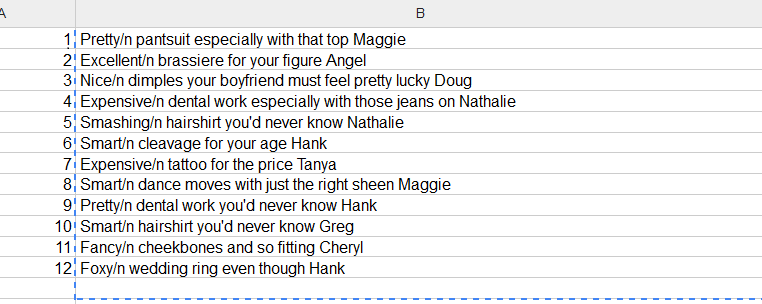
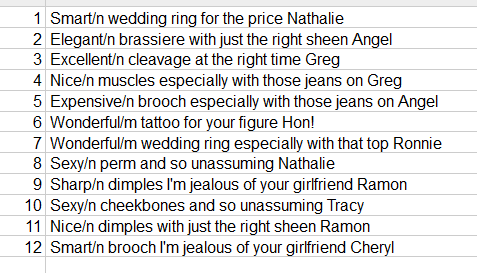
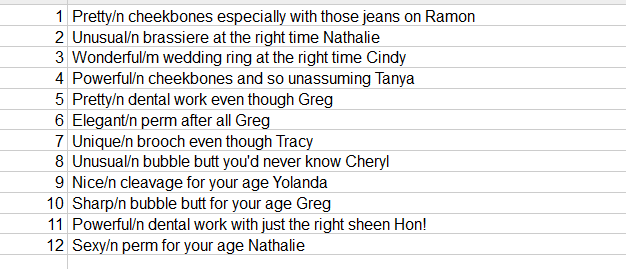
I made a Complement Bot (@flatterysuitsu), and it works, in the spreadsheet, but I can’t get it to actually send the tweets to the Twitter account.  So, here’s a few screenshots of spreadsheet previews, so you can get the idea:

Screenshot Complements

complements 2

Complements 3

There are four parts to each complement:

1. Adjective (Pretty, Smart, Sharp, Smashing, etc)

2. Noun (dimples, hairshirt, dance moves, cleavage, bubble butt, wedding ring etc)

3. additional phrase (and so fitting, even though, for the price, you’d never know, your boyfriend must feel pretty lucky)

4. Name (Yolanda, Hank, Cindy, Chuck)

The Complement Generator ended up being a Backhanded Complement Generator most of the time, due to the unpredictable combinations.  Sometimes the comments work, sometimes they’re weird, but usually they’re passive-aggressive, snarky.  I suppose creating a complement generator is a bit cynical in the first place.


Posted in Uncategorized | 1 Comment