Historical WebMD

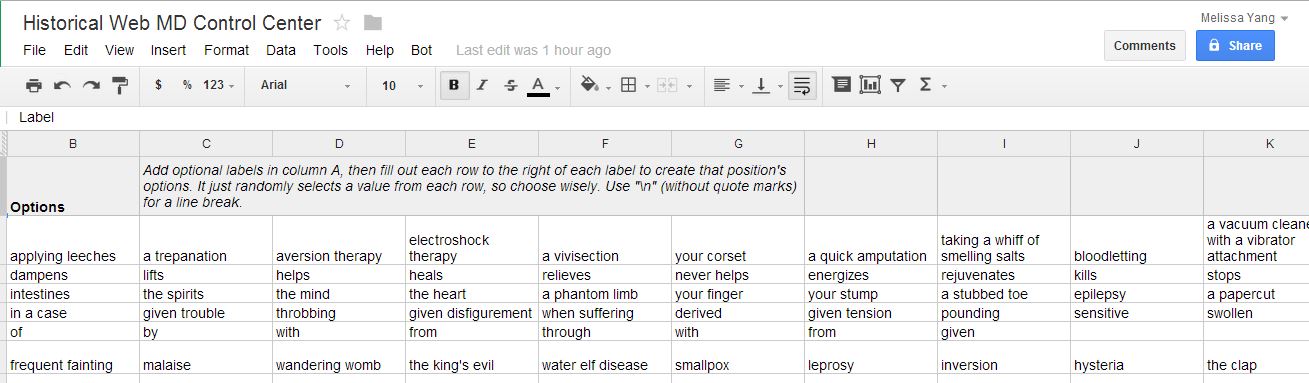
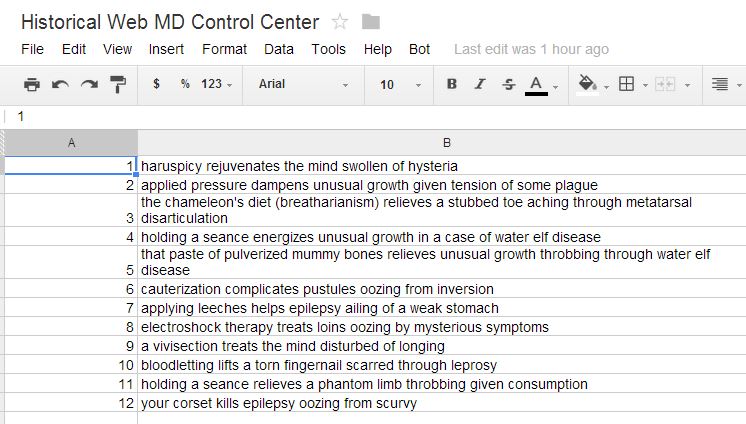
Hi all, I made a Twitter bot! Old Timey Doctor is dispensing health tips @HistoricalWebMD generated by influences ranging from Vesalius to the Victorians, and before and beyond!

I used the instructions linked in the syllabus, and am still ironing out the bot’s vocabulary.
(ETA:) Currently, the behind-the-scenes Google Doc looks like this:webmd_vocab

webmd_preview

Please share your favorite ailments, remedies, and/or corresponding pseudoscientific turns-of-phrase if you’d like to add to the algorithm — I look forward to gory suggestions!


Posted in Uncategorized | 6 Comments

Honey Dear

I was talking to my girlfriend about Strachey’s love-letter generator (as you do), and she told me that there are apparently 21st-century analogues. So I present to you the Girlfriend Keeper and BroApp, which are proof that we live in either the best or worst of all possible worlds.

The former is a joke, and more like Strachey’s program because it creates messages itself – with limited believability, of course. BroApp is fascinating to me, though, because it’s smart in some pretty spooky ways: if you’re connected to your girlfriend’s wireless for example, it won’t send her messages, because you’re obviously together.

Of course, that doesn’t save you from this awkward moment:

Tom confessed to News.com that the most painful moment in the app’s creation came when he had to turn to his girlfriend (presumably in person) and tell her what he’d been developing for the previous three months.

Plus ça change, plus c’est la même chose.

Yours adverbially,

Nina

Posted in Uncategorized | Comments Off on Honey Dear

This Old House

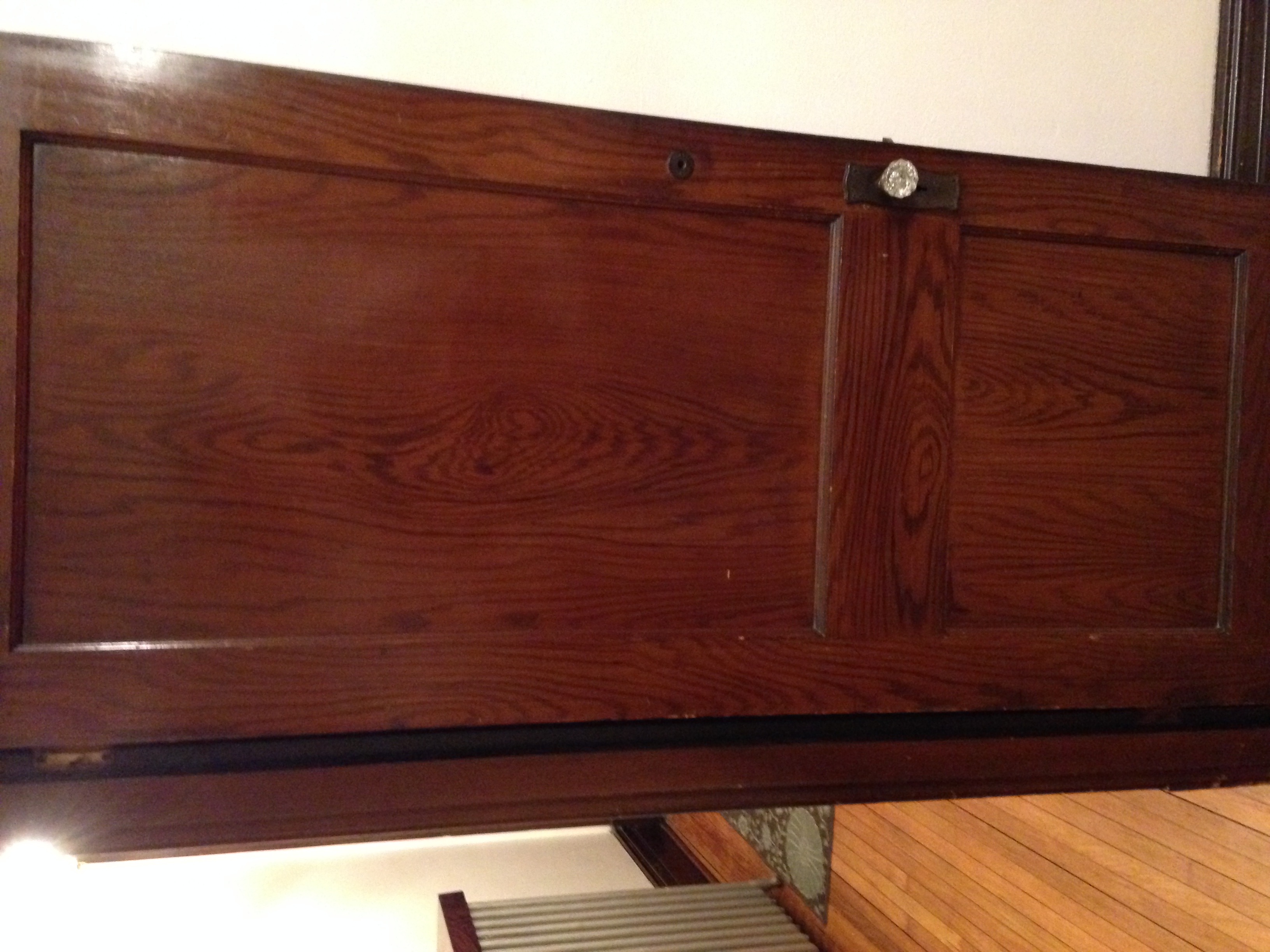
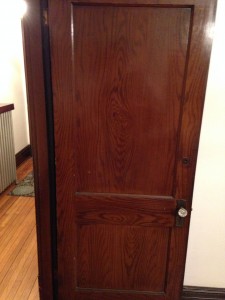
doorWhat looks to be a solid wooden door separates the vestibule of our new home from the dining room. When we first toured the home, we noticed the doors only to say how richly colored hey were. When I toured the home with our inspector, he pointed out the doors, asking, “These look like solid oak doors, don’t they?”

“Yes,” I said, “we noticed them on our first walkthrough.”

“Well they’re not,” he said, rapping his knuckles on this door in particular. A hollow sound rang out; the sound of wood much lighter than oak. “But I think these are even cooler than a solid wood door, and certainly a helluva lot lighter.”

He continued: “Look at the grain on this door. See how it’s inconsistent in places. This isn’t actual woodgrain. The people who first painted this house painted this grain on the door. It’s not real. They probably spent hours doing that, just so they wouldn’t have to spend all that money and all that hardwork wrestling a solid oak door in here. Because they’re heavy! They probably had a whole array of painting tools, feathers, specialty brushes and so on, and they had fun with it, making these swirls and designs, all in an effort to make a door that wasn’t oak look like a door that was.”

______

This is one of my favorite parts of the house my wife and I bought last March. Our inspector, Dennis, was full of little bits of information like this. He pointed out original masonry work where you could see the edge of the trowel as it cut a line in the mortar that glued together the bricks of our 100+ year old house. He showed me the fist-sized ball of lead that connected the external water main to the internal plumbing, the finger-sized indentations of the worker who molded the ball still evident. He was clearly taken with these little clues that connected the present day to the time when the house was built in the late 1800s. And his enthusiasm was contagious. Soon after we moved in, I scoured our house for other little markers of the past, residual traces of all the people that had something to do with our house, whether it was the masons who laid the bricks, the plumbers who shaped the pipes, or (as I secretly hoped) the single, multi-generational family that lived in the house from the time of its construction to the time we purchased it.

______
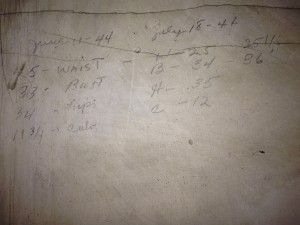
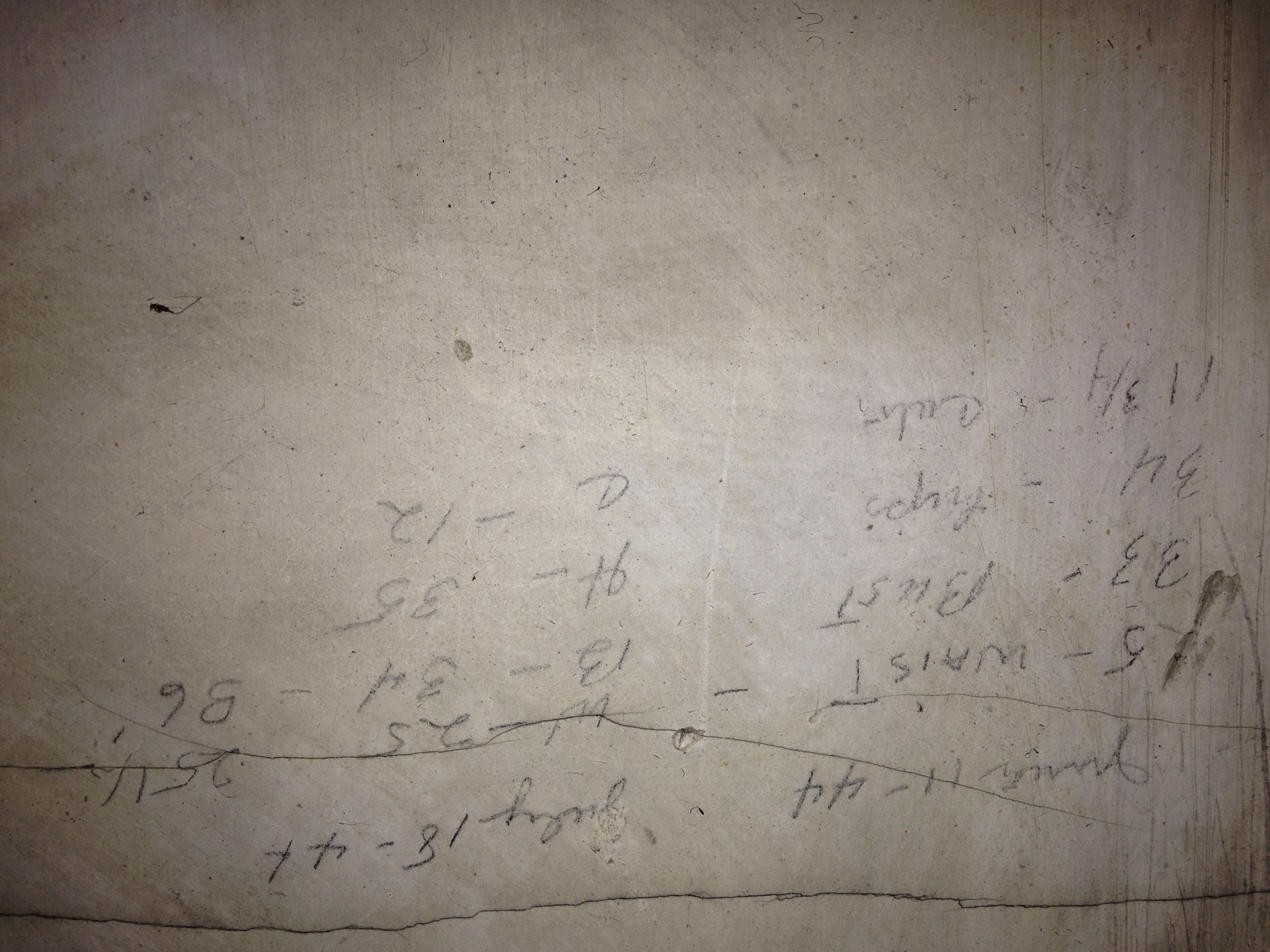
measurementsIn the smaller of the third floor rooms, inside a closet, written on the original, unpainted, unfinished horsehair plaster wall, a former resident kept track of her body measurements. Waist, bust, hips, and calves, measured and recorded in June and then again in July of 1944. This is unwanted writing that I hope survives forever.

What’s initially peculiar about these measurements — viewing them, as I am, from our current era obsessed with thinness — is that they indicate growth. The writer’s waist expands from 25 to 25 1/2 inches, her bust from 33 to 34 to 36 inches, her hips from 34 to 35 inches, her calves from 11 3/4 to 12 inches.

They are, perhaps, the charting of measurements for purposes of vanity. Maybe this is a woman who wants a larger bust, more vivacious hips, a more womanly body. I’m reminded of the Violent Femmes song, “36 24 36”: See a girl walkin’ down the street, just the kinda girl that I’d like to meet. It ain’t her hair, her clothes, her feet, somethin’ much more discreet. 

If these are recording of measurements for the purposes of vanity, though, I’m not sure why they’re in a closet, in pencil on the third floor. Why hide them in something that seems much more removed than, say, a diary, or a journal? Why seek out the inner wall of a closet? And how on earth does a woman’s bust grow two inches in a single month?

______

Of course the other thing that happened right around March/April of last year was that Wylie was born. We like to stack our major life events right on top of each other, see, so that as we struggle with the difficulties of a newborn child, we also struggle with the difficulties of an unfinished living space. It’s always nice to be able to move furniture into a house as you’re trying to stay very quiet so that both your wife and your child can get some sleep.

______

Baby boomers are folks born in the years immediately following World War II. The story goes that as servicemen returned home from the European and Pacific theaters and immediately sought out their sweethearts and wives, celebrating their victory and their livelihood in a way they found natural. They had sex. The boom peaked in the later 1940s, plateaued for most of the 1950s, and slowly dwindled in the late 1950s and 1960s.

______

Ursula Sangl, the last occupant of our home, was 12 in 1944. Her parents, William and Sara, were 42 and 40 respectively. Ursula was the oldest of William and Sara’s three girls. Carol was 7 and Norma was 4.

______

Elizabeth “Betty” Sangl Enright was the upstairs tenant of the Sangls. She was 31 years old in 1944. In the 1940 Census, her relationship to the head of household (William) is listed as “daughter.” She is likely his younger sister. She is a typist at a factory.
Posted in Uncategorized | 2 Comments

Regent Square Rentals and Spam

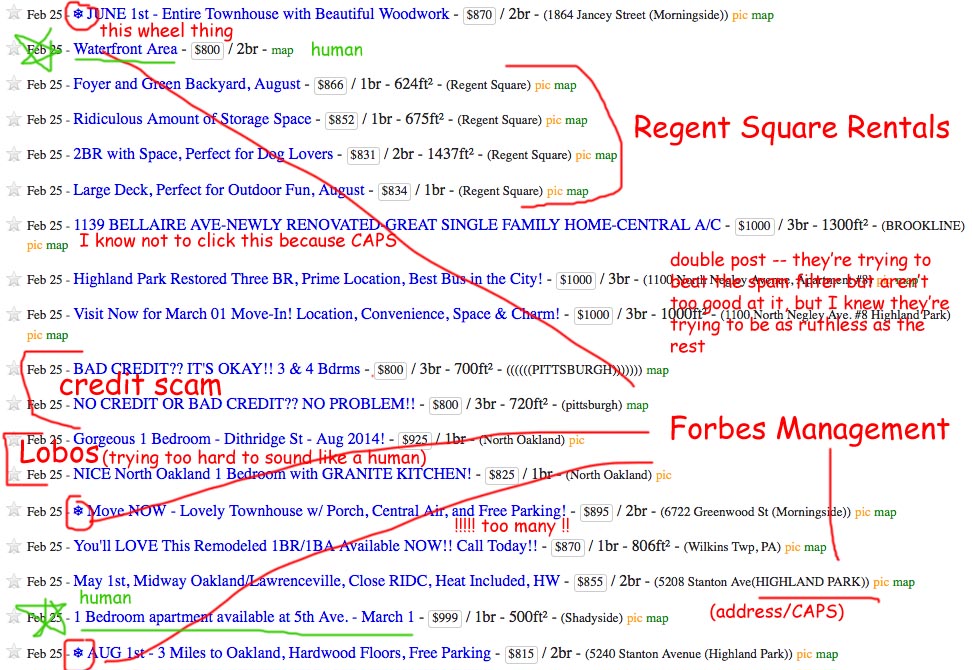
When Michelle and I first moved to Pittsburgh, we spent a long time on Craigslist looking for a place to live. But we quickly found that the majority of Craigslist was run by two or three main companies: Forbes Management, Regent Square Rentals, and Lobos.

Given the limited amount of time that we were in Pittsburgh, and the fact that real humans don’t start listing their apartments in Pittsburgh until a month or so before the start of the lease, these three companies were essentially our options, and so we chose to go with Regent Square Rentals, which was an okay experience, actually, even though I’m about to badmouth them all over the place, but we were nowhere near as happy as we are with our current house, owned by a human, a very nice one, in fact.

I want to share the patterns I started recognizing in order to find the house I am now living in, and the patterns that helped us find housing for some of our friends, and talk about some of the real-world ramifications of Craigslist spam.

craigslistspam

Basically this is how I came to see Craigslist — I WAS the algorithm, because I had none. I learned how to filter pages and pages of Craigslist in the blink of an eye.

The hardest company to recognize is Lobos — I believe Craiglist kicked them out or something, because at some point during our search, they stopped putting their name on things, and only putting their number, and the name of an agent. Or perhaps this was in an attempt to seem more human-like: you present the facade of humanity to hide the giant company looming behind? Anyway, once in a while, their ads would fool me, and I’d click on them, but immediately back out once I saw the number, which is drilled into the back of my brain in flashing neon lights with a giant NO next to it.

What is interesting is that this sort of spam-sifting became a completely embodied experience. It was less of a mental capacity, more of a combination of scrolling and scanning, scrolling and scanning, and I didn’t even have to think, really. I’d pop windows into new tabs that were from humans, and evaluate those tabs, ignoring everything else. It was almost meditative. It made the labor of looking through Craigslist much easier once I found what the signifiers of posts from big companies looked like.

This is important because Regent Square Rental’s business plan is to hook a customer by flooding Craigslist with millions of ads, send their peppy young house-showers on commission around with people to give the illusion of normalcy, offer apartments that pretend to be in Regent Square but are actually in Wilkinsburg, skimp on repairs and maintenance, tell the residents they must renew their lease starting 6 months before it ends, parade people around the apartment unit starting 6 months before the lease ends, then raise the rent $40/month at the end of the lease. Nobody really would WANT to stay in this situation. But that’s not the point. The point is the 1-year lease that forces to you stay a whole year in the first place.

The RSR model relies on the hook itself — I have never seen more people moving in and out of an apartment building. And if you do decide to stay, given, perhaps the cost and stress and labor of moving, you will be paying $500 more for the same deal (this happened both to us and to a friend as well). Most don’t.

The hook is only possible with the creation of an excessive amount of automatically generated Craiglist ads. So for RSR, spam IS the business model. The difference between this kind of spam and the hacking/virus/phishing spam is that it’s entirely legal, actually. Given a certain amount of infrastructure, and a good bot, RSR can maintain a relatively healthy tenant occupancy, despite not responding to complaints or maintenance calls, despite not having a good relationship with any of their tenants, despite invasive and almost illegal lease agreements (almost).

Anyway, I just find it interesting how their business works, and how spam can, in some cases, even in this current iteration of the drama, be completely legal, despite ripping off unsuspecting people and causing a large amount of discomfort in people’s lives.

Posted in Uncategorized | 1 Comment

Marginal Animals

A) 2006 – 2011

The summer of 2006 was the first best summer of my life. It marked the first time I was ever allowed to write in a book. I was, in fact, encouraged to write in books — the near dozen of them assigned in a six-week seminar on “The Quest,” from Virgil’s Aeneid to Keruoac’s On the Road, by master teacher Herr Schade. Now, I cannot remember if we rising public high school seniors were offered guidelines to writing in books, or even a rationale — I only remember feeling liberated. Maybe too liberated.

One of our odder readings was Barbara Kingsolver’s Animal Dreams.
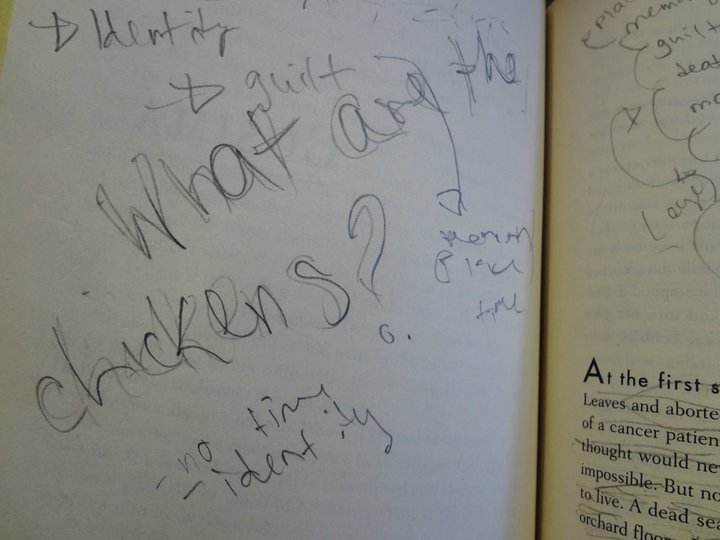
I recall disliking it and not much else, and when I re-opened the book as a course intern in summer 2011, I was struck by some giant marginalia about chickens:
animal_margins
I am a chicken lover, yes, but had not realized my theoretical preoccupation with chickens in literature extended back to 2006. At least — thanks to my new discovery of being allowed to write in books — I could trace it back to that summer. (Now, if only I had thought of starting http://www.chickensinliterature.com/…)

Leafing through my catastrophically annotated texts now, I find lines consistently underlined with such vigor that words are crossed out entirely. Sometimes when I took notes excitedly enough that they were illegible, I would write them again — double (sometimes triple) marginalia. I actually have two copies of most of these books — but (I hope this gives you peace, Noel), I never plan to sell them used. Especially not the marked up copies. Not when there are chickens to be found.

B) 2011

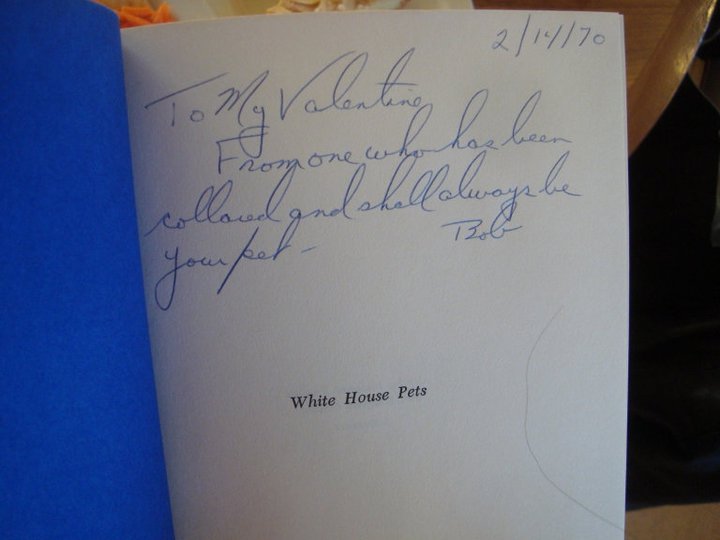
Animals are, arguably, marginal in academia — at least, that’s what I figured in my final year of college, when I decided to write every other paper about animals. It was in my final semester when an anonymous donor dumped an entire shelf of free animal books in the library. I knew no professors studying animals (beyond the one admitting he’d never read Heidegger because his cat always climbed on top of the book when he tried — a la http://petsonacademia.tumblr.com/), and I still wonder who gave up all of those wonderful books. I took almost all of them, and gave one away as a gift: Margaret Truman’s White House Pets. I kept this picture, though:

unwanted_vday1
As a rather sad case of unwanted writing.
(Excuse the unwanted piece of hair contaminating the left-behind page.)

C) 2013

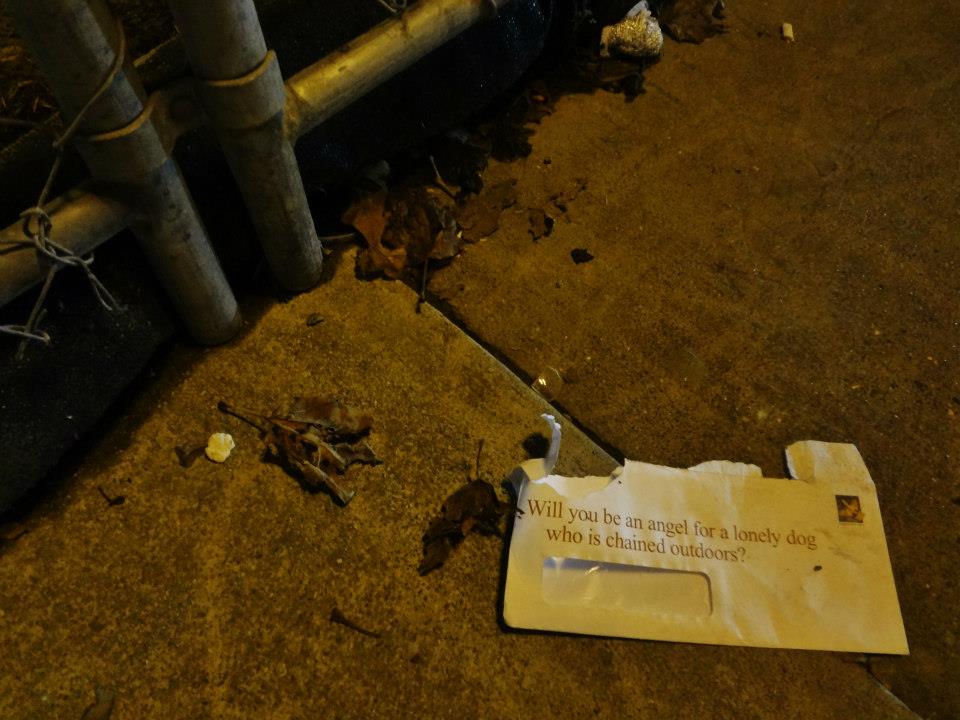
I will sign off with a case of abandoned minor printing on a San Francisco sidewalk to symbolize ideas abandoned in this post: 1. a paradelle appropriated from collected 2009 spam headers in the “Spoetry” subfolder of my inbox, and 2. a discussion of a Barry McGee (famed San Francisco graffiti artist) exhibit I saw at the Boston Institute of Contemporary Art — right after relocating from SF to MA — and the accompanying senses of displacement.

animal_margins2

Posted in Uncategorized | Comments Off on Marginal Animals

Fakey Marginalia

The Sherman reading got me thinking about what kind of books I feel okay defacing.  Most any book I buy, I deface with my thoughts, unless it’s an art book or something pricey like that.  Library books, though, sometimes stop me.  But not always.  I think it has something to do with the artistic value I place on the book.  I recently marked up a critical companion to contemporary poetry, with absolutely no remorse, probably because criticism doesn’t seem like art, and the next book will replace it in a few years.  Maybe it’s respect for art that stops me, like the graffiti writers who aren’t supposed to tag up others artists’ pieces.

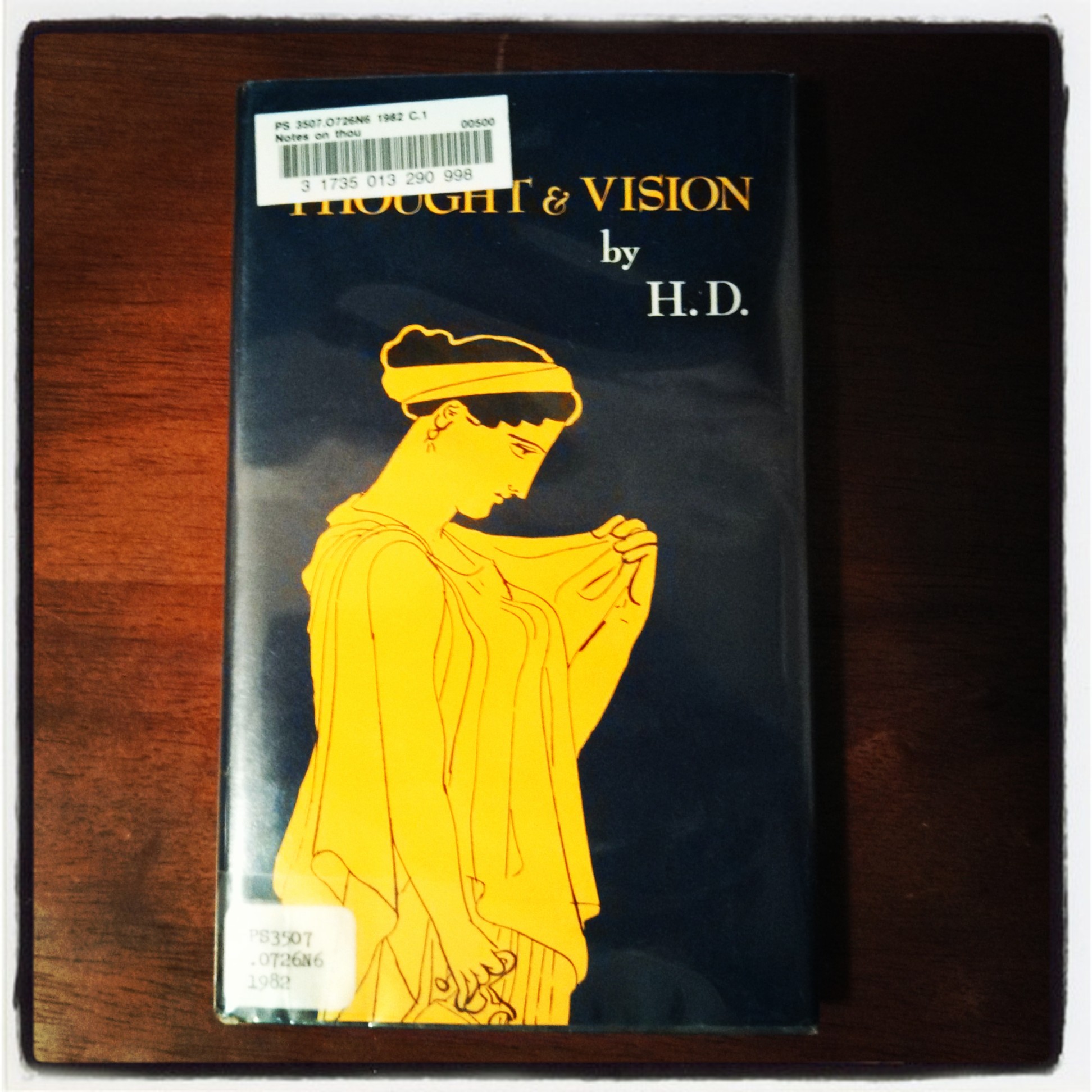
For a few days now, I’ve been resisting the urge to write inside of H.D.’s Notes on thought and Vision.  It’s Literature.  She wrote it in 1919 and City Lights published it in 1982.  The cover is pretty.  An ochre yellow Sappho seared upon a blue so midnight it’s also black.  I’d feel guilty writing in it.

hd cover

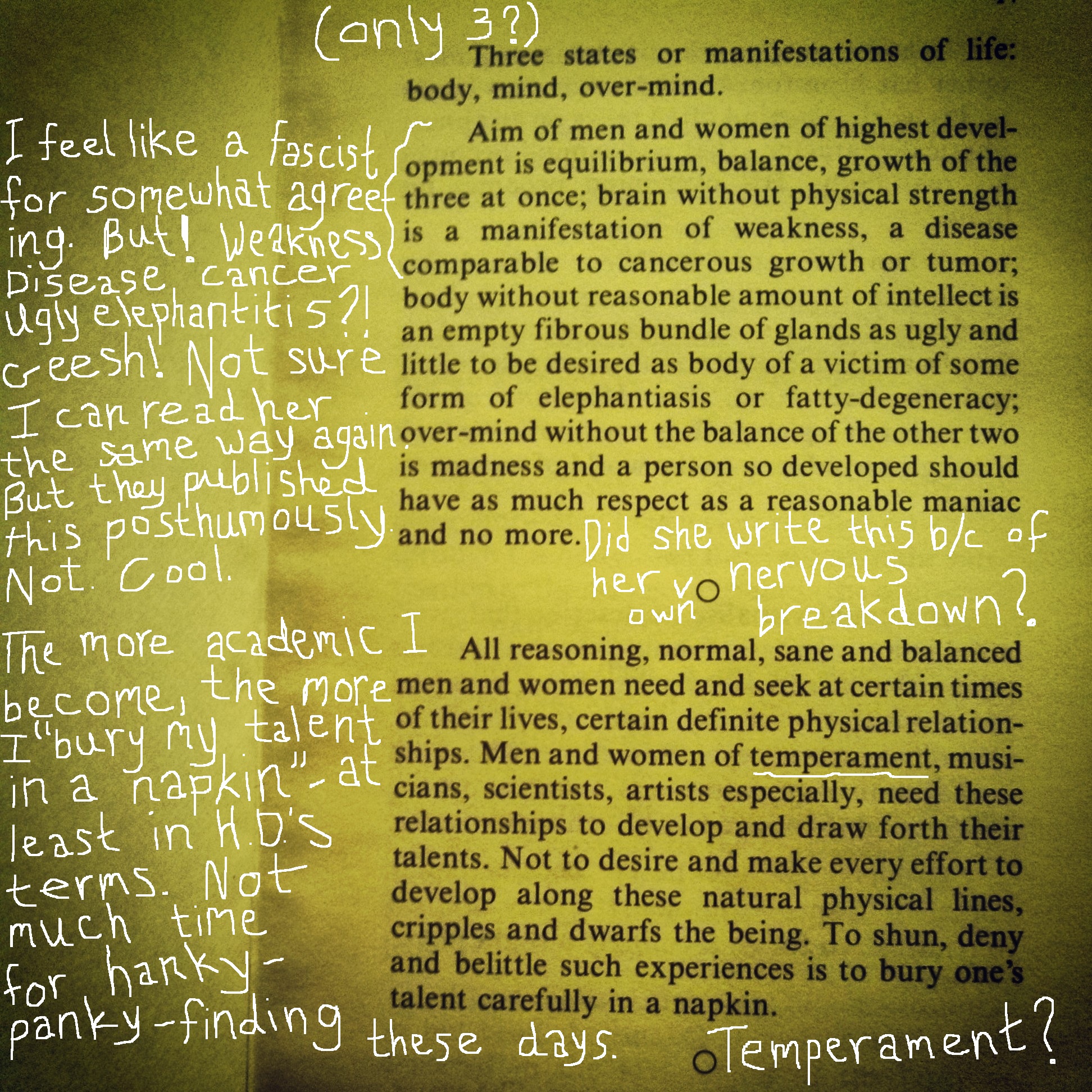
The inside is pretty too.  And, the book is tiny, which makes the considered offense seem even more obscene.  The printed area of the page is 3×5, at most.  I find tiny things more attractive, for some reason.  But I really want to write in it, because I like it, and because it also pisses me off.  So, I took a picture of one of the pages and put it into paint, so I could do as I please.  The little circles are also pleasing.

hd

I had to use the eraser tool, because the pencil tool wouldn’t show up on the darkened pages, so this took me a while.  And, my forearm cramped.  I went slowly, and probably spent more time feeling more strongly in response to the things H.D. wrote.  I wonder if people who wrote with quills and other slow writing utensils had a heightened relationship with the texts they wrote in.  As I wrote this, I realized I wouldn’t want to write these things in a library book because they’re embarrassing.  The things I write inside of a critical companion to poetry are not as personal or silly.  They’re more cerebral, perhaps even useful to future readers– more useful than the crazytalk I’ve bestowed upon you guys here–an even more public forum.  But the internet is almost un-defaceable, with some exceptions, maybe like screwing up wikipedia entries or something like that.  It’s more like the internet helps people deface themselves, while the internet itself remains impervious.

Posted in Uncategorized | Comments Off on Fakey Marginalia

Marginalia as art/ Art as marginalia

As soon as I saw this I thought of you guys:

photo-51
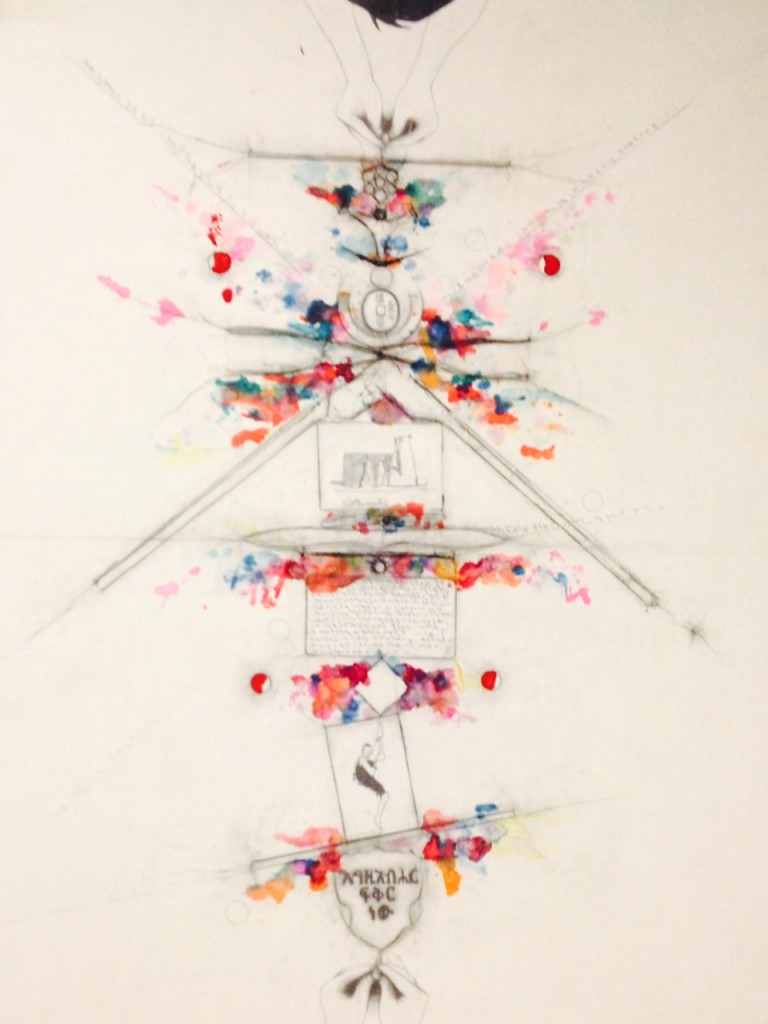
I was wandering around the Pompidou, thinking about how disillusioned I was with the art world (in a past life, I made sculptures) when all of the sudden, I happened upon this strange and heartwrenchingly beautiful exhibition of drawings. I was struck by how many of them contained writing. This one has writing in a variety of different languages, a variety of different hands. It’s by Allghiero e Boetti. It’s called Attratto da improvviso centro.
photo-53
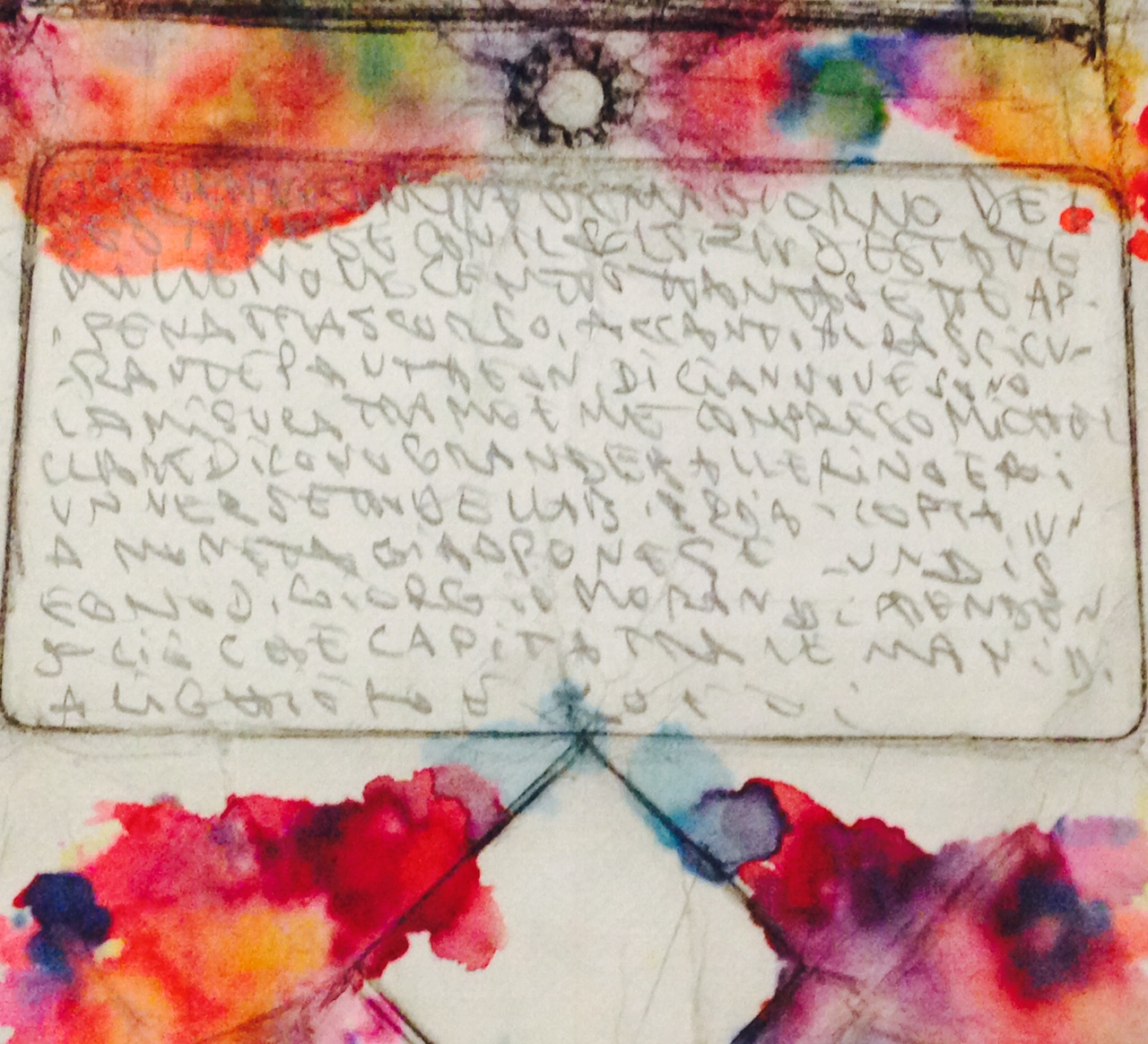
This is purposeful, not marginalia like the stuff on the diagonal lines, but it’s also purposefully sloppy and illegible. I can’t even tell what language it is. Maybe it’s just important that it IS language, not what it’s saying. Which, come to think of it, is almost NEVER the case with marginalia or graffitti. That stuff is there to lay claim, to impose meaning especially where it’s not wanted. This keeps to its place, says nothing.
photo-52
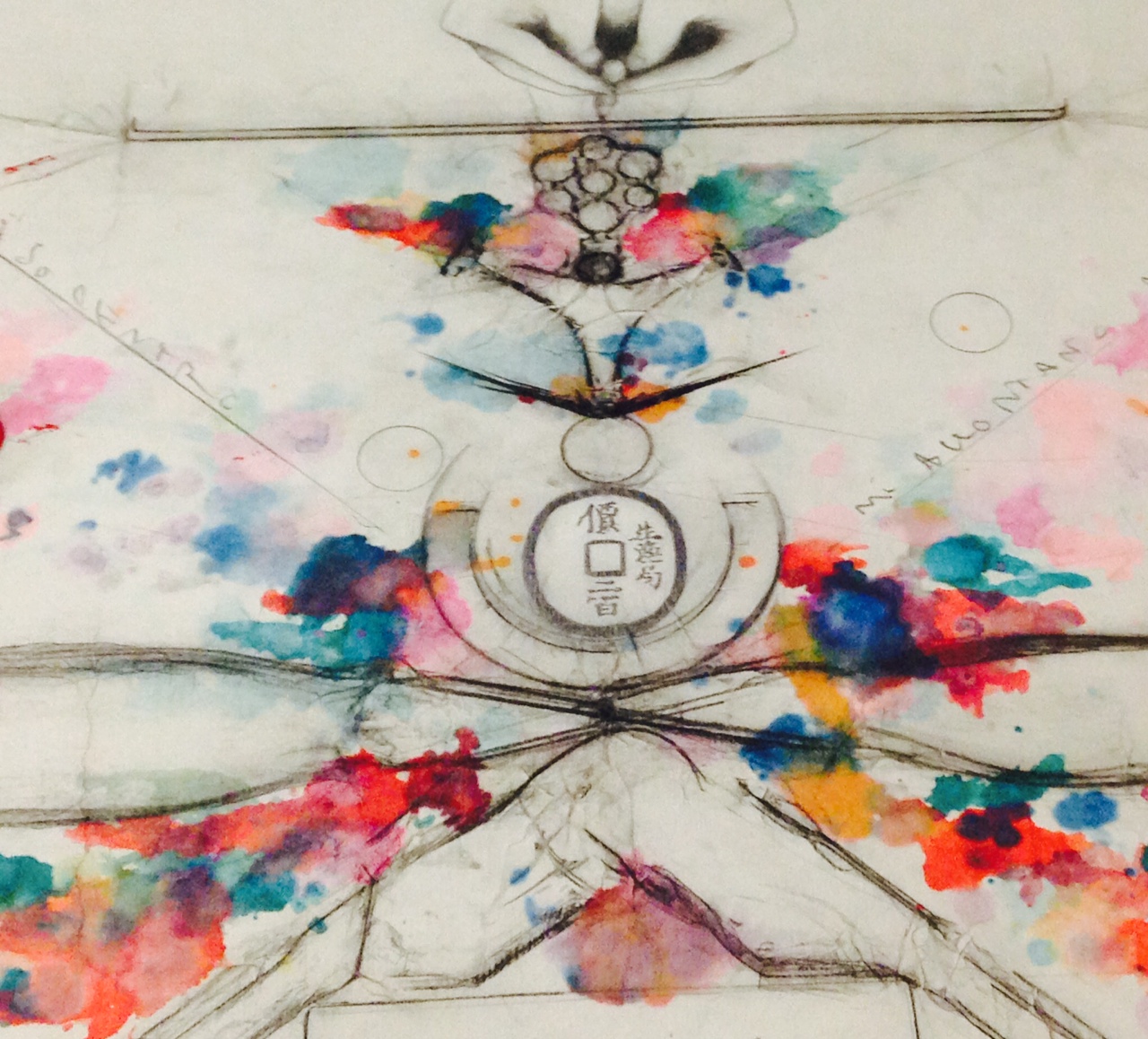
Some seems very purposeful, like the Chinese/ Japanese coin here in the middle, but can you also see the scrawling hand pointed outward?
photo-54
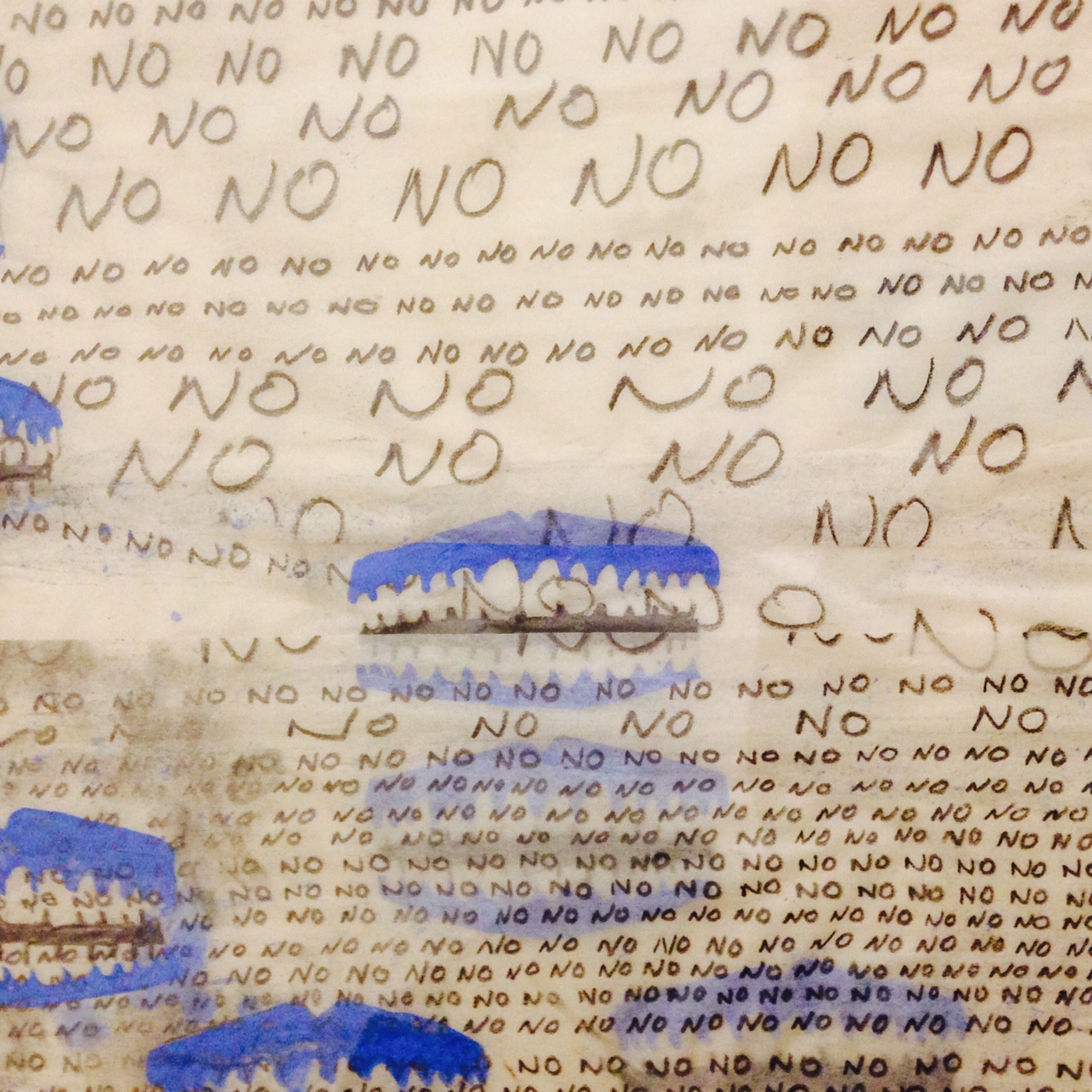
This one broke my heart. It’s not graffitti because it’s in a frame. It’s not marginalia because the word is not in response to any other word, I don’t think. Unless the “no” builds on the “no.” Unless the fury of the word becomes the meaning of the word, like the gesture of some graffitti. I looked at this long enough that I thought I saw a “yes,” but when I looked back, it was gone. Untitled by Rona Pondick.
photo-55
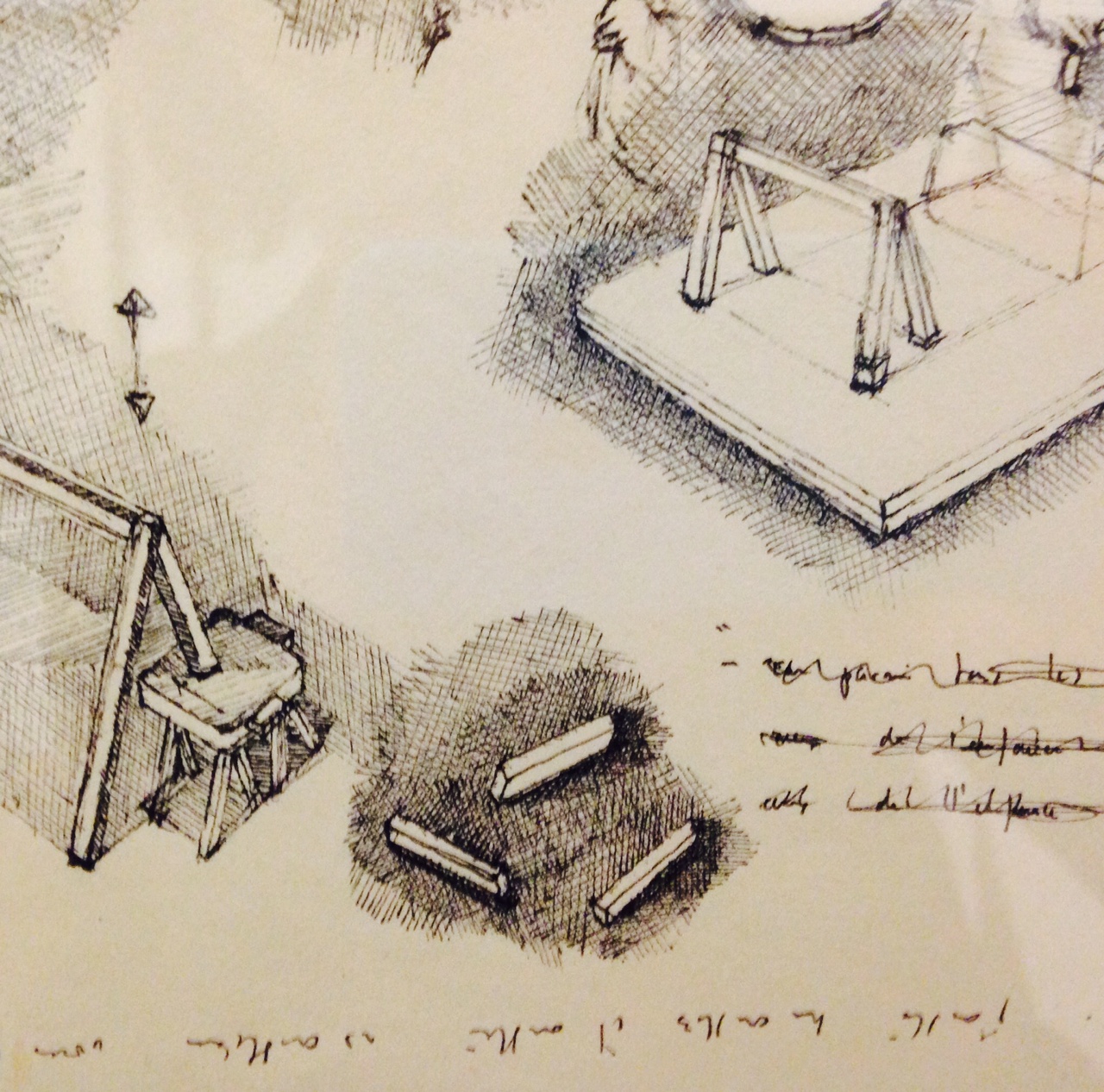
I wish I could show you more pictures by this person, but these drawings were so minute and intricate, it would take 15 pictures to show you much at all. But most of them have writing, illegible, around the periphery. And this one has the writing crossed out. Did the artist plan this? Or was she just drawing and took a notion to write something down and then cross it out? And why am I so moved by the drawings of sawhorses alongside the gesture to annul language?
photo-56
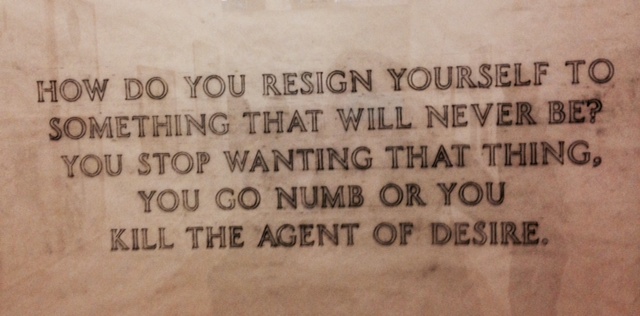
Lastly, this. Jenny Holzer. Of course it’s not marginalia at all, but how strange that she is an “artist” and not a “writer,” that her words are in frames and those frames are in museums– it’s not so far removed from graffitti, the font is important, the brand and the gesture.

Posted in Uncategorized | Comments Off on Marginalia as art/ Art as marginalia

Let your voice be marginalized

I had a little problem when I began drafting this signment. See, the thing is, I did the readings and suddenly there was marginalia everywhere I looked. And I wanted to write about it all. It doesn’t help that I compulsively photograph these things anyway.

I’ve decided that attempting to write about every aspect of everything ever is a poor plan which would result in an ungodly-long blog post, so this is what I’ve chosen to focus on instead.

I am a writer of fiction. Austin’s introduction discusses writers of trains. Medieval texts were written on one side of the page, so as to allow room for later writers of commentaries. Even spam is written, even if its writer is unidentified, or if that identity is so murky as to be beside the point. But the text that is produced speaks, and it doesn’t necessarily speak in the same voice – acts of public writing are often acts of ventriloquism, too.

2012-10-23 17.28.51

The thing that I love about marginalia and graffiti and “illegitimate” authorship is that it’s so clever so much of the time. Its existence is self-justifying – however it’s written is how it exists in the world. And things get very self-aware very quickly. What happens then is something I’ve spent hours talking about in workshops: the author takes on a narrative voice. I’m trying to think of a better way to put that. How about this: marginalia is both relatively anonymous and very personal. Even a graffitied tag is different from a signature in that way. We’ve already talked about how speech and text do not align precisely, but these things have an even more uncertain relationship to the oral world.

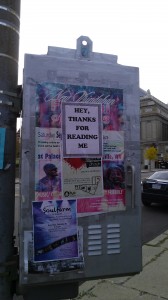
Figure 1: a signboard near the Cathedral last year that has gained sentience.


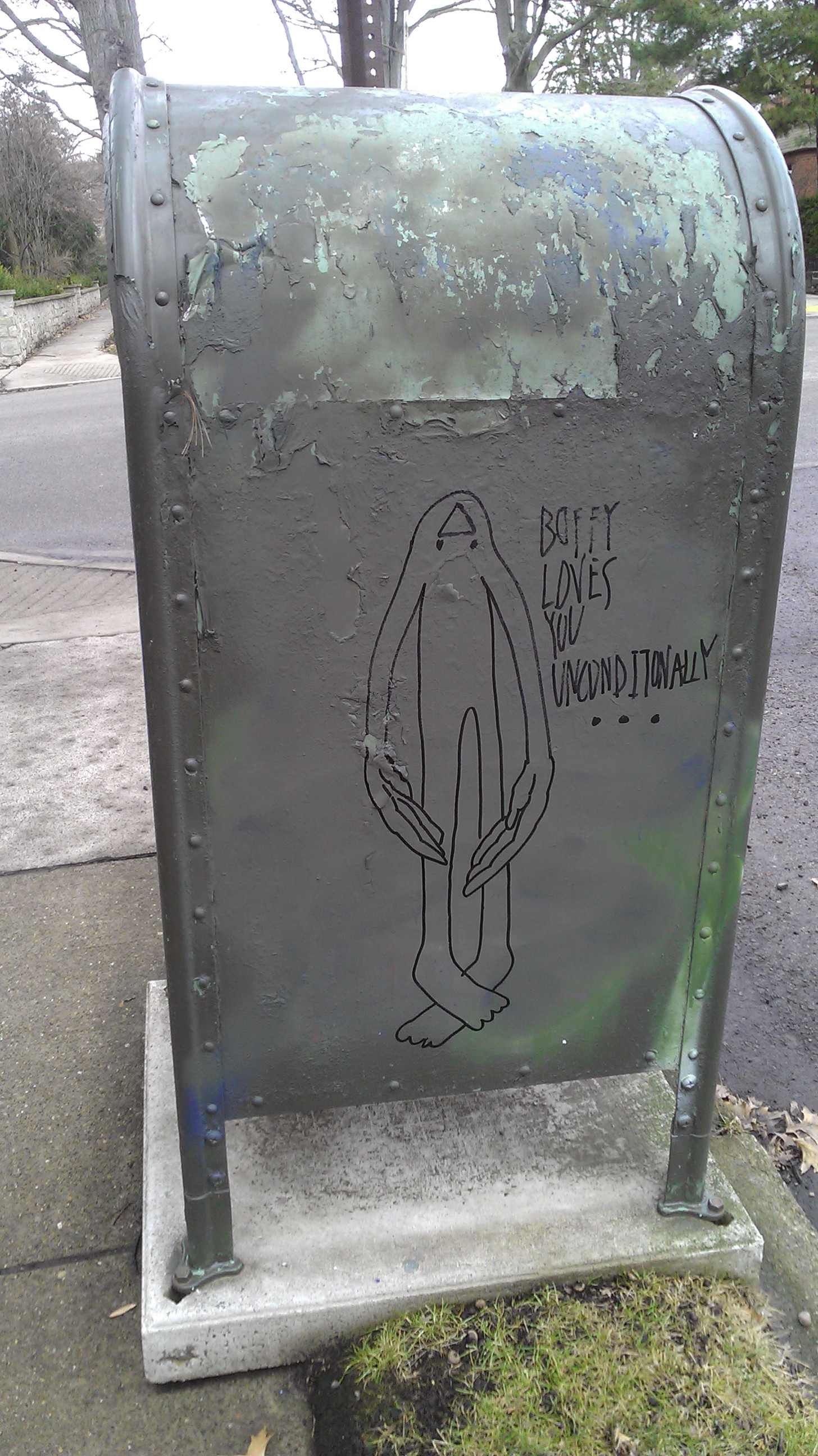
Figure 2: a mailbox in Shadyside that wants you to feel better.

2013-02-23 12.03.50
Thanks, Boffy.

I’m being flippant here, of course. Someone – God bless them – stood at this mailbox and drew Boffy with a pen held in a hand. Someone designed and printed a flyer and taped it over twenty over designed-and-printed flyers. The mode of production isn’t mysterious here. But the fact of production is. I found both of these greetings from the wi(l)der world while out on walks. Like the hilariously indignant anti-Papist sentiments written in your average Renaissance-era Bible, these writings modify an already-existing object. But they don’t comment on it. “This mailbox sucks” or “these posters use fonts that are offensive to my eye” are commentaries. This is a signboard pointing out that it’s a signboard. Or, even more surreally, a mailbox insisting that it’s actually a mythical creature. Not commentaries but alterations.

(I am thinking at this moment of the pasted-together books that Sherman describes briefly, and I want to say before I forget that the other place I’ve heard of such a thing is in Soviet Russia. (I make everything about Soviet Russia.) Commissars who had fallen out of favor were erased from photographs, with acid and markers and scissors; many, if not most, of the official photographs from Stalin’s era are composites. Again, not a commentary – something stickier.)

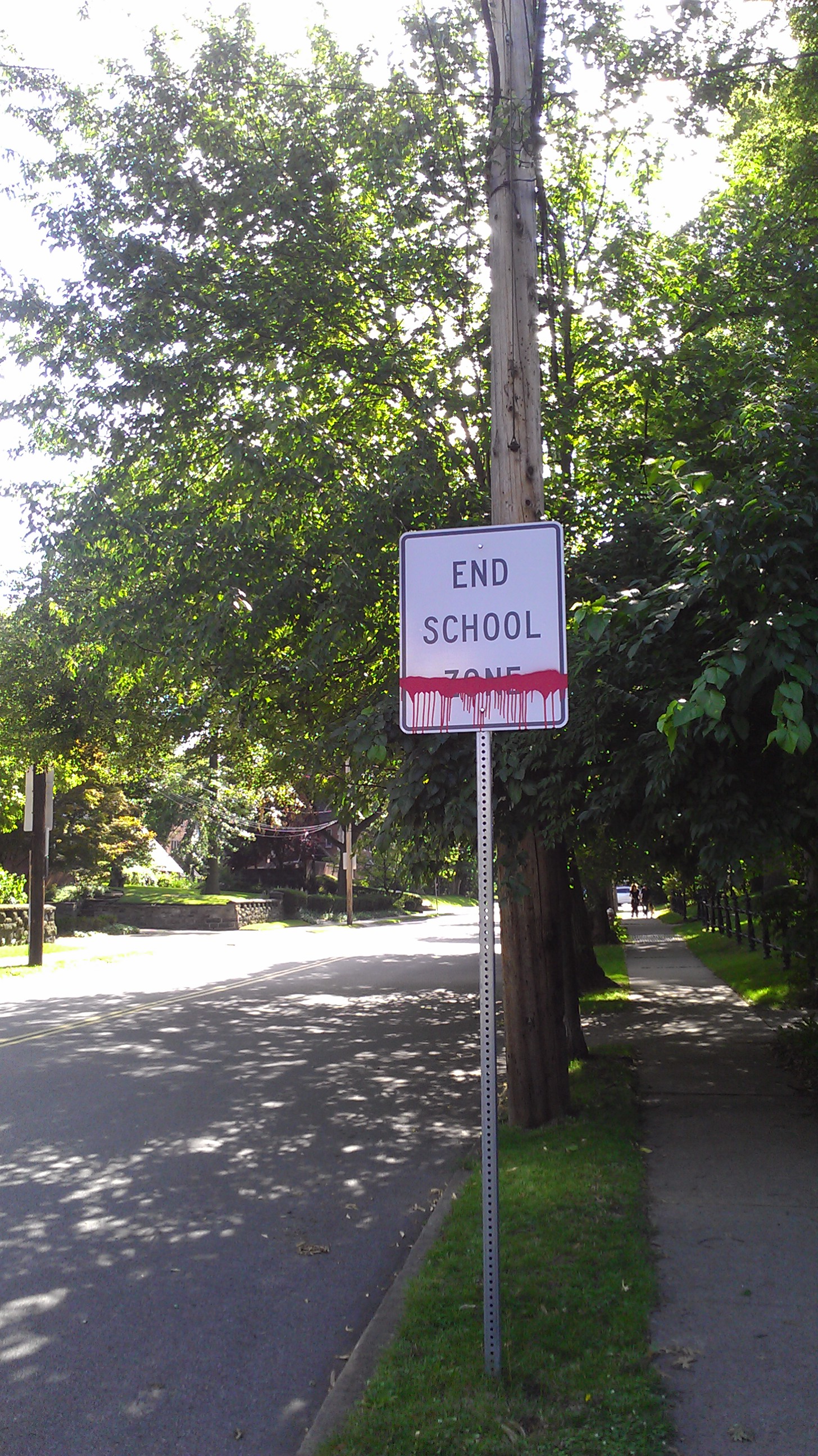
2013-07-06 16.57.49Subtraction can have a flavor, too. Here’s a lavishly defaced street sign, also in Shadyside. What makes me laugh about this photo isn’t the oh-so-seventh-grade deletion that turns this unremarkable object into a rallying cry – it’s the way the deletion is done. Look at that red paint, applied just so; it’s the campiest blood I’ve seen in a long time. Even though this is a more direct engagement with the text that’s being amended, it’s still self-consciously done. This sign is now something besides a sign.

What I’m trying to say – probably very unclearly – is that we’ve been talking about the writer writing and the reader reading, but what marginalia affords is the opportunity to talk about the reader writing. Texts aren’t sacrosanct. Duchamp drew a mustache on the Mona Lisa, and he’s in the art textbooks too.

That, and it’s just sort of wonderful to think about objects existing beyond us. We author things and then must let them go – and then what?

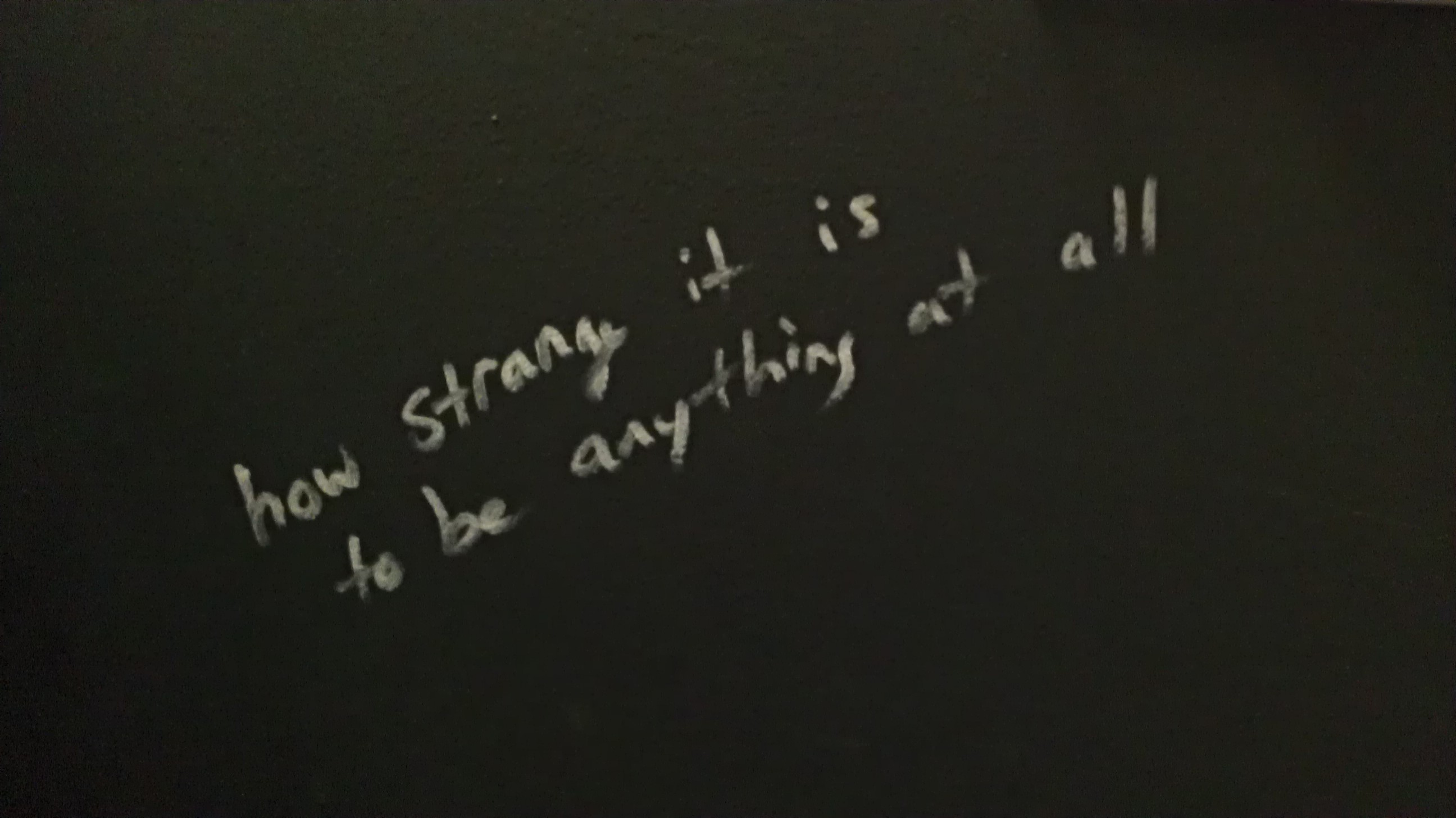
In the words of Jeff Mangum, and in the pen of a visitor to the Rex Theater in Southside:

2013-09-10 21.09.31

Posted in Uncategorized | Comments Off on Let your voice be marginalized

Door-to-Door Spamming

“…spamming is the project of leveraging information technology to exploit existing gatherings of attention.”

– Finn Brunton, “Introduction: The Shadow History of the Internet.”

Today, walking home from Crazy Mocha, I realized that I needed to check my mail, a task that often feels extraneous and arduous. I do not mean email here. As I gazed up at my front porch, I saw that my mailbox, my snail mail mailbox, was overflowing with junk mail to a point where the situation could no longer be ignored. Spam as it has existed through its email manifestations has also been called junk mail. There are filters and separate digital storage spaces that have developed to take care of this issue, to hide “junk” or “spam” from me, most of the time. However, I can’t escape the junk that goes to my snail mail “inbox.” Is snail mail an information technology? Is snail mail a medium? Is snail mail a genre or set of genres? It seems enabled by a variety of technologies and institutions, including print, the automobile, the plane, “The United States Postal Service” etc. Not to mention all of the various social, ideological, and historical developments which interacted with these technologies to form certain expectations about communication and the exchange of goods at both national and international scales. Somehow, along the way, junk mail became an inseparable component of mail in America, and this seems to have occurred before the widespread availability of personal computers.

So, despite the fact that “spam” or “junk” has a unique meaning in the digital age, I found myself wondering if this actually all starts with the computer. Brunton traces the evolution of spam through different stages in the history of the computer, but could we go back farther? Is “spam” made possible just because of some unique technology of the computer and the unique way people interact with and form communities online? Certainly, the volume of spam’s presence is heightened through the computer; some of the functional capabilities lead to new “genres” of junk, which became divorced from the concept of mail. “Clicking” on spam can lead to far worse results than reading through a letter from a credit card company. Or, at the very least, the turn-around is much faster, and some computer users seem less aware of the dangers and pitfalls within the new context. I am wondering if isolating spam within its most recent, digital manifestations, which are starting to evolve away from the concept of mail, is necessarily the only or most productive way to talk about this form of unwanted writing. Or, does the idea of “junk” and its ties to financial duping actually have a history that stretches back across a much longer historical continuum and acts through and with a variety of technologies?

Why has snail mail and its spam not vanished completely? Why are these print forms and technologies of delivery continuing to exist alongside their newer, digital counterparts? We still live in physical spaces, we still have mailboxes, and these kinds of papers, which hold their own kind of writing, continue to be delivered. Each day, I come home and have to check my mail. I know it will primarily be full of junk mail, but I have to sort through it lest I miss one of the few, rare and important deliveries, lest the post office stop delivering until I clean out the mail receptacle. I have to take this extra step, I have to check both kinds of mail. Do unwanted forms of writing always die as new technologies develop, or do they proliferate and become hybrid, present in new spaces and adjusting to these spaces, while still existing and working within the older spaces?

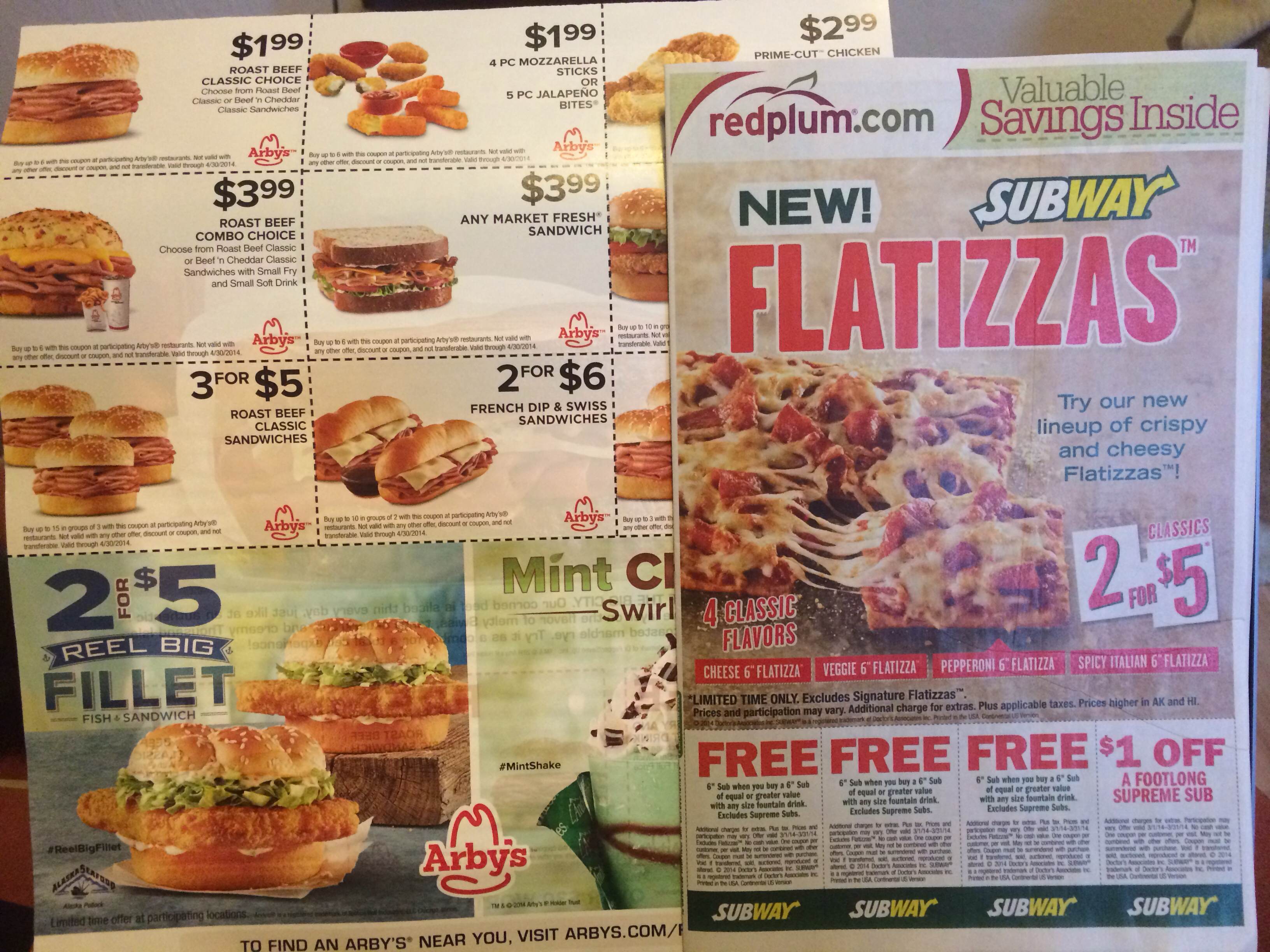
Here is some categorized collection of my junk mail from today, either through the postal service or “door-to-door spamming.” Note: I have never paid this much attention to my junk mail before:

1) We have this first grouping, the least spammy of the snail mail spam because these actually provide the recipient with functional discounts, if the effort of selecting and cutting and/or tearing is undergone. These are…the coupon booklets. I personally do not know many people who use these on a regular basis, which leads me to believe that the classification of this as “junk” or otherwise has something to do with class and age bracket:

coupons

2) Next we have the pages of advertisements informing the recipient of deals going down in various stores and/or the low prices of items in certain stores more generally. In theory, this could be useful. However, this seems like a rather aggressive or invasive form of advertising because the low prices exist entirely apart from the writing. Bringing in your copy of the writing does not lead to the prices, like the coupon. Everyone gets the low prices, even if they didn’t receive the advertisement on their actual porch:

advertisements

3) Next, we have various attempts from cable-related companies tempting you to drop your current service, which probably means they looked up what you have, and know you are a viable house to drop these at:

cable

4) And, finally, the most annoying/insidious/unethical, the ones that come in envelopes and often remain unopened, cards, offers, or current ongoing “deals” from banks. This could just be a statement or something, but I usually don’t risk opening it. No picture because you could see my address.

This post has gotten rather long, so I’ll stop for now. Suffice it to say, these print items interact with “attention” in ways that seem similar and different to that of computer-based spam. I think the lineage/connections might be interesting to explore further.


Posted in Uncategorized | Comments Off on Door-to-Door Spamming

Reading the City

Before reading part of Joe Austin’s “Taking the Train” this week, I had never thought to consider graffiti as a highly developed modality for writing or communication. This seems strange, given that it surrounded me, growing up, on the highways of central New Jersey and out the windows of trains that rumbled through Philadelphia. I admired the geometric boldness of the tags and symbols that melded into mural arts projects in West Philly and San Francisco, even as I learned, on a subconscious level, to associate graffiti with the potential for threat. Especially when I followed my parents and uncle around the heavily marked streets of Manhattan, I was vaguely aware that territorial systems of influence overlay the gridded streets like a net. It was an urban language I was not allowed to partake in—I also had no idea how to read it.

So it feels like an entirely new system of significance has been revealed to me: even if I only know a few phrases here and there, I now have a new way of reading the city.

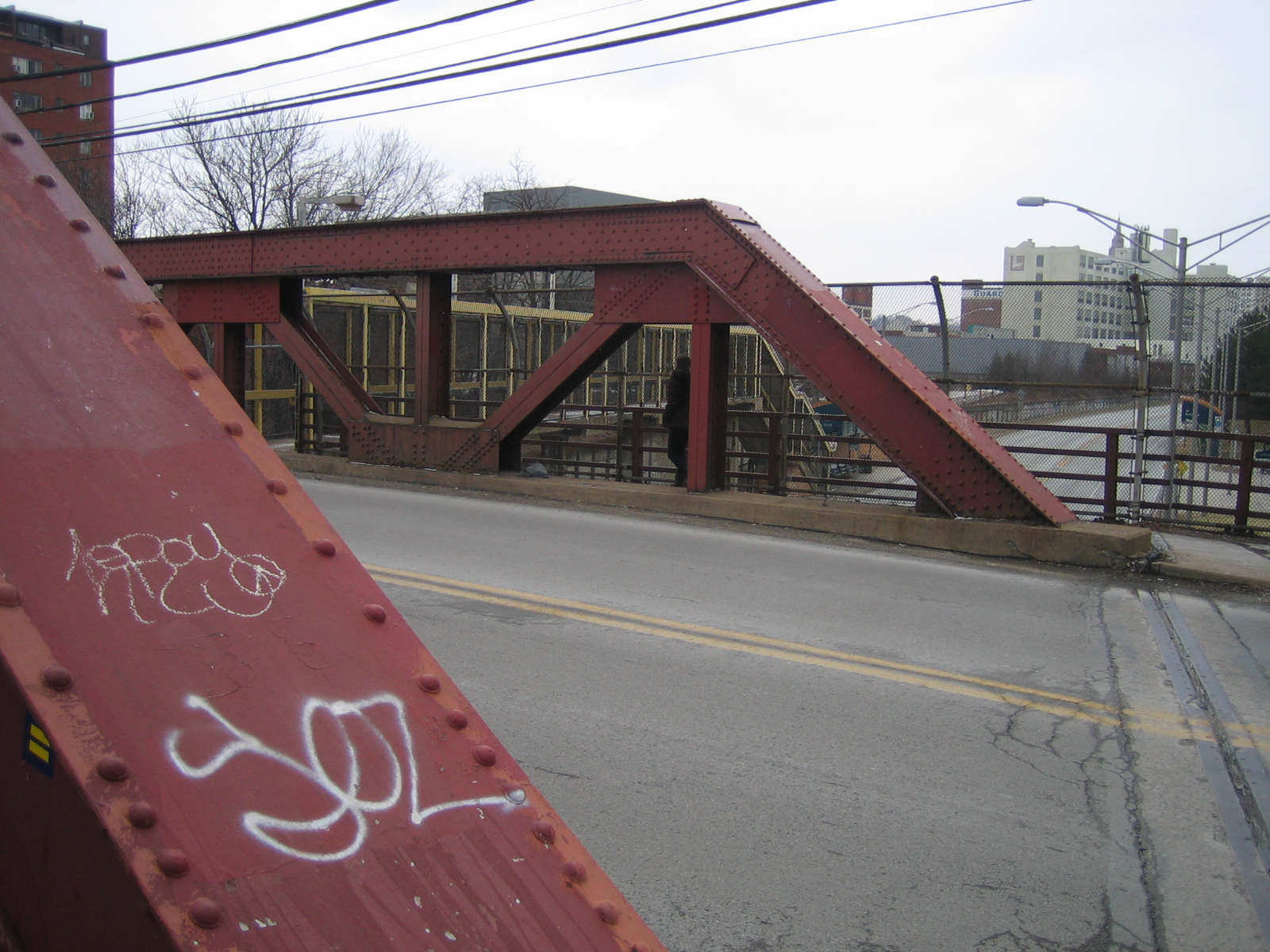
To get groceries, I regularly walk from my apartment in Shadyside to the Giant Eagle on the corner of Negley and Centre Ave. To get there, pedestrians cross a bridge that spans the East Busway, which runs parallel to Fifth and Centre like a deep vein through the city.

IMG_4632_2

This bridge, to my mind, marks a kind of separation between Shadyside and the neighborhoods of Friendship and East Liberty that lie adjacent to it. There’s decidedly different feel to the intersection just over the bridge—it’s a congested tangle of roads, lights, and cars; rounding the corner of Centre, a homeless man rattles a cup at people on their way to buy milk and bread. Only a few minutes away are the cobblestones of Walnut with its Banana Republic and a leather goods boutique, but it feels much farther. Cities are like this.

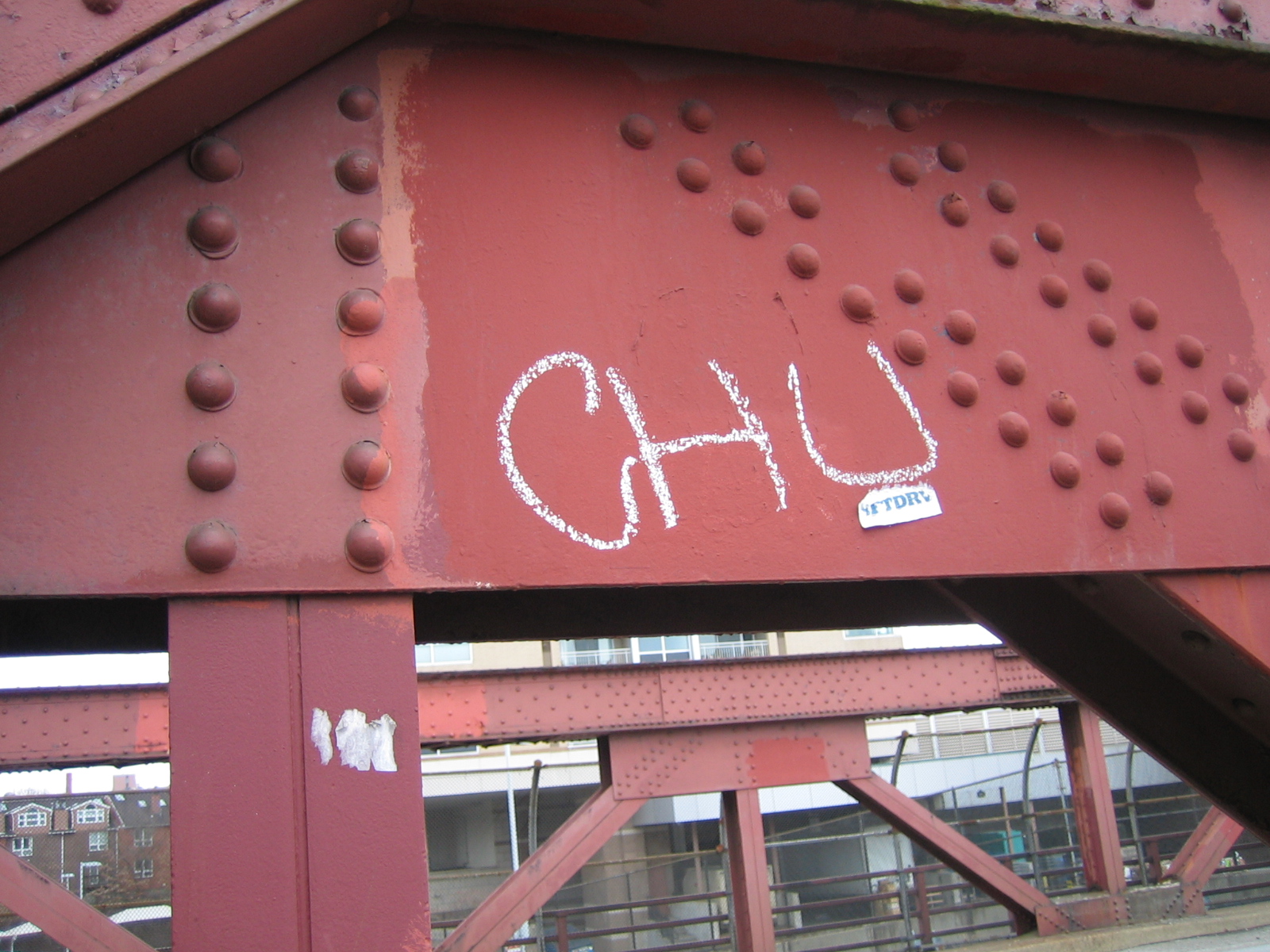
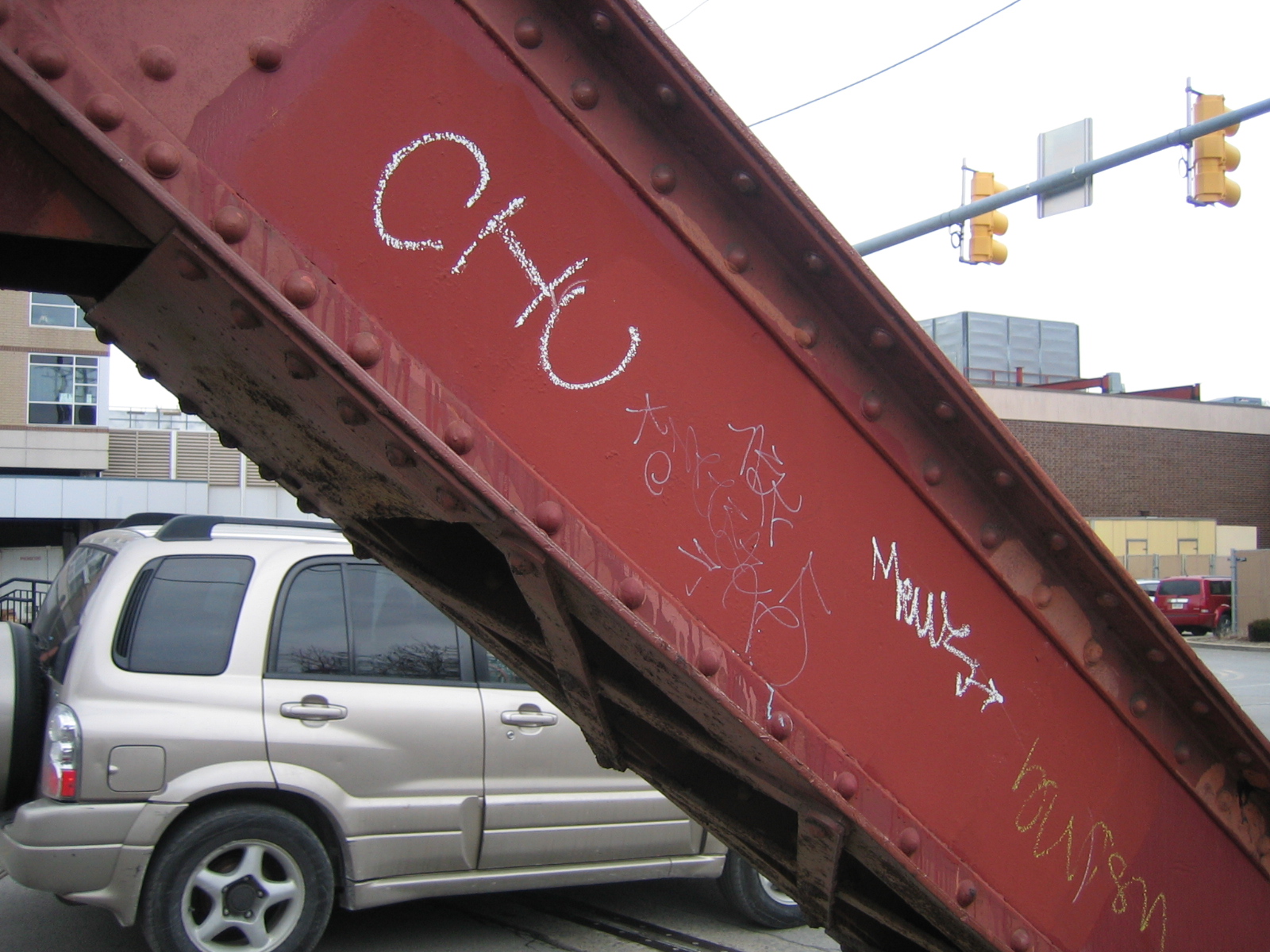
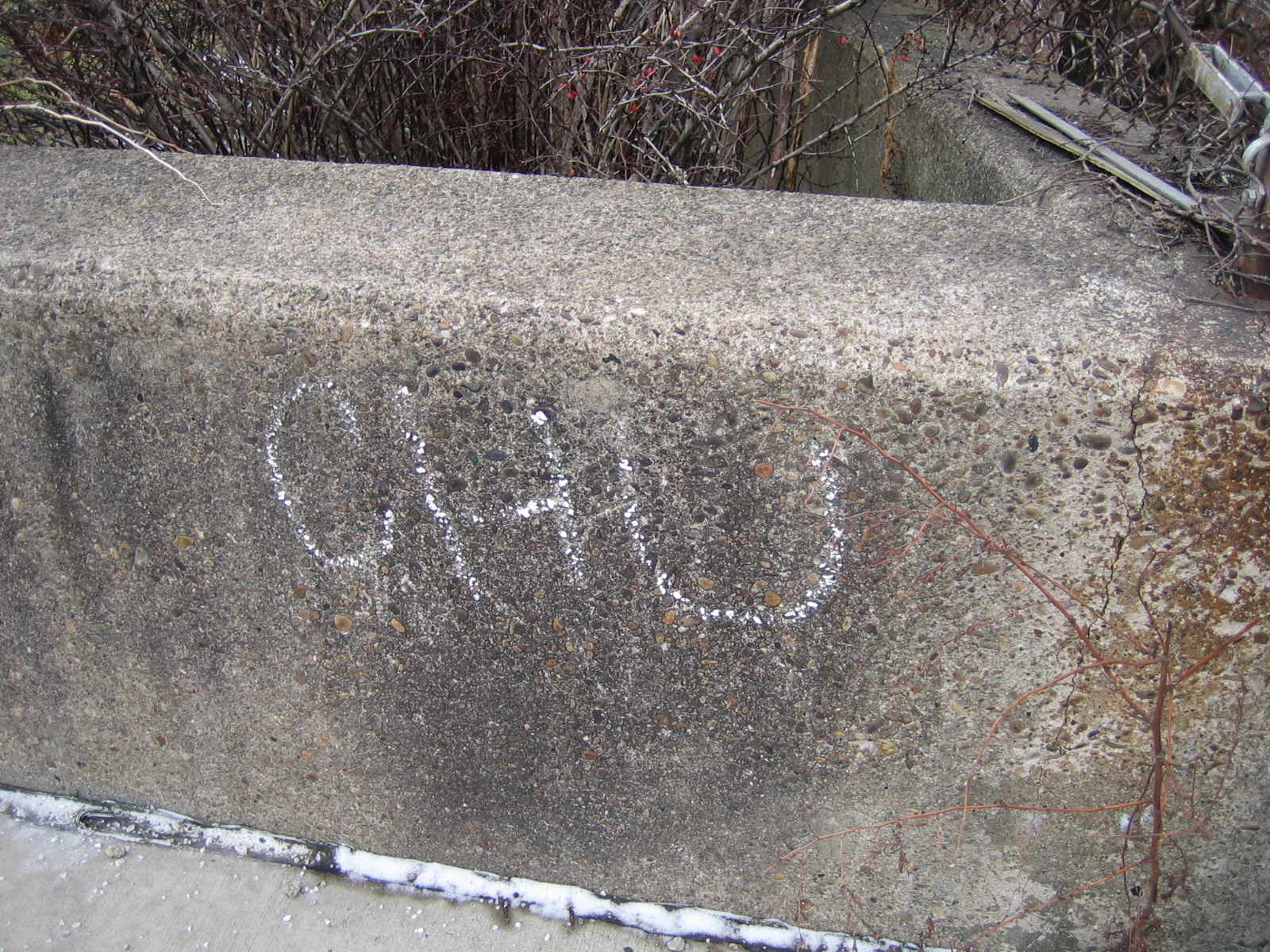
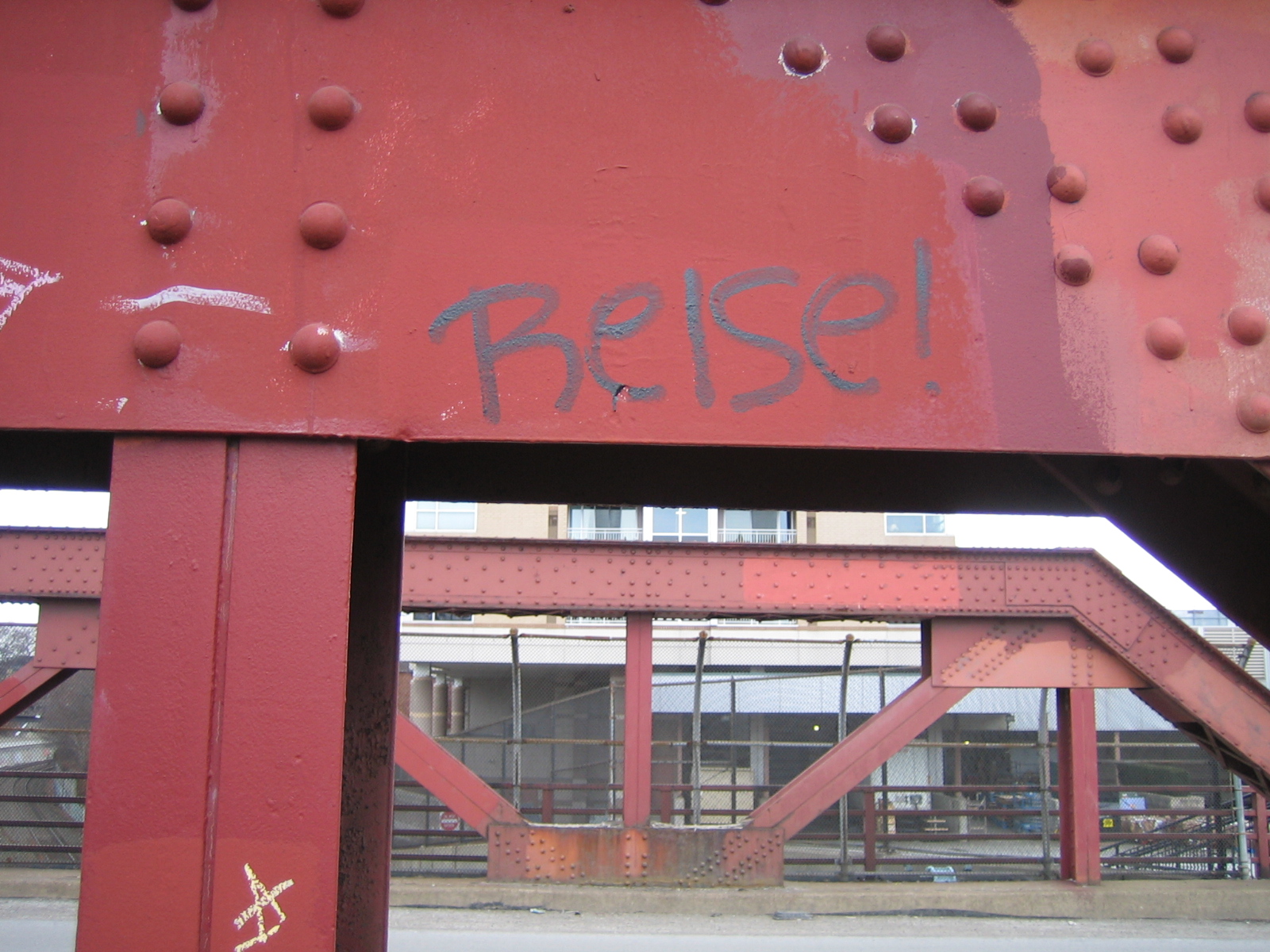
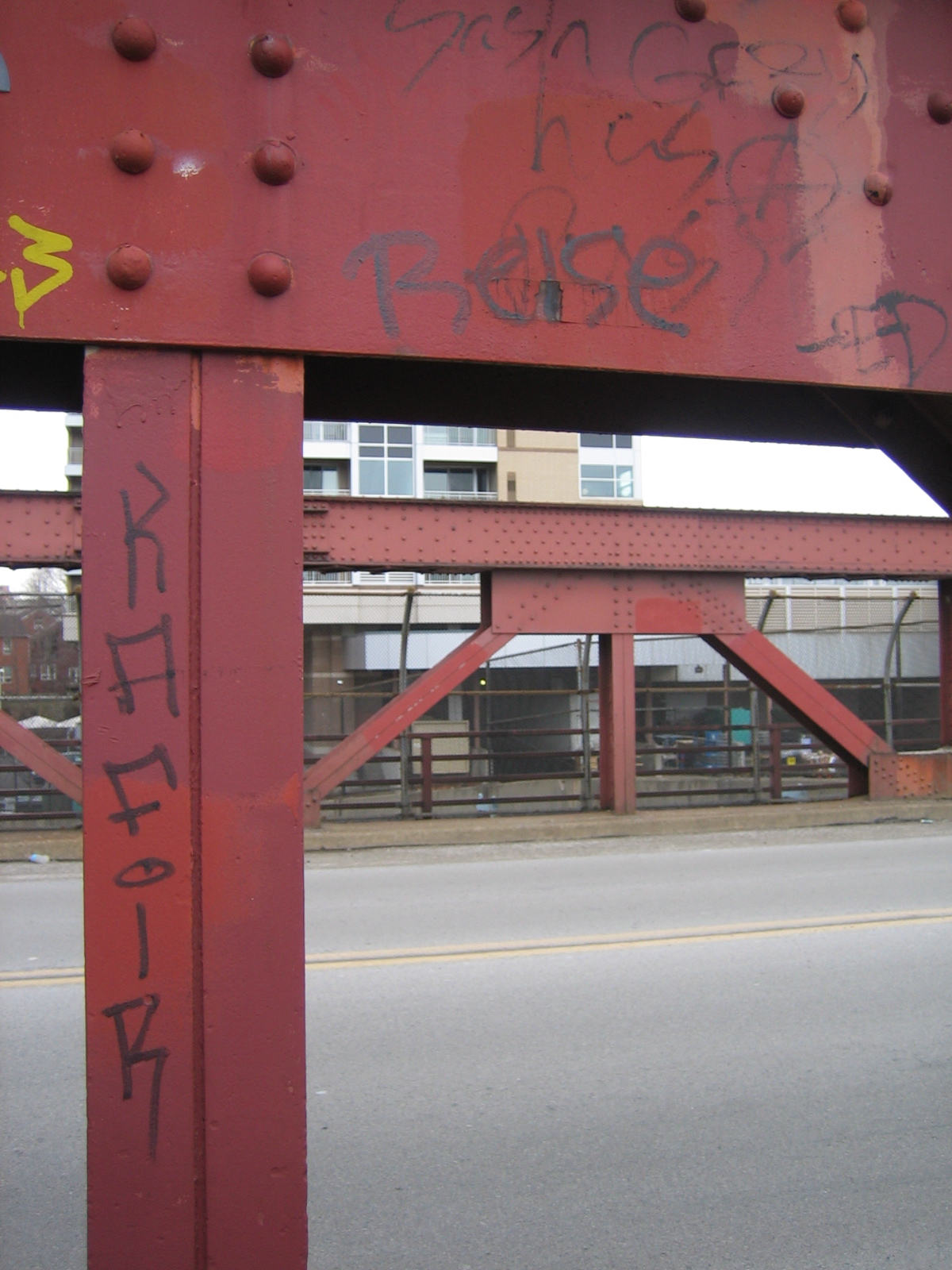
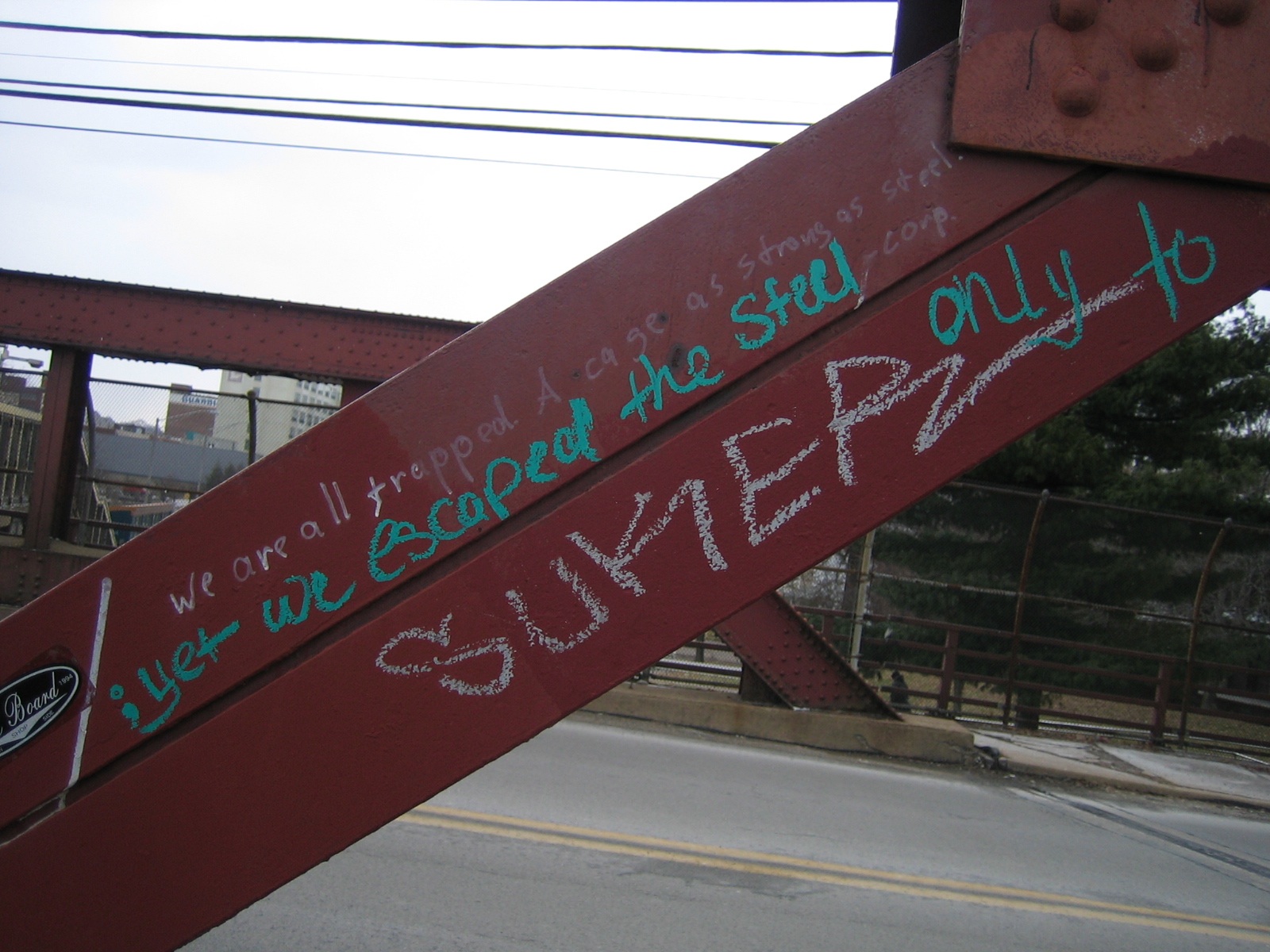
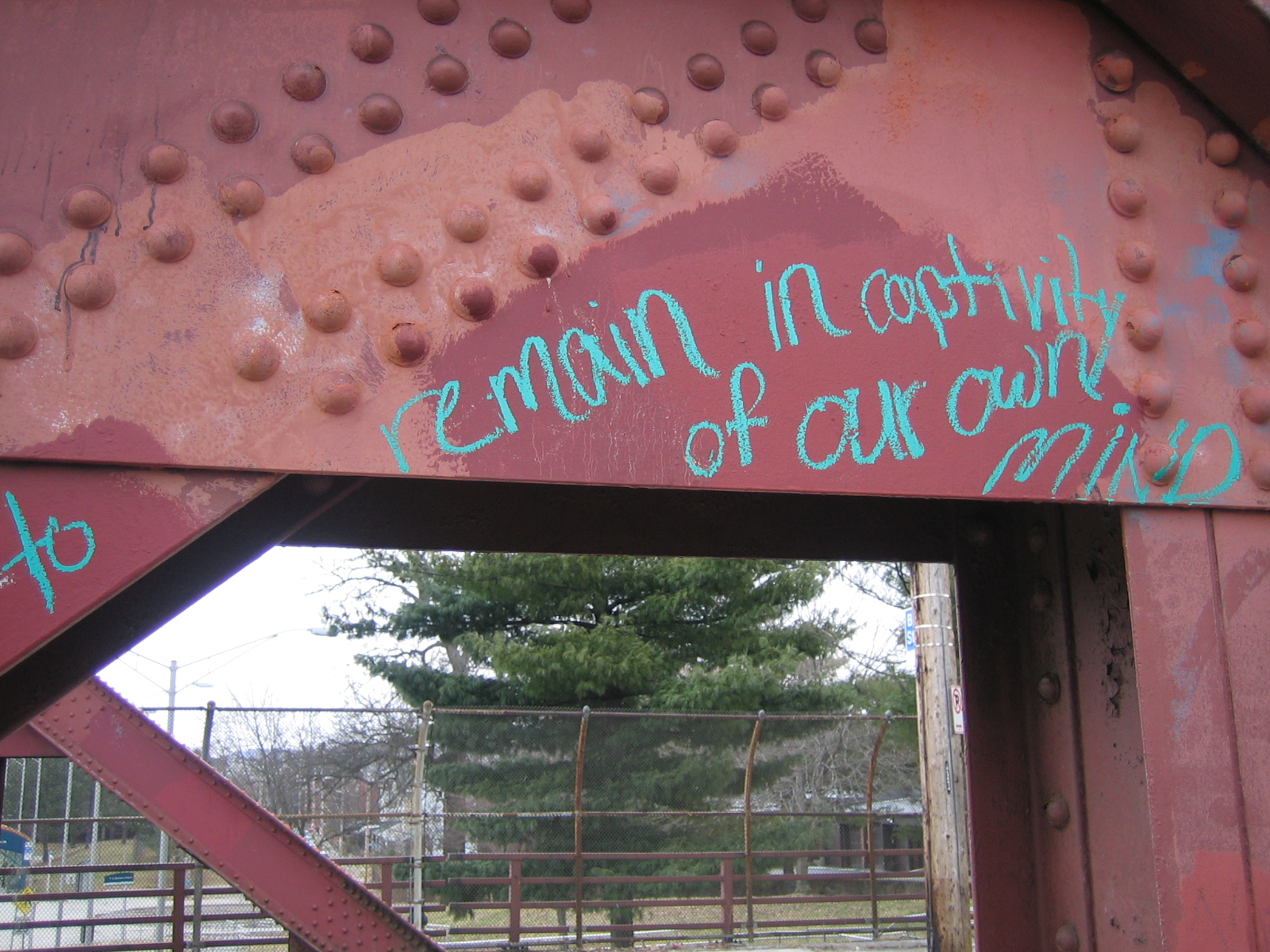
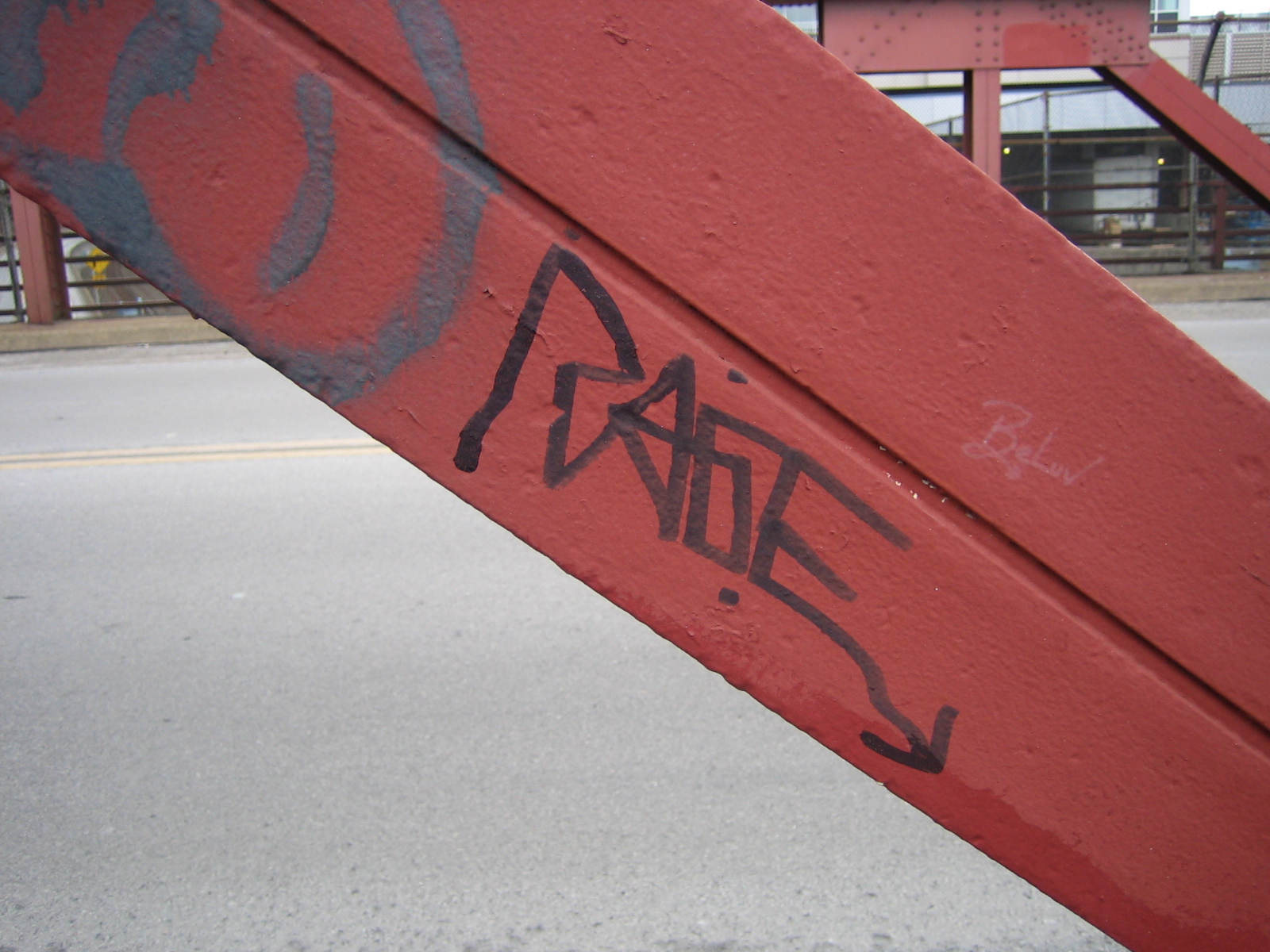
I had noticed the graffiti on this bridge before, but I returned to look at it today with new interest. I felt sure its taggers must have noticed, or felt, as I did, that it marked a significant artery between neighborhoods. These writers seem to strive for ownership, exposure, and expression by marking this unglamorous but crucial thoroughfare. Seeing the graffiti, I think this: others have been here before, others feel strongly enough about their ties to this city to mark it with their chosen names. In a way they claim it, as they force the metal and stone of the built environment to bear the traces of their hands and identities. I’m still not in a position to interpret these writings with any nuance, but maybe that can be allowed given how new my graffiti-literacy is.

So who has marked the bridge? Two names return over and over, competing with each other for exposure: “CHU” and “Relse.”

IMG_4608_2 IMG_4617 IMG_4619

IMG_4614 IMG_4612_2

Another rails generally against our social and economic conditions:

IMG_4627_2 IMG_4628

Another simply writes:

IMG_4613_2

Posted in Uncategorized | Comments Off on Reading the City