Marginaffiti (n): marginalia graffiti

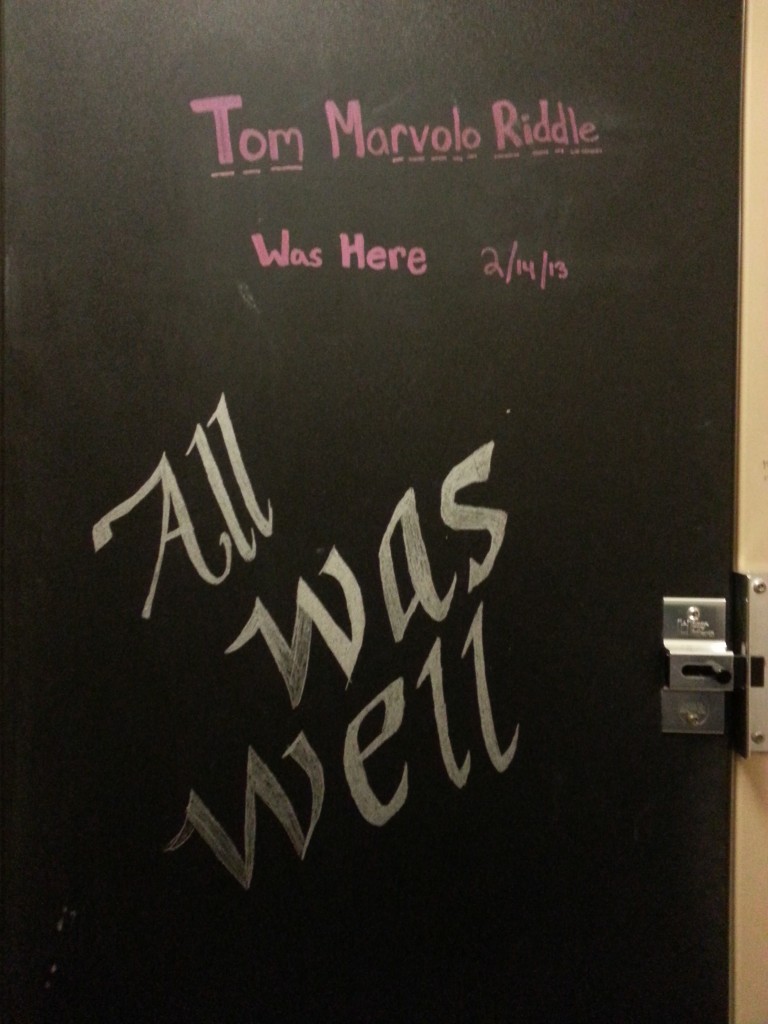
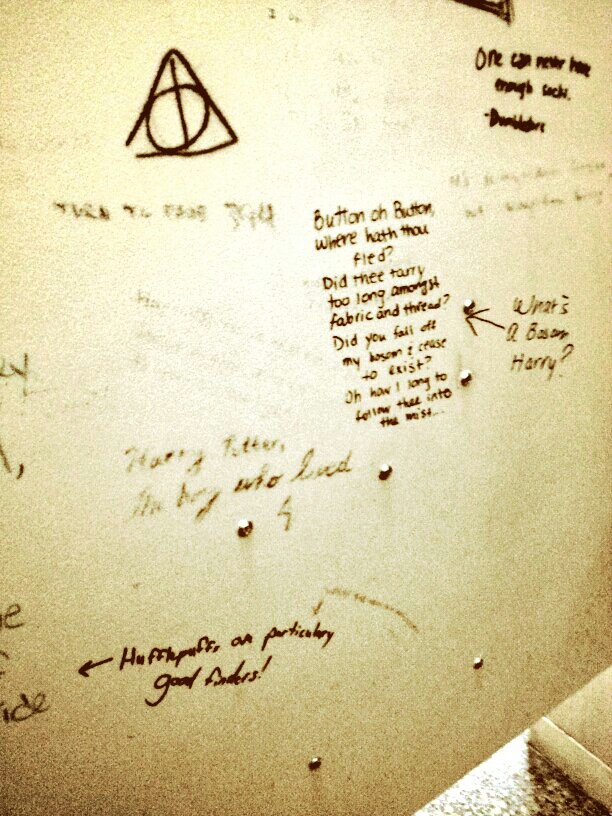
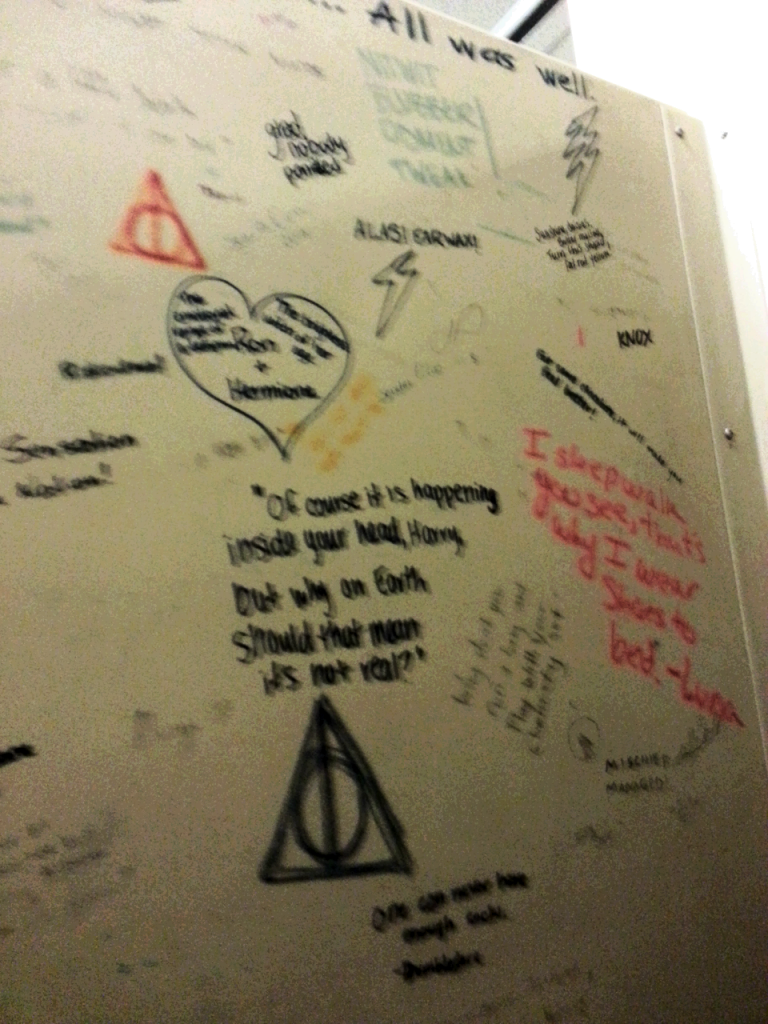
20140224_153514As perhaps only the women in this class may be aware, the women’s bathroom on the third floor of the Cathedral of Learning has a stall filled with Harry Potter graffiti, and/or (I’ll argue later) marginalia — so, mixed genre “unwelcomed” text(s). We know at this point that the generation of undergraduates attending college at this moment were raised on the Harry Potter books, and the graffiti shows a fierce attachment to the books, and also seem to represent some kind of solidarity amongst the writers. The writers hold the first ethical precept of graffiti writers Joe Austin outlines in Taking the Train (55): out of respect, no writer writes over the others’ work. The disrespectful writing in this mural of quotation and symbolism from the Potter books is present, but minimal.   There is also, of course, the occasional intrusion of non-Potter related graffiti, which also remains unaltered, but is generally ignored by the other markers.
1393340344773

The style and individuality of the marks (as per Austin’s second ethical precept), is not a factor for these writers. What is of value, instead, is their relation to one another. The collaborative work. For several of the writers, they draw arrows to other people’s writings, not unlike the hand symbol Sherman discusses in his discussion of Renaissance marginalia. It offers the writer opportunities to respond in turn or in kind, either with other quotations or individual marks of relation. I only read the Harry Potter Books once (I believe as “escape” reading after my MFA applications, right when the last book came out?) so I’m sure I am missing interesting points of connection — but it’s the collaborative approach to this graffiti that is so interesting. It is so very unlike the politically charged graffiti of the 1970s and so much more like the marginalia of Sherman’s Renaissance. 
2014-02-25 14.52.18

It’s like the idea of the “et amicorum” (with friends) with the signatures of book owners, the stall “radically customized” as a new locale of intertextual relationships. I can’t help but think of this stall as a displaced margin — a white space where dialogue happens with the original text and with other readers. I think of retweets and literary tattoos in the same sense — displaced marginalia — a materialization of one’s process of reading, a way that lets a text come with you, or as archived in an alternative place than the pages of a book. A space that lets others engage in turn. Even if primarily through requotation, those texts as appropriated, adequately cited with their original proclaimers or not, acquire new and/or sustained lives on the bathroom stall walls. It’s the stall I go to every time — not only to have something to read, but to relish in the vibrant material and textual relationship happening in this space.

p.s. most of my definition titles come from the OED… this one was clearly made up.
Posted in Uncategorized | 1 Comment

Desecration & Evidence.

…their traces struck me not as desecration but as potential sources of evidence.

—William Sherman (Books & Readers in Early Modern England 123)

1

For this first story, I have nothing to show you.  This is a memory, brought round by Joe Austin’s Taking the Trains, and it’s been about twenty years since the place remembered existed as such.

Route 12 is the highway I took to go to church, youth group, dance lessons, my dad’s office, the bank, the grocery store, the drive-in, ice cream in the summer, public skating in the winter, a series of despised summer jobs waiting tables, and various inane local “festivals” that usually involved sloppy drunks clothed in pirate costume and, when I was older, anxious encounters with frenemies and former boyfriends.  Though by then, the graffiti was already long gone.  The portion of highway that I’m thinking of—two lanes connecting Alexandria Bay to Route 37 in Morristown—was dynamited into the bedrock running along the St. Lawrence River sometime when my dad was a kid, and along this length of highway, one drives through pine woods and marsh and descends into rock cuts that make the radio crackle.

When I was very young, these rock cuts were covered in graffiti: I remember the neon pinks and blues and yellows against matte brown rock.  I remember the enigmatic initials and symbols and how it was the placing of the declaration of forever-love on rocks at a precarious height that made it seem like a promise Bob and Jackie were still keeping.

Like Joe Austin’s urban graffiti, the general public considered this rural graffiti a blight; there must have been movements to clean up rocks and crack down on painters, though I don’t know for sure.  As a kid, I was largely outside of that conversation, busy mentally transforming certain graffiti into personal landmarks on the ride home from Alexandria Bay.  There was a Daffy Duck, perhaps ten feet tall, on a wide, flat rock-face that I thought the epitome of artistry.  When I saw it, I knew we were only a minute or so from home.  Daffy held out for a while after all the promises, curses, and affirmations vanished, and then he, too, faded into the rock, lightest colors first.  I mostly don’t notice the rock now, but sometimes I do, and for a moment I think I might still see him there, like the shadow-traces that decayed leaves impress on sidewalks.


2

Unwanted Marginalia

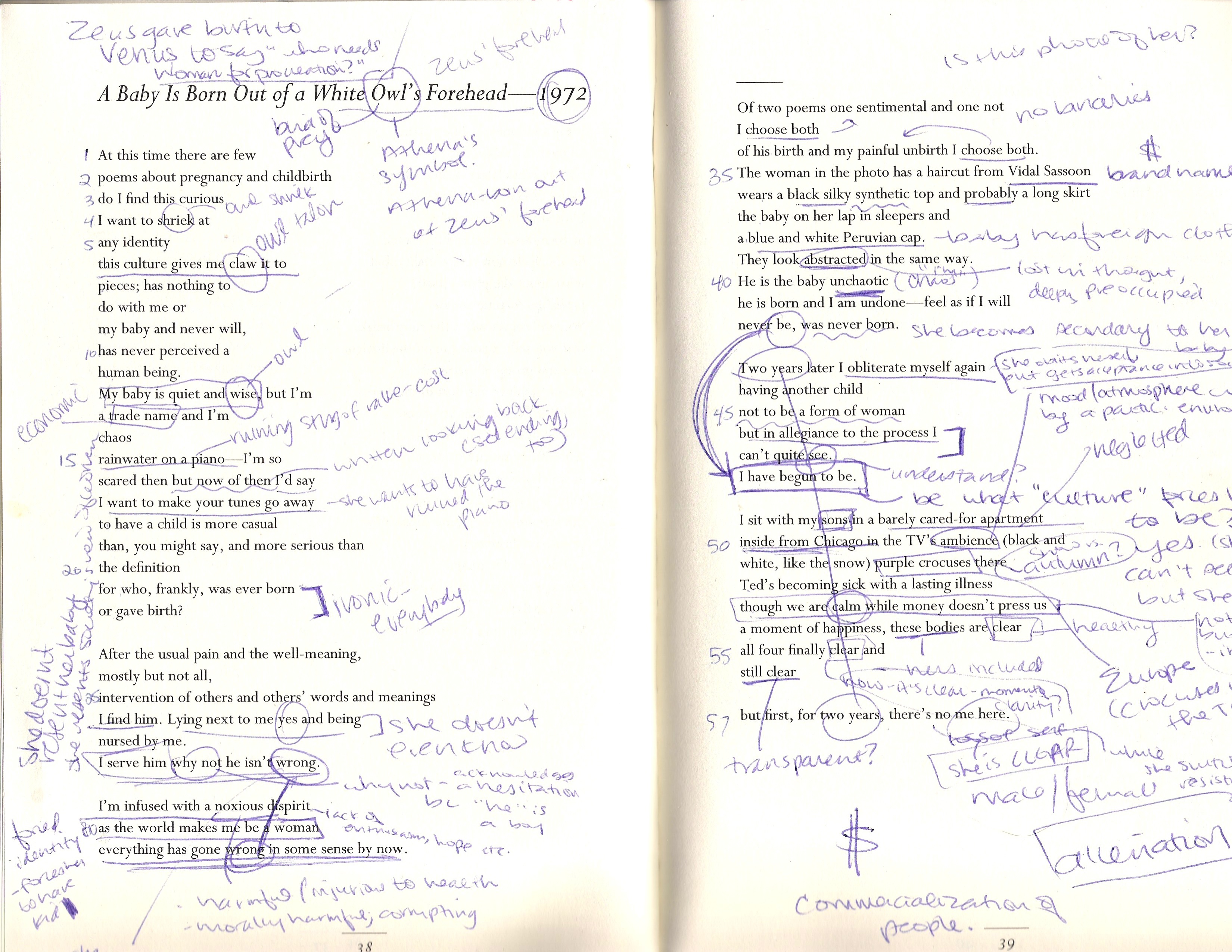
This is the book that broke the camel’s back.  I mean: this is the last book I bought from Amazon under the personal policy of buying the cheapest used copy available.  I bought Alice Notley’s Mysteries of Small Houses precisely for this poem, “A Baby Is Born Out of a White Owl’s Forehead—1972,” and this is what the poem looked like—only this poem and one other—when the book came in the mail.

It’s not just about the unreadableness of the poem, or the sloppy handwriting, or the cheap ballpoint (although, yes, clearly, it is very much about these things), but it’s also about the way this marginalia exists in relationship to the poem.  It’s about the kind of reading this marginalia evidences: as if, by writing extensive analytical notes in the style of a New Critics parody, the reader might come to “Understand” the poem.  Capital-U Understand.  And Understand in order to write a terrible, sterile analytical essay or pass a pop quiz, which, frankly, pains me.

Obviously, I have a special animosity reserved for the unknown reader of this piece.  But it kills me that anyone would read a poem this way, or instruct someone else to read a poem this way, especially a poem like Notley’s: experimental, conversational, both lyric and prosaic, in the business of sifting through the syntactical layers of reminiscence.  Notley writes, “to have a child is more casual / than, you might say, and more serious than / the definition / for who, frankly, was ever born / or gave birth?” And the reader responds, as one might to a question for which one has entirely missed the point, the pain, the wonder: ironic—everybody.

I found it impossible to inhabit this book the way I wanted to—even the other poems on which there was nothing written.  I can’t exactly articulate why: I realize there’s no good reason for my outrage or for the fact that I never finished this book (a wonderful book) and never picked it up again until today, to scan these two “desecrated” pages.  I don’t even think books are sacred spaces; nor do I think poems are sacred.  But I do think poems deserve—demand—a certain kind of reading engagement—maybe they ask us to approach them with more generosity and intuition than we would approach another kind of text—and the approach inherent in this marginalia, with all of its relentless semantic connection-making, is not it.  Not it.

Posted in Uncategorized | Comments Off on Desecration & Evidence.

Marginalia for learning

I’m not a marginalia person.  I don’t do it myself, and I don’t like seeing it by other people in my books.  So when I buy used books I flip through them first to make sure they’re clean.  Sometimes I don’t have an option, and I’ll just deal with it.

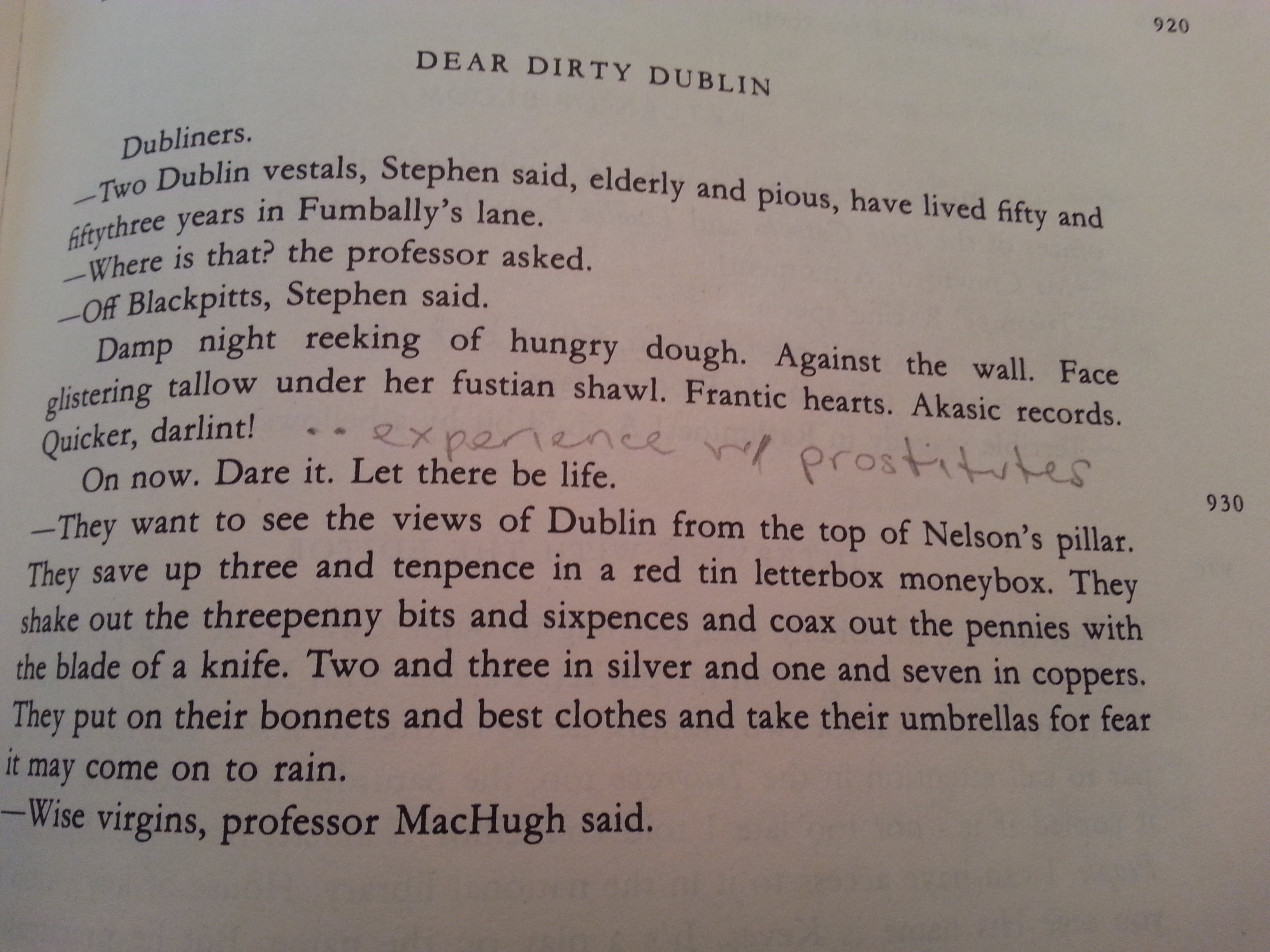
When I was an undergrad I took a James Joyce class.  For the used Ulysses copy I bought, I can’t remember if I was in a rush or if it was the only copy left or if it was the least written in copy.  There is marginalia throughout, written in pencil, although I can flip ten, twenty pages without seeing any markings.

I thought of my marginalia’d Ulysses while reading Brunton’s Spam reading.  Not because of the lit spam but because of the way spam works through both a computer and a computer user’s interaction with spam.  For spam to spread, spammers need the (usually unknowing) cooperation of the user and their computer.  It made me think of the much less nefarious working together that was my first time reading Ulysses with the help of the marginalia.

I definitely struggled reading Ulysses for the first time.  And I wouldn’t say every bit of marking helped me.  Her (..or his) markings include underlining lines and passages, notes, and numbers that I don’t think I realized at the time are previous chapters and the lines in said previous chapters that are being called back to.  I think the notes helped me the most.  Sometimes it was underlining and noting when Bloom is thinking about Martha’s letter, or other motifs.  In Aeolus, she expands:

20140225_115224

which I almost definitely wouldn’t have picked up on.  Ulysses is an unwieldy read, and I was glad to have someone there, even in a non-physical sense, to help with the puzzle.

Posted in Uncategorized | Comments Off on Marginalia for learning

Reading Markson Reading.

So, in anticipating all the very interesting marginalia next week, I thought I’d share a site that I’m rather in love with.

http://readingmarksonreading.tumblr.com/

If you’re not familiar with him, David Markson (died at 82 in summer of 2010) was a great writer, but under-read. He was arguably one of the better read writers around, although one wouldn’t intuit that until a late tetraology of books:

Reader’s Block, This is Not a Novel, Vanishing Point, The Last Novel.

Each one of these is a mix of throwaway moments or what one could consider marginalia in their own right. Yet Markson arranged them in a fascinating way. They are some of the best, most manic, and most pleasing reading I’ve ever done.

In any case, Markson also was an inveterate scribbler inside of books. When he died, sadly, his whole library was sold to The Strand in NYC. And not until a few perspicacious fans saw his inscription inside, did they decide to hunt for ALL OF THEM. Then begin posting the marginalia and connecting it with whatever he’d written in the past, etc.

My favorite marginalia is from his copy of Don DeLillo’s Mao II where he just writes, “Bullshit” next to a comment about art that he was not fond of.

I think people should be arguing and talking to the book, even in a banal way. I’m always so much more appreciative of books when I receive them and they are already in the middle of an argument or absurd digression. There’s a sense of mystery mixed with linearity that I don’t often get otherwise in life.

I’m going to post some marginalia by me and others that I’ve gotten soon…


Posted in Uncategorized | Comments Off on Reading Markson Reading.

Wintry Mix

Speaking of writers using materials in compelling ways, it just occurred to me that the Shelley Jackson currently making headlines (“Story in the Snow“) for her gorgeous snow project short story is the same woman responsible for the skin project! I remember yearning to be old enough to get a tattoo for the piece when it was announced in the early 2000s. While I’ve grown out of the phase since then (or have I?), the website says it’s still seeking participants…

Anyway, between the two, Jackson has chosen materials on nearly opposite ends of the spectrum of ephemerality, as well as the spectrum of public to private access — from photographing words in the snow to distributing words for volunteered to have tattooed. I’m sure there are many other factors to reflect on, as well. Do you all have other writers you admire for using materials creatively or non-traditionally to tell stories, etc.?

Unrelated to this post, another blast from the past: “Fear of Reading” (1992) brings me endless joy and was I was reminded of it in class last week via: “(d) Miscellaneous Bibliodysfunction: Aversion to the typeface used; an onslaught of shivers every time you touch the paper; thinking the book smells funny.”

Also: remember last summer when the creator of Comic Sans spoke out about his font?

Posted in Uncategorized | Comments Off on Wintry Mix

The art of failure.

So….

At this point, I’ve spend about 4-6 hours on this. But I don’t have a finished product. My original idea for this signment was to create a variation on a “Dr. Seuss” font. When I was in high school, we had these old-skool overhead projectors in math class. (I swear I’m not a math nerd, I don’t know why I keep bringing up math. I’m not myself.) Anyway, we’d write on these transparent cellulose-based pieces of paper that had been printed with math problems with dry erase markers in front of the class. You know, everyone do math LIVE, don’t mess up. And one time, in algebra, I was working out a problem. In algebra, math sometimes involves letters, although the signification is quite different and not actually related to the English language. Probably the Greeks, it all goes back to the Greeks. (“Or does it???”—Joanna Drucker.) The point is this: a kid in the class yelled out that my handwriting looked like Dr. Seuss. At the time, I wasn’t sure what that meant, except perhaps irregular or quirky or weird. Yet, the statement stuck with me. If I was called upon to describe my handwriting today, I’d probably say “like Dr. Seuss” automatically, yet with a vague and detached air because I don’t actually know what that means.

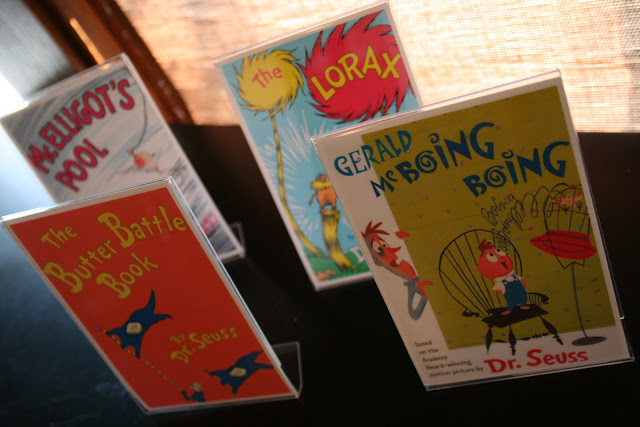
After perusing Ellen Lupton’s guide and re-viewing Helvetica, I decided to really find out what font(s) Dr. Seuss used. I did some hard-hitting research on Google, and from the first few entries, it seems that Dr. Seuss books primarily contain several different variations of Garamond. I also found someone claiming that there was a trademarked font called “Dr Soos,” but I’m dubious, that was on a yahoo thread or something. I decided to look at pictures of Seussian book covers.

drseuss

The “By Dr. Seuss” is pretty consistent in appearance, but the other type varies dramatically from book to book, and from the “By Dr. Seuss” font itself. Many of these fonts look like they MUST be illustrated to me, rather than a regular font. (Note the curly-cues etc.) Also, worthy of note: Garamond is a serif font, but these books are pretty willy nilly and inconsistent in their use of serifs, and tend to lean more heavily toward the sans serif than the serif. However, the capital “D” and “B” in “By Dr. Seuss” always maintain a humble yet blocky serif, in flagrant disregard of what the rest of the letters are doing, which usually does not involve serifs. However, like with Garamond, with Seuss, we see the “lilting” counters by which Lupton characterizes “humanist” typefaces.

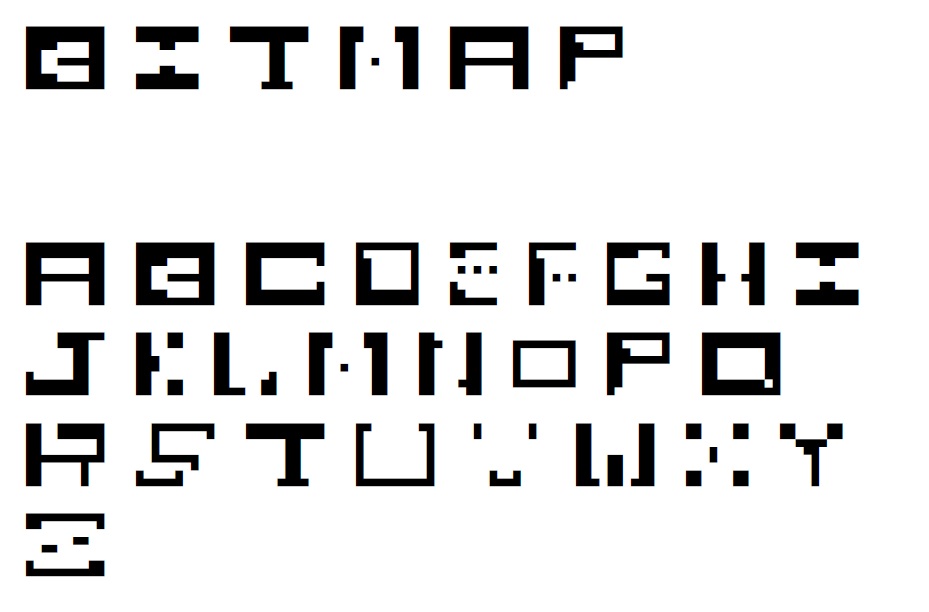
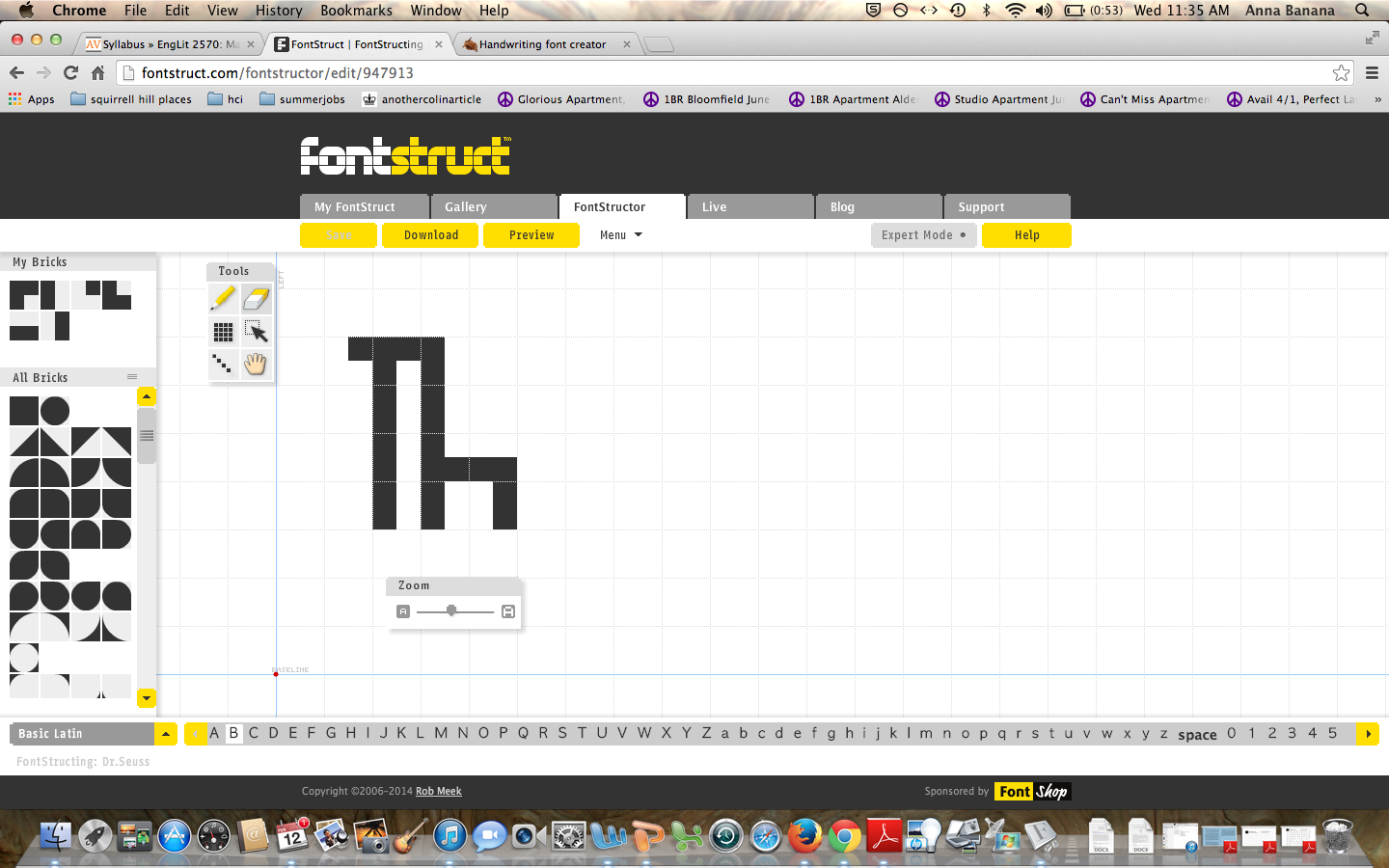
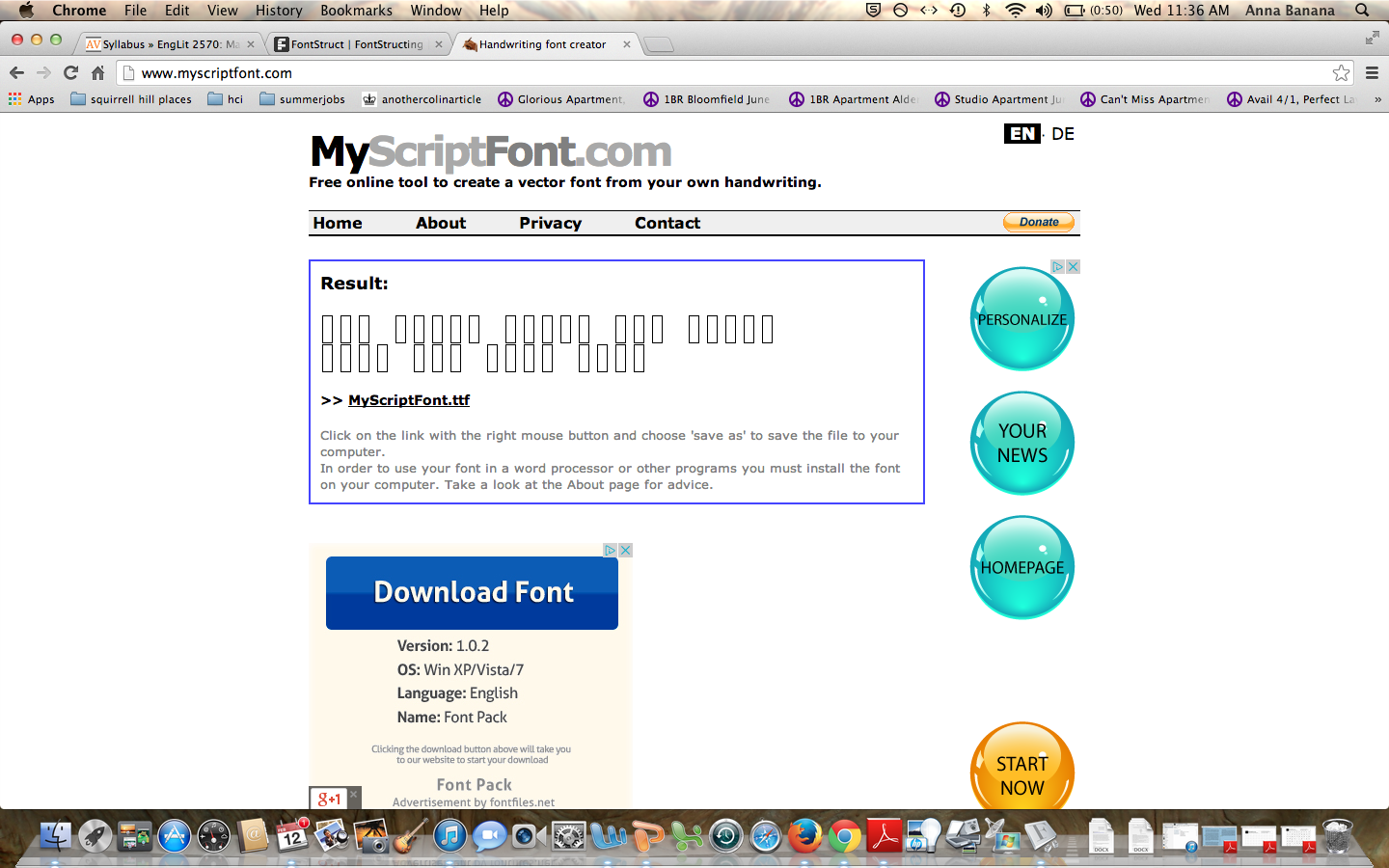
I wanted to design my own version of Dr. Seuss, one completely sans serif and without lilting counters, BUT with a certain lilting character to the lines, an almost-italics-but-not-really (in bad taste.) That’s how I write, my upright, vertical lines tend to lilt to the right, merging with the next letter, and refusing to remain upright. Something about this seems Seussian. However, I completely failed at finishing the task in either fonstruct or myscriptfont in a reasonable amount of time. With fonstruct, I couldn’t judge how the letters looked TOGETHER, side by side, if I followed it’s letter by letter format. When I tried to just write a sentence within a one-letter space it started glitching out on me. Also, the bricks weren’t allowing me to design a lilting font anyway.

Screen Shot 2014-02-12 at 11.35.41 AM

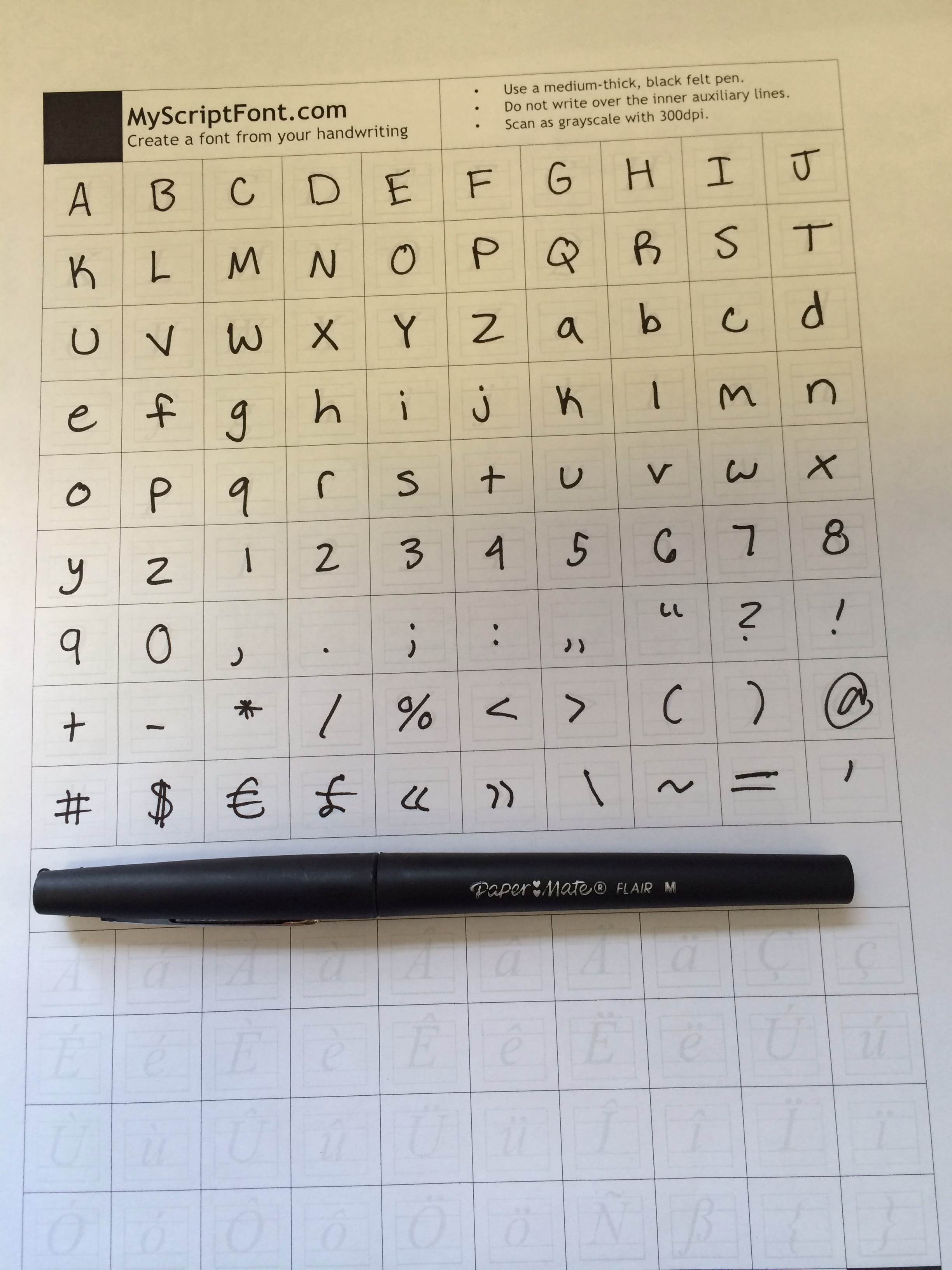
This morning I switched over to myfontscript. I’m not really sure what went wrong here. As you see, both of my font attempts ended up being super modernist and abstract, and not dissimilar to furniture in appearance. I’ve included my template to give you an idea of just how wrong things went. I haven’t had time to investigate why though. I’m hungry. Also worthy of note: things went wrong on the template too. I couldn’t really lilt as desired because they have these guiding letters that lilt in a Kindergarten-teacher, not a Seussian way. I kept spazzing out and following those lines instead of doing my own thing.

lilt

Screen Shot 2014-02-12 at 11.36.11 AM

Not what I was going for at all. Although, it is interesting to think about how much failure resembles IKEA.


Posted in Uncategorized | Comments Off on The art of failure.