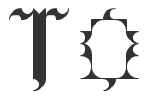
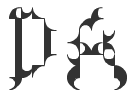
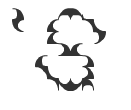
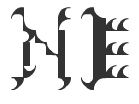
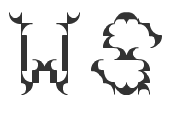
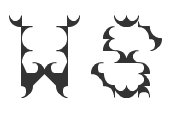
flames

Screen shot 2014-02-10 at 5.16.41 PM  Screen shot 2014-02-10 at 5.18.24 PM Screen shot 2014-02-10 at 5.18.29 PM Screen shot 2014-02-10 at 5.18.34 PMScreen shot 2014-02-10 at 5.18.40 PM  Screen shot 2014-02-10 at 5.18.45 PM Screen shot 2014-02-10 at 5.18.50 PM Screen shot 2014-02-10 at 5.18.55 PM

okay, this is the first try of my flame font.  I saw the flame shapes on fontstructure and they just spoke to me.  So then I wrote this like it’s some newsletter from hell.  I only made capital letters, I think this font would be only used for decorative purposes, so it wouldn’t be used to write out whole paragraphs.  I screenshot this directly from the webpage’s preview screen and did two letters in each shot, hence the unevenness of some of the words sorry about that.

I could see this font being used on posters for a hell-themed party (or a New Jersey Devils fan gathering).  Or I can see it being used by a snowboarding brand, either on a snowboard itself or a t-shirt or sweater.

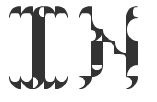
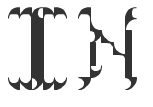
I am really really pleased with the “Y”.  the “W” actually gave me the most trouble.  I tweaked the “W”, “D”, and “S” after this first go.Screen shot 2014-02-10 at 5.40.43 PM Screen shot 2014-02-10 at 5.40.48 PMI worked on tweaking the “N” to using the thicker straight lines, but felt it just looked better with the thinner lines.  I think Lupton would hate that I didn’t keep line widths consistent, so here is a comparison Screen shot 2014-02-10 at 5.47.44 PM

Posted in Uncategorized | Comments Off on flames

Mind Your Gs and Qs: A Cautionary Tale

Set Up

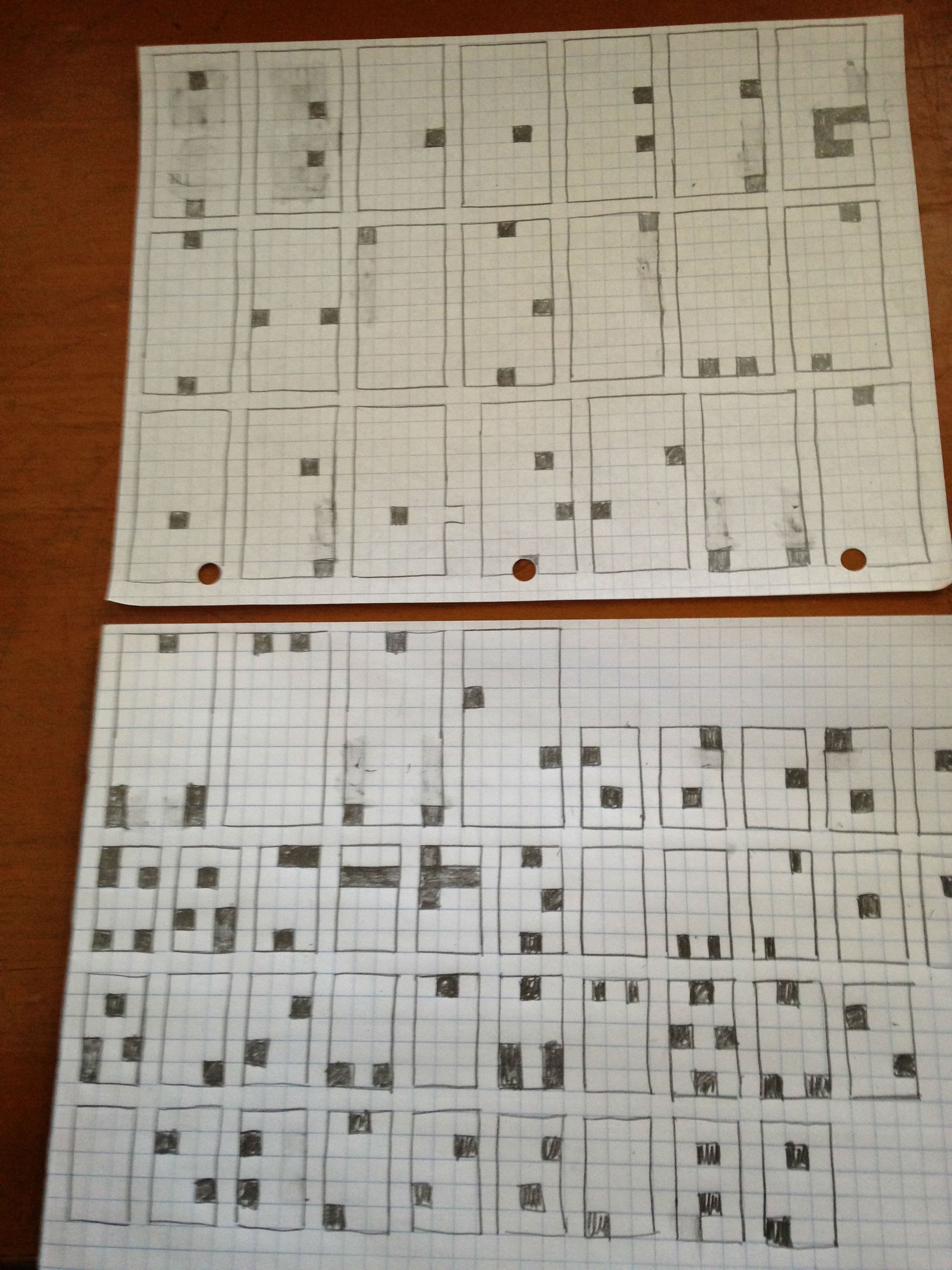
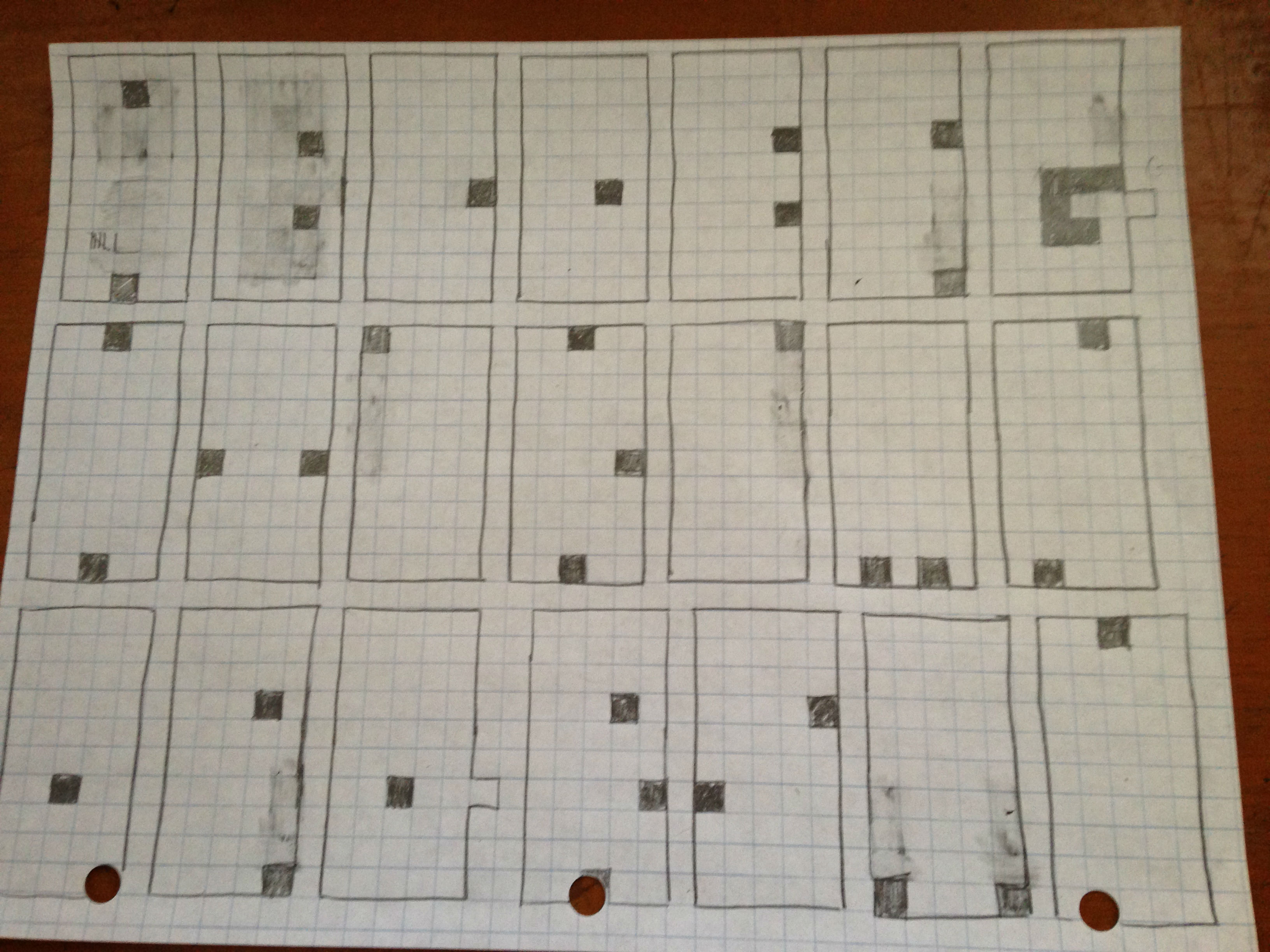
Originally, I wanted to craft a font comprised of my big, dumb face making vowel and consonant faces. My thought was maybe I could create a “font” that could be “read” by Wylie. I could use it to spell out words like “m-a-m-a” and “d-a-d-a” by flashing images of me making m-face a-face m-face a-face. But then I started thinking about “C” and “K.” What’s the difference between c-face and k-face? And what about “M” and “P,” which, but for some tension of the lips, look the same at the beginning of their sound. It’s the act of saying “P” that differentiates it from “M.” So I considered making a font comprised of gifs of my big, dumb face making vowel and consonant faces. But then I realized this was a rabbit hole. A hugely time-consuming rabbit hole that would have me spend more time making gifs of my big, dumb face making vowel and consonant sounds for my son, than I would be spending time making big, dumb vowel and consonant sounds for my son in person.


So, I did the “Modular Letterforms” activity on page 78.


The Font’s Not the Interest, the Making of It Is

IMG_3287 IMG_3288 IMG_3289


One of my first aesthetic decisions was that I wanted letters that were about twice as high as they were wide. I can’t necessarily fully account for this aesthetic decision, but I think it comes from my own handwriting, which tends to be pretty tall (I think), but not so tall that it looks like it’s going to fall over. It’s tall, but it’s got a good base to it. Might this aesthetic decision somehow be wrapped up in my own body image?

Working with graph paper, I reasoned that three wide, six high might be too small for some letters. M and N, for example. I figured they’d need more space for the little spatial incursions. (This is foresight that I lacked when I transitioned to my lowercase letters, incidentally. More on that later.) So, I settled on five squares wide, ten squares high for each letter.

Next, I wanted the incursions, the spaces that cut into the 5×10 block to be minimal. I hadn’t yet thought about how big the islands of space in the letters ought to be, so I used a bunch of blocks at first. I kept the incursions small, but the islands grew big.

This changed around the letter D. How, I thought, could one properly differentiate between a D and an O if the island of space inside the block was equally large. There ought to be some way of positioning the island of space inside the D block to the right, while centering the island of space inside the O block. But I was only working with islands that had the possibility of being three squares wide. So what? Make them two squares wide? Then you couldn’t center the island inside the O block, and one of the reasons I chose a 5-square wide base was for the centering possibilities. So, I figured that like the incursions of space into the block, I would also make the islands as minimal as possible. One square islands of space. This allowed me to position the islands to the right in a letter like D, while keeping them centered for letters like O and Q. This also meant that I had to do some erasing inside my A block.

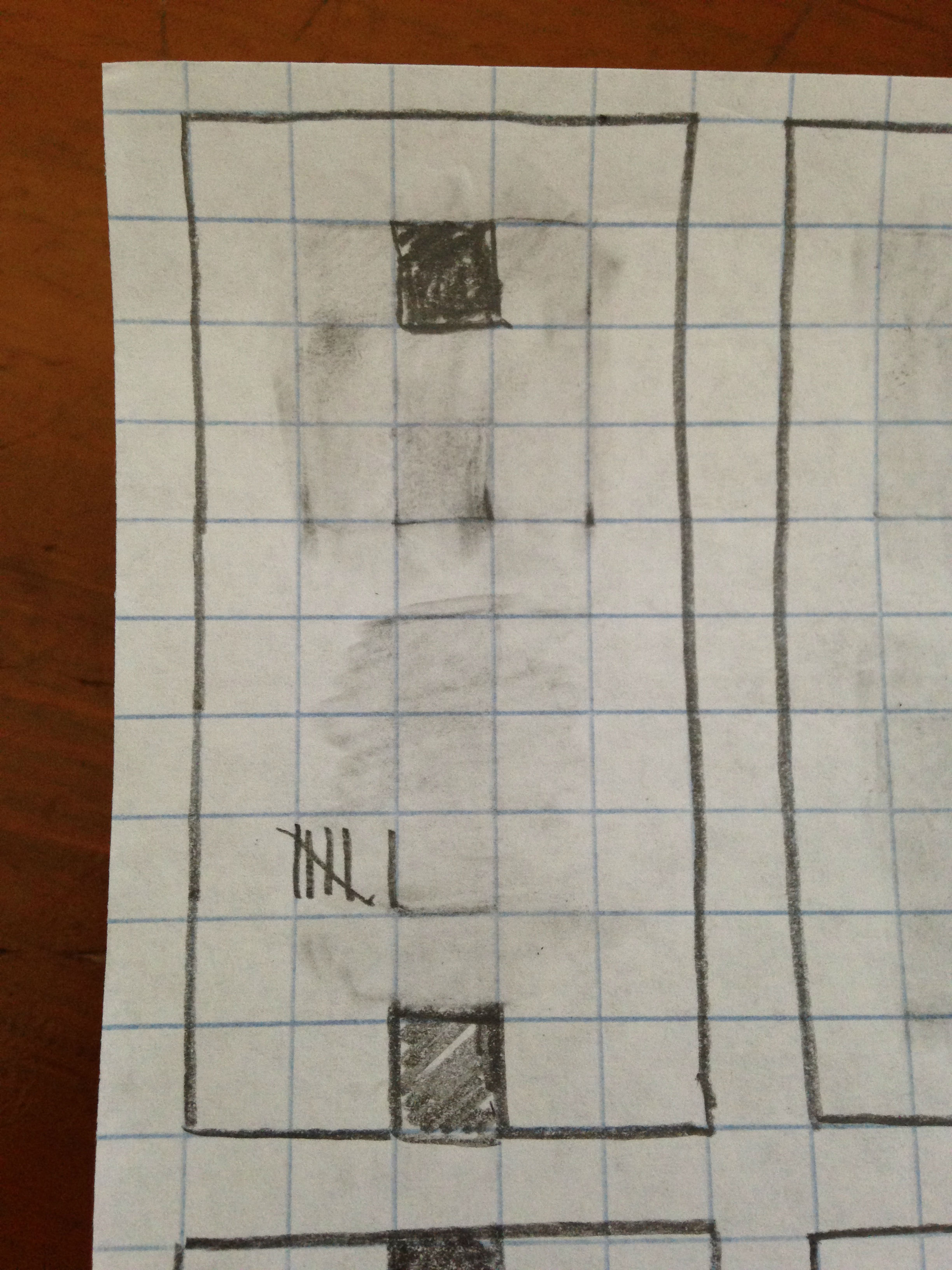
IMG_3290In fact, I did a lot of erasing inside my A block. Here’s a close up with a tally I kept of the number of times I made changes to this first letter. It wasn’t until about the letter H that I stopped going back to A to “fix it.” So, basically, for the first eight letters I tried to create for this font, I had to make amendments to my first letter six times, or 75%. This got to be a joke after awhile, but it made me realize that font creation is much like sestina writing. You’re working within constraints (incompletely designed though they were for me), and your operational decisions in those constraints represent an aesthetic-in-development. I had an aesthetic notion (a very rough aesthetic notion) of how I wanted my letters to look. But I had to, at least with the A and sometimes with the B, go back and amend that look as new constraints and problems and possibilities presented themselves.

Fuck You, GQ

When I hit my stride, the letters started writing themselves, particularly when I got to letters that mirrored other letters, as with M and W, S and Z, or J and L. Because of how I was creating these clunky letters, I knew that as soon as I got M, I had W, and as soon as I had S, I had Z. So for most of the letters in the alphabet, I cruised right along.

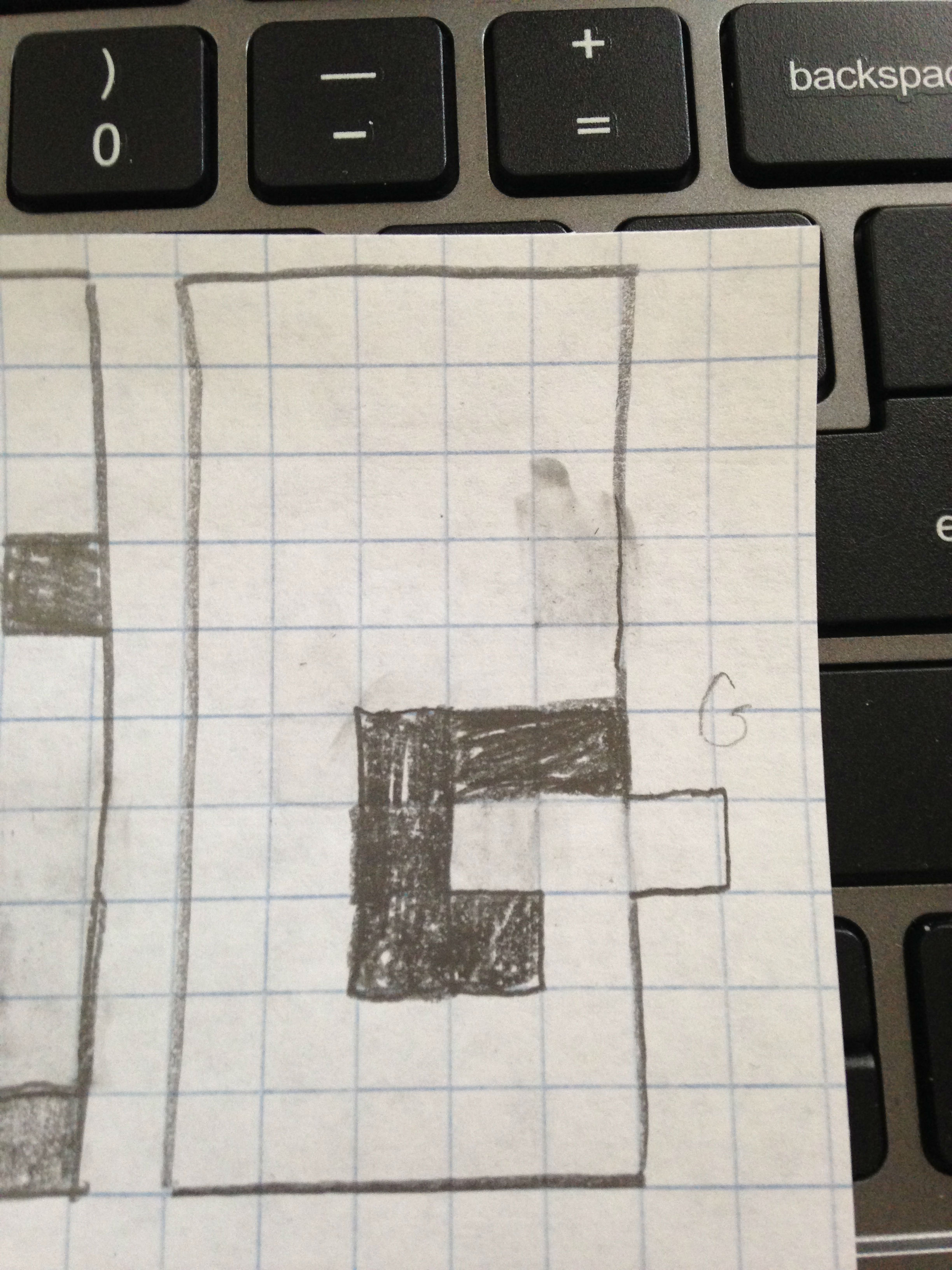
Except for G. I stared at the 5×10 block with much consternation before finally deciding to move on and come back to it. And Q was an even bigger nightmare. I actually had to get up from the desk, walk around the room, pet my cat, check my Facebook, and then sit back down again to figure out how the hell to make that little goddamn tail on my Q.

IMG_3292

To introduce some sort of cancerous outcropping, some sort of hideous growth that protruded like a hernia, that stuck out like, well, a thumb, it offended my aesthetic sensibilities. And keep in mind, this was for letters that lived within a 5 square by 10 square rectangle, so I wasn’t exactly operating with profoundly developed aesthetic sensibilities. Finally, I bit the bullet, and gave my Q its monstrous growth, a little wart that still grins at me like the smarmy prick that cuts in front of you at the grocery store.

And like all cancers, this aesthetic abomination metastasized, growing back and infecting my G.


I now had free reign to do whatever the hell I wanted with my G, so I added growths, and slashed into the block with reckless abandon. The result is the stepchild of my font. My compromise, burden, my responsibility, my G. Oh, sure, it looks like a G. But it also looks like it belongs to another font, a font with lesser aspirations.  IMG_3291


Lower the Boom

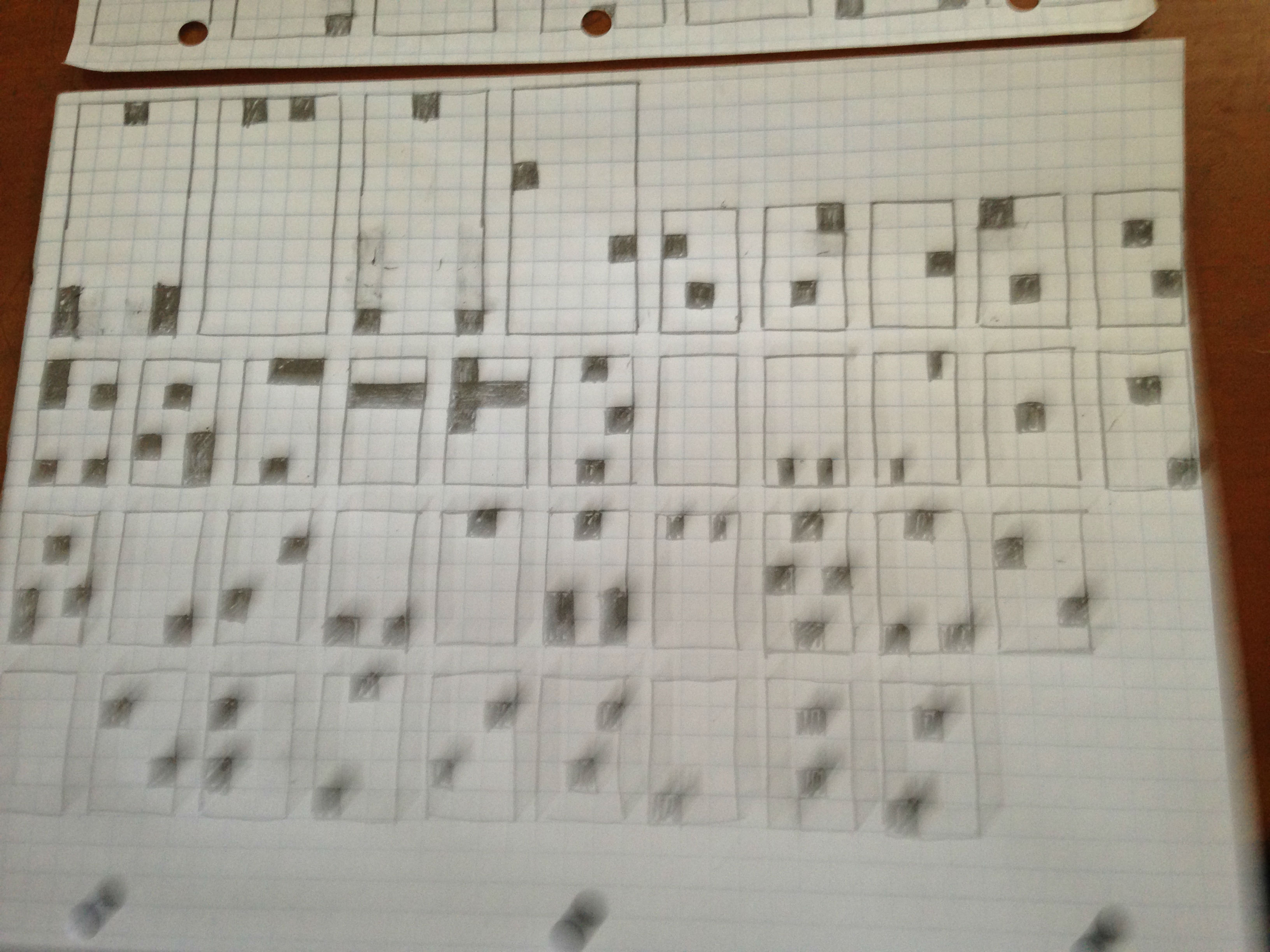
In my haste to forget my G and Q, I forgot make a capital X. No problem, as I reasoned that my capital X would be a rough approximation of my lowercase X. For my lowercase letters, I dropped the dimensions down to three squares wide, five squares tall. I wanted them to be half as tall as the uppercase letters, as well as slightly larger than half. If one were to write a word that started with an uppercase letter, it would be weird to be able to fit two lowercase letters inside one uppercase letter. But I liked the design possibilities of being able to stack letters next to an uppercase letter and have them be exactly as tall.

The lowercase letters flowed easily now that I had the hang of it. I’m in love with my i, and my l is pure simplicity, just a 3×5 block. I was doing great until I got to my m. I knew immediately that I had made a terrible mistake, a mistake which as I mentioned before, I had anticipated when crafting my uppercase letters, but not one that I considered before making my lowercase letters. Since my G and Q had already put me in the compromising mood, I decided to make the incursions 1/2 squares wide, and 1 square tall. “All in all, it was still a one square incursion,” I reasoned, “it’s not like I’m adding a goddamn tail.”

In a bizarre twist of fate, my held over frustration from G and Q were totally dissipated when I realized that, for as long as I remember, g and q have always been mirrors of each other in my mind. This must be a holdover from printing or cursive writing, in which the moves for making a lowercase g are inverted at the bottom of the descender. Initially, I tried to keep my g too simple, though, and my q ended up being identical to my e. So, I added a bit more space. Now, even though there is quite a bit taken away from their respective 3×5 blocks, I’m rather fond of my g and q.

Numbers

I should probably make my numbers a different height than my lowercase letters because in their current form, my 1 is the same as my l, my 2 is the same as my z, my 5 is the same as my s, and my 0 is the same as my o. As it is currently constructed, my font will require readers to do a little contextualizing work to differentiate between these numbers and their identically constructed letters.

And this reminds me of academics who resist calls for plain language, oddly enough. The argument goes that sometimes constructing complicated and convoluted prose is an act of resistance, in a sense, that such prose requires readers to stop and pause, to reflect on what they’ve just read. In a sense, it forces readers to be aware of reading, which Lupton suggests is the exact opposite purpose or aim of a good font. A good font is supposed to make you forget that you’re reading; it’s aim is to be a transparent technology of sorts. So what might the implications be if, when creating a font, a designer thinks to himself or herself, “I want them to get stuck up on this letter?” I’m looking at you, Medieval S/F!

Posted in Uncategorized | Comments Off on Mind Your Gs and Qs: A Cautionary Tale

Microprinting & micromoment.

[NB: There will be no picture this time because I can’t decide on anything.]

So this would seem a perfect topic for me to expound upon, and yet I’m paralyzed. Mostly because the kinds of things that we are to focus on this week are all around me all the time and I use them constantly. That is, at any one time I’m “reading” around 20 books. I use that term loosely. “Reading” = “opening up occasionally and idling glancing at a sentence, musing, then closely the book for another one.” It’s pathological and disgusting.

But I use these tiny scraps of anything to hold my place in the book. Airline tickets, receipts, index cards, tiny bits of ragged notebook paper, dry cleaner stubs, old checks, ATM statements, brochures, bills, money, napkins, and so on.

Many of these placeholders revive a moment in the past. Many of them don’t. I think what’s most interesting is how receipts for books I’ve purchased in the past are basically wormholes to the affective disposition I had at that time. This is good and bad.

For example.

My Collected Poems by Wallace Stevens has the receipt still stuck inside. The print is basically nonexistent. But I can still make out the date and place of purchase. Highland, Indiana. Winter. The money I used to buy it was a gift from a relative. I made my father stop off at a Borders before we left town. And since I was fancying myself a poet, I knew I needed more heavy-hitting poetry in my bin. The choice was easy. I had read some Yeats in my college freshmen English Lit. class. I’d get Yeats and be on my way. But the waffling ensued. I saw the Stevens. I knew he was big. I wasn’t keen on his stuff, but I knew he was hot shit. Altho, I came into the store with a jones for Yeats, I walked out with Stevens. What gives?

Here’s the thing. I don’t regret the Stevens. He’s become one of my favorite poets and a touchstone for my thoughts on language in the subsequent years. [Nevermind that the book sat on my shelf for a very long time before I even tried to open it.]

Now, back to the receipt. Levy’s meditation is interesting, but too wide in scope for me. Let’s keep the scope to a life. The materiality of the receipt is directly connected to the immateriality of the experience now dead and gone but only living in my noggin. And only when I pull that receipt out. I go back to my earlier Carl Sagan reference about how humans are the only animals that have off-shored our memory banks into other objects.

My respect for the receipt as a material thing comes to when I realize that narrative is capable of showing its hydra-head in the most scant of informative places.

Materiality offers evidence, proof. Proof of what, I’m not sure. But in this instance, it was proof that a decision was made, once, hastily, in a now defunct bookstore in northern Indiana.

Further, I find it fascinating that we go thru the trouble to PRINT material proof for the most asinine moments. Buying a donut. Checking out a library book. Paying your electric bill for the 1000th time.

And yet we neglect to print out anything for the most important decisions. First loves, death, birth, the cementing of friendships, etc. Is there something corny and insouciant about a receipt of death. A receipt of death isn’t a receipt, it’s a CERTIFICATE.

Sounds pretty trumped up to me.

As a parting thought, perhaps the printing and proof and materiality of a large-scale event would be to denigrate it somehow? I’m sure there are plenty of refutations to my idea here, and I’ll probably think of a ton as soon as I post this.

I just find it funny to imagine one young lover printing off a receipt of reciprocated love from a small electronic device kept in the side pocket.

Posted in Uncategorized | Comments Off on Microprinting & micromoment.

My Tea’s Realities

What value can be derived from a ripped-up wrapper of an individually packaged tea bag? As with David Levy’s document in “Meditation on a Receipt,” packaging — the small wrapper, especially — is “abundant and ordinary,” and (from what I understand about the habits of non-hoarders) often discarded without second consideration after its designated use-value expires.

The use-value of a tea wrapper is rather limited in the first place — the box is needed for wholesale, the tea bag for its flavorful leaves, but the individual wrapper? Not so much. It is supposed to keep the tea bag fresh for longer, but the avid tea drinker often finishes tea with such efficiency that it does not have a chance to expire. Furthermore, the same directions listed on the box are often reprinted and redundant on the wrapper: boil water, steep tea bag in water for a certain amount of time, sip carefully. Some suggestion of addition niceties might also be included: cream, honey, sugar, lemon, ice, etc. Does the wrapper have a purpose beyond freshness and frivolity?

20140204_20525220140204_205234

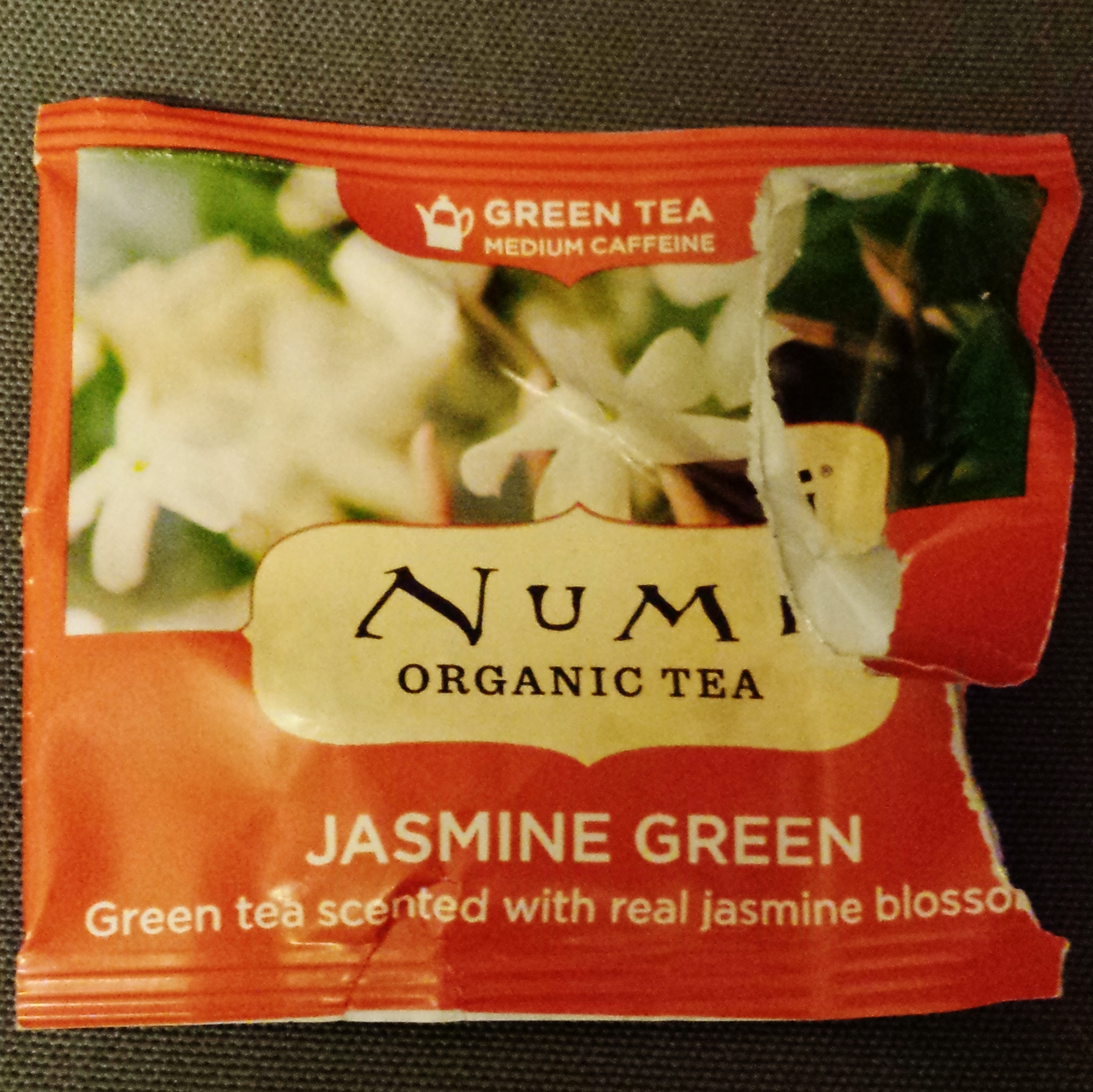
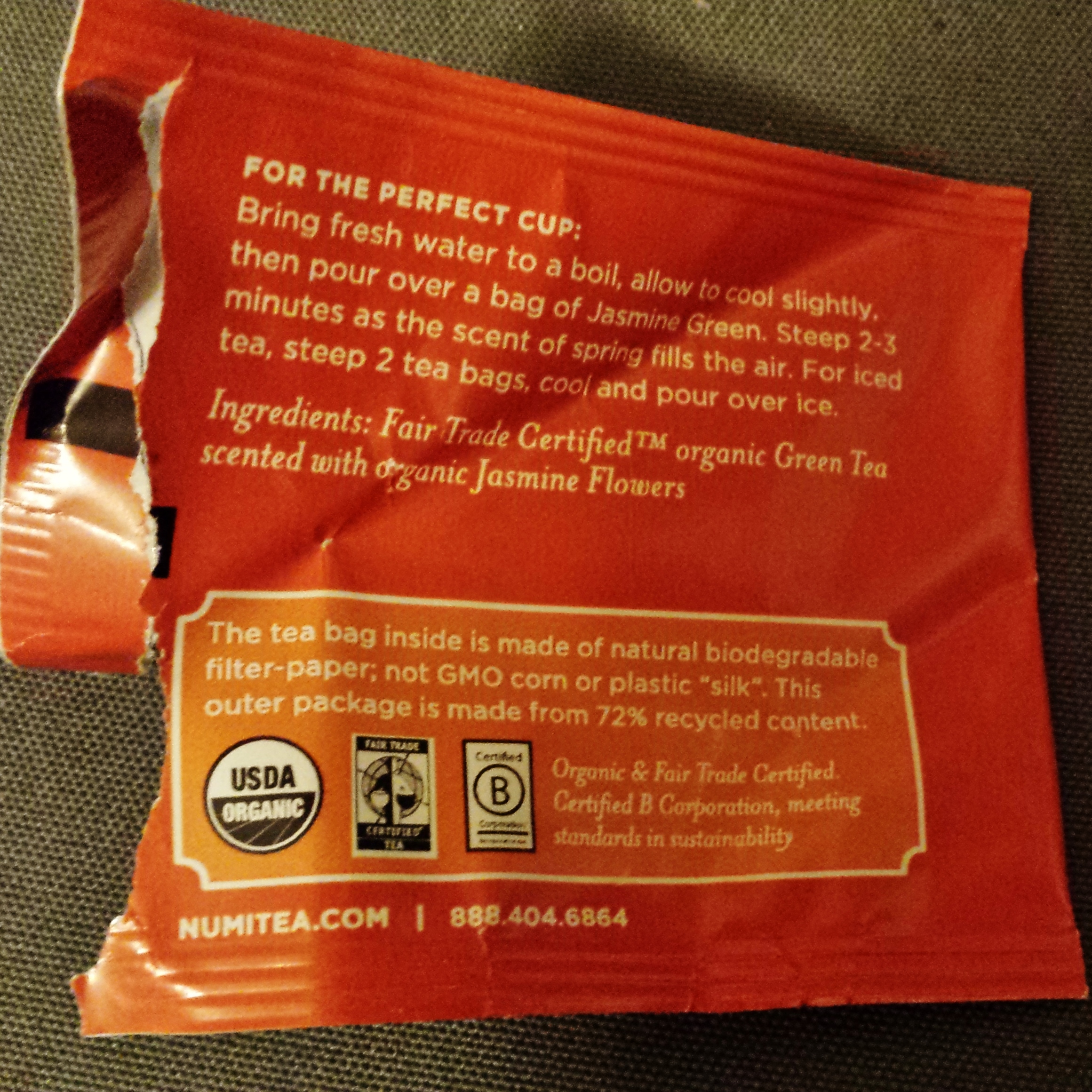
Here is a typical wrapper with some specific details. It tells the preparer that the water brought to a boil must be fresh, then cooled only slightly. The wrapper suggests the tea is seasonal — steeped as the “scent of spring fills the air.” A single jasmine blossom is found in focus on the wrapper’s photography, and the dark orange complements the greens, whites, light yellows (the dim lighting and the phone camera do not do these colors justice).

Learning about the contents of the wrapper might brighten one’s day beyond the colors: note how the contents are “made of natural biodegradable filter-paper; not GMO corn or plastic ‘silk’.” These disclaimers are meant to comfort the conscious consumer, so the tea-drinking experience is fully calming and guilt-free. Following the website linked on the bottom left to further research this particular Jasmine Green tea, the enthusiast is confronted with an even more decadent and exuberant description:

Fragrant organic jasmine flowers are laid atop organic green tea leaves as their scent is naturally embraced. Scented three times, this smooth green tea has layers of subtle fragrance and hints of moonlight.

Does this mean I have been enjoying this tea incorrectly by drinking it on winter mornings; is it meant to only be embraced by moonlight in the spring? I ask this with some facetiousness, but tea-drinking rituals are no laughing matter — tea ceremonies have been well-established cultural events throughout Asia for many centuries, and sharing a certain tea using a kettle and cups designed for a specific season is often expected and respected. The tea and everything it is served with are all worth meditating on in the tea house. Those teas tend to be loose leaf or matcha powder, though — and rarely ever contained by the individual tea bag.

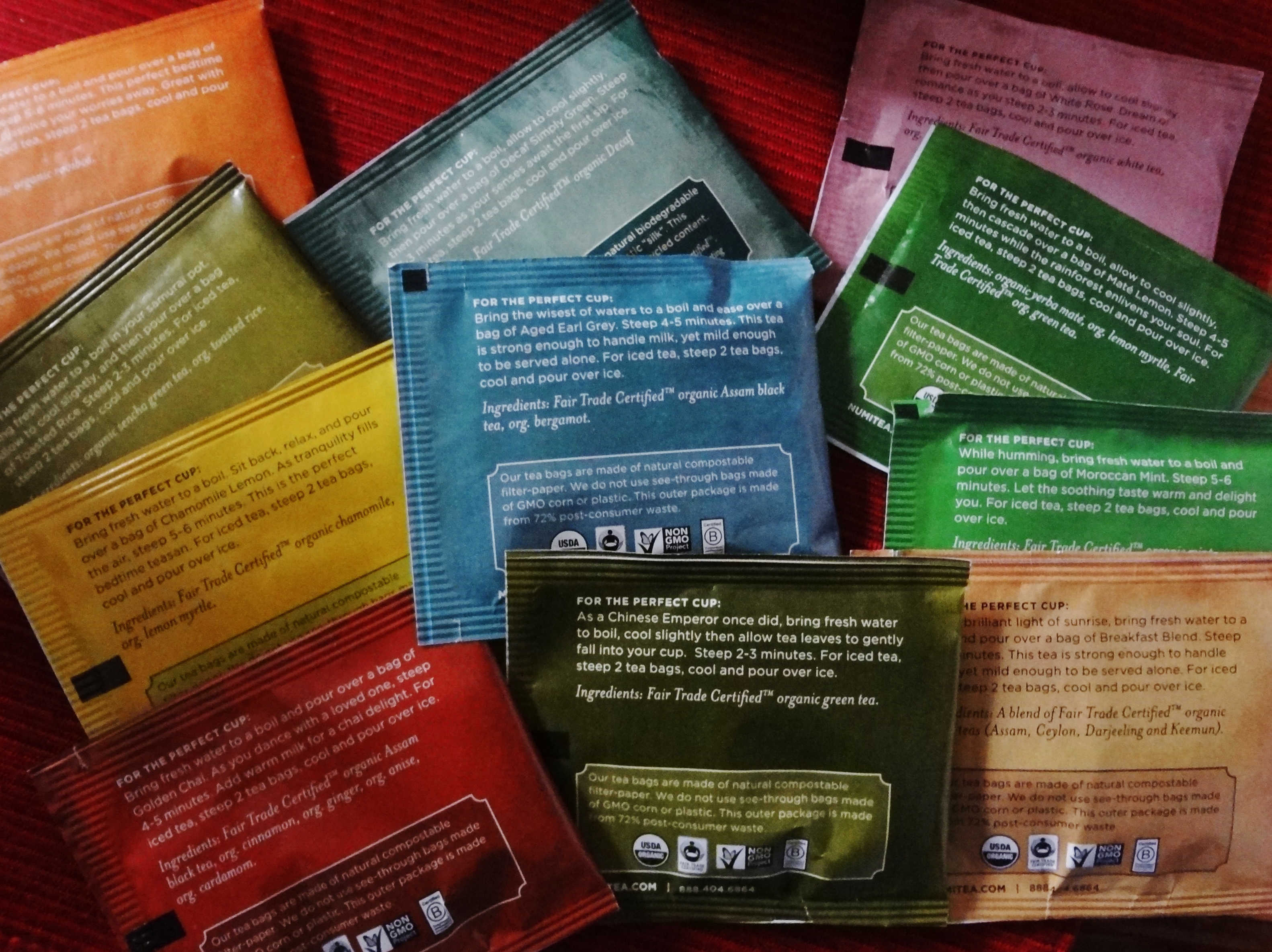
Nevertheless, imagine my delight upon emptying an entire variety pack of Numi teas to discover that every “For the Perfect Cup” description is different:

DSC01009

Clearly, someone was hired to consider these documents with some care. To what end? I have no clear answers, but I would like to offer highlights to meditate upon:

When preparing your green tea, boil water “as the Chinese Emperor once did” and “…allow tea leaves to gently fall into your cup” (this is particularly ambitious given that the tea leaves are constrained by the “natural compostable filter-paper” tea bags from actually falling anywhere). “Bring the wisest of waters to a boil” to “ease over” your Earl Gray, and be “humming” when you boil your water for your cup of Moroccan Mint tea. “Dance with a loved one” for 4-5 minutes while waiting for your Golden Chai, and Chamomile Lemon must be steeped a minute or two longer “as tranquility fills the air.”

Levy ends his article with a note that while “it may seem strange to place small, trivial, invisible documents” such as his receipt “alongside the great ones, and to speak of them in the same breath…this is exactly what we must do if we are to see the entire class of documents, all of them, as a single species; and if we are to see their shared properties and their joint work in the world.”

Of “joint work in the world” construed freely, one particular tea wrapper has been home to a favorite writing material for the past few years on my walls:

20140204_234858

Tea leaves have long been read for fortunes.
Should we be reading tea wrappers for anything beyond basic instruction and for occasional amusement?

Posted in Uncategorized | 2 Comments

Histories /

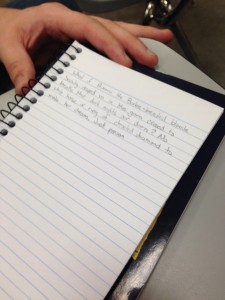
For homework, I asked my students to submit three prompts derived from poems in Natalie Diaz’s When My Brother Was an Aztec. This is one of them.

6. If Eve Side-Stealer & Mary Busted Chest Ruled the World
Write a poem alluding to well-known stories, sayings, metaphors, and/or something of the like, but suggesting a change in the story, as to create a new imaginative world in order to convey one idea. Use at least 4 stanzas and at least 1 story, saying, metaphor, etc. per stanza.
E.g.  In “If Eve Side-Stealer & Mary Busted Chest Ruled the World,” Diaz suggests a slight change in biblical stories and extends the stories with metaphors to speak to an issue of racial perception.

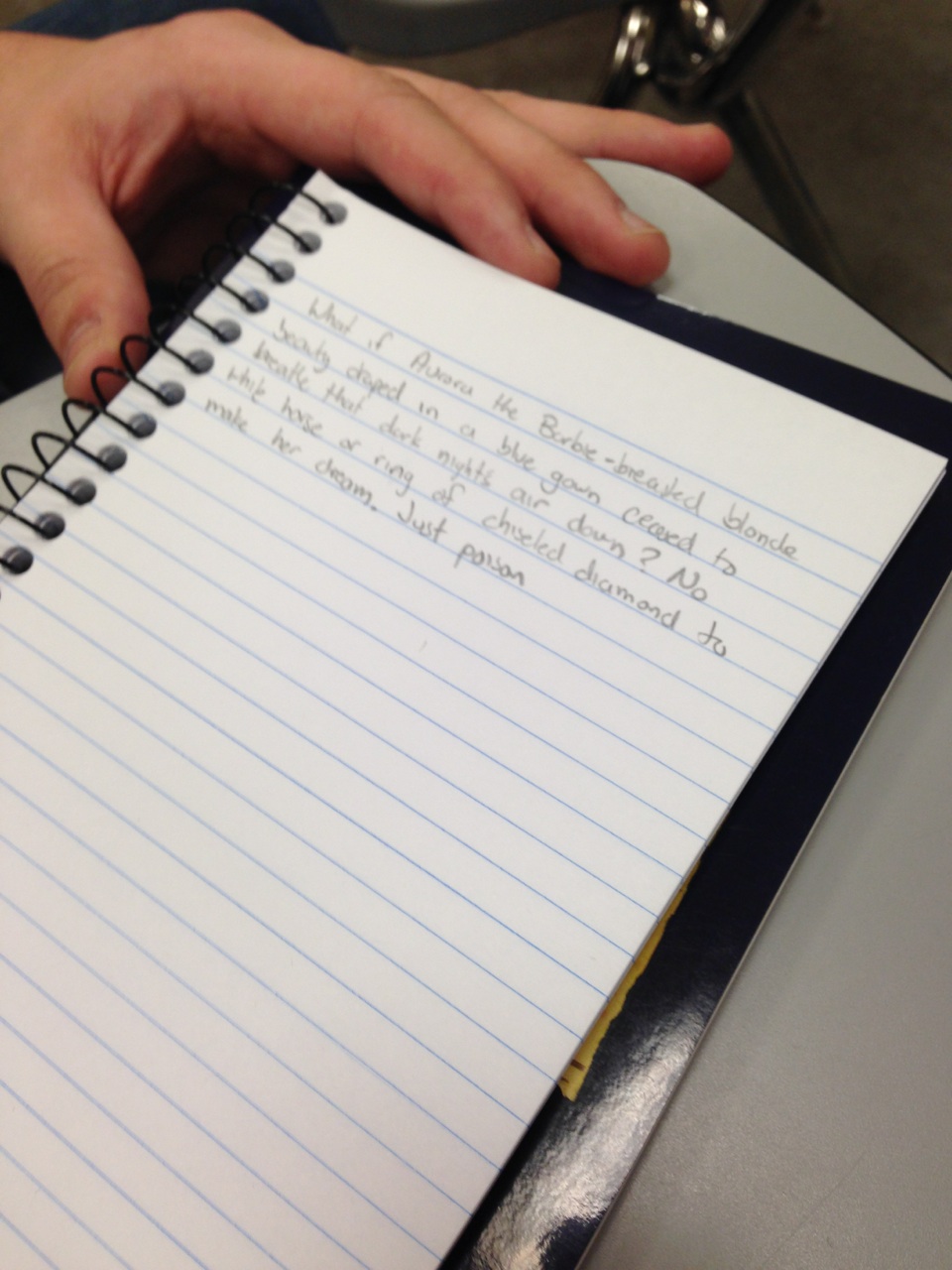
My student wrote a poem about the Disney princesses. She asks the question, “What if the princesses had ignored the men? Would they still be beautiful? Is beauty something one can possess only in the presence of a man?”

She drops some dramatic images, some nails and coffin, some apple, some hair ripped out, some sarcastic descriptors (“barbie-breasted blonde”), and she ends with the line: “And in the absence of heroic Princes, what became of beauty?”

This poem, as all poems, is a record of a moment in her life, this second semester of her Freshman year, her writing out of her childhood, of the early stages of her feminist inquiry, perhaps, of her relationship to men, to her consumption of media, to her fear of death, even. These are real concerns, real important concerns, and this is a record of all of this.

And yet, it is mostly a record of my own life, because it was not her decision to print the poem; it was my own.

1. The poem did not make optimal use of available line breaking strategies.
2. The poem was complicated enough to invite a multiplicity of meaning, given the proper use of line breaks.
3. The project was similar to many other students’, so it had value as a class-wide pedagogical tool.
IMG_1822

This is the decision-making process. But in order to understand that, you must understand this:

I’ve been writing prose poems for a very long time. For a while it was the only thing I could write. Everything was in prose. And I began to fantasize about a poem that wasn’t simply prose — I wanted a poem that was one line. Without page breaks, without wrapping down to the next line, just one long scroll with a single line. This could be the aim of a particular prose poem — many prose poems thrive in the sort of text block thing that happens when you write prose, but others seem to want to emphasize their unbrokenness. Their wholeness. Their fluidity. Mine did.

What is a poem without line breaks? It is almost not a poem. This is what I wanted to explore. But then I started breaking my lines. And so.

The printing of this poem embodies that mindset. It is the possibility of materiality that I’d been considering even before designing the assignment. Before even knowing I’d be teaching poetry this semester.

And in order to understand the urge toward the prose poem, you have to understand this:

My poems had short sentences. They moved like this. They were harsh. They were violent. They wanted nothing. They wanted everything. They were hopeless. They were lost. They wanted to break. They were breaking. I was seeing images of death. I was seeing entrapment. My tongue was caught. And my language showed this.

The form of the prose poem speaks to me. Prose poems keep plodding on and on. They never stop. There is no white space. No breathing room. No breathing. And when breath and rhythm are controlled solely by syntax, it is these short, violent, subject-verb sentences that rise to the occasion.
IMG_1828

My student’s poem was not a prose poem. But it had that feeling. Not because her sentences were the same sort of sentence I’d been writing. But that violence, that lack of breath, that overwhelming force of language, that anger, that confusion. That’s what I was drawn to, and that’s the feeling I thought she was undermining with her haphazard line breaks that brought an amount of air/levity to the piece.

In order to understand my love of the prose poem, you have to understand when I started writing them. I wrote about my mother. I wrote about my father. And I wrote about internment camp. There are no line breaks in internment camp. There are fences, it is crowded, there is no room to breath, and when you do, the dust gets in your lungs. It is cold, and then it is hot. It is hot and then it is cold. Everything you do, someone knows. There is no privacy. There are guards with guns watching your every move. There are your annoying neighbors who complain every time you roll over in your straw mattress. The floorboards creak. Someone knows you’re getting up for breakfast. And everyone knows what you ate that morning. Because they ate the same thing, too.

Perhaps it is too much to say that internment caused my love of the prose poem. Perhaps it is too much to say that my parents’ divorce caused the prose poem. Perhaps it is too much to say that moving to Pittsburgh caused the prose poem. Perhaps there is too much to be said. There. Perhaps that’s the cause of the prose poem: when you are completely overwhelmed by language, by the possibilities of all that could be said, and you crumple into a ball and try your hardest to say something, but nothing comes out, because there is nothing you can say to convey the horror of war/displacement/exile.

(There is no metaphor for exile.)

I worry that sometimes people believe is better to be dead and free of the oppressor, as my student writes of Snow White. This is the complicated nature of her poem: within the world of the Disney movie, the only way to escape oppression is to be dead, ugly, or miserable. And often it seems like these are the only options available to us as well. It makes sense to me that one might become a suicide bomber. And that’s a scary statement to make. But if it is your family, your loved ones you are fighting for, and if you believe, in your rational mind, that this will help, somehow, to make the world better, you’ll do it. What if Snow White eats the apple and dies? What if she’d rather be dead?

This is a record of how far we’ve come since Snow White. That our college freshmen can critique Disney movies, can, without prompting, investigate a feminist line of inquiry on their own, and actually get somewhere with it.
IMG_1830

Of course this all comes back to me, and my decision to print. It comes back to me, and the laser printer that my mother gave me, because, she says, all writers need a laser printer. It comes back to my mother, and her support of me in pursuing this creative endeavor. It comes back to my mother, who showered my sister and me with all kinds of creative outlets when we were small, paint and crayons and glue and feathers and fuzzy ball things, her enrolling me in music lessons, the stories I wrote when I was small, the plays my grandmother helped me type up on our Apple IIe computer, the books upon books that my grandmother bought me, my grandmother making “S” sounds when we passed stop signs, the lyrics I began to write in 7th grade, AOL Instant Messenger chats I had with my friends, where we challenged each other to not look at the keyboard when we typed. The decision to transfer to UC Riverside and study creative writing. The poets who made me decide to write poetry instead of fiction. The MFAers here at Pitt that decided to ask both me and Michelle to join the program.

And I’m sure my student has the same sort of historical record that she brings to the document. And there is something about our relationship, my ability to freely be myself in the classroom, something I’ve been able to do only now, in my fourth semester of teaching, my ability to share myself, and to allow students to share themselves as well, it’s about bringing to them the concept of duende, and having them understand it better than many grad students, it’s about creating an environment in which students feel safe enough to submit poems that are experimenting, are trying, are important. And this is something that I am proud of having accomplished, in some sense. And I’m grateful to my students for giving back to me what I believe I am trying to give them.

Poetry is, in the end, about human connection. Line breaks are there to enhance this connection.

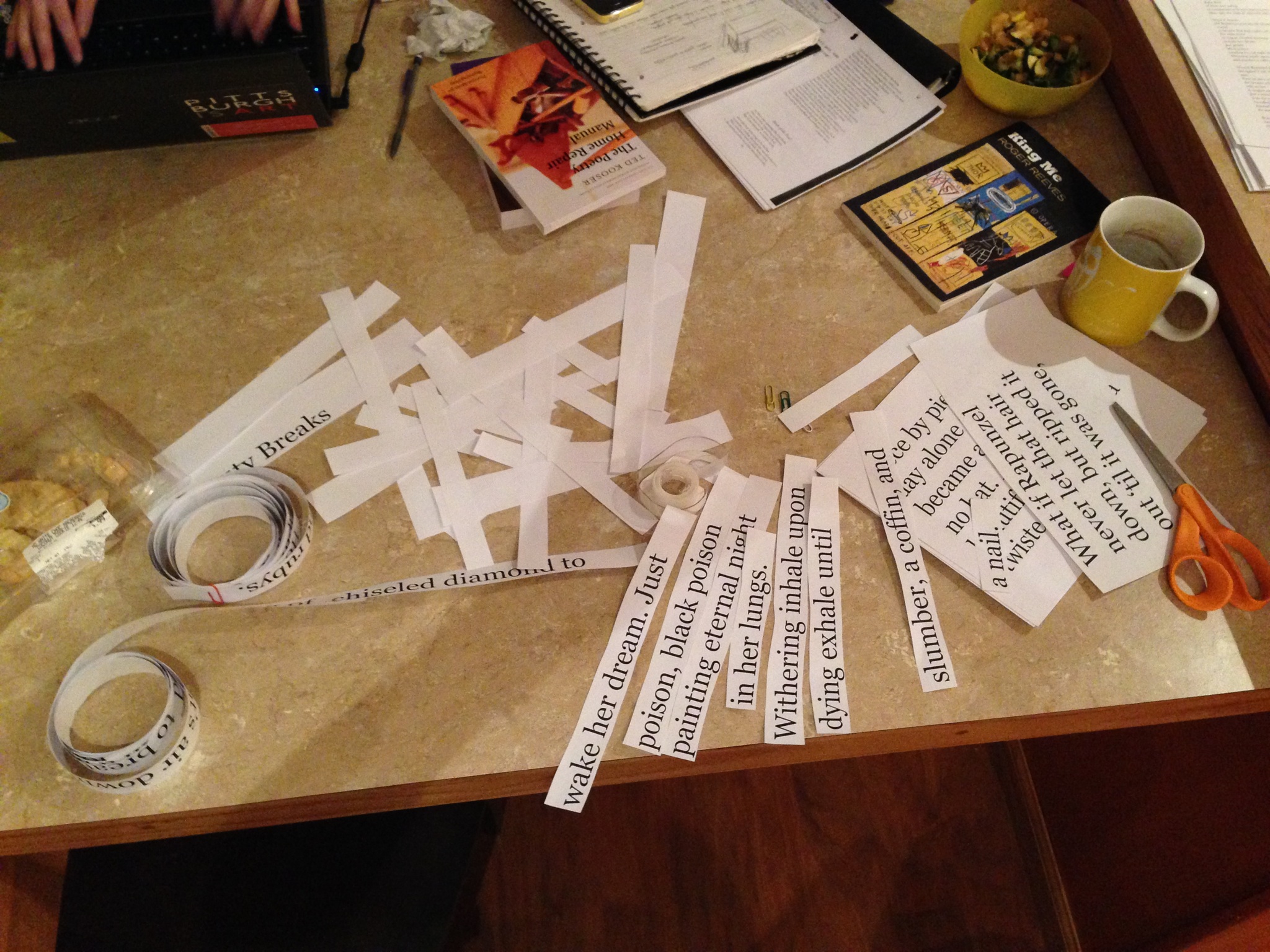
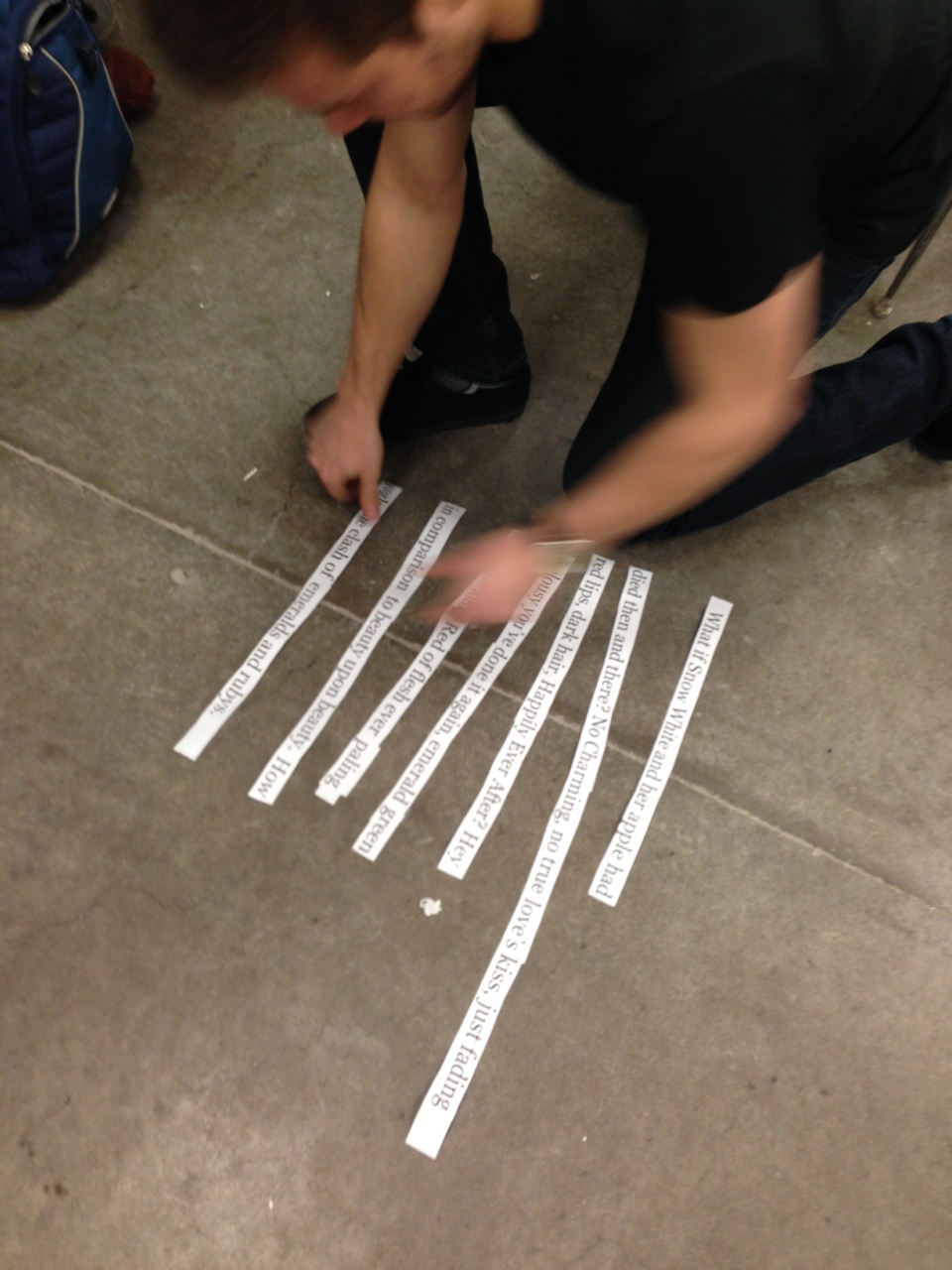
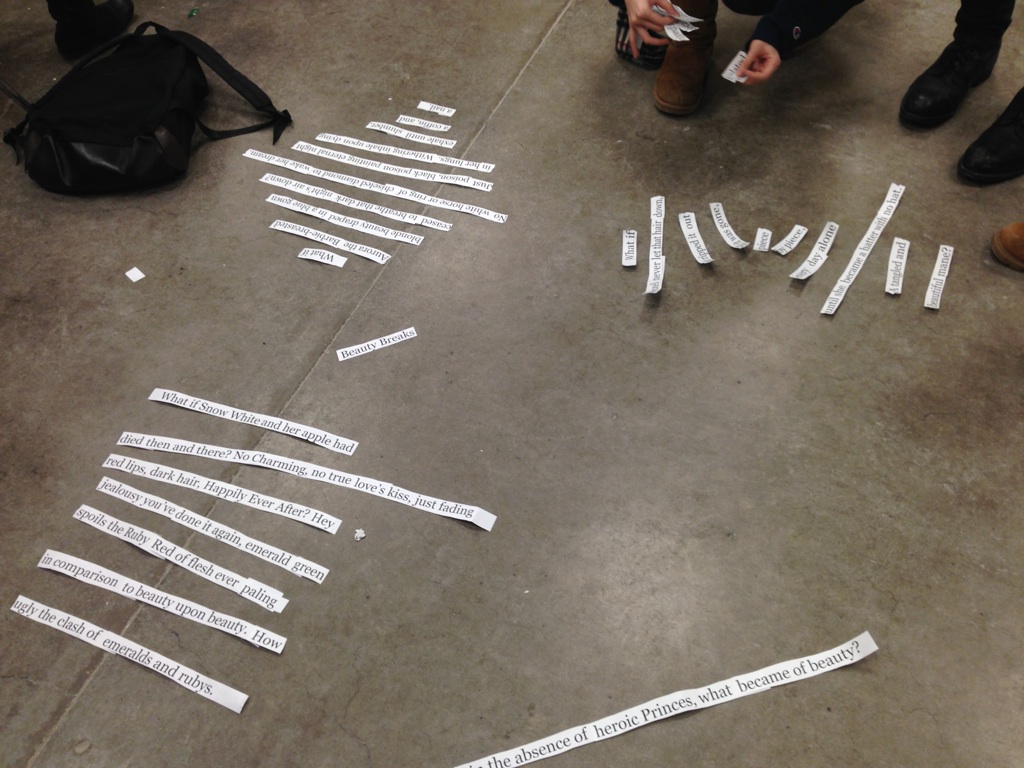
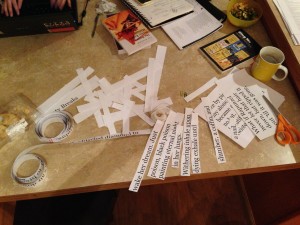
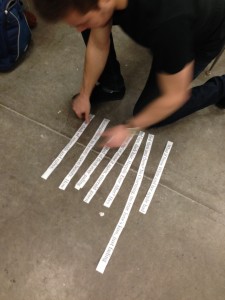
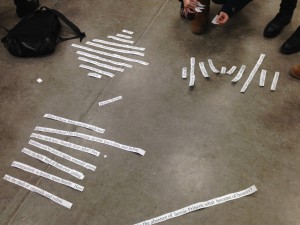
This is how we practiced those line breaks: I broke the students into three groups.

Each group was tasked with a different assignment.

Group 1: create surprising lines
Group 2: create additional meanings within the lines
Group 3: create aesthetically pleasing lines
IMG_1833

They were to tear/cut the one line into separate lines. This is what they did. The assignment worked well. This is not the point. Or perhaps it is.

It is, because this physicality of working with language is the point. Because the act of tearing, the act of arranging, the act of seeing words in 48 point Georgia looking at you from the ground of a classroom in the Cathedral of Learning is exciting, gets me excited about poetry. Because we debated leaving the poem in its broken form in the middle of the classroom for the sorority meeting that follows. Because we ultimately decided it would simply be too messy, despite our guerrilla poetry aspirations. Because my student wants people to read her work. Because she’s proud of it, and seeing it in material form gave it more meaning, more substance. Because my selecting of her poem gave her a certain level of gratification. Because she knows that it is important to work to me. Because all my students’ poetry is important work to me.

It is not, because this does not let you understand what my family went through to allow me to be here, to put words on the ground, to teach a class of undergrads how to write poetry. It is not, because you can’t understand my love of the prose poem, my frustration with language, my frustration with my parents, my frustration with myself. You can’t understand how blessed I am to have been given the things I’ve been given, my grandmother’s love, her insistence upon reading, the library she’s gifted me, the hours she spent with me in her lap, pointing at words, asking me to read along. You can’t understand my mother, her love, how she now listens to audiobooks because she wants to be closer to me and my writing, my mother, who buys books on poetry and tries to understand. My paternal grandmother, who listens to NPR and watching PBS, recording all of the poems she hears, all of the interviews with all of the poets, the grandmother who taught me how to read, who has since gone blind, this wonderful audiobook technology that allows her, as well, to continue to read. You cannot understand what it means to love a group of people so much that you could die for them, you could kill for them — when the world feels unjust and unfair and there seems to be no way out — you cannot understand why I write the prose poem, what the prose poem means, how much I need the prose poem, how much I need poetry.

poetry means refusing
the choice to kill or die

— Adrienne Rich
Posted in Uncategorized | Comments Off on Histories /

bottle

I am looking at the printing involved on a prescription pill bottle.  The markings are black and printed on a white and light blue background.  The surface is sticky paper, which is wrapped around the bottle.  The surface is smooth to the touch.  The words CVS/pharmacy are the only markings not black, they are printed in red on the top.  CVS’s branding always has the name in red, but it also makes the name stand out.

There are two columns of printed information.  If the sticker were laid out flat and read from left column to right column (how I, reading in English, would read it) I would read first what I consider to be the back of the prescription, and second the front.  So putting the sticker onto the cylindrical bottle is part of its functionality, although if it were flat it would not be incomprehensible (and possibly my eye would be drawn to the larger, bolded font of the right “front” side first anyway) and it wouldn’t be useless either.

The markings are all about information.  Much of it is pedestrian.  There’s my full name, the address of the CVS I used, my address, the store phone number.  The information for me that I need to actually check the bottle for is how many pills to take at once (at least that’s something I needed when I first started taking them), and how many refills are left.  How many pills the user is supposed to take is in some of the biggest writing.  I’m guessing to prevent overdosing.  The refill information is in a smaller font.  A lot of the words and names and in all capital letters.  The bolded parts include my name, the drug name, the store phone number, and the Rx#.  Also slightly bolded on the back are the Date Filled and Discard After information.

Posted in Uncategorized | Comments Off on bottle

“We speak to people as if they knew fire, whatever it is.”

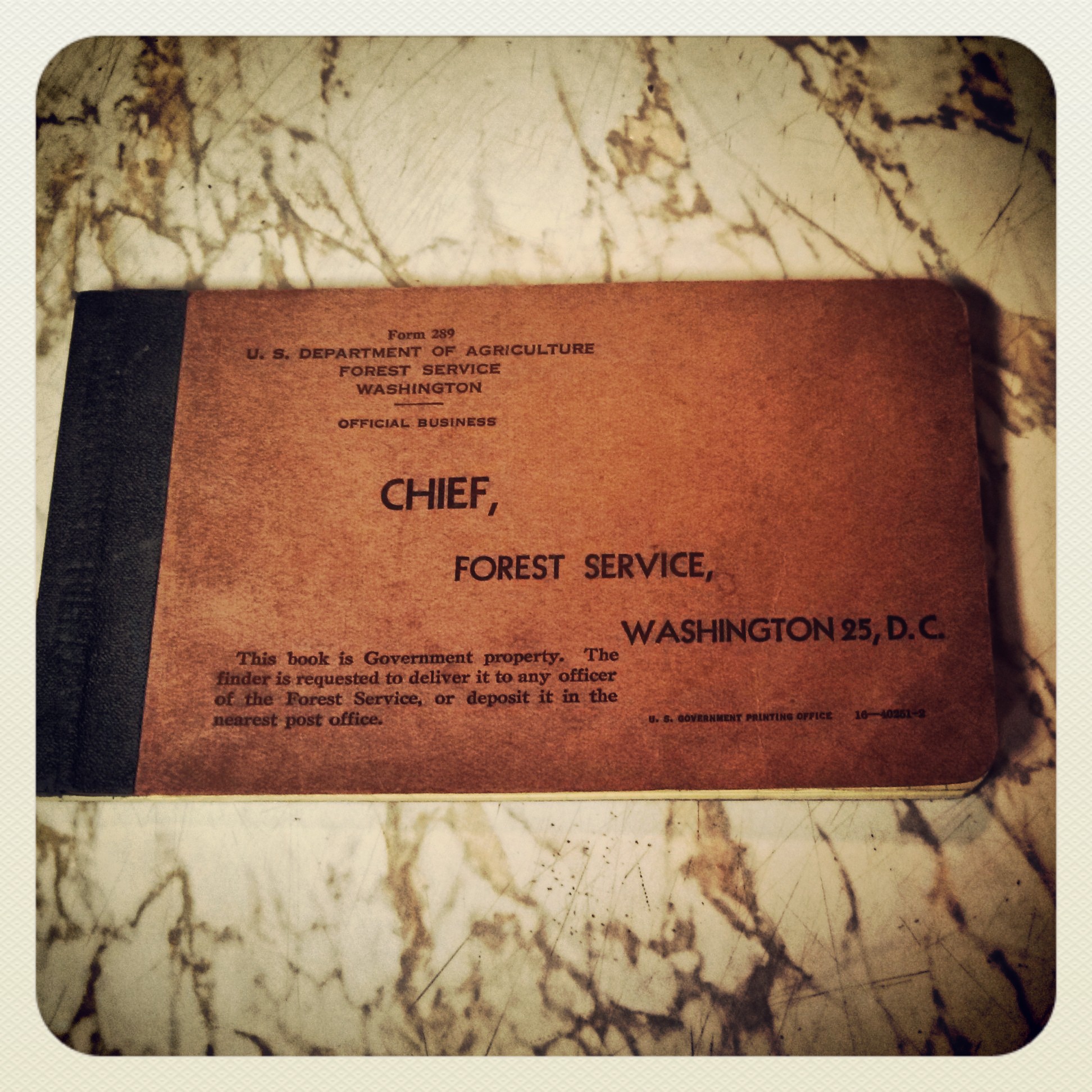
ChiefForest

I found this at my family home during my last visit, inside a communal desk crammed full of pens, pencils and old notebooks, for the taking.  My stepdad was a firefighter in the forest service 40some years ago, but he wasn’t the chief or anything, so I’m not sure why he had it.  I wanted to ask him about it, but he likes to talk for an hour, and I was in a hurry that day.  The smaller type at the top reads:

Form 289

U.S. Department of Agriculture

Forest Service

Washington

Official Business


and at the bottom:

This book is Government property [I like how they capitalized government, like God] .  The finder is requested to deliver it to any officer of the Forest Service, or deposit it in the nearest post office.

U.S. GOVERNMENT PRINTING OFFICE    16-40251-2


I chose to write about this notebook because it’s odd– it’s called a document on the face, but inside it’s full of blank perforated sheets, yellow, 3×5.  The front side of each page is gridded, the reverse side is blank.  Maybe it’s a document for generating documents?  Maybe if the Chief signed one of the pages, it could become an actual document?  Otherwise, how could the Chief’s notebook be a document?

I just use it for scrawling ideas.  My ideas especially like this booklet.  Somehow it’s funner to write in this because it’s not for me, because I am the finder.  Sort of.

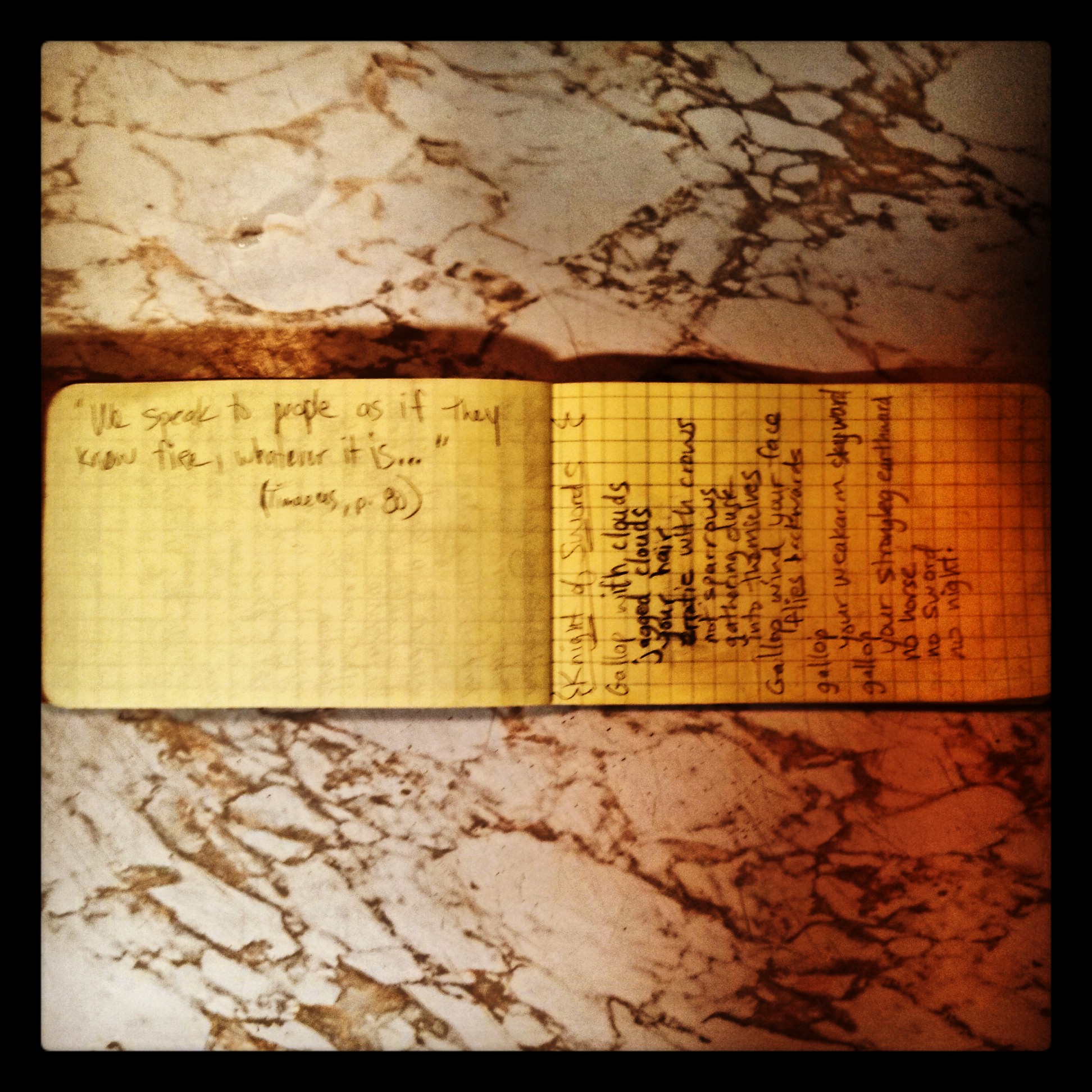
ForestInnards


I googled “form 289 U.S. department of agriculture”, and found something much more current, specific, and standardized: a pdf with about 25 different boxes to fill in, check, and sign.  USDA Form 289 seems way more official nowadays, four or five decades later, and it now has a proper title: “PROPERTY LOSS OR DAMAGE REPORT, Fire Suppression”.  There’s always a forest fire in Southern California.  I don’t think forms are going to suppress any of them.

It’s funny, I just realized that the page I took a photo of has the quote: “We speak to people as if they knew fire, whatever it is.”  That’s from Plato’s cosmological treatise, Timaeus.

Posted in Uncategorized | Comments Off on “We speak to people as if they knew fire, whatever it is.”

Bread and Puppet: Postcards from Vermont

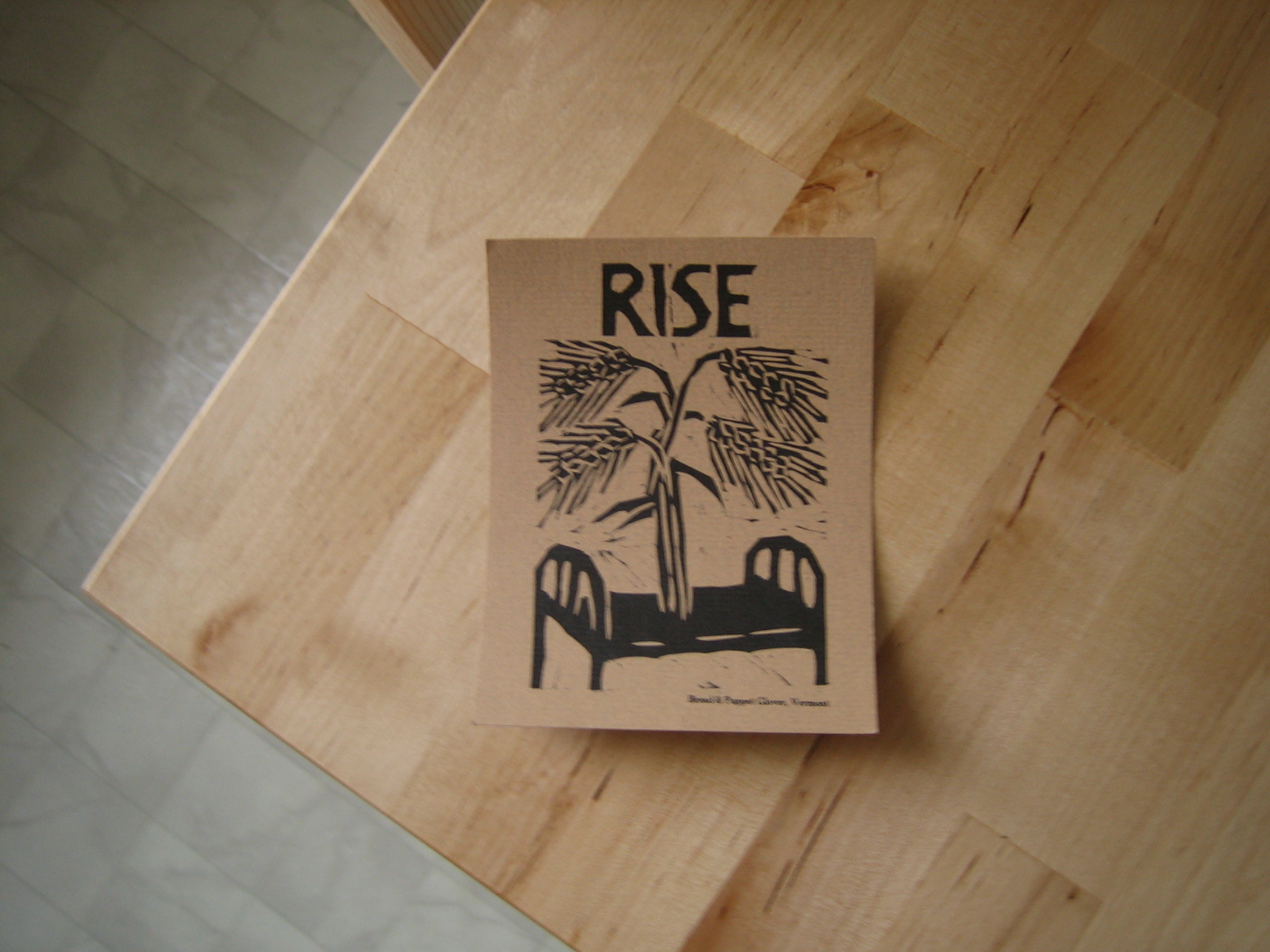
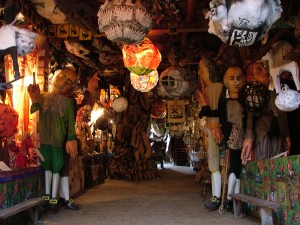
This is a postcard, bought rather informally at the Bread and Puppet Museum in Glover, Vermont, last summer.

IMG_4580

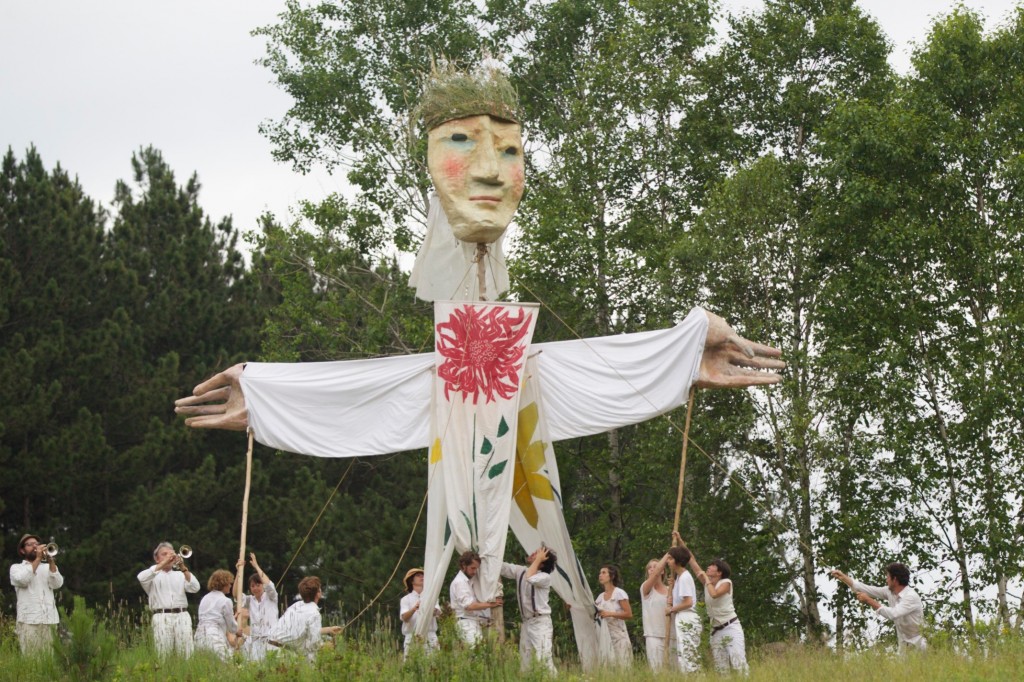
The Bread and Puppet Theater started in the ‘60’s in New York, but I associate it (as do most) with the unfussy houses and winding backroads of Vermont’s Northeast Kingdom. Bread and Puppet tours the country with politically radical, low-tech shows involving larger-than-life-sized puppets and youthful performers who sing, dance, play a motley assortment of instruments, and urge viewers to reconsider their capitalist and government-driven lives.

circus

The folks behind Bread and Puppet also have a correspondingly irreverent art practice outside of their huge, whimsical, sometimes alarming puppets—they make flags, banners, posters, postcards, small batches of illustrated chapbooks, calendars, and comics, among other things. The connecting thread is cheapness, themes of self-reliance (read: anti-government), and a blocky print style. This is what their website says about it:

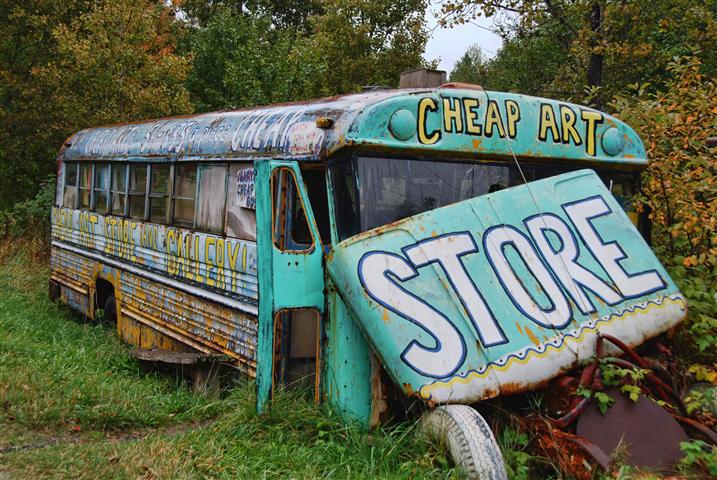
“Bread and Puppet’s Cheap Art Philosophy and production was born in 1979 when Peter Schumann and his company and friends filled their old schoolbus with hundreds of small pictures painted on scraps of masonite, cardboard and newspaper, painted slogans and statements about art and Cheap Art, and hung them on the outside of the bus. Then they drove it to neighboring towns and sold the stuff for 10 cents to 10 dollars. Today Cheap Art is practiced by all kinds of artists and puppeteers all over, and continues to cry out: Art is Not Business! Art Is Food! Art Soothes Pain! Art Wakes Up Sleepers! Art Is Cheap! Hurrah!”

The Cheap Art Bus
The Cheap Art Bus

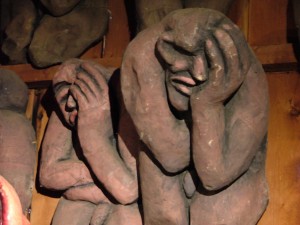
In August of 2006, I arrived, by surprise really, at the Bread and Puppet Museum, which quietly sleeps off Route 122. In New Jersey, where I grew up, “routes” are big scary legit ROADS where you could hurt yourself. Route 122, or at least this part of it, is a gentle pastoral jaunt through some hills surrounded by (what are in the summer) sprawling green fields of unmown grasses. I stumbled into the museum, which is a massive, converted hay barn, and wandered through the huge, dusty exhibits of retired puppets.

B&P


B&P2

These pictures come from the Bread and Puppet Museum Photo Gallery. Click here for more  (it’s well worth it): http://breadandpuppet.org/about-bread-and-puppet/photo-gallery/museum-images

This “museum” is loosely curated and unguarded: some people may have been tending the gardens out back, but I never saw them. In the store, below, I rounded up a bunch of their posters, chapbooks, and postcards, and looked to pay. By the door I found a locked wooden box with a slit in the top that said, roughly, that we could pay whatever we saw fit for whatever we planned to take. This piece of minor printing, then, was not acquired through a traditional financial transaction, where a set price is paid for a product. I think I stuffed $15 into the box for my handful of things. Bread and Puppet operates under a kind of honor code that abhors the “supremacy of money,” a phrase I take from one of their posters.

The Bread and Puppet printshop often uses images like the grain on this postcard as a shorthand for subsistence, local farming, and anti-capitalism. A Danish woman I spoke to afterwards about the Bread and Puppet printing aesthetic (who visited the museum with me this past summer) told me she didn’t like it too much—it reminded her of a kind of Russian graphic style that smacked of propaganda. As for the text, B&P often relies on in-your-face, one-word cries like “AWAKE,” “GOOD MORNING,” “COURAGE,” or “AH!”

Here’s what their website says about the production process:

“The production mainly takes place in a modest printshop on the Bread and Puppet farm, where we hand-burnish masonite-cuts and also use a vandercook sp20 letterpress. Fully embracing Bread and Puppet’s Cheap Art Philosophy, we indulge in unorthodox printing methods, inexpensive materials, and enjoy the participation of neighbors and friends in the work. Our emphasis is on the utilitarian uses of art for such vital activities as celebration, decoration, argumentation, rumination, and puppetry!”

I don’t know about the paper the postcard is printed on, but it would be safe to say that it’s probably recycled, and it’s probably cheap. The postcard also doesn’t bear the other usual markers of postcards—no handy address lines on the back, no pre-printed square to tell you where to put the stamp. Bread and Puppet is low-maintenance, it seems, in their shows, their art, and their printing.


Posted in Uncategorized | Comments Off on Bread and Puppet: Postcards from Vermont

The Worksheet

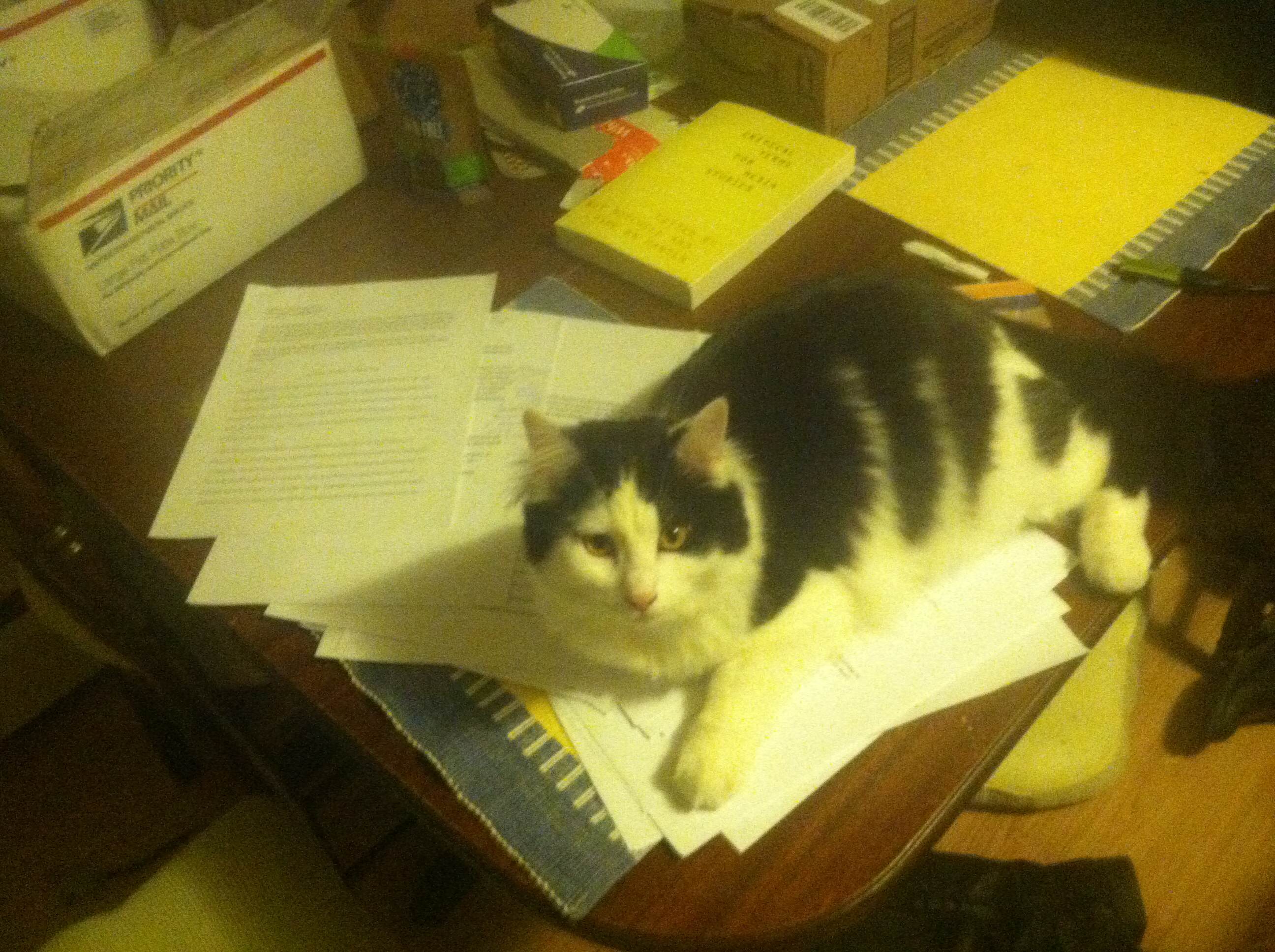
At first glance, this appears to be a picture about my cat:

buddybaby

However, this is actually a picture about the paper documents my cat has decided to make his seat. I fanned this papers out on my dining room table in preparation for this picture after a long day of changing my mind about what to take a picture of, what to write about.

For some reason, this signment has been the most difficult for me in terms of settling upon a topic. Maybe this difficulty is due to my indecision in choosing a direction for my final project. Or maybe it’s due to the sheer number of examples of minor printing I realized exist in our hybrid print-digital world after reading Lisa Gitelman’s piece.

For instance (and this speaks to Tablet’s post) I got a parking ticket today. And I also thought about going to a movie, which requires purchasing a ticket. And both kinds of tickets are examples of minor printing, and they’re both called tickets. What defines a ticket as such? It seems to have nothing to do with content and everything to do with some material properties. Yet, in the case of “tickets,” the differentiation of content seems incredibly important, if ignored by the naming(s). In the instance of the film or concert ticket, we might save the square piece of paper to remind us forever of an event to be incorporated into our life narrative. In the case of the parking or speeding ticket, we only keep the ticket long enough to pay it. Then we trash it and attempt to erase the event from our memory as thoroughly as possible. What is the history of “the ticket,” anyway”?

However, I decided not to write about tickets (even though I accidentally kind of just did) because I didn’t actually go to a movie. I started prepping for the class I teach tomorrow instead (SC). I was thinking about what kind of workshop we should do tomorrow, how early I would have to get to campus in order to print and make copies of the workshop worksheet for everyone in my class. Then, I realized that I do this three times a week. 19 copies “hot off the press,” so to speak. I author the workshop questions, the students author the essay or discussion board excerpts which I curate. Then, we all read/look/work/talk at/on/about these co-authored sheets of paper together. Without this minor print genre—the worksheet—my class would cease to be the same class. It would not function in the same way. I often bemoan the worksheet. Without the worksheet, I would not have to get to campus as early. I would not be “wasting” so much paper all of the time. I would not have so many extra or unused copies of worksheets thrown all over my apartment. Yet, it is hard for me to think of another material way to do the same kind of work that the worksheet allows us to do.

The papers fanned out on the desk are extra copies of worksheets from last semester. Somehow, these select few made it into my filing box (not a whole cabinet, don’t get excited.) The selection seems fairly random. I always make sure I have a hard copy of the worksheet for myself. But most of these have disappeared. Instead, I seem to have large amounts of copies of the same few worksheets. Did I get overzealous at the copier? Was everyone absent that day? I don’t remember anymore. I know that there are more SC worksheets floating around my apartment. Why do I save them, why do I bring them home, why do some get filed? I have digital versions of all of these papers that I can revise and print for this semester. I have almost no use for three print-outs of a worksheet from September, even if I could find them. If I move to a new apartment, I’m sure most of these papers will go in the trash, and they’ll be lucky to receive a glance first. Still, it feels safer to keep them for now. Even if they just become toys for my cat.

Does this teach us anything about the relationship between teaching and print?

Posted in Uncategorized | Comments Off on The Worksheet