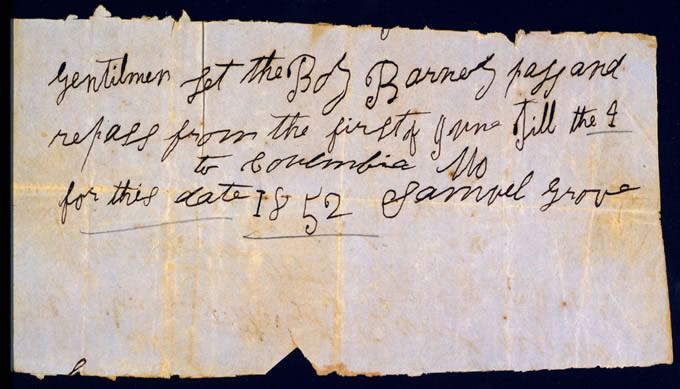
A slave pass signed by Samuel Grove, permits “the Boy Barney” to pass and repass to Columbia, MO from the first to the fourth of June for this date in 1852. This pass is a complicated and sad story about slavery, literacy, and escape.
Grove’s pass is most definitely a forgery. According to History of Ray County, MO, Samuel Grove was one of the original settlers of Tinney Grove in Ray County. He was a literate, slave-owning Methodist Episcopal reverend from Virginia who moved to Tinney Grove in 1840.
We can envision Barney, then, squirreling away different passes he received from Grove, passes that allowed him access to nearby lots or fields. Barney, much like Peter Randolph (Sketches of Slave Life, pg. 27) or Thomas L. Johnson (Twenty-Eight Years a Slave, pg. 12), likely studied Grove’s handwriting on these passes, slowly teaching himself both how to read and write and how to pen his own pass.
This pass needed to have just enough detail (“first of June till the 4,” “for this date 1852”), but not too much (“to Coulmbia (sic), MO”) to simultaneously seem legitimate, but also give him fairly open access to the 110 miles of slave-country that separated Tinney Grove and Columbia.
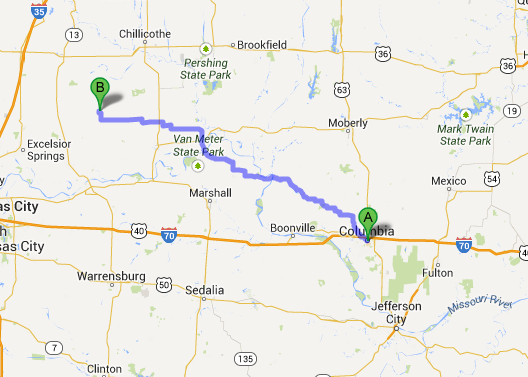
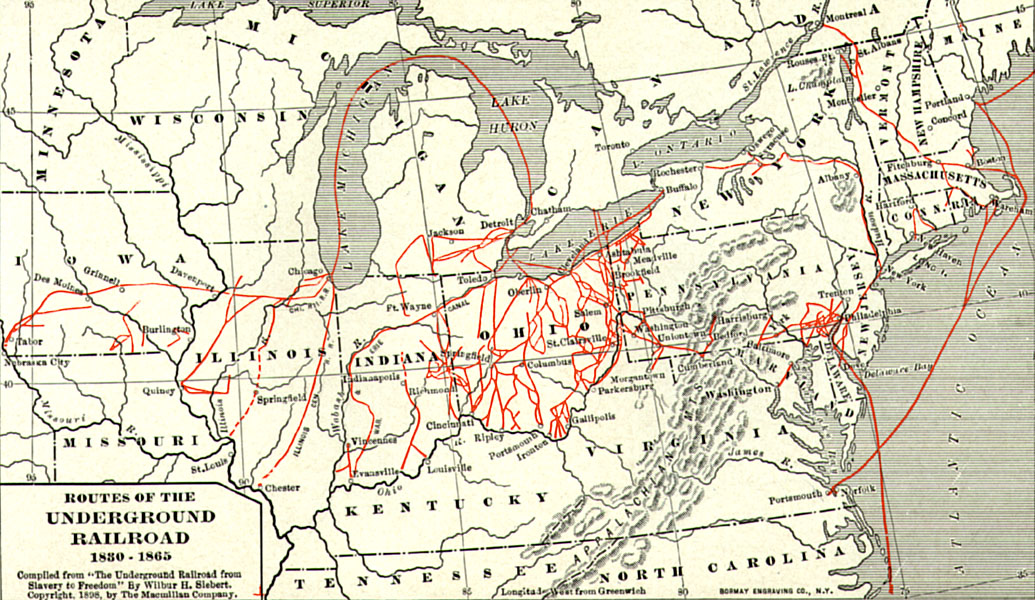
When in Columbia, Barney could hopefully find safe passage via the Missouri river into St. Louis, where he could hook up with one of the northbound routes of the Underground Railroad up through Illinois to Chicago, and across Lakes Michigan and Huron to Detroit.
But this pass betrayed him. The peculiar slant to the penmanship, its shakiness with the letter “y” and idiosyncratic way of starting the lowercase “d” with the stem, and not the loop; this is not the handwriting of a literate preacher. The misspelling of “gentlemen” and “Columbia,” the peculiar shift from written numerical adjective (“first”) to written number (“4”) in the dates of the pass, the strange insertion of “Coulmbia MO” between the second and third line, as though the pass was written and that later amended to add more specificity; this is not the direction of a literate preacher.
And true enough, when presented with this pass on June 2, 1852, Joseph Mattose identified the peculiarities of the pass, apprehended Barney, and returned him to Samuel Grove, returned him to slavery.
