At first glance, this appears to be a picture about my cat:
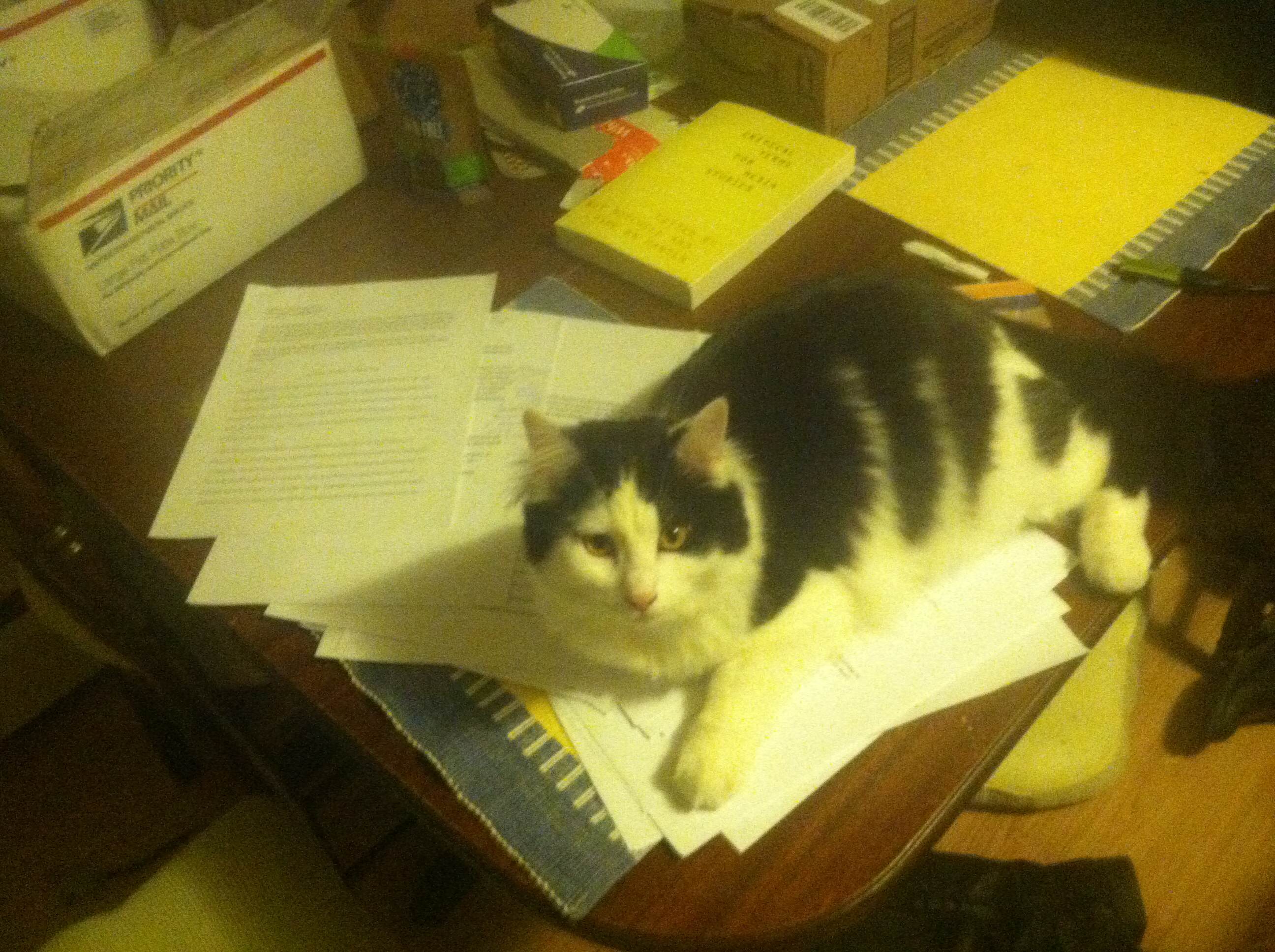
However, this is actually a picture about the paper documents my cat has decided to make his seat. I fanned this papers out on my dining room table in preparation for this picture after a long day of changing my mind about what to take a picture of, what to write about.
For some reason, this signment has been the most difficult for me in terms of settling upon a topic. Maybe this difficulty is due to my indecision in choosing a direction for my final project. Or maybe it’s due to the sheer number of examples of minor printing I realized exist in our hybrid print-digital world after reading Lisa Gitelman’s piece.
For instance (and this speaks to Tablet’s post) I got a parking ticket today. And I also thought about going to a movie, which requires purchasing a ticket. And both kinds of tickets are examples of minor printing, and they’re both called tickets. What defines a ticket as such? It seems to have nothing to do with content and everything to do with some material properties. Yet, in the case of “tickets,” the differentiation of content seems incredibly important, if ignored by the naming(s). In the instance of the film or concert ticket, we might save the square piece of paper to remind us forever of an event to be incorporated into our life narrative. In the case of the parking or speeding ticket, we only keep the ticket long enough to pay it. Then we trash it and attempt to erase the event from our memory as thoroughly as possible. What is the history of “the ticket,” anyway”?
However, I decided not to write about tickets (even though I accidentally kind of just did) because I didn’t actually go to a movie. I started prepping for the class I teach tomorrow instead (SC). I was thinking about what kind of workshop we should do tomorrow, how early I would have to get to campus in order to print and make copies of the workshop worksheet for everyone in my class. Then, I realized that I do this three times a week. 19 copies “hot off the press,” so to speak. I author the workshop questions, the students author the essay or discussion board excerpts which I curate. Then, we all read/look/work/talk at/on/about these co-authored sheets of paper together. Without this minor print genre—the worksheet—my class would cease to be the same class. It would not function in the same way. I often bemoan the worksheet. Without the worksheet, I would not have to get to campus as early. I would not be “wasting” so much paper all of the time. I would not have so many extra or unused copies of worksheets thrown all over my apartment. Yet, it is hard for me to think of another material way to do the same kind of work that the worksheet allows us to do.
The papers fanned out on the desk are extra copies of worksheets from last semester. Somehow, these select few made it into my filing box (not a whole cabinet, don’t get excited.) The selection seems fairly random. I always make sure I have a hard copy of the worksheet for myself. But most of these have disappeared. Instead, I seem to have large amounts of copies of the same few worksheets. Did I get overzealous at the copier? Was everyone absent that day? I don’t remember anymore. I know that there are more SC worksheets floating around my apartment. Why do I save them, why do I bring them home, why do some get filed? I have digital versions of all of these papers that I can revise and print for this semester. I have almost no use for three print-outs of a worksheet from September, even if I could find them. If I move to a new apartment, I’m sure most of these papers will go in the trash, and they’ll be lucky to receive a glance first. Still, it feels safer to keep them for now. Even if they just become toys for my cat.
Does this teach us anything about the relationship between teaching and print?
