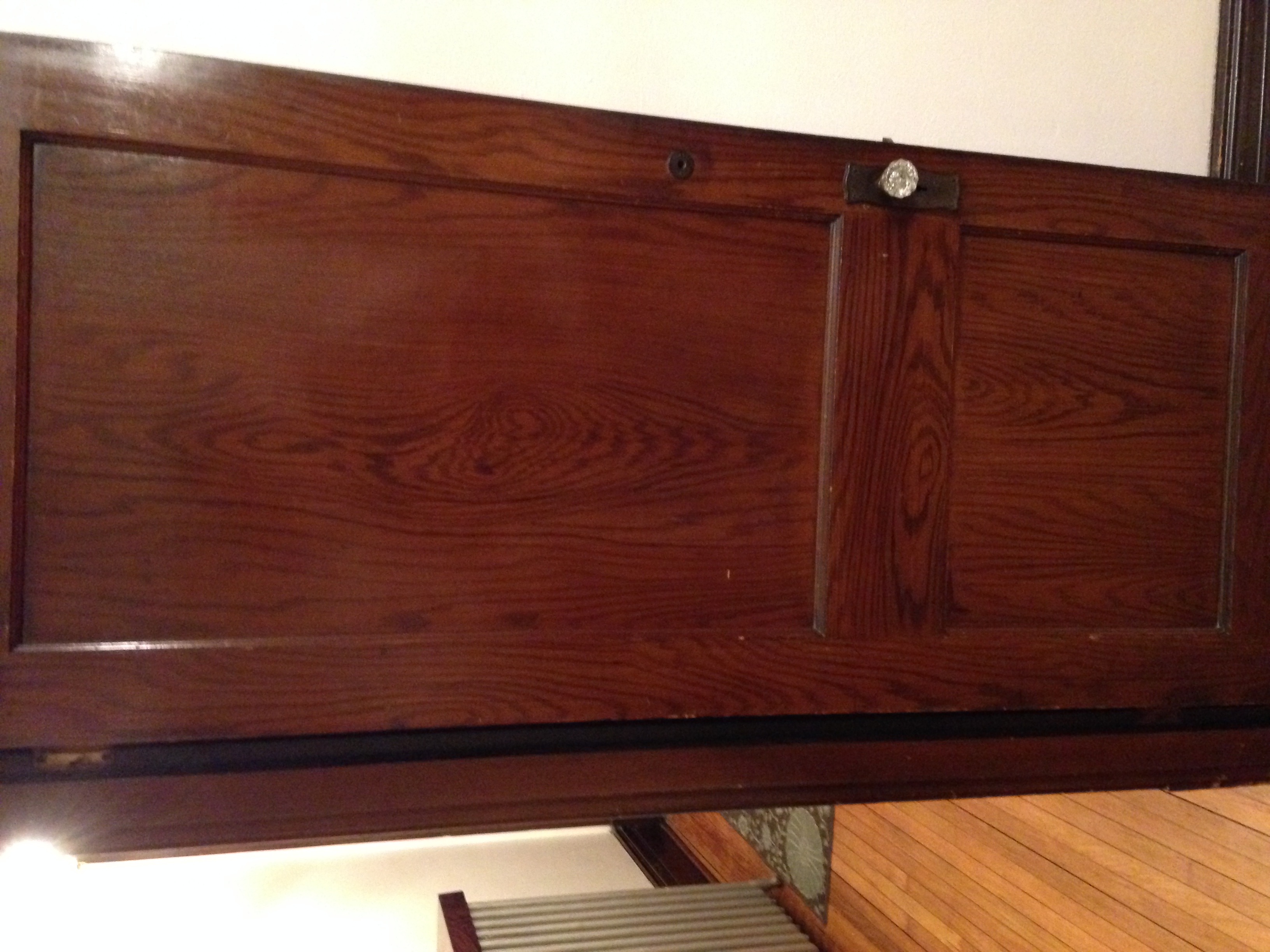
 What looks to be a solid wooden door separates the vestibule of our new home from the dining room. When we first toured the home, we noticed the doors only to say how richly colored hey were. When I toured the home with our inspector, he pointed out the doors, asking, “These look like solid oak doors, don’t they?”
“Yes,” I said, “we noticed them on our first walkthrough.”
“Well they’re not,” he said, rapping his knuckles on this door in particular. A hollow sound rang out; the sound of wood much lighter than oak. “But I think these are even cooler than a solid wood door, and certainly a helluva lot lighter.”
He continued: “Look at the grain on this door. See how it’s inconsistent in places. This isn’t actual woodgrain. The people who first painted this house painted this grain on the door. It’s not real. They probably spent hours doing that, just so they wouldn’t have to spend all that money and all that hardwork wrestling a solid oak door in here. Because they’re heavy! They probably had a whole array of painting tools, feathers, specialty brushes and so on, and they had fun with it, making these swirls and designs, all in an effort to make a door that wasn’t oak look like a door that was.”
______
This is one of my favorite parts of the house my wife and I bought last March. Our inspector, Dennis, was full of little bits of information like this. He pointed out original masonry work where you could see the edge of the trowel as it cut a line in the mortar that glued together the bricks of our 100+ year old house. He showed me the fist-sized ball of lead that connected the external water main to the internal plumbing, the finger-sized indentations of the worker who molded the ball still evident. He was clearly taken with these little clues that connected the present day to the time when the house was built in the late 1800s. And his enthusiasm was contagious. Soon after we moved in, I scoured our house for other little markers of the past, residual traces of all the people that had something to do with our house, whether it was the masons who laid the bricks, the plumbers who shaped the pipes, or (as I secretly hoped) the single, multi-generational family that lived in the house from the time of its construction to the time we purchased it.
______
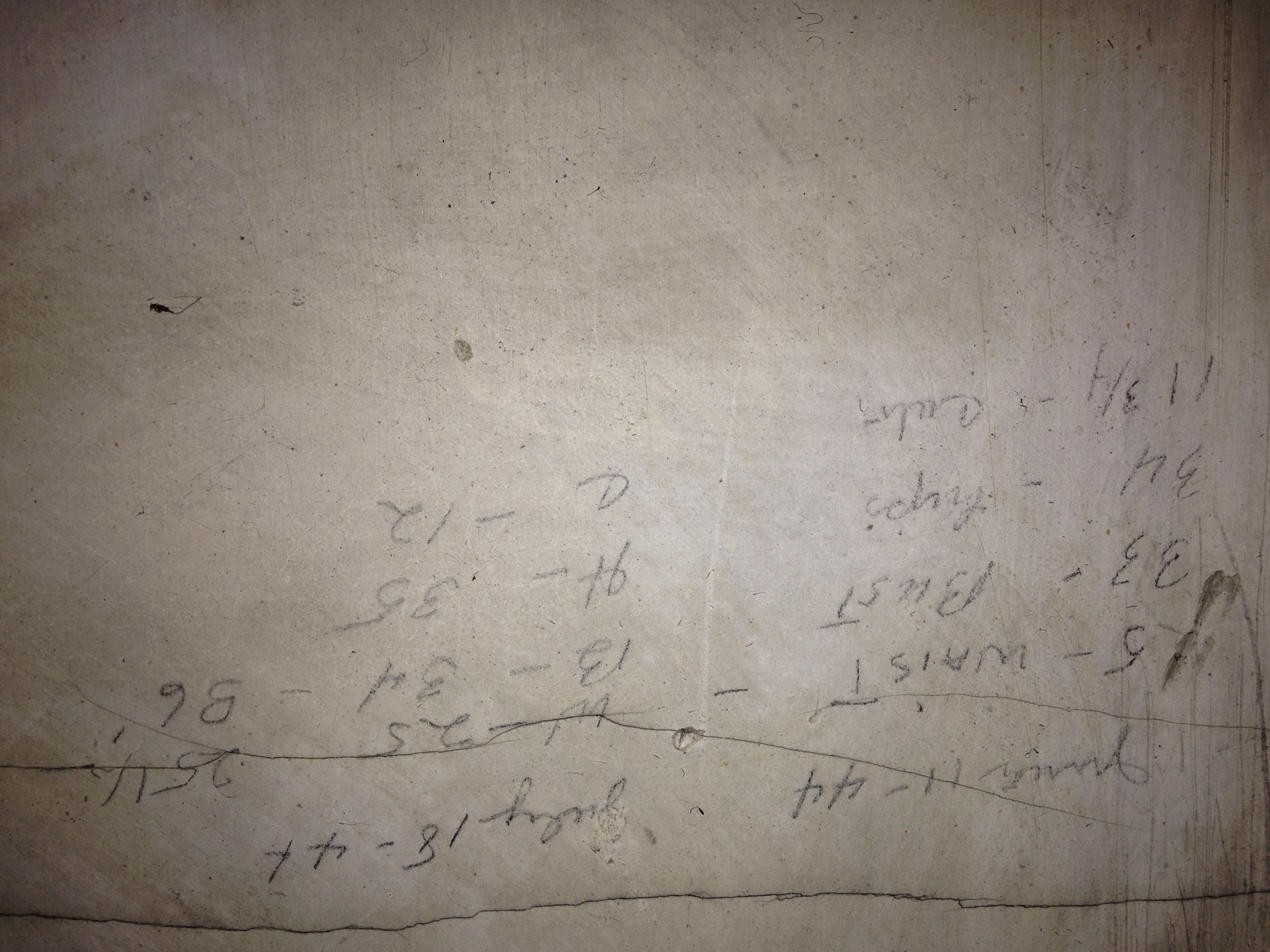 In the smaller of the third floor rooms, inside a closet, written on the original, unpainted, unfinished horsehair plaster wall, a former resident kept track of her body measurements. Waist, bust, hips, and calves, measured and recorded in June and then again in July of 1944. This is unwanted writing that I hope survives forever.
What’s initially peculiar about these measurements — viewing them, as I am, from our current era obsessed with thinness — is that they indicate growth. The writer’s waist expands from 25 to 25 1/2 inches, her bust from 33 to 34 to 36 inches, her hips from 34 to 35 inches, her calves from 11 3/4 to 12 inches.
They are, perhaps, the charting of measurements for purposes of vanity. Maybe this is a woman who wants a larger bust, more vivacious hips, a more womanly body. I’m reminded of the Violent Femmes song, “36 24 36”: See a girl walkin’ down the street, just the kinda girl that I’d like to meet. It ain’t her hair, her clothes, her feet, somethin’ much more discreet.
If these are recording of measurements for the purposes of vanity, though, I’m not sure why they’re in a closet, in pencil on the third floor. Why hide them in something that seems much more removed than, say, a diary, or a journal? Why seek out the inner wall of a closet? And how on earth does a woman’s bust grow two inches in a single month?
______
Of course the other thing that happened right around March/April of last year was that Wylie was born. We like to stack our major life events right on top of each other, see, so that as we struggle with the difficulties of a newborn child, we also struggle with the difficulties of an unfinished living space. It’s always nice to be able to move furniture into a house as you’re trying to stay very quiet so that both your wife and your child can get some sleep.
______
Baby boomers are folks born in the years immediately following World War II. The story goes that as servicemen returned home from the European and Pacific theaters and immediately sought out their sweethearts and wives, celebrating their victory and their livelihood in a way they found natural. They had sex. The boom peaked in the later 1940s, plateaued for most of the 1950s, and slowly dwindled in the late 1950s and 1960s.
______
Ursula Sangl, the last occupant of our home, was 12 in 1944. Her parents, William and Sara, were 42 and 40 respectively. Ursula was the oldest of William and Sara’s three girls. Carol was 7 and Norma was 4.
______
Elizabeth “Betty” Sangl Enright was the upstairs tenant of the Sangls. She was 31 years old in 1944. In the 1940 Census, her relationship to the head of household (William) is listed as “daughter.” She is likely his younger sister. She is a typist at a factory.

2 Responses to This Old House