As I was doing the readings for class – especially the excerpt from The Nature of the Book – I started thinking about one of my favorite novels. (I’m a fiction MFA, so that’s really just typical. Literally everything reminds me of novels.)
The book in question is Jonathan Safran Foer’s Everything Is Illuminated. Whatever your thoughts about Foer as an author, you can probably agree that EII does some smart and tricky things with texts as physical presences. The moment when this is made clearest is this one, in which the elders of the shtetl, charged with recording all of history, run into the problem of wordlessness. They cannot think of what to say, but they must always be recording, and so there’s a solid page and a half of their real-time log of inscription. (I am typing…I am typing…)
Johns takes care to stress that texts have bodies, that they don’t just exist out in some idealized thoughtsphere. This is meant in direct opposition to a kind of history that sets books apart, as if the course of printing weren’t a human venture. The goal of any text that aspires toward respectability is seamlessness – the image not made by human hands, if I may cite my Orthodox background. A dictionary that shows the fingerprints of its makers is not a reliable dictionary. (Or it is – it might be perfectly reliable – but it isn’t perceived as such, and that’s sort of the same thing.)
So that’s all well and good. But then I started thinking about how on earth I’d write something that referenced its own materiality, and things got very meta very fast, and long story short I abandoned my idea of transcribing that page from Foer’s book. It wouldn’t be referential in the right way; what I’d be evoking would be the book, not as a physical object but as a woozy cloud that happened to be embodied in this way or that. Which isn’t what a book is. And besides, the shtetl elders only have the one parchment to write on, so making a copy didn’t make too much sense either.
Instead, I went out to the kitchen for a snack and ended up playing with the magnetic poetry on my fridge. (One of the first things that went up when I moved this weekend.) I love it for its untranslatability. You can copy over a poem written in magnets on your fridge, but what’s the point? Half the fun is in the magnets themselves, these little rectangles marked in clear font; there are literally, physically, only so many words in a set, so each one feels weighty.
So that’s where I’ve gone with this week’s signment.’
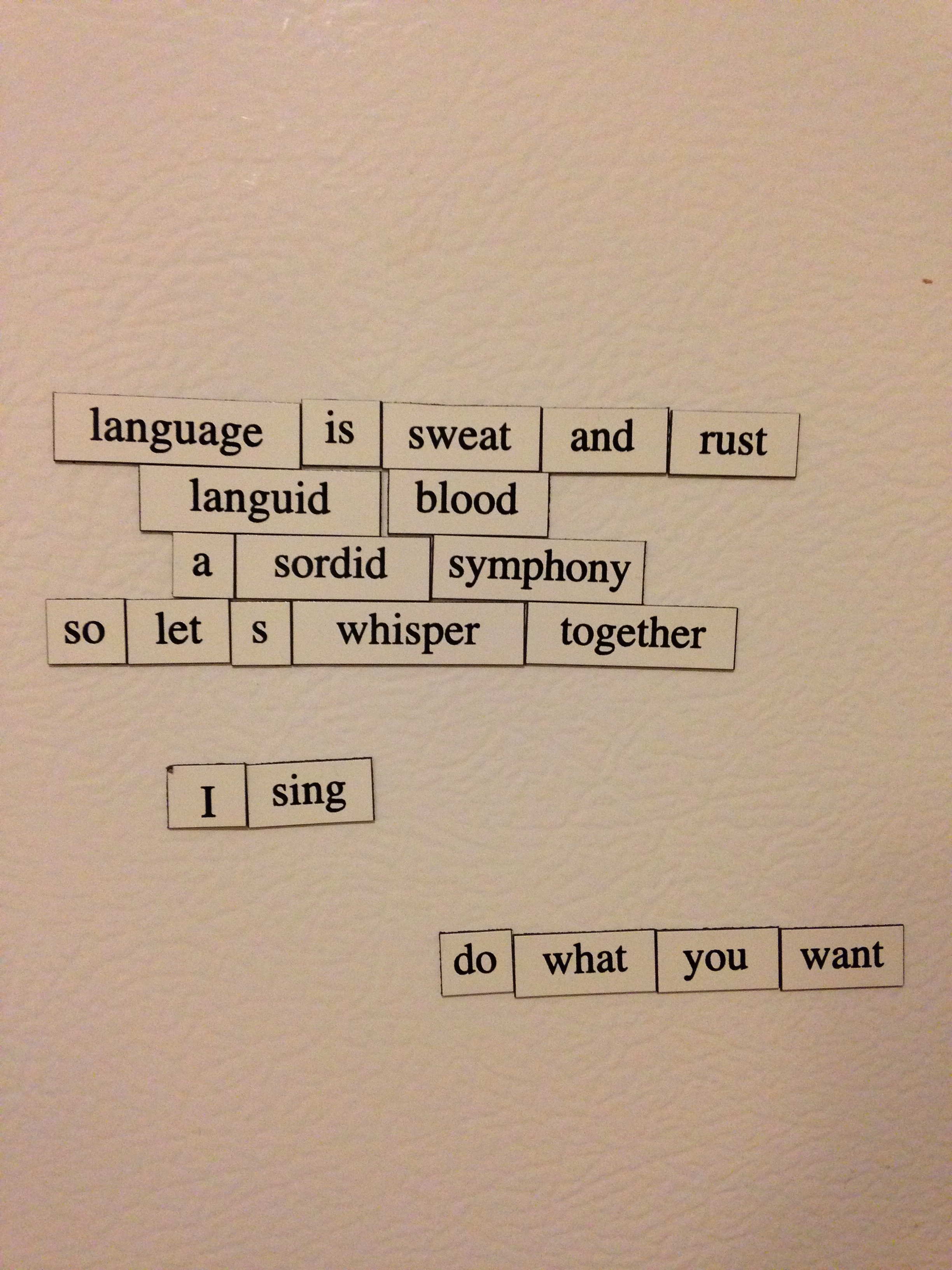
It’s clunky and weird, and the words aren’t quite what I’d have chosen myself, and that’s why I like it. To read it, you also read the constraints. Seamlessness is overrated.
