I chose to make what I expected to be a fairly relatively simple bot in the style of the Poe example provided for the class. I thought I would use text from John Cage’s “Lecture on Nothing,” which is composed of short artful lines that I thought would lend themselves well to tweet form. I set up my Twitter account and app and pulled the text I needed from the Internet Archive, feeling perhaps overly confident about pulling together a project that would be easy(ish) to execute and have a fairly interesting outcome. That is of course a rookie move, and I quickly realized what I had chosen to do wasn’t as simple as I had thought. It is fitting and ironic that I selected a text that ends:
“All I know about method is that when I am not working I sometimes
think I know something, but when I am working, it is quite clear that I know nothing.”
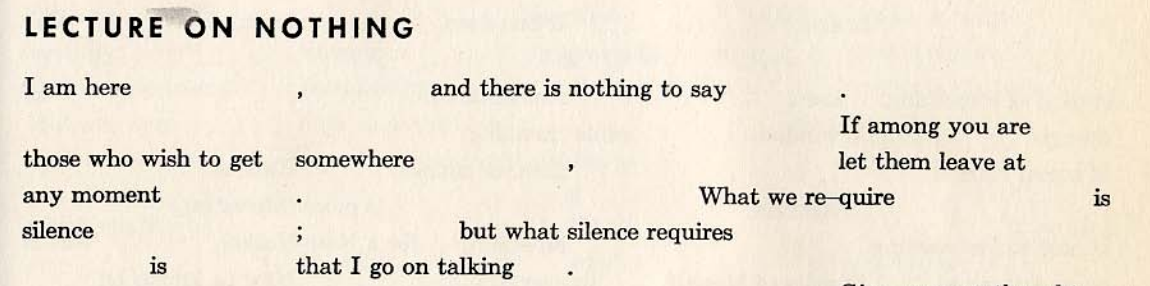
“Lecture on Nothing” is written out as a musical composition, in measures with musical spacing and repetition. On the page, it looks like this:
The same content, in a plain text file, looks like this:
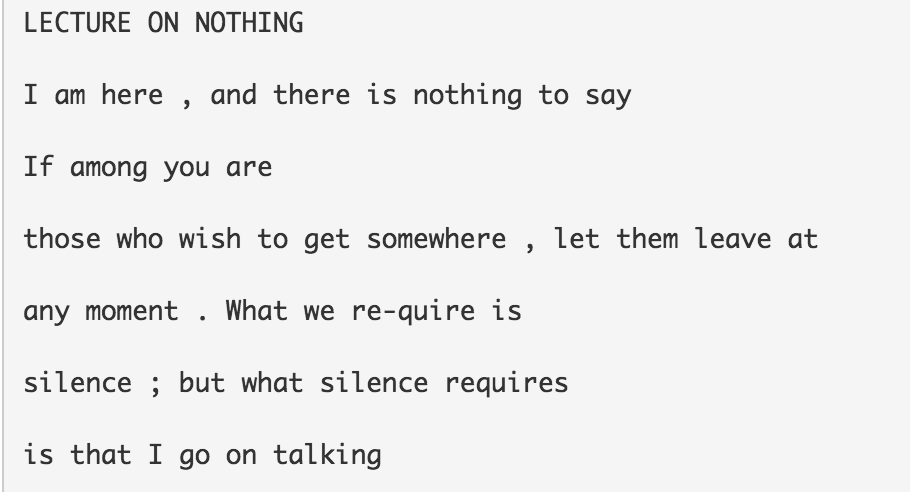
So far, so good! But the order dissolves almost immediately afterward.
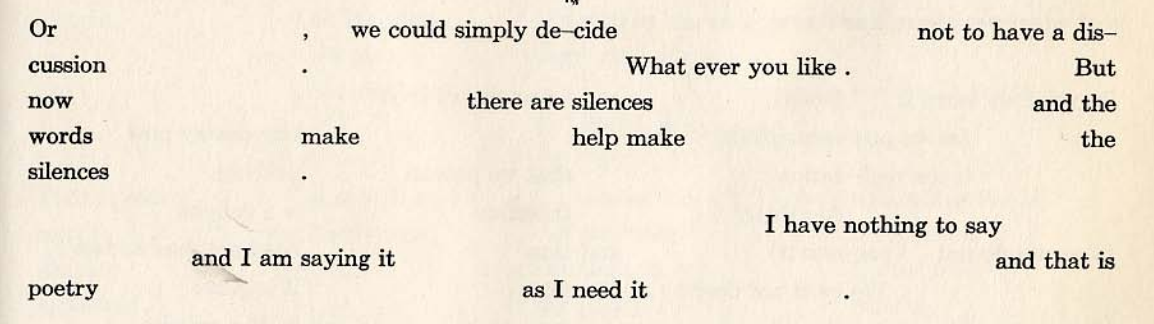
A little further down the page, the above image translates to the following text:
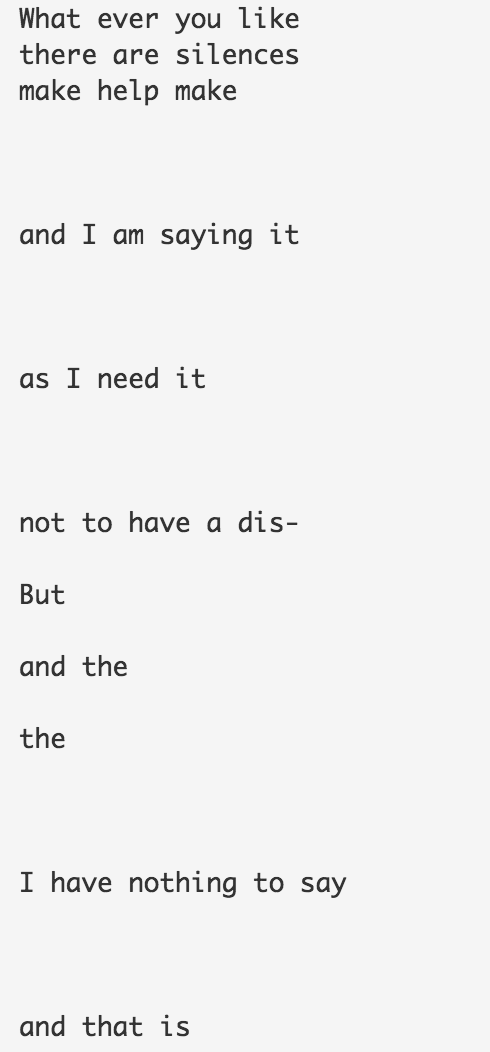
It looks like a fairly standard OCR problem. I found it sort of funny and fitting that in trying to create a bot, I had inadvertently picked a text that a machine had essentially already altered for me. My file ended up creating a nonsensical word-jumble effect that seems fairly common to bots, without my actually coding it to do that. So I ended up with some very typical bot tweets:



While working my way through the initial process of creating the bot, I spent some time reading through additional tutorials and documentation, and thought about bots as compared to human-generated outreach projects on Twitter, like NPR’s Today in 1963, or historical societies that have tweeted diaries from their collections. I’m interested in the impact of these projects, and how the use of bots in these settings can automate the workflow of posting; and yet curatorial decisions made by humans are at the root of these accounts. Additional searching also turned up no “Lecture on Nothing” text that wasn’t similarly formatted in the OCR process. The part of me that would follow a John Cage bot wonders if creating that text by hand is the only way to generate an accurate machine-readable version of the lecture, and if I am the person who will end up obsessively taking the time to type it out…
I love the results that you got with the John Cage piece! Really great choice for this kind of work, precisely because it comes out so bot-like, but in a kind of wonderful way. You’re right to tie it back in with the OCR; I think there are definitely some possibilities there. Maybe something like a twitter bot project where the bot takes an OCR’d version of a text and compares it to a published e-text version, tweeting out any discrepancies. I like the idea that, somehow, there’s a way to expose the otherwise-invisible labor present there, to make-visible the fact that the digitization process still requires human oversight and intervention at times to create a suitable result. Though as you point out, in order to undertake that project with the “Lecture on Nothing,” you’d probably end up doing a lot of the legwork yourself…
I have to say, now that I’ve started in on this process, and have learned a bit more about how bots work, I kind of want to see this particular project through. The idea of two bots dealing with this same text in different ways is a really fun one. Transcribing the text could be tedious, but the arrangement is specific enough that there would probably be some interesting challenges along the way. Plus, I imagine I’m not the only person who has ever needed an accurate text file of this lecture.
You clearly are the person for the job of completing this bot! At first glance, I was tempted to see the lines as parts of a multi-vocal score. Upon reading I had to dismiss that idea, but I found myself counting the beats since, as you say, the “Lecture on Nothing” “is written out as a musical composition, in measures with musical spacing and repetition.” So here is a challenge for you: Not only does the bot read the text, it is programmed such that it maintains the temporality implied by the spatial score. So, lines that are close together might be tweeted with a few seconds between them, lines that are more distant, such as those to either side of the long gap after “and there is nothing to say” (which I read as extending deep into the absence of line 2), would take a commensurate pause between tweets. Have fun with it!