As I read Ian Bogost’s book, Persuasive Games, I found myself subconsciously substituting “coding” for “gaming” quite frequently. So, for example, I read that “It is common…to equate videogame playing [CODING] with idle time” or that CODING (and gaming) are “easily denigrated as trivial” (Preface, vii). It seems that since coding has not yet found its place in my average “work day,” I often perceive it as belonging to those stolen moments in between one activity and the next. Is this how others view coding and gaming?
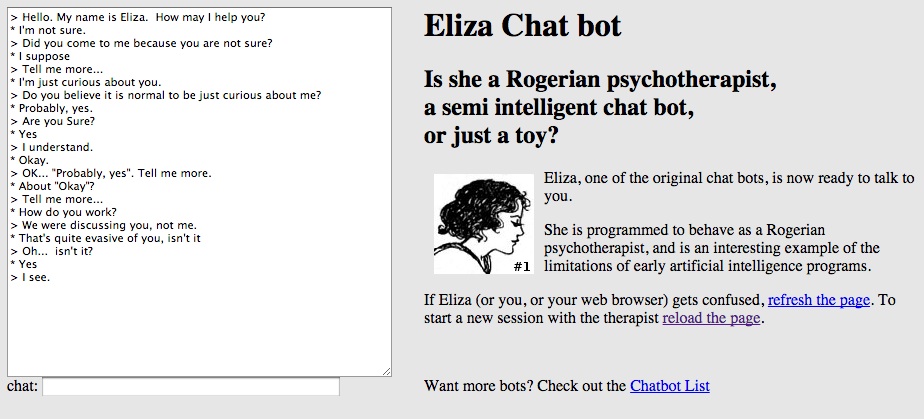
The Eliza Chat bot: a disappointing therapy session
In addition to drawing these parallels, I attempted to embrace Bogost’s thesis of persuasion as accomplished through procedurality. When Bogost described ELIZA, an early example of Natural Language Processing (I believe “her” program was written in 1973), I opted to try the Eliza Chat bot to get some sense of how these conversations ran on procedures (see image). My session with Eliza quickly revealed why she was/is called a “Rogerian psychotherapist,” as she expressed an unnerving degree of empathy and was constantly reaffirming my feelings by regurgitating phrases I’d previously entered. Of course, this type of therapy “logic” aligns well with the way subroutines in code are established, and the façade of language fluency quickly disappeared from this interaction. I had a few “conversations” with Eliza, and they all left me feeling frustrated and, in some way, inadequate.
Progressing beyond ELIZA and to the games themselves, I found Chapter 4: Digital Democracy, incredibly compelling. Looking for a form of effective expression and a “desirable possibility space for interpretation” (28), as described early in Bogost’s tome, I was intrigued by the macabre games simulating such events as JFK’s assassination, the September 11th terrorist attacks, and the Waco siege of 1993. These games require players to embody the roles of victim or assassin subjected to randomly-assigned circumstances. So, during one session, a player might escape the World Trade Center, but on another they may be forced to jump to their death. Although these games may create a type of “meaningful engagement with procedurality” (124), I’m still unsure of the purpose of this type of engagement. Are these games attempting to generate an even greater degree of empathy for the victims? Or are they satisfying some strange curiosity about these events, and feeding our somewhat disturbing appetite for spectacle? Speaking of which…Bogost writes about the spectacularity of JFK’s death in JFK Reloaded.
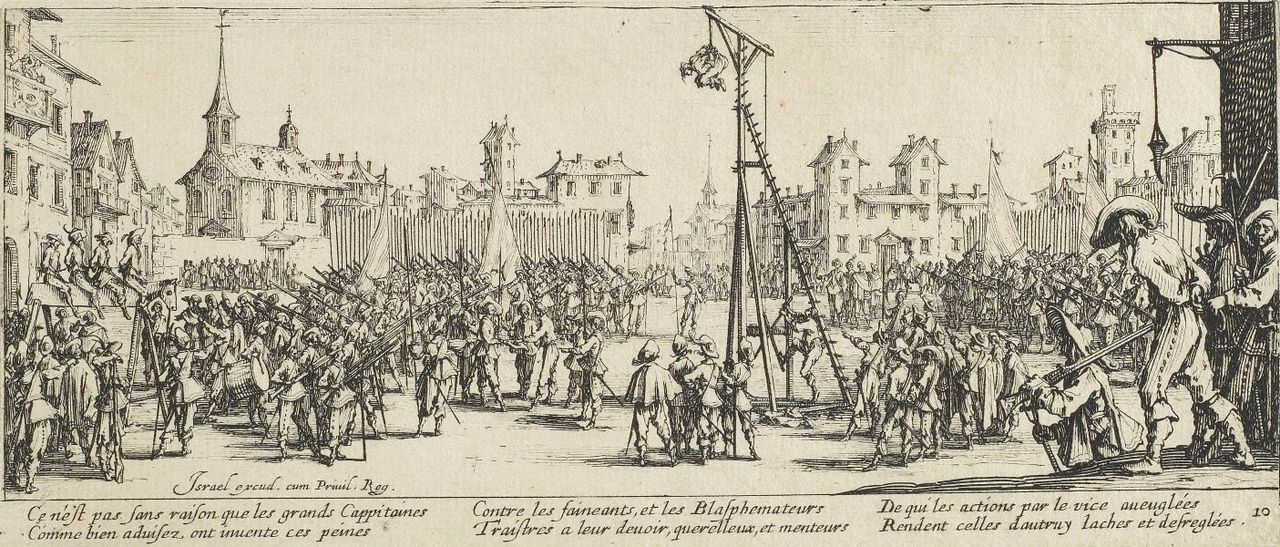
The Strappado. Courtesy of Wikipedia.
This immediately transported me to Michelle Foucault’s Discipline and Punish, and his descriptions of punishment as public spectacle. This, in turn, brought me to Francisco Goya’s etchings, Los Desastres de la Guerra or The Disasters of War, and Jacques Callot’s Les misères et les malheurs de la guerre or The Miseries and Misfortunes of the War. Both of these series are unique in their unapologetic depiction of war as horrific spectacle. What is the difference between Callot’s 17th-century engravings and Goya’s 19th-century etchings and Waco Resurrection, for instance? The game and Callot’s series are:
- staged,
- they place the viewer in the midst of the action and the various gruesome procedures of war,
- and they adhere to a pre-defined sequence controlled by the creator.
Perhaps I’m oversimplifying things in order to make my argument work!
I’ll leave you with a couple of additional questions:
- How can political campaigns incorporate “meaningful engagement with procedurality” when the outcomes are unknown? The examples provided in the book are of historical events defined by their outcomes…but how could Bernie Sanders, for example, incorporate procedurality in his current campaign tactics? Bogost’s examples (including Howard Dean) all pre-date Twitter and seem *somewhat* outdated, so I’m wondering what a game might look like now?
- This is a reference back to the beginning of the book, but Bogost describes a videogame as a “medium,” in the sense that film and radio are media. Is “code” a medium?
I am interested in your commentary on the nature of spectacle in games such as 9-11 Survivor and JFK Reloaded. The connection to Foucault’s Discipline and Punish particularly apt. I’d like to build a bit on your post by discussing further the value of spectacle and the interplay between video games and the media.
As you point out in your connection between these video games and the gruesome nature of Goya and Callot’s works, horrific imagery is employed consistently throughout time as a means of engaging an audience’s attention. From films like the Saw series and A Serbian Film to novels such as American Psycho and just about anything written by Chuck Palahniuk, spectacle persists in present day media as a means of allegedly providing commentary on art, society, and the human condition. However, the question typically arises as to whether this spectacle is a necessary vehicle for conveying the prescribed message or if it exists merely as shock value. I tend to agree with Bogost’s claim that, if the procedural rhetoric is sound, spectacle can lead to critical engagement and even empathy on the part of the player. For instance, while players may be drawn to 9-11 Survivor due to the spectacle of its portrayal of a still recent national tragedy – as well as, perhaps, due to negative media attention – they will potentially consider ideas such as security and terror, fear and uncertainty, and their own relationship to public spaces throughout the course of gameplay (129-130). Thus, it would seem that spectacle is an effective way of engaging with the player’s interest in order to convey a broader message; however, I am curious as to how many players critically consider this message without analytical guidance.
While these games might be compelling due to spectacle, the media attention they receive grants them even wider spread popularity. Whether it is the conservative right denouncing Grand Theft Auto or The Guardian’s report on Senator Ted Kennedy claim that JFK Reloaded is “despicable” (http://www.theguardian.com/technology/2004/nov/22/usnews.games), a reactionary rhetoric is spun around these games that provides them with a notoriety, which in turn, leads to even more attention (118, 128). Perhaps, then, it is this counter-rhetoric of the media that could be engaged with in order to address your question as to what a current political game would look like (e.g. a Bernie Sanders campaign). From the reporting on Donald Trump, it appears that spectacle is what the public wants to see on its nightly news (newsfeed, dashboard, YouTube subscriptions, etc.), and as we’ve established, video games certainly seem more than capable of providing this. A truly effective political campaign game, then, might consist of an initial spectacle, an underlying procedural rhetoric that utilizes this spectacle in order to convey a powerful yet clearly comprehensible political message, and enough pizzazz to warrant prolonged media attention. At this point, however, I’m just…speculating.
Since the two of you have already done a great job working through the particulars of procedure and spectacle, I wonder if another keyword like “participation” might be brought into play. It seems that part of the tension that comes with playing a game whose procedure forces you into an uneasy position of culpability (like being JFK’s killer) has to do with how it enables or disables certain kinds of participation. I know, for example, that if I were placed at a computer running JFK Reloaded, that I would play it, regardless of what the ethical stakes for me might seem to be. What is it about the (now-universal) prevalence of games that convinces us to participate, and is /not playing/ ever a meaningful rhetorical act?
I think that the concept of games created for a purpose such as spectacle or education is a really interesting topic to pursue, and I really like the question of how political campaigns can put things like this to greater and effective use.
Perhaps most effective would be to remove from the game the actual process of the election itself, as well as the intended results because, as you say, the conclusion would be at that time unknown. Rather, take the political ideologies and place them through a procedural gameplay scenario so that the constituents can see the play out of certain policies, while gearing it in a way that would favor a certain candidate. For instance, by selecting early on in a game to increase funding to education, the next step of the procedure would be to deal with the repercussions of that spending while the player works their way through. It would be a way to educate players on political issues that they may not know as much about while also attempting to show them that the agenda being espoused be a certain candidate would be the correct one for them.
However, as addressed above, this does not involve a ton of spectacle and may not be the most exciting game to play. A lot of the impact of gaming comes from a level of spectacle. It is entertaining, or is supposed to be. So whether or not a game of that nature would be an effective tool would remain to be seen.