Thanks for the great discussion last night! I wanted to share the links for the things I brought up in class. First, the document with your definitions of code. And the visualization (thanks to Aisling for the reference to Voyant!):
Here’s the video of Why the Lucky Stiff explaining how programming should be fun and easy, like games:
He references this short piece he wrote, “The Little Coder’s Predicament.” And if you’re curious about _why, then you can read his Wikipedia page, or this interesting article in Slate that covered his disappearance (referencing a lot of Pittsburgh connections, incidentally), or his this article in Daily Dot on his slight return, when he put out a novel in printer command language.
And finally, some summary snippets of your blog posts from last week, which I meant to distribute in class, but forgot:
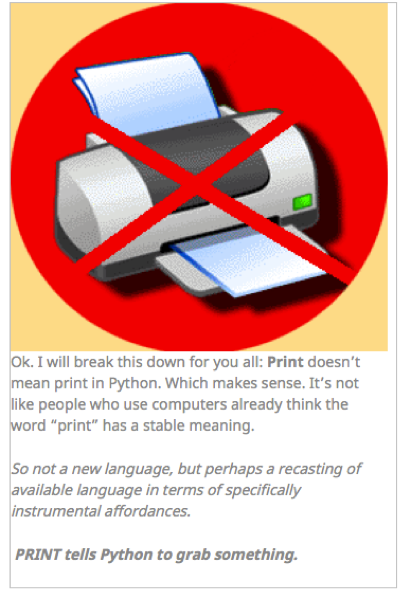
The contemporary computer seems to be the most extreme example of a media that erases itself, or hides its true core. Introducing someone to the most “basic” ways of interacting with a computer like word processing or Google actually seems to dull or blunt the basic skills and instincts useful to programming.
the efficiency and simplicity of the language (once attuned) mixed with a determined infrastructure is giving me hope that there might be a computational critical method that can be excavated onto rhetorical criticism at large (not just semantically)
Well, supposedly Python is named after Monty Python, who are some of my favorite Englishmen, but putting jokes aside, it’s a language, right?
It is not about the beauty of the writing, but simply about the speed and accuracy of its results.
It strikes me as odd that the infrastructure available does not seem to comply with the general stated goals of programming literacy.
I felt that I was acquiring a set of skills that would allow me to navigate a breadth of ideas and content and, eventually, with practice, express my own original content, or a point of view, to communicate with others and contribute to a larger dialogue…. For all the rules, and all the value of the rules, I suspect that code is more malleable than it feels when we are learning it, in the way that language is not as rigid as rules of grammar and sentence structure could make it seem. Once you learn what you are working with, you build on it and test the boundaries of what you can do outside the rules.
I’m thinking about coding as a language that alters the way we think.
There’s a tendency when coding to develop your own style and throw best practices out the window, but as I’ve mentioned, keeping up with those practices makes it easier to transition between languages while also making your code easier for others to read and, therefore, modify.
code in Python, like the traditional sonnet, has a series of beats and lines that must be filled according to protocol; I will not be able to Berriganize my code, despite a desire to, by the end of this class, produce some kind of aesthetic object that eludes fixity.
I got the result I wanted to move forward (“done enough“), but it’s not the way it “should” look (and I don’t mean “perfect,” but rather, more acceptable or conventional, or maybe, more “precise” is the way to put it).
we in the humanities like nuanced, complex definitions and are fully willing to let them shift and evolve as we encounter and construct new information. In the world of computer sciences, this is not at all the case. Definitions are agreed upon and clear. In the world of coding, I learned, we can make anything equal anything, so long as what was presented and what was equalled makes sense in the language of the code.
I hope to help bridge the gap between theory and lived experience.
I was forced to figure out the mistake on my own, and it was much more liberating and empowering than simply referring to a troubleshooting manual.
I have found that coding, or doing work in the digital humanities, has consistently required a level of concision and efficiency that I hadn’t previously encountered using the tools of pen and paper or Microsoft Office.