“[T]he essential features of all games: symmetry, arbitrary rules, tedium.”
– Jorge Luis Borges, “An Examination of the Work of Herbert Quain”
I’d been reading video game/critic Ian Bogost’s Persuasive Games off and on for a few days when I played board game designer Antoine Bauza’s 7 Wonders with some people at a Eurogames Meetup. 7 Wonders is an accessible game, one they trot out with ‘nubes (like myself), or when time is a bit short. By then I’d heard Bogost’s take on about a hundred video games both obscure and familiar, and I found myself thinking about 7 Wonders in light of his work. Procedural rhetoric and literacy certainly seem to apply to rule-based artifacts of all sorts.
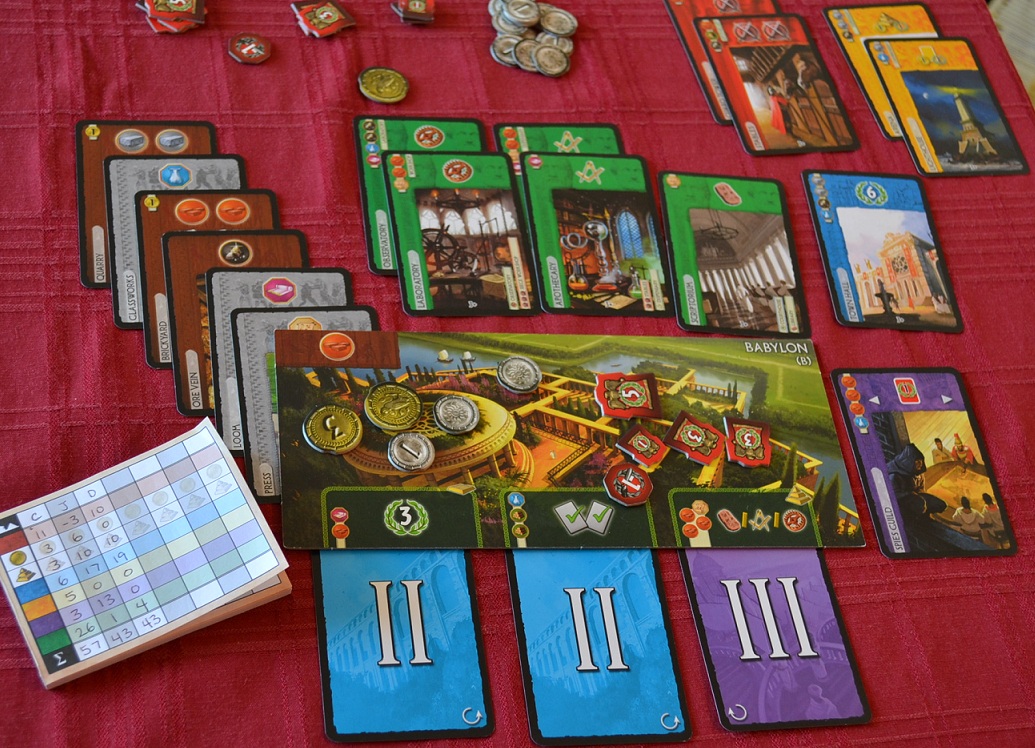
The conceit of 7 Wonders is that you are guiding, in a sort of undefined, god-like way, the growth of an ancient civilization amid a field of rivals.played Babylon most recently.There is no geographic game board, which is unusual in empire building games. Instead, everyone has a kind of place mat (“wonder board,” I think) that lists some basic information about your empire and serves as a baseline for you to set up cards you accrue as the game goes on. I Here is a more official description:
“You are the leader of one of the 7 great cities of the Ancient World. Gather resources, develop commercial routes, and affirm your military supremacy. Build your city and erect an architectural wonder which will transcend future times” (more of this at boardgamegeek.com).
But back to Bogost. In Chapter 8, “Procedural Literacy,” we find this definition: “Procedural rhetoric is a type of procedural literacy that advances and challenges the logics that underlie behavior, how and why such logics work. Procedural literacy entails the ability to read and write procedural rhetorics – to craft and understand arguments mounted through unit operations represented in code” (258).
I mention this passage because it clarifies the relationship between these two slippery terms. Procedural rhetoric is presented here a subset or style of application of procedural literacy. [Perhaps less helpful is the end of the sentence, which alludes to Bogost’s Unit Operations.] Bogost follows up with a list of question one asks when engaged in the “type of ‘reading’ and ‘writing’ that form procedural rhetorics”:
- What are the rules of the system?
- What is the significance of these rules (over other rules)?
- What claims about the world do these rules make?
- How do I respond to those claims? (258)
I’ll take these questions as a procedure, of sorts, and apply them as a heuristic to 7 Wonders:
- What are the rules of the system?
You are dealt a hand of cards. You choose one to play, and pass your discards to a player to one side. You can select resources or, if you have enough of them, buildings. The buildings you create can offer you victory points, cash, or more obscure benefits. If you grab a few resources early on, you’ll have better luck building later. The cards get passed around the table in successive hands. (If you really want to get a sense of the mechanics, here’s a video made by a guy who sounds inspired by the majesty of the game.)
- What is the significance of these rules (over other rules)?
In the situation, the rules mean that you have a very particular relationship to the opponents to either side of you, because they get the cards you don’t play. So occasionally you’ll consider to yourself points like, “Ah if I don’t build this Fortress, they might, and then I’ll be at a military advantage.” Oh, I neglected to mention the game goes in three rounds, after each of which is a quick comparison of military power. It’s not a big deal, but you earn points. (For the sake of brevity, I’ll punt on the “over other rules” element.)
- What claims about the world do these rules make?
Well, the military conflict is inevitable, its just part of the ancient world. Another claim is that it pays to focus without become too specialized: if you build several science cards, for example, you’ll start a cascade effect in which its easier to build more cards of the same time. But you also want to play enough cards to build your Wonder. It’s the name of the game, after all, and serious points tend are involved.
More generally, I think the game claims that history is the stuff of fertile representation. Think back to Bogost’s fascination with Guns, Germs, and Steel. He notes, “Jared Diamond attempts to expose the underlying patterns that determine why history plays out in the way it does.” 7 Wonders is a bit like that insomuch as its mechanics presume a commonplace understanding of ancient history. There is a material basis for everything you build, and specific cultures have different aptitudes.
But of course 7 Wonders takes the whole thing less seriously. It’s somewhere between Civilization (Bogost: “In Civilization, material and technological innovation enables civic and military dominance”) and Settlers of Catan (which is now being released as just “Catan” to mute the colonial trope). Like these games, though, individuals are basically not on the board. Only aggregates are of consequence, so there again is a bit of historiographic resonance with Guns, Germs, and Steel.
- How do I respond to those claims?
Well, for my purpose here it seems apt to respond to those claims through a bit of the lens Bogost creates for us in Chapter 8, “Procedural Literacy.” Bogost simplifies the field of educational theory in this chapter, presenting behavioralism as invested in linear, 1:1 correspondence between teaching/game environments and the world, and constructivism as using specific activities to suggest more general, abstract principles. This is a short summary, but Bogost’s opening moves boil it down to pretty much this opposition: specific versus abstract theories of educational payoff. He plots his vision of procedural literacy as a middle path between these poles.
Both specific and abstract. This assertion that specificity matters seems to be one of Bogost’s main innovations. After all, he accepts Mateas’s earlier definition of Procedural Literacy as “the ability to read and write processes, to engage procedural representations and aesthetics, to understand the interplay between the culturally-embedded practice of human meaning-making and technically-mediated processes” (qtd. in Bogost 245).

Ian Bogost reading this.
Do I grasp the connection between meaning-making and technical mediation in 7 Wonders? I think so: The rules are the set of constraints defining the game and the coding of the cards with numbers and interrelationships sets up its algorithmic process. Each card is pretty straightforward, but when you get seven players passing around a half a dozen cards, you introduce a great deal of variation. Just enough, really —you don’t want a game to be so complex that each turn feels like doing math homework, yet you also don’t want the mechanics to be so simple the likely outcomes are utterly transparent. We’re not going for Go, or Chess. While elegant, such pastimes lack the mystery of a more complex algorithmic procedure.
Although to be entirely fair about the math point, 7 Wonders provides a little pad to help with the chore of figuring out who wins the game, which requires detailed tallying after the last cards are played. Which is the great thing about video games: the machine is doing the algorithmic work that turns the hurdy-gurdy of semi-intellectual play. But if you could understand the code, and had access to it, perhaps you’d have as much fun reading it as I might a phone-book sized set of rules for the mother-of-all board games.
But, to keep Bogost in play a bit longer, I’m still looking for the specific import as it relates to the abstract take-away here. The (specific) procedures that run 7 Wonders imply a world of material and social interdependence (abstract), but the game play does very, very little to urge players to think with any seriousness about the ancient civilizations represented in any specificity. It would take a discursive context, a community of interest, a roomful of history buffs, or even a class to push beyond this underlying message —history is ours to ransack for our pleasure; traces of times past are the playthings of our distraction, and surface detail is more than adequate.
There is absolutely no reason that 7 Wonders couldn’t be digitized. Yet such a platform might distance the procedurally rhetorical pleasure of seeing how 7 Wonders allows a group of people to engage in “the art of persuasion through rule-based representations and interactions” (Bogost ix). A game is always an argument, at least insomuch as it is taken as fun. That is, the game has to let you and your fellow travelers in ludic diversion convince each other that leisure happened, that it was indeed fun. It’s much easier to make that argument in the company of others, though a community of videogame players surely accomplishes much the same feat, as I believe James Gee discusses in work of his What Videogames Have to Teach us About Learning and Literacy-era.
Either way, I’m not sure Bogost adequately engages the sociality of games as specific instances of literate practices —social practices in which the pleasure of diversion may be understood to be embodied, rhetorical, and procedural.
Since I have already questioned the ideological assumptions that follow from the mechanics of certain video games, on other posts, I am imagining carrying this same ideologic over to board games, and wondering if there is any way to separate “games,” as we conceive of them, from capitalism proper. Is there, for example, a kind of credit logic (of money or resources that accrue outside of historical and geographic context) that operates behind a game like 7 Wonders? Could we read the way that “Settlers”-type games limit resources or cards-per-hand as a means of obfuscating the actual historical process of primitive accumulation? Is capitalism a kind of game, with its own idiosyncratic procedures and rules? How not fun am I being???
I have a lurking suspicion that Bogost use of computation rhetoric forgoes many issues of “the social”, as the scope of his work is limited by his utilization of primarily computer games. Second, his use of the rhetorical tradition seems to be at times non-sequiter with the computational aspect of his work. If we are too take “procedural rhetoric” seriously (I rather call it the “rhetoricity of procedures”) then further theorization about the constitution of the social need not be overlooked in analysis of procedurality. Furthermore, I think that Bogost in his attempt to get back to classical rhetoric overlooks many social theorists and a rich intellectual history that could illuminate the intersubjective moments of game theory in an illuminating manner (things such as “rules”, “laws”, etc…where the super rich history of rhetorical theorization could be illuminating). I think your intuition is spot on on this issue.