Though it may be true that “Rhetoricians never tire of defining rhetoric” (Brown 496), my limited experience participant-observing in this field has me wondering whether rhetoricians ever tire of defining (and re-defining) any word in existence which might be integrated into the difficult-to-define discipline at all. This semester alone, we’ve spent significant time pondering nuances of meaning in terms from coding to computation, procedure to process, machines, and more. As I think through how such terms are being reframed and redefined across readings, I am, more practically, trying to utilize them productively in several projects I am working on right now. (Though after reading about Erasmus, I was tempted to pen adoxographies in lieu of a substantive entry).
I’ll offer this as an opening artifact:
This project was made with several obvious sets of constraints – it is my response to an assignment at the Digital Media Composition Institute, where I was asked to define/illustrate a concept using sixty seconds of video footage. Pedagogical procedure is inherent, and up until the very end, when “This video is processing” is a notification received in the last step of uploading a video online, the terms surrounding computation are evident. (I am also resisting the urge to make a [sic] pun “In yolking rhetoric to print” on page 5 of the Brown and Vee draft, which in all seriousness is a useful introductory essay I feel lucky to have gotten a sneak preview of; the balance of serious and not-so-serious wasn’t only a struggle in Erasmus’s day).
Besides Brown replacing Geertz’s turtles with machines (and I’m still digesting his ideas on animal/machine interchangeability via Derrida), Losh’s work with Malinowski offers another moment of anthropological nostalgia. With her comment on how “contemporary users who send and receive digital files must be mindful of unintended audiences, unanticipated purposes…” (2), I almost expected more discussion of Malinowski’s infamous Diary (never intended for the public but published posthumously, it was a blow to his reputation), but nevertheless.
When thinking of procedures, after all, the first thing that comes to mind is the intensive methods training I had to undergo as an undergraduate anthropology major. I’ve been revisiting this most recently while conducting research for a poster I’ll be presenting at the International Writing Centers Association Conference (in Pittsburgh next week!). The lengthy conversations I’ve been having with local directors and coordinators of various writing centers have all followed the gist of a script. To make this even more literally “machines all the way down,” the interviews themselves were on mechanisms of operation – from training procedures to best practices for a writing center to run smoothly (like code?). The similarities in language kept bringing me back to the computational foundations. Especially with the emphases on collecting numerical data, and on assistive technologies such as text-to-speech software, directors collaborate with machines to run effective centers. The staff at Carlow University’s center recently received an award for developing an innovative interactive digital training module for tutors. How machines are used to aid in learning and foster an even more robust face-to-face relationships is fascinating to me. Furthermore, the majority of schools have some sort of online tutoring option, whether it be synchronous or asynchronous, written or videotaped – there are many variations on writing centers procedures worth studying (and nearly ten hours of interviews to process which have rendered me behind on just about everything else).
Moving from anthropology and administration to art, Losh writes compellingly about multimodal installations such as Mark Jeffery’s The Operature and Caitlin Fisher’s Circle – using such evocative phrasing as when “reading machines consume text on human skin” in her depiction of Jeffery’s piece (17-8). In Steve Carr’s Close and Distant Reading seminar last spring, I had attempted another procedural project which was my own attempt at iPad art, and reading this reminded me to revisit my progress. Specifically, I engineered (a liberal use of the word) a series of erasure “poems” from academic articles zoomed fully in on an iPad and photographed with a phone camera. In its own way, this was a play between registration and representation (to allude to the scanner vs. camera issue), and as an act of close and distant reading merged together. Here are random screens:
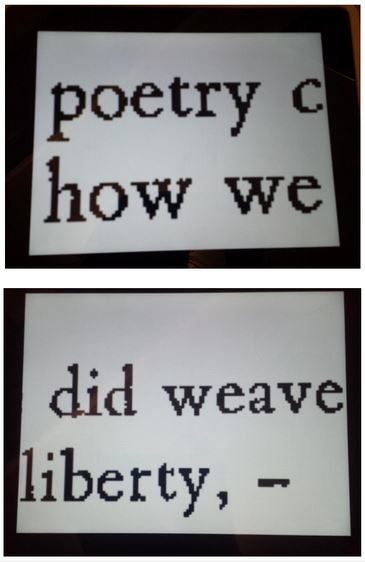
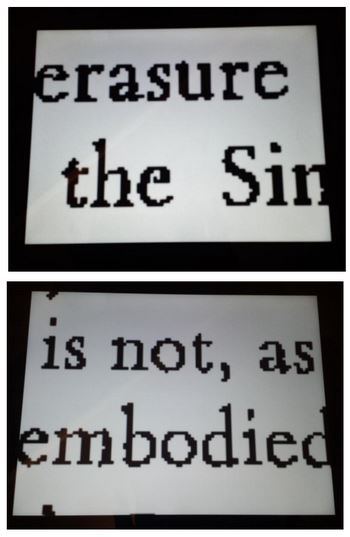
The actual project-in-progress was more carefully arranged before I unceremoniously abandoned ship, but the concept involves machines forced to “participate in producing…literary experience'”(to take Pressman qtd in Losh 15 out of context; I meant to bring in Maher and ethics somewhere in here…). Of other art that has been left behind, I was disheartened to discover that Marina Abramovic’s chair hasn’t tweeted since March. Of erasure, I have Jen Bervin in mind – and Silk Poems deserves a place somewhere in this discussion.
To pull threads together, “While analysis of and writing about objects is a kind of making and is an engagement with the materiality of language, making, breaking, and designing objects offers a different way of engaging extrahuman rhetorical relations” (Brown 510). I find myself reinvigorated when reminded of Bogost’s call for carpentry (as recalled in Brown 511), as “in attempt to see, smell, taste, touch, or hear the world differently” (511). I have always been more drawn to “making, breaking, and designing objects” than to what might be considered traditional forms of composing, so this sort of work is compelling to me. Breaking forms — figures, objects — leads to invention, new arrangements, and pedagogical experiments — and lots and lots of processing.
(ETA: There was discussion of automatons at some point so I intended to write about the animal-machines of Digesting Duck and gastrobots, but I accidentally left this behind at some stage of haphazard revision so consider this a placeholder for follow-up.)
I’ve been thinking a lot about the urgency in the humanities to define and redefine, and it’s something I simultaneously love about our field(s) and have come to have difficulty with as well. Especially as we move up against the field of Computer Science where, as I commented in my first blog post, definitions are established and exact. In C.S. coding and programming is the same thing — there is no difference, neither is seen as below or above the other, neither describes anything different. They are exact synonyms — and yet we wanted to say differently because coding “feels” more pejorative or base than “programming.” Maybe this is simply because “programming” has more syllables and the more latinate the more complex? Who knows. It’s a thing that also rubs up against the Bitzer-ian conception of rhetorical situation. We imagine the situations are different, programmers simply doing their jobs see them as the same. Whose rhetorical situation is more appropriate? I’m inclined to side with those actually working in the biz.
p.s. The turtles do not belong (only) to Geertz!
I, too, am inclined to side with those actually working with the terms in industry for the most part — when I talk to the engineers in my life about the sort of work we’re doing with “their” terms (well, terms fundamental to/possibly originating from their field; ownership is always tricky), they tend to be somewhat baffled at the extensiveness of the elaborations and distinctions, etc., and the emic/etic divide becomes evident, among other things (granted, I may just do a sloppy job of articulating what we do to said engineers).
Re: Ps. I’m well aware of the mysterious origin stories of the turtles, but in the framework of anthropological nostalgia, they are yoked to Geertz in my heart and mind 🙂
Machine’s reference to urgency in a previous comment brought me back to Losh’s discussion of exigency…it seems that humanists may feel this sense of urgency or *exigency* most keenly because their disciplines are defined by human response (harkening back to James Brown’s discussion of response vs. reaction). Ah! There are so many binaries!!