Distance and the Digital

Though I knew little to nothing about the concept of “distant reading” and the critical contexts from which it emerged, I spent much of my undergraduate career conducting what I now recognize as distant readings. I don’t recall how this preoccupation emerged — but I do remember obsessively scouring Chaucer concordances for all occurrences of “sigh” and “sick” (and its other Middle English iterations) to make arguments about Medieval lovesickness. I don’t recall the legitimacy of these arguments, or many specifics — but I do remember how refreshingly expansive the project was. I got to read widely and bring together scholarship in literature, writing, history, and medical anthropology. In some way, experimenting with this form of distant reading (even if I didn’t know it by name) gave me my first taste of cross-disciplinary research, which is something I am still invested in today.

I am slightly better informed in the way I conduct and represent research now — but despite my best efforts, I am often surprised by how many digital tools escape my knowledge. Not only do they present themselves to me in coursework (Agate? Help?), but also quite randomly in daily life. While avoiding work and chatting with an art history scholar at a Halloween party, I got an impromptu lesson on mapping technologies (which I should have taken notes on…). While sharing my latest research on the etymology of [ornithological] jizz with a non-academic interlocutor, he pulled up an n-gram for me and was surprised that I hadn’t already done so for my own research.

To that end, one of my Jstor DFR queries was “jizz ornithology” (I’m not sure why I chose that phrasing, and am curious as to what different versions of it would shore up — I am slightly afraid of just inputting “jizz,” but maybe I need to get over that fear for the sake of thorough research). Another bird-related single-word query I did enter was “alerion” (a footless mythological bird I have been able to find too little information on). Finally, I queried “infinite monkey theorem,” my best effort at a topic relevant to computation. (My current plan is to discuss it alongside the recently trending story of Betty, the Tweeting chicken.)

One of my enduring questions about distant reading is in how to keep up with the technology — knowing which digital tools will be most efficient, productive, and effective for the research I am trying to do.

Embark! (again)

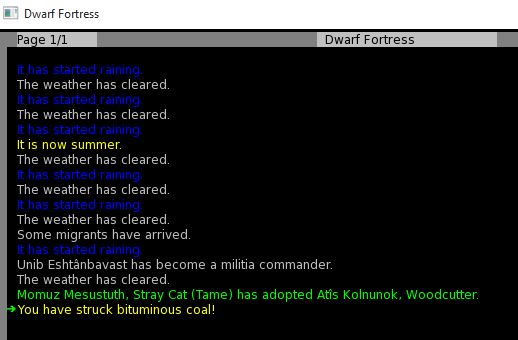
That was then: bulky font, stubborn cat, indecipherable landscape.
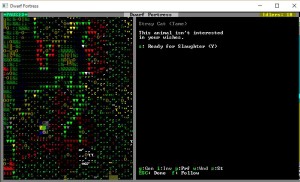
df_sadcat
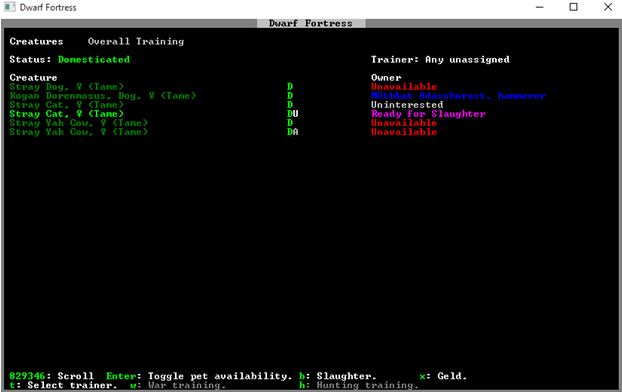
This is now: domestication, designation, and progress to be proud of!
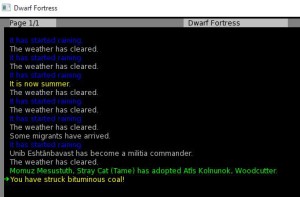
df_coal!

Even a stray cat which wanted nothing to do with my commands adopted a dwarf companion and I finally figured out how to use designations to go coal-mining! (I know…it only took about ten hours before I got around to tackling the technical objectives of the game). I credit the “phone a friend” lifeline — I called my (gaming enthusiast) sister in a bout of frustration after losing a previous world of dwarves to a winter storm from dehydration,* and challenged her try Dwarf Fortress. She figured things out in a fraction of the amount of time it took me to (down to the helpful note that “F12 makes the font nicer “), and walked me through some basics over a clarifying call.

(*note the mental anguish of my poor hammerer:

df_horrifying. My mental anguish certainly matched this, even as I reminded myself of Boluk and Lemieux’s “Dwarven Epitaphs” sign-off of “Dwarves must die for this game to be fun” (150).

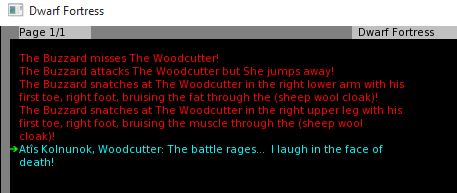
I am now intent on winning this game (“to win the class”), with defiance matching my woodcutter’s:
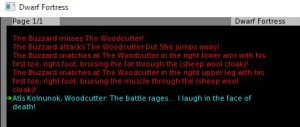
df_defiance

This is saying something, since I am historically so terrible at games that I never made it through Oregon Trail as a child because the learning curve was too steep. When asking gamer friends for recommendations, they suggest that I should really just stick to games “which only involve collecting animal friends” — which, to be fair, is what I spent my first four hours of Dwarf Fortress trying to do, and how I somehow win some rounds of Settlers of Catan (by exclusively collecting sheep). Clearly I am beginning to identify too much with my dwarves (“she dreams of mastering a skill”), so let’s move onward to more scattered digging. Specifically:

slippery chicken.

Listen to this — a whole album of compositions generated by slippery chicken, the enigmatic “algorithmic composition program” Michael Edwards created and mentioned in his fascinating article on computational music. Of course I was most eager to unearth the origins of its name. Thanks to Edwards’ detailed notes, I quickly discovered (here):

“The structural ideas for slippery chicken were developed during the composition of two pieces of mine, the techniques of which led to their formalisation in this programme: pas de poule,pas de pot and slippery when wet, hence the combination of the two titles into something even more abstruse and silly than the originals (humour is an important part of staying sane whilst programming). Also, the overall design of the software was quite taxing and some organisational problems were about as easy to grasp as a slippery chicken (plucked, naturally).

How adorable is that? I know I can’t resist a terrible pun, especially when poultry’s involved. Finding this tidbit made me wish Edwards had done more with the element of absurdity, and by extension playfulness, in his article. (Why are absurdity and play inextricably yoked together in my mind? I should perhaps disentangle this). Play was implied by Edwards throughout, but invoked literally only once, as music is “played” in compositions — yet play didn’t emerge as a major point of analysis. Of course, the article was already doing plenty in setting up the groundwork on computational music, but especially when looking at how aleatoric music plays with chance, there is clearly much to expand upon. Granted, I was also reading this on the heels of Mateas and Monfort’s persistently play-filled “A Box, Darkly,” and the juxtaposition of the two may have highlighted this slight lack in Edwards’ piece. In addition, the conversation last week about what sorts of “play” is “fun” — and what constitutes fun more broadly — is  something I still have in mind, as tied to “fun” and Dwarf Fortress.

The selection of “computational creativity” readings in themselves were fun for me — perhaps because, unsurprisingly, they appealed to my delight in all things whimsical and odd and confusing, and at least partially spoke the language of my right-brained self. The opening of the final paragraph of “A Box, Darkly” rang true: “Perhaps most oddly, obfuscated programs and weird languages are inviting.” “Inviting” – yes; even with my limited grasp of code, this was an inviting read. Considerations of the readability, play, and poetics of code, in addition to functionality, intrigue me. I keep returning to this Donald Knuth quote: “I do think issues of style do come through and make certain programs a genuine pleasure to read. Probably not, however, to the extent that they would give me any transcendental emotions” (Knuth 6 qtd in Mateas and Monfort 2). The invocation of “transcendental emotions” as something which might be expected of literature, by comparison, is curious. The possible poetics and aesthetics of code — and the styles of composition in general — are items I am eager to learn more about, though I might only be able to absorb them in bits and pieces until I have a fuller grasp of code.

An afterward-aside: While writing this, I was disrupted by the tragic news that my neighborhood storefront silkie hens needed new homes since the Animal Nature pet store is closing. I was quickly sidetracked, and made it a priority to take a last minute stroll to visit them (through their window) before they slipped out of my life forever (yes, my excuse for a late-night entry is literally slippery chickens).  Anyway, the computer programmer companion who I dragged along on this excursion made efforts to keep me on topic by brainstorming impromptu lessons about weird code topics. He taught me about quine (it turns out a quine once won the “worst abuse of the rules” prize in the International Obfuscated C Code Contest, via the linked Wikipedia entry) and lint (which can target bugs, style, any “syntactic discrepancies” and is “derived from the name of the undesirable bits of fiber and fluff found in sheep’s wool”), and a few others things. I can’t recall if these were mentioned in previous readings (they very well could have been but I feel like I would remember if they were? Nevertheless, there have been so many unfamiliar terms that a few must have slipped my memory bank), but I hope to return to these later, in addition to the many things mentioned in the essays. I also keep meaning to study up on Jarry’s ‘Pataphysics. Anyway, perhaps I’ll make it beyond tinkering with absurdities and puns to more focused analysis at some point, but I’ll sign off here for now and return to my Fortress, with its twelve idlers and a fighting dog.
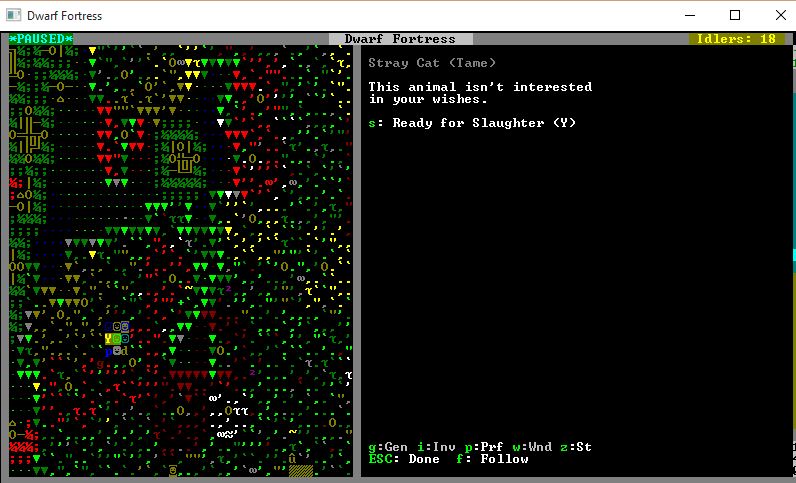
“Following Peach-Faced Lovebird Man”

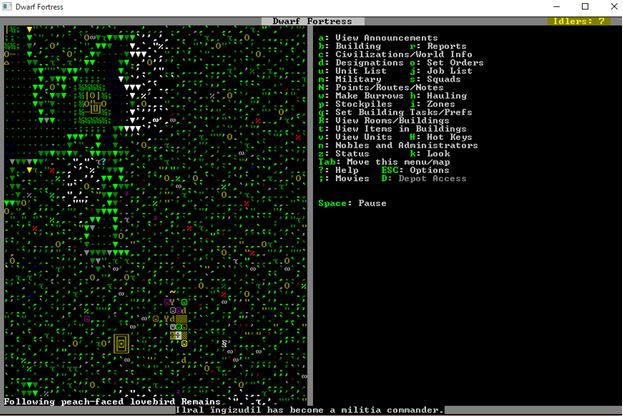
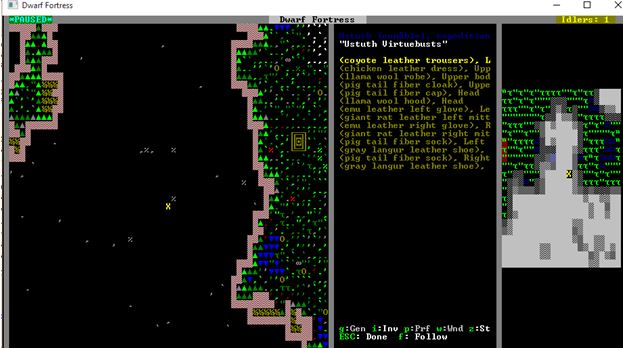
I write with a split screen and my peripheral vision tracking my number of idle dwarfs (fluctuating from 2-5). It has rained five times and the season just changed for the second; Autumn has come. I have eleven citizens now (a few announcements back, migrants arrived). My wild animals include a giant skunk (“large monster in the form of a skunk”) and peach-faced lovebird man (“colorful person with the head and wings of a peach-faced lovebird”). I have seven tame animals, of which two dogs have been adopted. Muthkat Adasshorast, my hammerer, is especially pleased with his pet (In his own words, “I played with my pet. I’m feeling so fond!”). No one has gone dead or missing; everyone appears to be healthy (much to my chagrin). I have two burrows (named Halls and Persiflage). The Military of Lorbamnol has two squads (The Granite Orbs and The Feral Quakes), with three soldiers, but only one active. Ilral Ingizudil wins my most productive citizen award – she first became militia commander, and then a bookkeeper of The Books of Speechlessness. She is fifty-six and very fat, with dark tan skin, gold hair, and ochre eyes. She “often feels lustful,” likes catapult parts and giant chinchillas, but “absolutely detests flies” and “doesn’t handle stress well.” Unfortunately, she’s also “somewhat uncomfortable around those that appear unusual or live different from herself.”

df_ilral
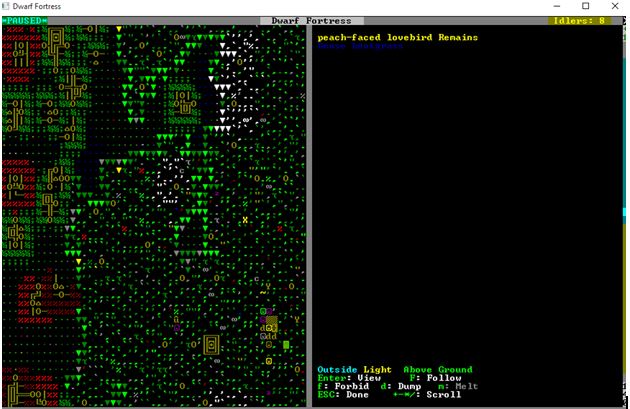
It took me several world-builds and a few tutorials to make it this far, and I’m still not sure I have a clue as to what I’m doing – rather, whether or not I’m in any way working towards the objective of the game – but I’m certainly having fun. I quite literally squealed with delight, some hours ago, when I discovered surprise hedgehogs and remains of magpies and peach-faced lovebirds among claystone pebbles, cherry flowers, and long yam plants while skimming across the lush yet minimalistic map with the “k” key activated.

df_lovebirdremains
Maybe I’m just charmed by the characters populating my world. Maybe it’s because I’ve also gotten to entertain my morbid inclinations by collecting two stockpiles of corpses and preparing a cat for slaughter.

df_cat
And – yikes! In the few minutes I’ve taken to write this, a third citizen has become a militia commander, Giant Kea monsters have stolen a wheelbarrow, stepladder, and a copper pick – and one has died! Furthermore, a caravan from Velminkot has arrived with several merchants (including Bim Luslemaban, who has fuse-lobed narrow ears and gapped teeth, a swordsdwarf, and a marksdwarf). I must go attend to the site; I’m told “merchants need a trade depot to unload their goods…” and my idling dwarves have gone up to 7-9. This is unacceptable, but I also have no idea how to create a trade depot. Alas, pressing the question mark too many times will yield this message:
df_help
But yes, this game is a “micromanager’s dream” (as Weiner wrote in NYT) and I can see myself using it for found poetry projects. Also, a chicken leather dress? My dwarves are so fashion forward. I’m a fan.
df_chickenleather

Processing All the Way Down

Though it may be true that “Rhetoricians never tire of defining rhetoric” (Brown 496), my limited experience participant-observing in this field has me wondering whether rhetoricians ever tire of defining (and re-defining) any word in existence which might be integrated into the difficult-to-define discipline at all. This semester alone, we’ve spent significant time pondering nuances of meaning in terms from coding to computation, procedure to process, machines, and more. As I think through how such terms are being reframed and redefined across readings, I am, more practically, trying to utilize them productively in several projects I am working on right now. (Though after reading about Erasmus, I was tempted to pen adoxographies in lieu of a substantive entry).

I’ll offer this as an opening artifact:

This project was made with several obvious sets of constraints – it is my response to an assignment at the Digital Media Composition Institute, where I was asked to define/illustrate a concept using sixty seconds of video footage. Pedagogical procedure is inherent, and up until the very end, when “This video is processing” is a notification received in the last step of uploading a video online, the terms surrounding computation are evident. (I am also resisting the urge to make a [sic] pun “In yolking rhetoric to print” on page 5 of the Brown and Vee draft, which in all seriousness is a useful introductory essay I feel lucky to have gotten a sneak preview of; the balance of serious and not-so-serious wasn’t only a struggle in Erasmus’s day).

Besides Brown replacing Geertz’s turtles with machines (and I’m still digesting his ideas on animal/machine interchangeability via Derrida), Losh’s work with Malinowski offers another moment of anthropological nostalgia. With her comment on how “contemporary users who send and receive digital files must be mindful of unintended audiences, unanticipated purposes…” (2), I almost expected more discussion of Malinowski’s infamous Diary (never intended for the public but published posthumously, it was a blow to his reputation), but nevertheless.

When thinking of procedures, after all, the first thing that comes to mind is the intensive methods training I had to undergo as an undergraduate anthropology major. I’ve been revisiting this most recently while conducting research for a poster I’ll be presenting at the International Writing Centers Association Conference (in Pittsburgh next week!). The lengthy conversations I’ve been having with local directors and coordinators of various writing centers have all followed the gist of a script. To make this even more literally “machines all the way down,” the interviews themselves were on mechanisms of operation – from training procedures to best practices for a writing center to run smoothly (like code?). The similarities in language kept bringing me back to the computational foundations. Especially with the emphases on collecting numerical data, and on assistive technologies such as text-to-speech software, directors collaborate with machines to run effective centers. The staff at Carlow University’s center recently received an award for developing an innovative interactive digital training module for tutors. How machines are used to aid in learning and foster an even more robust face-to-face relationships is fascinating to me. Furthermore, the majority of schools have some sort of online tutoring option, whether it be synchronous or asynchronous, written or videotaped – there are many variations on writing centers procedures worth studying (and nearly ten hours of interviews to process which have rendered me behind on just about everything else).

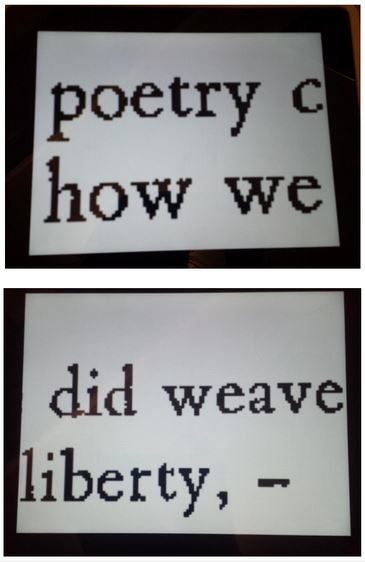
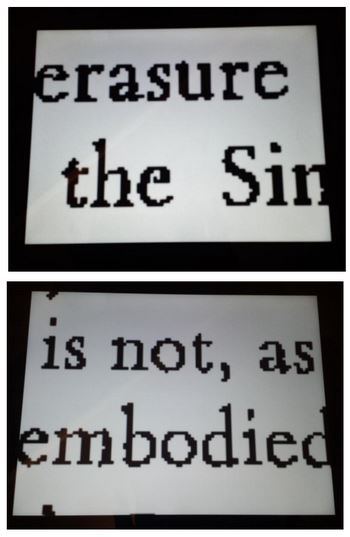
Moving from anthropology and administration to art, Losh writes compellingly about multimodal installations such as Mark Jeffery’s The Operature and Caitlin Fisher’s Circle – using such evocative phrasing as when “reading machines consume text on human skin” in her depiction of Jeffery’s piece (17-8). In Steve Carr’s Close and Distant Reading seminar last spring, I had attempted another procedural project which was my own attempt at iPad art, and reading this reminded me to revisit my progress. Specifically, I engineered (a liberal use of the word) a series of erasure “poems” from academic articles zoomed fully in on an iPad and photographed with a phone camera. In its own way, this was a play between registration and representation (to allude to the scanner vs. camera issue), and as an act of close and distant reading merged together. Here are random screens:

erasure_2 erasure_1

The actual project-in-progress was more carefully arranged before I unceremoniously abandoned ship, but the concept involves machines forced to “participate in producing…literary experience'”(to take Pressman qtd in Losh 15 out of context; I meant to bring in Maher and ethics somewhere in here…). Of other art that has been left behind, I was disheartened to discover that Marina Abramovic’s chair hasn’t tweeted since March. Of erasure, I have Jen Bervin in mind – and Silk Poems deserves a place somewhere in this discussion.

To pull threads together, “While analysis of and writing about objects is a kind of making and is an engagement with the materiality of language, making, breaking, and designing objects offers a different way of engaging extrahuman rhetorical relations” (Brown 510). I find myself reinvigorated when reminded of Bogost’s call for carpentry (as recalled in Brown 511), as “in attempt to see, smell, taste, touch, or hear the world differently” (511). I have always been more drawn to “making, breaking, and designing objects” than to what might be considered traditional forms of composing, so this sort of work is compelling to me. Breaking forms — figures, objects — leads to invention, new arrangements, and pedagogical experiments — and lots and lots of processing.

(ETA: There was discussion of automatons at some point so I intended to write about the animal-machines of Digesting Duck and gastrobots, but I accidentally left this behind at some stage of haphazard revision so consider this a placeholder for follow-up.)

Twitterbot Check-up

For the Materialities of Writing seminar two years ago, I created a questionable/silly “Old Timey Doctor” bot (@HistoricalWebMD). It spewed out poorly phrased medical advice from a fairly limited word bank for longer than it should have been allowed to run until eventually something broke, and I shut down operations. This week’s excursion is my first time back in Twitterbot land, and since I apparently have enough Twitter accounts for my phone number to not allow me to make a new app, I’m currently reusing my old bot for new testing purposes.

In my last Twitterbot foray, most of the code was provided for me; I just needed to enter the word bank. This time — even with over ten hours of Python tutorial under my belt (confession: in the over ten hours, I maybe made it halfway through) — playing with the code was much more of a challenge. It confounds me how much metadata runs behind what appears to be a simple 140-character (or less) Tweet.

My original/eventual vision for my Computational Media bot is called J. J. Audubot, and it’ll use text from John James Audubon’s Ornithological BiographyI realized, however, that the pdf digitization of the volumes makes it difficult to cut and paste into a text-only document — so I’m still in the early stages of figuring that out, and from there, deciding what J. J. Audubot will actually say, and why it might matter to the wider world of Twitter. (Maybe J. J. Audubot should be a Chatterbot instead).

Tips. Or: let there be light?

At the time of writing this, I am only an hour into the Python tutorial and (I fear) rather far behind (so I’m taking a break to enter a post). I might have stared at the screen for so long trying to decipher the final lesson of “Tip Calculator” that the computer lab’s motion sensor lights went out on me. It turns out where I kept trying to enter number values, I was simply supposed to repeat the text (“meal + meal = etc.”). Duh. 

I am prone to overthinking and have cultivated an unfortunate learned helplessness in math (blame childhood rebellions against my math-enthusiast engineer father). This combination of traits makes this sort of activity especially fraught for me. Glancing at other posts, I take it I’m not the only one filled with (perhaps unnecessary) anxiety over this supposedly low-stakes exercise — to the extent that I’m stepping away from it to talk it out. This sort of blogging about my feelings is now giving me flashbacks to my middle school LiveJournal, so I’ll turn outwards to the second prompt of the entry: relevance to English studies.

Well, supposedly Python is named after Monty Python, who are some of my favorite Englishmen, but putting jokes aside, it’s a language, right? English studies is concerned with the art of language. In addition to being a language itself, the language that is used around Python (and other coding langues) are worth noting. Rhetoricians are certainly interested in discourse communities and disciplinary terminology, etc. (I, for one, always get so excited when I encounter the term “Boolean,” which may be a commonplace term for engineers but always feel novel to find in traditional English studies). This feels like another Duh sort of answer, but I will use this as a placeholder and perhaps update more thoughtfully when I finish my full two-hour foray and also take a nap.

(In the meantime, via clearly trusty fact-checking on Wikipedia, I’ve found an appropriate bird anecdote: “Additionally, a 2001 April Fool’s Day joke by van Rossum and Larry Wall involving the merger of Python with Perl was dubbed “Parrot” after the Dead Parrot sketch. The name “Parrot” was later used for a project to develop a virtual machine for running bytecode for interpreted languages such as Perl and Python.”)