When I began my Library and Information Science masters program in 2010, the use of Second Life in libraries was a popular topic among some of my fellow classmates, and was frequently cited as an example of an innovated “Library 2.0” outreach tool, and often, as a means of reaching library users who may not be able to physically visit a library. I was never sufficiently convinced that it provided a unique public service, beyond perhaps novelty, and as a result, never took the initiative to test the experience out. (I was also deterred by the game’s explanatory one-liner: “Second Life is a 3D world where everyone you see is a real person and every place you visit is built by people just like you,” which is also arguably a way that one could describe actual life.)
Though the enthusiasm for library services administered through Second Life seems to have quieted, for a period of time it was used often enough to receive some attention in professional literature and at conferences, and studies were conducted on the ways in which libraries employed the virtual world as an outreach or communication tool, and the ways in which users interact with libraries in Second Life.
In reading Noah Wardrip-Fruin’s Expressive Processing, I found myself occasionally thinking of Second Life and its utility as a library services tool. By the time I got to the chapter on the SimCity Effect, I was curious enough to download Second Life to learn more firsthand. There are some comparisons to be drawn between Second Life and SimCity – perhaps namely in the realistic terrain and processes enacted by users. Indeed, a significant component of gameplay seems to be in enacting processes in an attempt to better understand the game’s operations. In the game’s heyday, the play may have been focused more centrally on interacting with the avatars of other real-life members of this virtual world. In 2015, most of the libraries I visited looked like ghost towns.
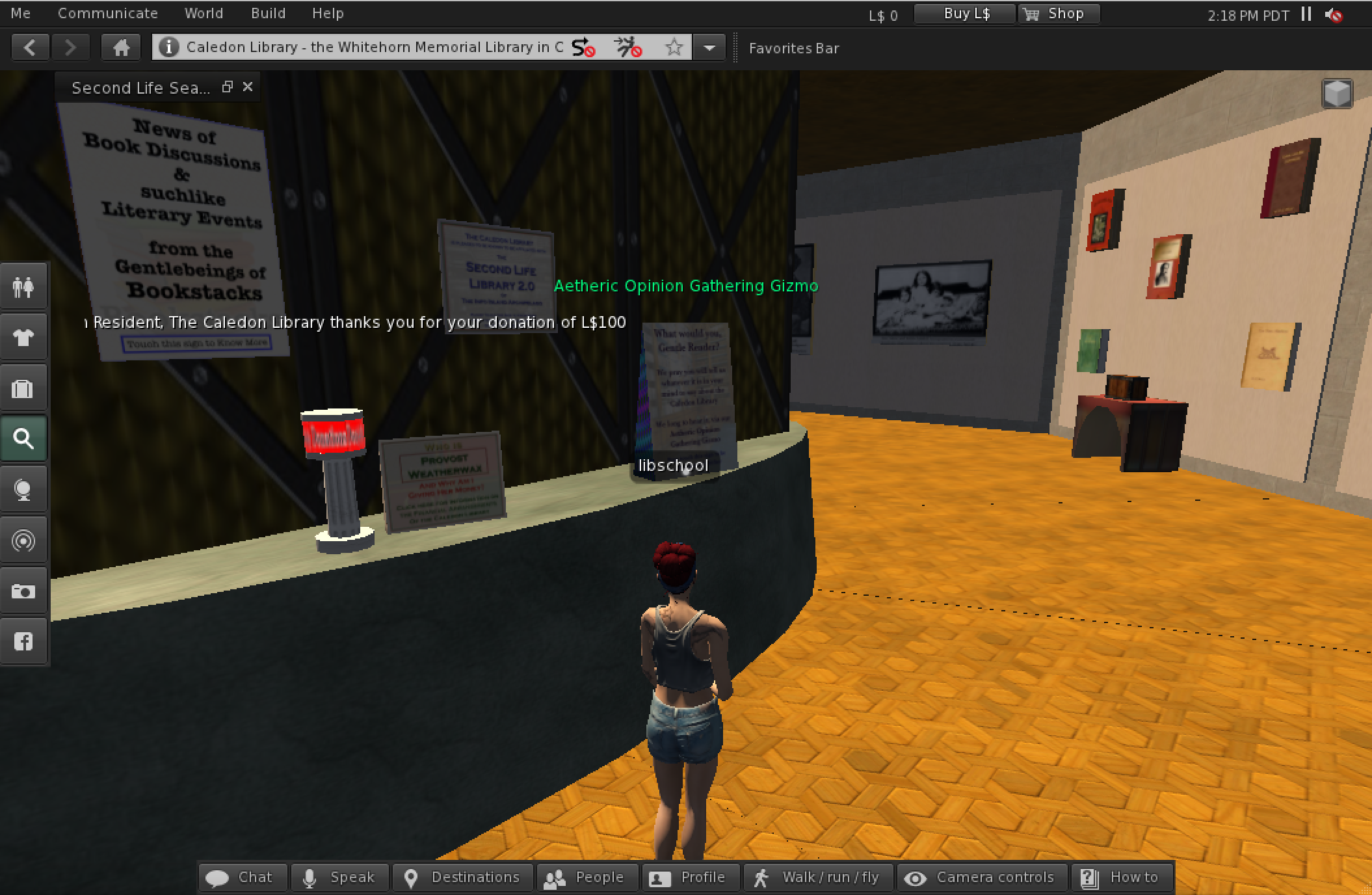
One can imagine that, in years past, there may have been a librarian avatar at this Caledon Library desk, ready to answer reference questions and direct the visitor to resources (either resources modeled within the virtual library, or through hyperlinks to electronic resources elsewhere).
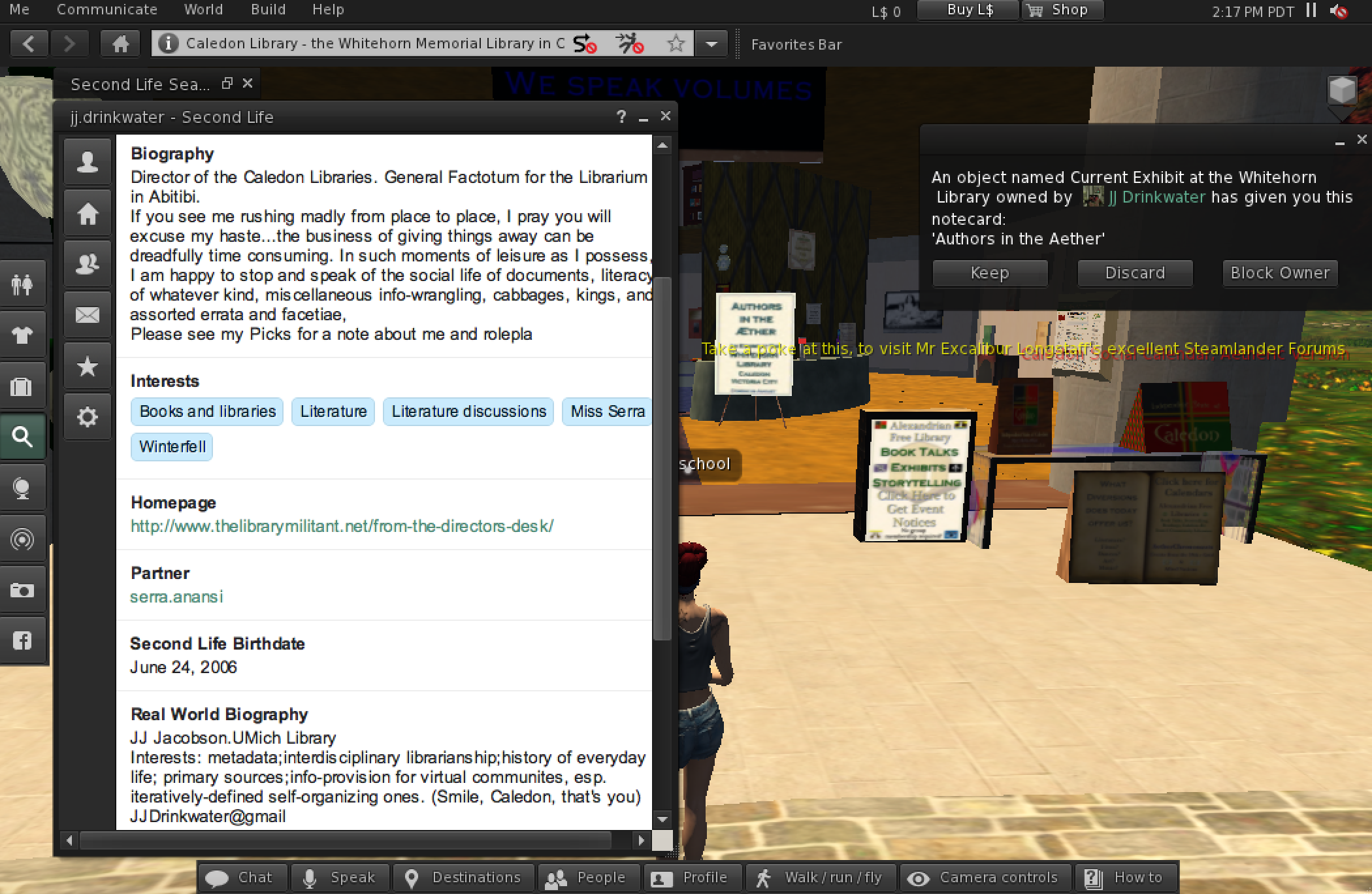
Further proof of life in the library comes in the form of looking at the profile of one of the library’s staff, last active three years ago:
Beyond modeling physical library spaces, users could hold virtual parties, lectures, or reading groups, attended in real time by real users, in avatar form. In forums and on blogs, I found several mentions of an anticipated Caledon archive, comprised of content from users of the fictional library.
My specific interest in the use of Second Life by real-life libraries is most connected to Wardrip-Fruin’s discussion of the ideological systems that inform simulated games. While I have not spent nearly enough time in Second Life to make a strong assessment of the values that may inform its processes, as a librarian, it would seem imperative to compare these with the professional values of librarianship as a field, or at very least the policies and procedures of a specific library system. Beyond mimicking the appearance and basic functions of a library (the surface with which the audience interacts), I am curious as to whether the operational logics of Second Life represent those of an actual library? A number of articles on the subject of library representation in Second Life note that libraries that exist only in Second Life are often more successful than representations of physical libraries, which suggests the possibility of a disconnect between systems.
The value system of the creators of the game is arguably most evident in the case of Woodbury University, which was banned twice from Second Life. In a Chronicle of Higher Education article on the subject, Edward Clift, dean of the university’s School of Media, Culture & Design, said that “he felt that the virtual campus did not conform to what Linden Lab wanted a campus to be—with buildings and virtual lecture halls” [emphasis mine]. Though in this case the restriction was not imposed by computational processes, but by administrative action, it does serve as a reminder that the virtual world doesn’t go unmoderated, and reminded me of Wardrip-Fruin’s statement that “any simulation is actually an encoding of a set of choices…[and] whatever the motivation behind the choices, there is inevitably a politics to how the world is simulated.” If a value assessment of what a university should be is implicit in the story of Woodbury, I wonder if there are similar assumptions of what a library should be, and how that may have been considered or reflected in the processes of creating, staffing, and using a library within the Second Life world.
(All of this is also leaving out the very obvious element that always made me feel uncomfortable about Second Life, which is the fact that you can actually buy system currency using real currency in order to build establishments or purchase goods, which probably means that we can safely assume that this machine runs on capitalism?)
Oh, Second Life! And the logics that construct(ed) it. You may find this tour of abandoned universities interesting.