One of the quirks we have harped on, in relation to Ian Bogost’s work, is the way he seems to endlessly reference his own games in order to prove a given point. To be kinder to Bogost, he also references games produced by other theorists who have similar didactic designs for their aesthetic products. Reading across Bogost, this begins to feel very silly, for example in this moment in the “Persuasive Games” article:
Crawford refers to his own game Balance of Power as a contrasting, desirable, high process intensity specimen. The game simulates Cold War geopolitics by algorithmically analyzing data like insurgency, economics, might, and prestige across many nations in relation to user actions like sending aid, escalating conflict, and backing down.
Good for Crawford, I wanted to say after reading this. I found this seemingly unquestioned habit of citing programmer/theorists, rather than just theorists, sort of nauseating — what could be worse, and more conspicuously tautological, than a theorist who thinks their own work is one of the best, and/or one of the only examples of a game that they want to exist more broadly within the culture?
At the same time, I am above all other things a relativist, and realize that the particularity of the discourse community we are moving through must be considered as a factor in how we interpret its rhetorical gestures. In considering my own experiences moving through other “canons” in the academy, big or small, I have begun to realize how much this habit of self-aggrandizement is part of what we often define as a Modernist sensibility. In the field of poetry studies, there is a term deployed to describe makers like Ian Bogost–poet-critic. Within the field of poetry studies, being a poet-critic, having a foot in both creative and critical practice, is the most-respected position possible. Authors like Ezra Pound and Gertrude Stein continue to be appraised as greats partially because of their hybrid practice, and often these two authors’ work involves a self-appraisal of greatness within the extra-poetic work, a self-appraisal that we question little today. Perhaps, then, it would be best to think of Bogost and company as a vanguard of sorts, though I’m apprehensive to attempt to map a radical politics onto anything that involves computing. Pound and Stein were fascists anyway.
Across his career, Pound develops his own processes towards producing an ideal poem that “contains history” — at first, this can be seen in his attendance to verbs and nouns over all other forms of speech, then he turns to the Chinese ideogram, which he believes better-refers to an object or concept than any other form of writing. Eventually, he turns to patchwriting and “translation” that can often be read as plagiarism of others’ work. As one moves through the work, one can see Pound amassing more and more processes to write the Cantos. I would argue that the Cantos are almost all “process” pieces whose surface refers back to everything underneath. From the very first Canto, the process of translating from different sources, and of intervening within this translation, is foregrounded in the surface of the text. The historically-real Pound seems to speak directly to Andreas Divus, whose translation of Homer he translates into English, then ends the poem with a colon that ought to signify continuation:
And Anticlea came, whom I beat off, and then Tiresias Theban,
Holding his golden wand, knew me, and spoke first:
“A second time? why? man of ill star,
“Facing the sunless dead and this joyless region?
“Stand from the fosse, leave me my bloody bever
“For soothsay.”
And I stepped back,
And he strong with the blood, said then: “Odysseus
“Shalt return through spiteful Neptune, over dark seas,
“Lose all companions.” And then Anticlea came.
Lie quiet Divus. I mean, that is Andreas Divus,
In officina Wecheli, 1538, out of Homer.
And he sailed, by Sirens and thence outward and away
And unto Circe.
Venerandam,
In the Cretan’s phrase, with the golden crown, Aphrodite,
Cypri munimenta sortita est, mirthful, orichalchi, with golden
Girdles and breast bands, thou with dark eyelids
Bearing the golden bough of Argicida. So that:
(bolding mine)
Wardrip-Fruin, in his citation of Tristan Tzara in his book’s introduction, seems invested in the idea of vanguardism relating to his project. I would argue that Pound’s vanguardism reflects a sophisticated, explicit understanding of one of the diagrams in Wardrip-Fruin’s book, figure 1.4:
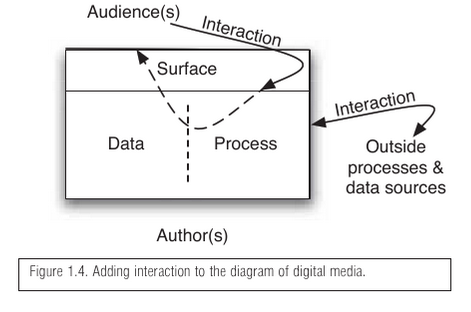
The reader of Pound’s Canto, if they become dissatisfied with its irregular surfaces, is forced to move through Pound’s process- and data-oriented writing practice–if I understand Wardrip-Fruin’s diagram correctly, the reader of The Cantos must consider their movement through them in relation to all of the parts of this diagram. Surface and process are difficult to distinguish, something considered part and parcel of the poems’ construction.
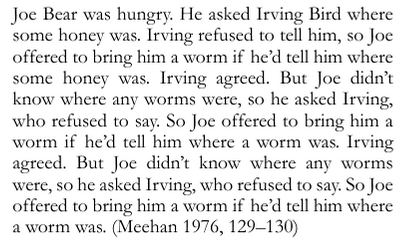
To elaborate upon this, my experience reading the chapter on Tale-Spin also mirrored some forays into Modernism. One “error” passage reads like a computerized Gertrude Stein:
Beyond Modernist poets, Wardrip-Fruin’s elaboration of Tale-Spin also reminds me of a favorite, bizarre, critical article — one on William Faulkner’s “A Rose for Emily,” by Jennifer Burg, Anne Boyle and Sheau-Dong Lang published in Computers and the Humanities in 2000 (if anyone is interested, the article is available on JSTOR). In their article, Burg, Boyle, and Lang develop a computerized methodology to track the temporal movements and activities of the characters in that story, reducing them to a set of variable-coordinates, only to find that the variables can never possibly line up:
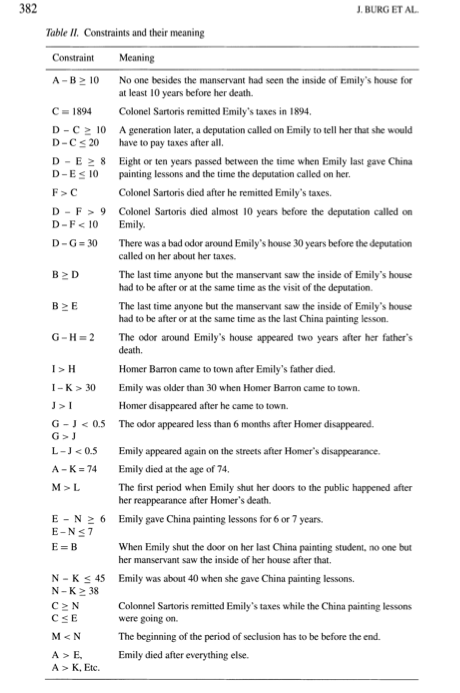
It seems to me that the academic procedure involved in the Faulkner article is a kind of reverse-engineering of the types of processes that produce the texts in Tale-Spin, which leads me to a final question. If we want to emphasize process-intensity in computer-generated texts, why not turn to the Modernist strategy of self-reference in order to foreground this? It seems to me that a more- “broken” version of Tale-Spin would draw attention to its processes in a way that would invite inquiry beyond the surface and allow those who interact with the text to do so in a dynamic way.