I was interested in our discussions last week regarding algorithmic composition, and so I wanted to spend some time this week trying to tackle this idea, and other algorithmic systems, a little bit more. In considering this topic, I wanted to bring to the table an algorithmic system that I recently learned about and, perhaps arbitrarily, have found myself opposed to.
I attended a brief lecture a week and a half ago on different training philosophies behind swimming, as well as their positives and negatives. The lecturer, Sergei Beliaev, was a sports scientist that had come into his own during the height of the USSR, and therefore had been researching in a time of near unlimited government financial support for sports research. Unsurprisingly, he believed that the best system for training was his own, SuperSportSystems, or 3s.
The 3s system takes an algorithmic approach to training by gathering information, running it through a program, and spitting out a day, week, and season plan for training to reach specific goals. . In order to write this blog post, I created a trial account and went through the paces with one of my own swimmers as an example. The program starts out by simply asking for the swimmers best event, current best time, goal time, and the size of the pool in which the swimmer trains. For my swimmer, I have chosen a best event of 100 yard butterfly, best time of 1:01 and goal time of :57

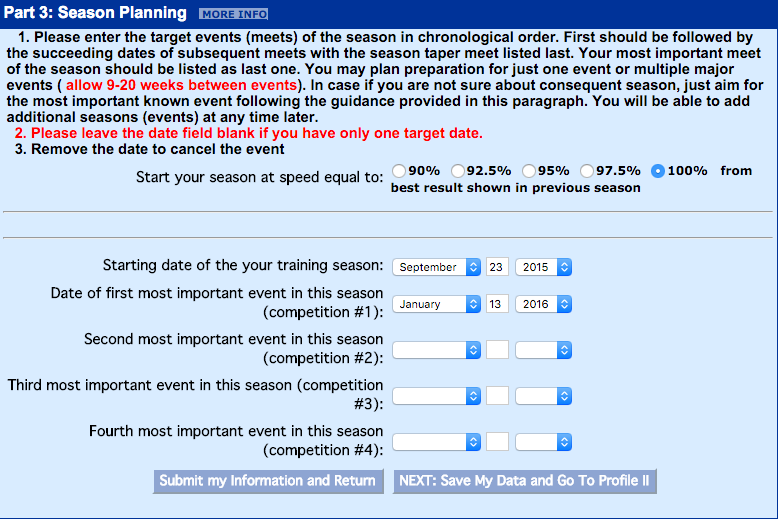
Next, the program asks for the big meets of the year, as if to say: where do you want your swimmer to be able to compete at their best?
After that, it asks for the usual breakdown of a week of training:

And finally, once all of this information has been gathered, it spits out its plans (pictured below is the sample plan for a single day).
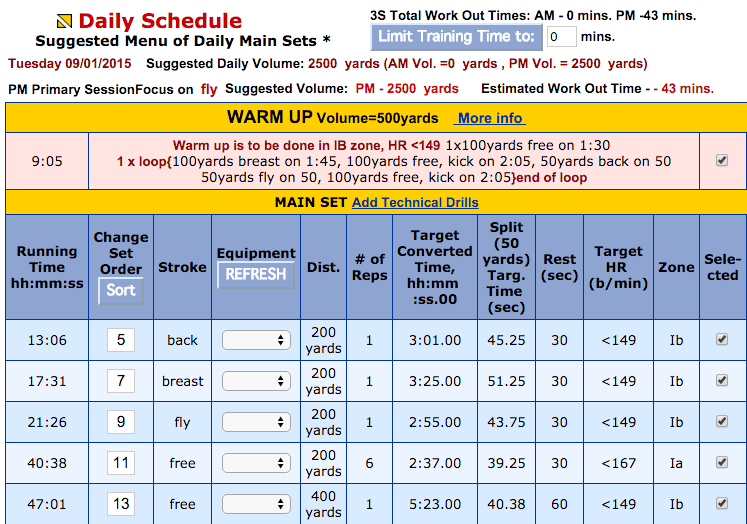
Now, this is just a single practice for the afternoon session of one week. Also on this page (not-pictured) are the total yardage amount for the entire season, the yardage amount per day for each week, and workouts for every single practice, already planned and written. Each set, as you can see, is accompanied by “target times”, or times that the program believes my swimmer would need to be able to reach consistently on that day in order to achieve his goal at the correct time of year.
It is important to point out that this is not just a random website or a random system. It is used by thousands of coaches and over 15,000 athletes throughout the world, and has also aided in producing a handful of olympians and elite competitors. Considering these facts, why aren’t all coaches (myself included) buying this program?
I have two major issues with the program, and I believe that they can, in some way, connect to other types of algorithmic processes, such as composition. My first issue relates to something that occurred just last week. On Thursday, I had planned a difficult workout. However, about 30 minutes into the practice it became obvious that the kids were tired, too tired to be able to do what I had planned with quality efforts. Because of this I decided to abandon what I had planned in favor of something easier to accommodate their physical state. 3s does not accommodate this type of change.
The second issue I have is with the setting of an upward bound on progress. The training is based on a goal that is set at the beginning of the year by a swimmer and coach, in my example case a :57 for a 100 yard butterfly. The training is then geared towards achieving that time by the set goal meet, which in my example case is in March. This does not seem like an issue until you consider that, looking back at the goals that kids gave me at the beginning of the season, my swimmer had planned a goal time for the season of a 1:03 in the 100 yard butterfly (down from a 1:10). In the first meet of the season he eclipsed this with a 1:01. I was not training him for a 1:03, but was instead training him just to get stronger and faster, having the goal time as a motivator rather than a focal point of training. If I had trained him for a 1:03, maybe he would have gone faster, maybe not. My fear is in limiting potential results by setting a bar.
The issues, I believe, can be simplified by calling them issues of communication. When I am at a workout, or considering training, I am (philosophically, perhaps) engaged in a dialogue with my swimmers. I have to be able to interpret the information and make adjustments in real time. It is for this reason that I don’t plan out every workout for an entire season in one sitting. There needs to be a level of read and response going on. An algorithmic training system removes this possibility, and it is this absence that makes me uncomfortable. It doesn’t take account of different strengths and weaknesses, performance variations, feelings on a specific day or week, health, etc. I takes numbers an returns numbers.
Thinking of it this way called to memory a quote from a podcast that I had listened to recently (the RadioLab podcast, “Words”):
Take a musician…here is a form of thought that carries you through a definite sequence of phrases, feelings, emotions, changes, and there are no words. But there is something that we get access to when we gain a full natural language that we can use not only to communicate with other people, but with ourselves.
A composer, then, when composing a piece of music, is also engaged in a dialogue with the listener. While not using words or language, there is a type of communication that goes on, that aids in the triggering of feelings, emotions, etc. I am beginning to think that perhaps algorithmic composition, or other types of algorithmic, computational approaches to things such as training or writing, remove this direct dialogue. And while there can still be the argument that the composer is in fact in dialogue with the program, the composer is still a few steps removed from the human audience with the program acting as interpreter, and this is perhaps where the mark is missed. It is one of the reasons that the Love Letter Generator makes us laugh instead of swoon.
I like the way your post presents your experience with a specific computational artifact and situates this experience within a semiotic domain (athletic swimming coaching) to help us understand why it is meaningful.
By the end of the post, I hear you advocating a more dialogic, less strictly computational approach that that offered by Sergei Beliaev’s charts and graphs. When you adjust your team’s workout, you sound like a mindful student-centered instructor. That is you sound like a teacher trying to meet her students where they are such that they actually remain within reach of the Vygostkian zone of proximal development. If that is so, and you imagine communication leading to an atheleticized version of such a growth-supporting space, you may have the basis for a claim that nautical sabermetrics ain’t all Baliaev has cracked it up to be.
There may be an unresolved tension here. Competitive swimming tends to be measured according to time, which I think tends to invite the algorithmic approach, while many teaching situations grapple with processes that are too qualitative or subjective to reduce to a number. Composition or Creative Writing, for example, are more difficult to assess via computational means. By emphasizing communication, you might be transposing values from one domain to another. Similarly, I’m not sure that your thoughts about audience, as in the musical performance, can be easily adapted to quantized standards of achievement in athletic events, though we do enjoy participating in them as spectators.
Did you ever see the terrible surfing movie “North Shore”? The surfer in the film ultimately decides he doesn’t care about competition. Perhaps you are taking the smallest steps down such a road – I only suggest that this because your post doesn’t seem to draw upon research about whether or not Beliaev’s method tends to sponsor faster athletes.
That terrible drop aside, I admire how your post hovers over a conceptual fault line, that space where a world dominated by computation processes, and the dominant literacies that maintain such an order, seek to access, understand, or enlist the body. Yet some of us hit the pool to get away from all that.