That was then: bulky font, stubborn cat, indecipherable landscape.
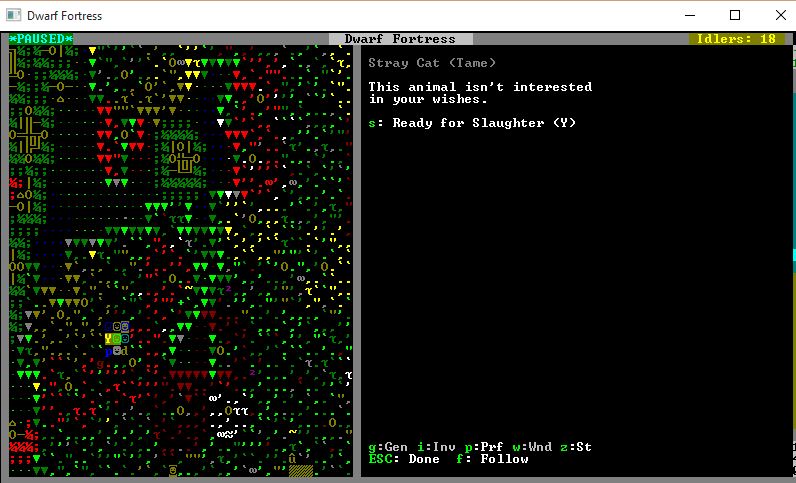
This is now: domestication, designation, and progress to be proud of!
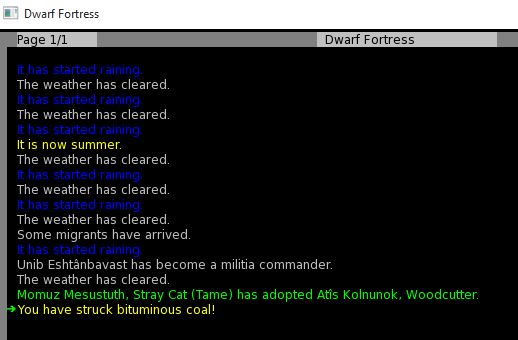
Even a stray cat which wanted nothing to do with my commands adopted a dwarf companion and I finally figured out how to use designations to go coal-mining! (I know…it only took about ten hours before I got around to tackling the technical objectives of the game). I credit the “phone a friend” lifeline — I called my (gaming enthusiast) sister in a bout of frustration after losing a previous world of dwarves to a winter storm from dehydration,* and challenged her try Dwarf Fortress. She figured things out in a fraction of the amount of time it took me to (down to the helpful note that “F12 makes the font nicer “), and walked me through some basics over a clarifying call.
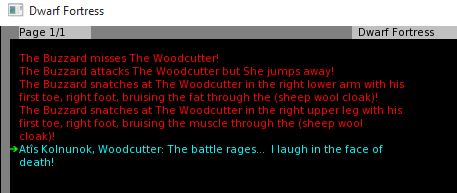
(*note the mental anguish of my poor hammerer:
 . My mental anguish certainly matched this, even as I reminded myself of Boluk and Lemieux’s “Dwarven Epitaphs” sign-off of “Dwarves must die for this game to be fun” (150).
I am now intent on winning this game (“to win the class”), with defiance matching my woodcutter’s:
This is saying something, since I am historically so terrible at games that I never made it through Oregon Trail as a child because the learning curve was too steep. When asking gamer friends for recommendations, they suggest that I should really just stick to games “which only involve collecting animal friends” — which, to be fair, is what I spent my first four hours of Dwarf Fortress trying to do, and how I somehow win some rounds of Settlers of Catan (by exclusively collecting sheep). Clearly I am beginning to identify too much with my dwarves (“she dreams of mastering a skill”), so let’s move onward to more scattered digging. Specifically:
slippery chicken.
Listen to this — a whole album of compositions generated by slippery chicken, the enigmatic “algorithmic composition program” Michael Edwards created and mentioned in his fascinating article on computational music. Of course I was most eager to unearth the origins of its name. Thanks to Edwards’ detailed notes, I quickly discovered (here):
“The structural ideas for slippery chicken were developed during the composition of two pieces of mine, the techniques of which led to their formalisation in this programme: pas de poule,pas de pot and slippery when wet, hence the combination of the two titles into something even more abstruse and silly than the originals (humour is an important part of staying sane whilst programming). Also, the overall design of the software was quite taxing and some organisational problems were about as easy to grasp as a slippery chicken (plucked, naturally).
How adorable is that? I know I can’t resist a terrible pun, especially when poultry’s involved. Finding this tidbit made me wish Edwards had done more with the element of absurdity, and by extension playfulness, in his article. (Why are absurdity and play inextricably yoked together in my mind? I should perhaps disentangle this). Play was implied by Edwards throughout, but invoked literally only once, as music is “played” in compositions — yet play didn’t emerge as a major point of analysis. Of course, the article was already doing plenty in setting up the groundwork on computational music, but especially when looking at how aleatoric music plays with chance, there is clearly much to expand upon. Granted, I was also reading this on the heels of Mateas and Monfort’s persistently play-filled “A Box, Darkly,” and the juxtaposition of the two may have highlighted this slight lack in Edwards’ piece. In addition, the conversation last week about what sorts of “play” is “fun” — and what constitutes fun more broadly — is something I still have in mind, as tied to “fun” and Dwarf Fortress.
The selection of “computational creativity” readings in themselves were fun for me — perhaps because, unsurprisingly, they appealed to my delight in all things whimsical and odd and confusing, and at least partially spoke the language of my right-brained self. The opening of the final paragraph of “A Box, Darkly” rang true: “Perhaps most oddly, obfuscated programs and weird languages are inviting.” “Inviting” – yes; even with my limited grasp of code, this was an inviting read. Considerations of the readability, play, and poetics of code, in addition to functionality, intrigue me. I keep returning to this Donald Knuth quote: “I do think issues of style do come through and make certain programs a genuine pleasure to read. Probably not, however, to the extent that they would give me any transcendental emotions” (Knuth 6 qtd in Mateas and Monfort 2). The invocation of “transcendental emotions” as something which might be expected of literature, by comparison, is curious. The possible poetics and aesthetics of code — and the styles of composition in general — are items I am eager to learn more about, though I might only be able to absorb them in bits and pieces until I have a fuller grasp of code.
An afterward-aside: While writing this, I was disrupted by the tragic news that my neighborhood storefront silkie hens needed new homes since the Animal Nature pet store is closing. I was quickly sidetracked, and made it a priority to take a last minute stroll to visit them (through their window) before they slipped out of my life forever (yes, my excuse for a late-night entry is literally slippery chickens). Anyway, the computer programmer companion who I dragged along on this excursion made efforts to keep me on topic by brainstorming impromptu lessons about weird code topics. He taught me about quine (it turns out a quine once won the “worst abuse of the rules” prize in the International Obfuscated C Code Contest, via the linked Wikipedia entry) and lint (which can target bugs, style, any “syntactic discrepancies” and is “derived from the name of the undesirable bits of fiber and fluff found in sheep’s wool”), and a few others things. I can’t recall if these were mentioned in previous readings (they very well could have been but I feel like I would remember if they were? Nevertheless, there have been so many unfamiliar terms that a few must have slipped my memory bank), but I hope to return to these later, in addition to the many things mentioned in the essays. I also keep meaning to study up on Jarry’s ‘Pataphysics. Anyway, perhaps I’ll make it beyond tinkering with absurdities and puns to more focused analysis at some point, but I’ll sign off here for now and return to my Fortress, with its twelve idlers and a fighting dog.