Let’s Make It Political (?)

Mateas and Monfort explicitly state that they are not looking into obfuscated code that is created for commercial protection. Instead, they focus on obfuscation done mostly for the sake of play, with a little bit of art thrown in. However, their discussion of “bilingual” phrases or programming language got me thinking about another reason people might want to obfuscate their code, and what it could do.

In thinking about obfuscation in code and code as literary, I couldn’t help thinking of Russian and Soviet writers using Aespoian language to potentially, maybe, in-a-way-that-could-always-reasonably-be-denied, communicate subversive messages to audiences without breaking the rigid rules of socialist realism or getting targeted by the censors.

Socialitst realism style anti-alcohol poster

Here, the process of obfuscating language/stories often through the use of metaphors and symbols that were fairly open to interpretation clearly served both a political purpose and an artistic one. (However, it is entirely possible that some writers used Aesopian language to subvert only the art-limiting rules of socialist realism without saying anything antagonistic towards the state that instituted the system.)

Still, what can obfuscated code do?

Mateas and Monfort maintain that “to be worth anyone’s attention [obfuscated programs] must actually do something and have a machine meaning as well as a human one” (10). This “something” is full of so many possibilities. Perhaps obfuscated code can allow cheating in the spirit of the Volkswagon emissions violations. Certainly, that has to be on someone’s mind. Perhaps obfuscated code can be used to convey secret messages to humans in the form of INTERCAL’s “forgiving compiler” that simply skips code it doesn’t understand, thereby letting code look-a-likes to carry messages only visible to humans that the machine simply ignores. These hidden comments could then be deciphered by a key that the intended human recipients have in their possession. (And this could easily be modified to a more advanced version of cryptography, but that’s beyond me.)

Now, let’s bring in music into the discussion. But first, let’s talk about these super-weird, totally fascinating thing called numbers stations.

From Wikipedia:

A numbers station is a type of shortwave radio station characterized by unusual broadcasts, reading out lists of numbers or incomprehensible coded messages.[1] The voices are often created by speech synthesis and are transmitted in a wide variety of languages. The voices are usually female, although sometimes men’s or children’s voices are used. Some voices are synthesized and created by machines; however, some stations used to have live readers.[2] Many numbers stations went off the air due to the end of the Cold War in 1989, but many still operate and some have even continued operations but changed schedules and operators.

As excellent as that description is, it really doesn’t convey how terrifying and strange these stations are. In order to really demonstrate this, you really have to hear one of these. I kept trying to embed a broadcast here in this post, but that process has been giving me problems today. Here’s a link. (Start listening at 0:50 if you don’t want to listen to the whole  thing.)

*********************

********PLEASE LISTEN TO THE LINK*****************************

*******************THIS IS HERE TO MAKE SURE YOU DON’T MISS IT*****************

*********************************

These things are amazing. What this strange, esoteric recording on Youtube loses (outside of any mp3 or mp4 ghosts as JUMP talks about them), though, is context. These broadcasts are actively being transmitted to someone(?) in theory but to everyone in practice. You can listen to them as they occur with a simple AM radio. (Can you imagine finding one of these broadcasts by accident?)

Now, let’s bring music into the discussion. Think about what could possibly be done now with computer generated music. Perhaps there would be absolutely no messages hidden in the code for a music generator at all. Perhaps the generated sounds of this program would then be used as input for another program that then converts the generated music into human-legible messages. What if it wasn’t human-legible at all, but machine-legible. A music generator would output a strand or a song or whatever, and then another machine would use that as input to run its own code/functions/algorithms. Maybe it would use the musical output as the seed to write its own code to be executed. Perhaps it would be another song, and computers could sing to one another in a responsive, dynamic way using a method both humans and machines could hear.

What if everyone working on computer generated music set up their own radio stations. If you want to talk about a musical intelligence Turing test, like the article on Donya Quick‘s Kulitta, this could be a fantastic test. Would radio stations run by music generating code work and have listeners? If numbers stations have listeners (and they actually have avid ones), doesn’t that mean any noise-maker would have an audience? Well, no, I don’t think so.

Part of the appeal of the numbers stations is that they are mysterious, but their broadcasts seem like a breakdown of the normal expectations of radio stations. Some of these stations just have alpha-numeric messages, but some, like the one linked above, play music. In theory, if you’re just casually surfing channels on your AM radio, you could be fooled by the numbers station’s obfuscation/music and surf on without knowing you stumbled on something very strange…

The Contributions of Weird Languages and DF to Conversations about Computational Literacy

I’m really glad that we read the Mataes and Montfort article, “A Box, Darkly: Obfuscation, Weird Languages, and Code Aesthetics,” this week. Having played some Dwarf Fortress (well, watched the game play itself while hitting some buttons might be a better description…), I think I was able to approach this article with a different perspective than I would have if we’d read it earlier–or, perhaps, much later, after the pain of DF had receded in my memory.

Since I started this class–heck, since I read the course description for this class!–I’ve been thinking about and trying to inquire into the ideologies that may/may not be embedded in computer programming languages. The easiest place to look seemed to me to be in the syntax, vocabulary, and general conventions of computer code. Programming languages seem to be concerned with vocabulary this is function-oriented (in most cases). In other words, common functions seem to be labeled according to their function, with an eye toward both the human and computer audiences. They seem to be structured around hierarchical logical structures, nesting subordinate operations under higher-order ones. Documentation/commenting is necessary in (from what I can tell) all languages, because even those that are most intuitive and human-friendly still aren’t clear enough to be immediately readable without clarification. It’s these generalizations that I suspect could give me a glimpse of the ideologies inherent in the languages.

Weird languages were appealing to me for this reason. Their function names are misleading. Their logics are structured differently, it seems. For example, Mataes and Montfort write, “INTERCAL has no simple if construction for doing conditional branching, no loop constructions, and no basic math operations–not even addition. Effects such as these must be achieved through composition of non-standard and counterintuitive constructs” (147-8). In other words, a composer of a program in INTERCAL has to think differently about what the code needs to do and how to get it to do that in a new way. This–I think–means a disruption of any ideology that might be implicit in traditional nested logic structures. Now, I’ve never seen INTERCAL and have no idea how these tasks are accomplished, so I can’t say for sure that they represent a different way of structuring thought or approaching tasks.

In the case of Malbolge, though, it’s quite clear that since the code self-modifies and a composer of Malbolge programs must “think about Malboge […] as a cryptographer” (151), approaching this language does require the composer of the code to think differently. In this case, she must not only think of the task to be accomplished and go backward from there, she must be totally aware of the medium she’s using, and of the eccentricities of the language. This is because the code is based on trinity (which I didn’t fully understand, to be honest), self-modifies, and only contains a few operations that are valid. Basically, to write the “Hello, world!” (or, HEllO WORld, in this case) program, Cooke had to think not just about what he was trying to do; he had to remember which operations were valid in Malbolge, what they would be converted into after going through their self-modification phase, and what the result of those operations would be. Clearly, this language creates no illusion of immediacy–it is written in order to draw attention to the obstacles presented by mediation.

This is all very cool and interesting. These “art languages,” as the article’s authors are tempted to call them, “are intended to test boundaries of programming languages and design” and “comment on features of existing, traditional languages” (138). They show us what is possible, like the creation of a programming language that only accepts 7 commands, but still possesses the universality that is so desired in programming languages (149). They draw attention to the silliness that might go unnoticed in some languages, like when INTERCAL highlights the absurdity of “DO” in FORTRAN. They’re critical and creative and ask programmers to think critically about programming languages and their peculiarities. I’m about to recommend that every programmer be required to play around with BRAINFUCK in order to understand the potential for minimalism, and then I remember…

All this talk of the possibilities weird languages create, especially the play that languages like Shakespeare afford the programmer, is great, but what about the free play that’s available in Dwarf Fortress? I’m told that I can create a civilization of happy little dwarves with their own jobs and their own desires to go out and scavenge from corpses. There’s limitless creative possibilities there. It sounds amazing. But here I am, not able to figure out which menu lets me change my Dwarves’ jobs. I’m relying on Wikis and videos and sometimes I’m just hitting buttons to see what happens. I’m not doing anything creative. I’m not even doing anything comprehensible. DF’s low-level graphics, difficult menus, and open-ended orientation are all great as far as the way they critique video games and their users–we rely on simplistic models for controls; we actually want to be “on the rails” with conceivable goals, trackable progress, etc. When you take away the intuitive, pretty graphics, we’re no longer able to interpret what we see because we’re not smart enough (I’m not smart enough, at least) to memorize the dozens (hundreds? thousands? MILLIONS!?) of symbols that DF uses. We want pretty things that are easy and provide us with regular positive feedback. We like and crave the rules, the conventions that limit the possibilities that exist for us.

Of course, there are people who enjoy DF, just like there exists a person who was willing to crack Malbolge or create BRAINFUCK. Those people are impressively dedicated to thinking differently and understand the value in exercises in experimental thought. I think it was Boluk and LeMieux  who referred to DF as an “ontological experiment,” and now I think I understand what they meant. What happens when you ask a group of people to think differently–in fact, counterintuitively–about what it means to “play” a “game”? You can’t win. You are rarely rewarded for your actions in any traditional kind of way (well, at least I wasn’t). But you can watch things unfold. And by “watch,” I really mean something more like “read,” I think.

I think that those people are awesome and deserve to be praised. I mean, there is something important about challenging assumptions about what games are, what it means to play, to win, what a programming language is, why it is the way it is, etc. I do these kinds of thought experiments in the context of the English language and composition theory all the time–as English graduate students, I think we all do. So why am I viscerally opposed to DF?

From my title, you can probably gather that it’s because the barrier to entry for me is just way too high. I can’t bring myself to read pages and pages of information in order to figure out how to successfully (interestingly might be a better word) interact with Dwarf Fortress. Writing successful programs in Python is a daunting enough task for me without trying to think critically about the ideological or conventional implications of using white space to subordinate commands instead of brackets. You have to be a good writer and a well-versed reader before you start thinking critically about stories. For example, my seventh-graders are really just starting to learn how to form interpretive, critical claims about texts, and what they’re producing is very low-level and simplistic. They don’t know how to think about characters as representations instead of as people yet, for example; they don’t know how to separate a text from its author and they still have trouble distinguishing between author, narrator, and character. They’ve been reading for about seven years now. So I know the barrier to entry to the type of criticism I can do is pretty high, too. But do you need to read and write code for seven years before you become well-versed enough in it to make critical claims about programming languages, weird or otherwise? Do I need to play DF  for seven years to be able to even start to tell interesting stories in/with it? Or maybe fluency in video games would transfer?

I’m interested in investigating these barriers to entry for a lot of reasons. One reason is that I tell myself and my students that English is an important discipline because understanding how to think critically about a text is a transferrable skill that can help you to think critically about all sorts of texts/artifacts, including advertisements, political speeches, documentary films, institutions, etc. There are, apparently, limits, though. For example, no matter how much I’d like to say something interesting about the ideological implications of computer programming as a practice, all I’m really able to do at this point is talk about reading procedures (and, when I do this, I’m just hoping I’m getting Bogost right, not really adding much to the discussion). I can say that I think there must be problematic claims about the world, about theories of composition, etc. embedded in programming languages, but that’s only because I can demonstrate that human languages (well, one human language–English) has such embedded claims and so, by analogy, coding languages probably do, too.

What do we need to do, as educators and academics, to engage and to help students and would-be critics to engage with these kinds of texts more effectively than I’m able to do now? Will learning to code help us to say interesting things through/about the programming languages we’re using? Will asking students to play video games help them to talk critically not just about the representations in the games–a type of analysis that they can already do because of the priviliged place of text- and film-based artifacts in our culture–but also on the level of procedures, including the procedures the game asks them to go through as players/users, the procedures that are at work in the game itself (the NPCs’ AI, for example), and the procedures that (a) human author(s) went through in order to produce the game?

I’m intrigued though baffled by both code languages and Dwarf Fortress. I really liked what Mateas and Montfort said when they were debating what to call “weird languages.” In the footnote on page 148, they wrote “‘Esoteric’ is a more common term for these languages, but it is a term that could apply to programming languages overall (most people do not know how to program in any language) or to languages such as ML and Prolog, which are common in academia but infrequently used in history. A better designation might be art languages, though they go on to say that they’re reluctant to use that term. But they’re right. Code itself is esoteric to me, even after it’s been somewhat demystified through my Code Academy lessons and our TwitterBot workshop.

What I want to know is how to solve the problem of these barriers to entry, how to make code less esoteric so that students (of which I’m one, too) can see esoteric languages as something different from run-of-the-mill languages, and how to make students aware of the procedural rhetoric of the texts with which they interact. In short, how can I increase their computational literacy–and my own–without a CS degree, a portfolio of work on Git Hub, a level 70 character in World of Warcraft, a successful Dwarf Fortress (whatever that means), or some other time-intensive achievement? Is there a way for “outsiders” to analyze games, software, code, etc., and to say something useful about these texts? How important is it to be an author of procedural texts in order to read them effectively, and what qualifies someone as such an author?

I’m probably repeating myself a lot, but the central problems I’ve been grappling with in this class are 1. What is procedural literacy, how can one attain it, and to what degree(s) is it possible/necessary for the average person? 2. What are the implications of code to which we’re submitting ourselves without knowing it when we interact with or compose a computational text? 3. How do I make students (and myself!) aware of or able to discover the arguments that computational texts are making, procedurally or otherwise? Is that the same as computational literacy? Or some component of it?

Playing Dwarf Fortress and then reading about weird languages really forced me to think about these questions again, and from a different perspective. Maybe procedural literacy is harder to attain than I’d previously thought. It will take some time for me to come up with a firm position one way or the other.

Ghosts of Law

Ryan Maguire’s web page devoted to “The Ghost in the MP3” enlivens a technical feature of MP3/4 formats, compression, with the idea of the ghost, a gothic trope oft-associated (if my past life with literature is serving me well) with the eruption of a suppressed past into perception. As Maguire writes,

“moDernisT” was created by salvaging the sounds and images lost to compression via the MP3 and MP4 codecs. The audio is comprised of lost mp3 compression materials from the song ‘Tom’s Diner’ famously used as one of the main controls in the listening tests to develop the MP3 encoding algorithm. . . . The video is the MP4 ghost of a corresponding video created in collaboration with Takahiro Suzuki. Thus both audio and video are the ‘ghosts’ of their respective compression codecs.”

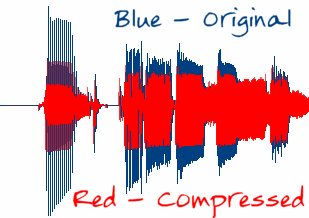
Because I’ve played around with some musical toys in the past, I think I follow what Maguire is saying about sonic compression. The effect funnels the waveform into a narrower dynamic bandwidth than the original. Peaks reduced, minimal signals magnified. Often, the goal is to create a sense of fullness and consistent presence. Pop music, especially, tends to use compression at multiple points in the recording process. Mastering with sophisticated forms of compression is one reason professional recordings can seem so much bigger or fuller in one’s speakers than your average Garage Band output.

We hear a lot of compressed audio.

But the “ghost” in these machines insisted upon by Maguire invites a social reading of these sources. The season aside, what exactly might be scary about compression? Maguire’s project asks us to consider what may have been lost in our uptake of the MP3. The “Ghost in the MP3” is the something left behind, a sonic detritus that when mixed just so and accompanied by the “corresponding video” (featuring a bug), makes you feel just a bit like you are seeing (and hearing) dead people.

Such a sensation asks us what other felt experience might have been foreclosed by computational processes to which few if any of us recall expressly assenting. [If you did ever assent, of course. Those who have held out with your vinyl all these years, you have my respect.] The raw material of “Ghost in the MP3” is a computational elision, the technical “ghost” we recuperate as aestheticized sensation.

I’d like to consider the word “procedural” in a somewhat similar way. As Maguire exploits polysemic connection with the word “ghost,” and suggests what we may have lost to computational formats, I’d like to consider how our current sense of computational procedurality compares with legal procedurality. Instead of de-synonymizing the meanings gathered round the word “procedure” in different contexts, I’m looking for ways that work with computational procedurality may be seen as relevant, even crucial, to a critical investigation of law, or the ghost thereof.

In Persuasive Games, Ian Bogost paints procedurality with strokes both manifold and broad.   “Procedural rhetoric,” for example, is “the art of persuasion through rule-based representations and interactions rather than the spoken word, writing, images, or moving pictures” (ix). And Bogost nests this procedural rhetoric within a more expansive sense of procedural literacy — “Procedural rhetoric is a type of procedural literacy” (258) — which “entails the ability to reconfigure concepts and rules to understand and process, not just on the computer, but in general” (245). The conceptual fulcrum upon which both definitions turn are “rules.”  So true with procedural authorship “of rules of behavior, the construction of dynamic models” (29). The fact that “in computation, those rules are authored in code, through the practice of programming” (29) notwithstanding, “procedurality can . . .  entail the operation of cultural, social, and historical systems” (8). In Persuasive Games, “rules” of various kinds are depicted as operating across a range of social processes. Bogost advances the concept as highly transportable across contexts.

What becomes of procedural law in an era of computational procedurality?

Bogost’s writing on procedurality, then, suggests the appropriateness of reconsidering legal procedurality in light of our extant and ongoing work with computational procedurality. Bogost’s nods to rhetoric also present a concept capable of embracing both computational and legal expression. Bogost recounts that Aristotle’s public rhetoric was typically legal rhetoric, yet elaborates his idea of procedural rhetoric through the treatment of mainly non-legal, computational artifacts. Therefore in my following comments I will present notes on my own very basic understanding of procedurality in law and then one possible application of this line of reasoning in a way that enlists some of our current thinking about computation.

According to Legalflip.com, a legal-educational site devoted to “simplifying legal matters”:

Procedural law is a broad term that deals with the rules that the court, lawyers, and parties must follow to properly try a case. In short, procedural laws deal with dates, times, numbers, and other procedural aspects of case that must be met in order for the case to proceed according to the law. Procedural laws are important because they afford parties due process of law under the U.S. Constitution. Due process essentially requires the government to treat individuals fairly under the law.

If you’ve read this far, it may be unnecessary for me to point out that this definition of legal procedurality emphasizes, again, rules. The stakes here, of course, are quite different than those in gaming contexts. Yet there is still the possibility of reading even everyday legal procedures for their metonymic relation to their governmental surround. As law professor Paul MacMahon notes in “Proceduralism, Civil Justice, and American Legal Thought,” discussions of “civil procedure” present “any reasonably competent American law professor” with “a vehicle for exploring questions of state sovereignty” (563).

MacMahon uses the substance/procedure dichotomy to further clarify the nature of legal procedurality. Substance seems to be what you are aiming for with a law, procedure the way to get there.

A procedure is a way of doing something. In law, procedure is a way of ‘doing’ substantive law. Substantive law is the body of rules that purports to guide people’s conduct outside litigation and the lawmaking process . . .  Substantive due process . . . prevents government actors from depriving persons of certain interests, no matter how they do it. Procedural due process doctrine regulates only how governments deprive a person of life, liberty, or property. (555)

*  *  *

With these definitions of procedurality in mind, I’ve been working through The Drone Papers. They are published by the Intercept, an online source of investigative news featuring journalists like Glenn Greenwald (who broke the story on our NSA’s collection of US cell phone metadata) and Jeremy Scahill (author of Blackwater: The Rise of the World’s Most Powerful Mercenary Army).

“A Yemeni boy walks past a mural depicting a U.S. drone on December 13 [2013] in the capital Sanaa.” cnn.com

In one of the series of Intercept articles unpacking the implications of the documents,  “Decoding the Language of Covert Warfare: A Visual Glossary,” Josh Begley writes:  

For many years, lawyers and human rights advocates have wondered about the chain of command. How are non-battlefield assassinations authorized? Does it fall within the Authorization for Use of Military Force (AUMF), or through some other authority? The documents we have are not comprehensive, but they suggest a linear chain—all the way up to the president of the United States (POTUS).

The government  source providing these documents  “said he decided to provide these documents to The Intercept because he believes the public has a right to understand the process by which people are placed on kill lists and ultimately assassinated on orders from the highest echelons of the U.S. government” (Scahill). Already, I find myself noting language requiring “decoding” and a “process” by which state violence is created in the style of legal procedure. The Intercept’s current find responds to our government’s determined effort to keep the actual process opaque:

The first drone strike outside of a declared war zone was conducted more than 12 years ago, yet it was not until May 2013 that the White House released a set of standards and procedures for conducting such strikes. Those guidelines offered little specificity, asserting that the U.S. would only conduct a lethal strike outside of an “area of active hostilities” if a target represents a “continuing, imminent threat to U.S. persons,” without providing any sense of the internal process used to determine whether a suspect should be killed without being indicted or tried.

KC_Heads01

from The Intercept “Drone Papers”

Perhaps a glance at the Intercept’s findings will convince you that this is a matter that might be aptly explored with critical legal rhetoric. But I’d like to add that computation enables the entire process. Unmanned aircraft couldn’t be flown without it.

In addition, the intelligence used to profile victims and ultimately try to kill them is largely the work of computational technology as well. Noting “the poverty of signals intelligence,” Begley writes:With limited ability to conduct raids or seize materials from targeted individuals in Yemen and Somalia, JSOC [Joint Special Operations Command] relied overwhelmingly on monitoring electronic communications to discover and ultimately locate targets” (A Visual Glossary).

The ongoing backdrop of computational communicative processes on a world scale is what allows our Drone Wars to continue. This contextualizes the NSA’s collection of our domestic meta-data; we are living through a US-led militarization and weaponization of personal data on a global scale. As Begley explains:

“Hellfire missiles—the explosives fired from drones—are not always fired at people. In fact, most drone strikes are aimed at phones. The SIM card provides a person’s location—when turned on, a phone can become a deadly proxy for the individual being hunted.”

“When a night raid or drone strike successfully neutralizes a target’s phone, operators call that a ‘touchdown.'”

The Drone Papers of course touch upon the inaccuracy of drone strikes and the willingness of their operators to accept high rates of human collateral damage — but I’ll assume all of you are already aware of these grim realities.

* * *

In closing:  If Bogost is right, that we can learn something fundamental about the nature of our society by examining the way computational systems enact their procedurality —

If procedural literacy can have implications beyond reading video games–

If the affordances of computation present states with capacities that outstrip the traditional constraints of legal procedurality —

If our drone warfare program yokes the capacities of computation to essentially an extra-judicial procedurality–

What might be revealed through a procedural-rhetorical reading of the sources on offer in The Drone Papers

Trapped in a Mountain of Plus Signs

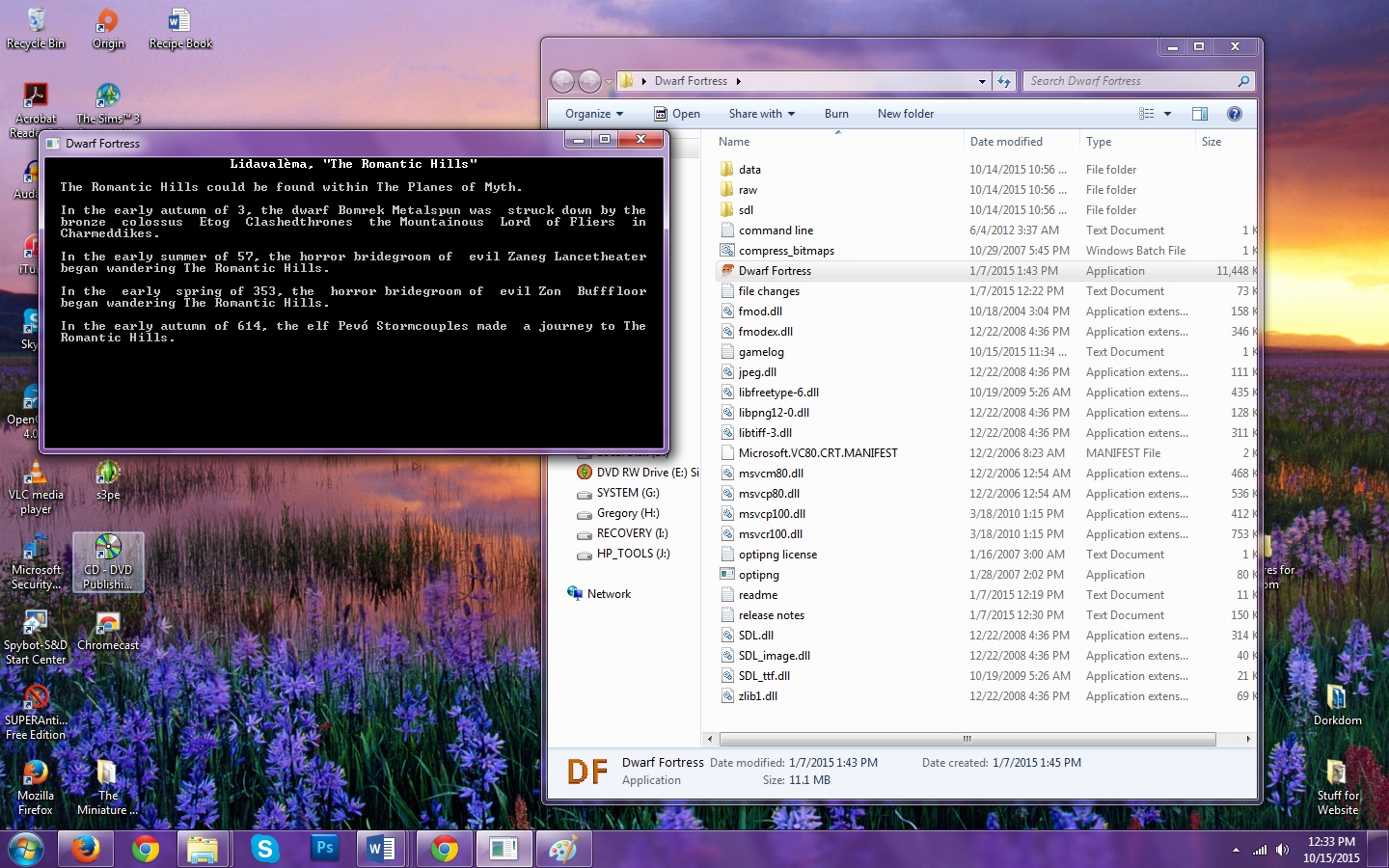
My first encounter with Dwarf Fortress was not a very positive one. After downloading and installing the Mac version of the game, I soon found that I couldn’t quit the game. I looked online and found that many users had the same problem. Posts with headings like “I can’t quit Dwarf Fortress, even if I try” detailed the same glitch, but they also gave me a bad feeling about what I was getting myself into. I finally fixed that issue and tried to download a graphics pack. It didn’t work. I tried another one. It didn’t work. Then, I found that DF wouldn’t work any longer. I’m not sure if it has something to do with my computer’s age (it’s an iMac from 2010) or what, but I was frustrated before I began playing. I uninstalled DF and reinstalled it and finally got to work (added bonus–on the second instal, the “abort game” option worked–yay!), and then I dug in. It only got worse from there. I came to class Thursday more frustrated thank I knew how to explain and feeling completely incompetent.

I have to say, though some of the successes discussed in class reinforced those feelings of incompetence, others’ frustrations and creative alternative game play strategies made me feel better. Today, I approached Dwarf Fortress again and I tried very hard to have an open mind. I tried downloading a few more graphics packs without luck, but I figured I could make this ASCII stuff work, and I decided to try “adventure mode.” I have to say, it did at least go better–at first. The beginning was probably the most fun–I got to name my Dwarf, HannahBadger, and level up her abilities, choose her weapons, etc. She’s tough, a good reader, a swimmer and climber, and she carries an axe. Then, I started the game play.

I spent about fifteen minutes trying to talk to a pair of coffins before I realized they weren’t people. I also shouted to the Dwarf Deity, but my calls must have fallen on deaf ears, because I heard nothing back. But eventually, I re-checked the guide and realized my mistake. I decided to try to find someone to talk to so that I could start an adventure. Eventually, I did. He had a strange name that I can’t remember, but he told me about some monster that killed his daughter, and I asked him to join up with me. So we walked along, came across a fish cleaner with some more tales of woe, but he didn’t know where to find the monster (or the human vampire) that we were looking for. He suggested that some human fellow did, but when I asked him more about this fellow, he said he didn’t know anything about him. Then he declined to join up with us.

We were wandering around for a while, and then I decided to descend some stairs because, hey, after about an hour of walking around, we were no closer to finding any monster or any human fellow who might know about the monster. I spent about ten minutes trying to figure out how to get down the stairs and when I finally got down there, I was pretty excited. Oh, if only I’d known what a bad move that had been!

Once down there, I immediately found a room full of leather goods. Awesome! I picked up almost everything–apparently my back pack can hold a LOT of stuff! I was excited, so I tried another door. Another room of free leather swag! And then another. And then another. And then my travel companion started to get cross. The yellow exclamation point popped up a lot. Tantrum. Was I moving too fast for him? Maybe he was hungry? I gave him some Dingo brains–another mistake–and some water. Then, yet again, more and more narrow passages with rooms of leather goods in them. No monsters. No human fellow. More yellow exclamation points from my partner, but every time I asked how he was doing, he said he was just peachy, so how was I to know what was going on? Then, the exclamation point turned teal, which I think means he was going crazy, and eventually, I lost him. I spent about an hour wandering around, opening doors. Dead ends, more rooms of crap (none of which was food–and I tried to eat a leather boot and licked it and it didn’t help matters). When HannahBadger was too tired to do anything else, I let her sleep–but then, the map disappeared! I couldn’t see which rooms I’d opened any more! I tried strategies, keeping to the outer edge, etc., but eventually, HannahBadger ate her last Dingo brain alone (yeah, I never did really run into my former travel companion again…) and I stopped the game so I wouldn’t have to see her starve.


I’m really not sure what I’m supposed to get out of this sad story, but I can give fellow DF players some advice, I guess. Hoard your Dingo brains and water. And, for goodness sake, if you climb down some stairs (which you do with this button: >), do NOT let them out of your sight.


There were no monsters, few people, and really not much of an adventure. But hey, at least this run, I basically understood most of what was going on. Progress?

Too Much Sand

I always feel a bit odd because I don’t really have a proper attention span for playing games. I care about narratives, but I seem to have no desire to be a participant in the narrative. Whenever I pick up a game, I lose interest in it extremely fast. Probably my favorite game franchise is Pokemon, which is very linear, and I’ve only managed to finish one of the titles. I just stop caring, even when there are guides and obvious goals dictating my path. Even with the Sims, I mostly just make characters and build their houses. The actual gameplay is never as fun.

That brings me to sandbox games like Dwarf Fortress. I can’t stand them. Being plopped in the middle of a world with no directions is both dull and daunting. However, I did my best to engage with it. I watched two Youtube videos about how to get started with the game and how to work basic, basic controls. I had my boyfriend play with me for an hour while we tried to figure out where a good spot for our dwarves would be and begin to dig out a cave. I built beds for my dwarves and made a dormitory room. Now, it’s summer. I’m sure my dwarves will go hungry soon.

In an attempt to care more about my little critters, I tried to enter legends mode. Unfortunately, that does not seem to be an option once you’ve started playing with your dwarves. So, I decided to create a new world with a “Very Long” history. It took 50 minutes to generate, so here are some unedited screen shots from that process. (I shudder to think of the person JUMP mentioned who let their world creation run for 10,000 years.)

About every 100 years, the region would change. I did my best to not formulate any stories based on the names of the regions because I wanted to be able to judge the story generation ability of this nonsensically alpha game.

Once finally created, I hopped into legends mode. Did anyone else try and explore the lore of their worlds? Apparently, you can play in a world you’ve explored in legends mode, but not the other way around.

Untitled11

When I explored the lore of the regions, a lot were like this. Lots of people moved through or settled in them.

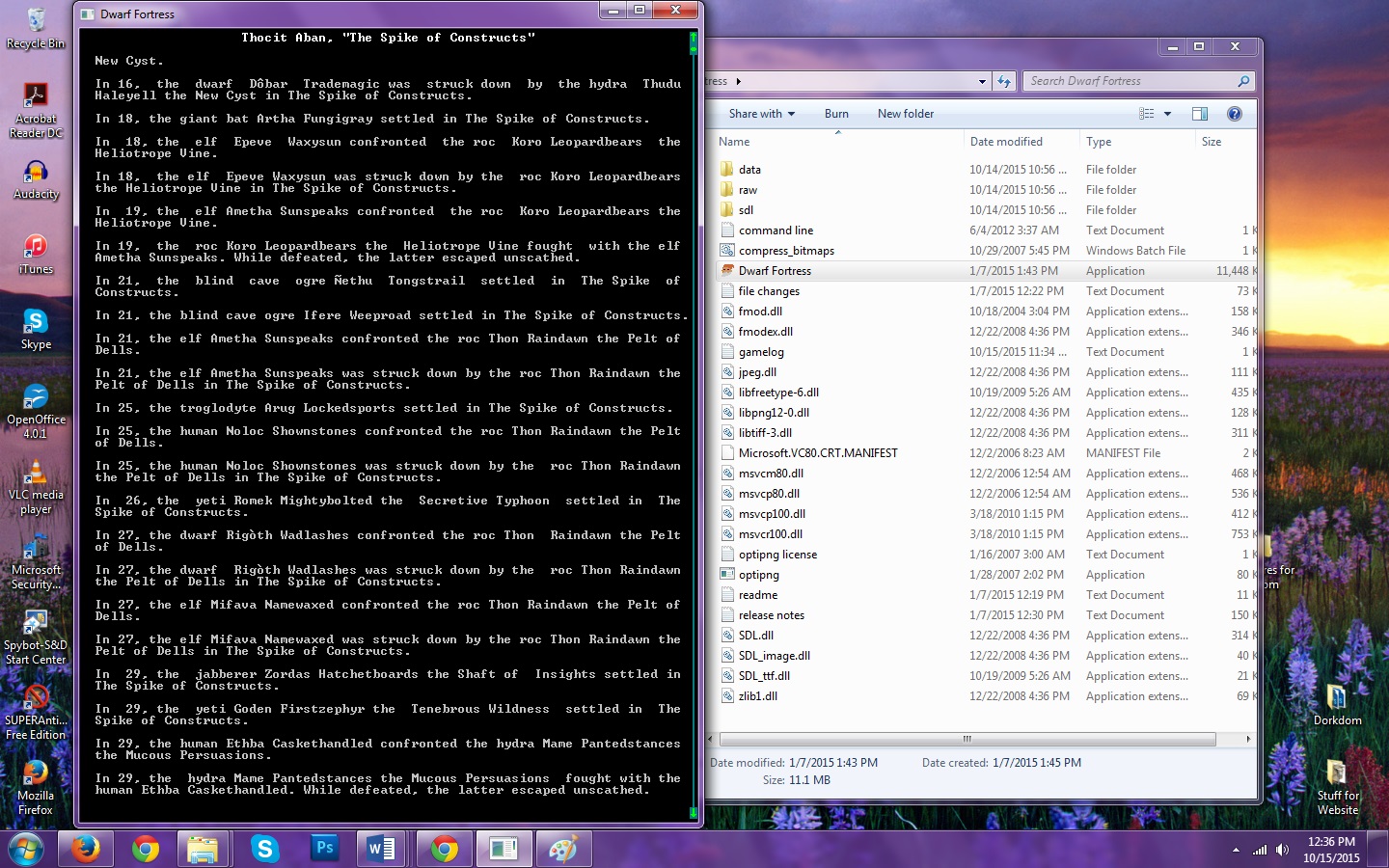
However, one of the regions that appeared twice during world generation, the Spike of Constructs, was huge.

Untitled12

There were multiple events entered for each of the 1050 years of world generation. It was crazy! Lots of people were struck down or defeated. Lots of people challenged various beasts in the area. When I went and explored the historical figures, I found a roc that had featured prominently in the tales of murder of the region and read his biography. In it, several of the battles I read about were mentioned again. He had a long and bloody history, since he existed before the region even began and was one of the first rocs in my generated world.

The generated stories reminded me a lot of the excerpts from Tale Spin’s stories we read. It made me wonder what exactly was happening behind the scenes and how Dwarf Fortress was generating these stories. One thing that made me pause was that in looking at the various historical people (lots of humans, dwarves, goblins, etc.), all the ones I looked at were of unknown parentage. Even those born in 1036 were of unknown parentage. That seemed like such a shame. I wish that Dwarf Fortress’s systems incorporated a sort of Universe aspect that made relationships between the characters more mandatory.

I did find a dead female goblin who rose to power in a religious group who had a husband and an only son, but that seemed too-little-too-late. In my exploration of regions, there were no records of births or marriages. It seems as though the systems privilege new figure-place encounters and antagonistic figure-figure encounters and their results. I found one story of a region being razed, but then that did not seem to impact the actors settling back in it immediately after. I found no stories of allegiances being made. Even the female goblin did not have “stories” about her marriage and her son. They were listed at the end of her biography as “related,” just like her religious society.

The exploration of the legends was really interesting, but since it was all centered on a world in which my dwarves don’t actually live, I’m still left with the issue that there’s just nowhere I want them to go. There’s too much black sand and silty clay in their environment and too much sand in my sandbox. I guess I’ll try and settle my very old world for next week and see if I can get the new dwarves to set up a cult around the Lionshell roc in the Spike of Constructs.

Do you know the old language?

I do not know the old language.

Do you know the language of the old belief?

As usual, I am interested in what it feels like to dip into a text like Dwarf Fortress and experience it in a raw way that doesn’t seek out context or a sense of comprehensive understanding of everything that is happening. But I’m definitely in over my head. After figuring out installation, and learning that it is possible to easily run .exe files on a Mac (I think my Mac knowledge is frozen ~2008), I was feeling confident. If I had made it over what seemed like the first weird hurdle, the game itself couldn’t be so bad, right??? The discourse around this game is just all exaggeration and as an ex-hardcore gamer I would be able to figure it out, right???


what does it all mean?!

I’m interested in the esotericism of the DF community, and what dipping into it might tell us about gamer or programmer discourse generally. When I read about DF, I feel like I am attempting to join a cult, and not doing a very good job of assimilating (my first year of grad school, heavy in critical theory shorthands without citation, felt similar). And I don’t feel like I am trying to join a vulgar sect of Satanism run by teenagers or something, either — this feels more like Scientology, if Scientology had a user interface that did things in the lobby of the Scientology recruiting center and the promise of Scientology was to learn how to read that interface and make it do things.

Some text from the DF Wiki, on the page about “Dwarf Fortress Mode”:

Fortress mode is the more popular of two modes of gameplay in Dwarf Fortress, with the other mode being Adventurer mode. It is often the mode implied when one talks about Dwarf Fortress. In fortress mode, you pick an embark location, and then assign your seven initial dwarves some starting skills, equipment, provisions, and animals to bring along. After preparations are complete and your hardy explorers embark, they’ll be faced with the fortress site you picked down to every little detail, from geologically appropriate stone types to roaring waterfalls to ornery hippopotami. Rather than control individual dwarves, you design everything and your dwarves will go about implementing your designs on their own.
[emphasis mine]

There is a definitely a strong sense of an in-group here that is so in- that they might not be able to even articulate things in a language I can understand. In my DF gameplay, I think I have stalled at the early mining phase (though I’m not sure how I could really tell). Here is what the Wiki Tutorial tells me:

Dwarves will automatically have some labors enabled if they start out with skill in those labors, and some labors (such as hauling and cleaning) are enabled for all dwarves by default. This is why you didn’t need to enable any labors on dwarves to get them to haul and mine, but later you may need a labor that no dwarf is currently capable of.

Look over your dwarves’ assigned labors. Press v (View Units) then place the cursor on a dwarf. Now, press pl for “preferences: labors”. You will see a list of labor categories that you can navigate using and +. You can enter each category with Enter (except for mining, which is a single labor), toggle each labor off and on with Enter, and get back out with Esc.

After exiting the View Units menu, you can use u (the units screen) to help you locate dwarves. Hit u, select a dwarf, hit z for “zoom to creature” and you’ll automatically be placed in view mode on that dwarf. (Then use pl to get to the labor configuration menu if necessary.)

Oh.

While I’m pretty sure I have correctly followed all of these instructions and set all my dwarves to mine-only (which feels like it will quickly lead to Carpal Tunnel Syndrome on my Macbook keyboard), and I have mapped out a mining space, my dwarves are all idle. Though I think they are moving around. This is about as far as I’ve gotten. What’s been funny for me is just how close this experience feels to the procedurality associated with coding that we have already explored, at length, in our discussions of learning how to use Python. Just as I struggled to understand what each bit of code was doing in order to enact the Pig Latin exercise, I’m struggling to read both the in-game UI of DF and also some of the text associated with it. Along with this, I’m a bit worried that it would be a bad thing to fully understand DF, or that if I ever did come to fully understand it, it would be at the expense of being able to, say, successfully complete a dissertation on anything else. What can we say for the depth of discourse and the proliferation of specialized signs that circulate around the game? When does the point of a game become its discourse community, rather than something one goes to to “have fun”?

“Following Peach-Faced Lovebird Man”

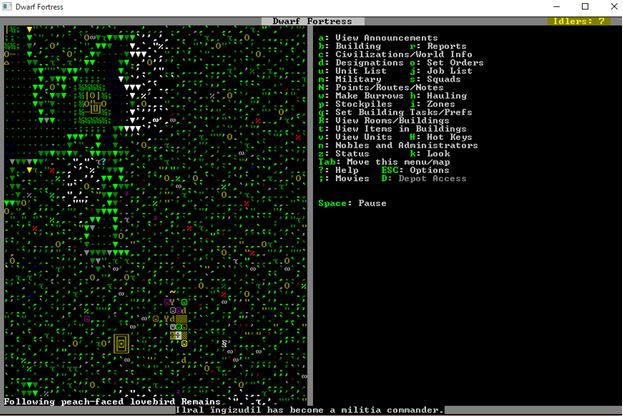
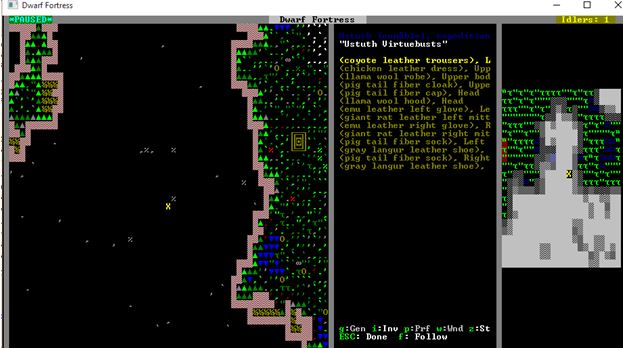
I write with a split screen and my peripheral vision tracking my number of idle dwarfs (fluctuating from 2-5). It has rained five times and the season just changed for the second; Autumn has come. I have eleven citizens now (a few announcements back, migrants arrived). My wild animals include a giant skunk (“large monster in the form of a skunk”) and peach-faced lovebird man (“colorful person with the head and wings of a peach-faced lovebird”). I have seven tame animals, of which two dogs have been adopted. Muthkat Adasshorast, my hammerer, is especially pleased with his pet (In his own words, “I played with my pet. I’m feeling so fond!”). No one has gone dead or missing; everyone appears to be healthy (much to my chagrin). I have two burrows (named Halls and Persiflage). The Military of Lorbamnol has two squads (The Granite Orbs and The Feral Quakes), with three soldiers, but only one active. Ilral Ingizudil wins my most productive citizen award – she first became militia commander, and then a bookkeeper of The Books of Speechlessness. She is fifty-six and very fat, with dark tan skin, gold hair, and ochre eyes. She “often feels lustful,” likes catapult parts and giant chinchillas, but “absolutely detests flies” and “doesn’t handle stress well.” Unfortunately, she’s also “somewhat uncomfortable around those that appear unusual or live different from herself.”

df_ilral
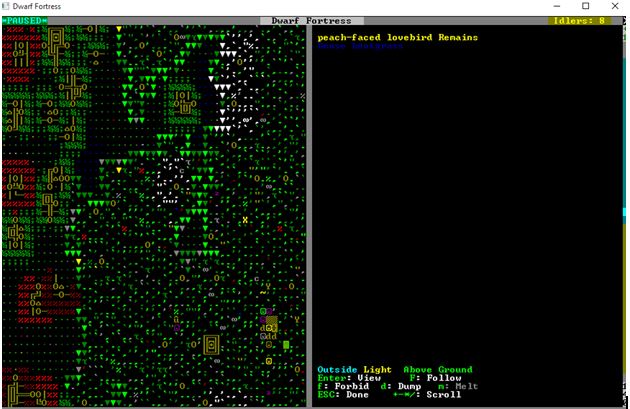
It took me several world-builds and a few tutorials to make it this far, and I’m still not sure I have a clue as to what I’m doing – rather, whether or not I’m in any way working towards the objective of the game – but I’m certainly having fun. I quite literally squealed with delight, some hours ago, when I discovered surprise hedgehogs and remains of magpies and peach-faced lovebirds among claystone pebbles, cherry flowers, and long yam plants while skimming across the lush yet minimalistic map with the “k” key activated.

df_lovebirdremains
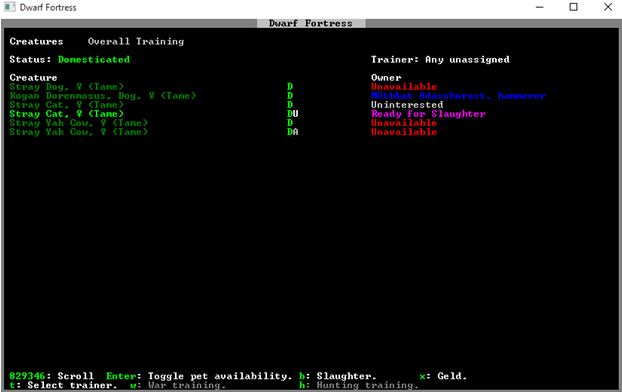
Maybe I’m just charmed by the characters populating my world. Maybe it’s because I’ve also gotten to entertain my morbid inclinations by collecting two stockpiles of corpses and preparing a cat for slaughter.

df_cat
And – yikes! In the few minutes I’ve taken to write this, a third citizen has become a militia commander, Giant Kea monsters have stolen a wheelbarrow, stepladder, and a copper pick – and one has died! Furthermore, a caravan from Velminkot has arrived with several merchants (including Bim Luslemaban, who has fuse-lobed narrow ears and gapped teeth, a swordsdwarf, and a marksdwarf). I must go attend to the site; I’m told “merchants need a trade depot to unload their goods…” and my idling dwarves have gone up to 7-9. This is unacceptable, but I also have no idea how to create a trade depot. Alas, pressing the question mark too many times will yield this message:
df_help
But yes, this game is a “micromanager’s dream” (as Weiner wrote in NYT) and I can see myself using it for found poetry projects. Also, a chicken leather dress? My dwarves are so fashion forward. I’m a fan.
df_chickenleather

The Waters of Circumstance

I hate to be this person: I have NOT yet been able to play Dwarf Fortress for more than an hour. I really just got it running.

His was a tale of woe. 

I downloaded the game on Monday – not too early, but not too late by the grad student clock, either – plenty of time to get in my 4 hours.

But ahh, fate: My otherwise trusty Macbook crashed while opening the file, and has been out of commission since.

* * *

I spent the hours I’d initially allotted to the Dwarf Fortress project with the blue polo shirt-wearing folks at our Pitt bookstore Brilliance Counter (they aren’t the Apple Store).

I watched these undergrad student workers try to restart my machine, getting the same interminable spinning wheel I’d tried all morning to abjure. They had a job I’d assigned them, but I lacked the knowledge to direct them. (Sound a bit familiar?)

One of them, Kevin, restarted the machine while holding down keys that I didn’t know would have any effect. Secrets! He was able to get into windows I’d never seen before, and he opted to run something called “disk verify.”

Bad move, son. The disk utility froze as well. Hah hah.

(Wait, that’s mine.)

* * *

Since leaving one’s machine is frowned upon, I loitered about the Brilliance Counter for quite some time, making small talk, answering the increasingly rare query about the machine, and doing lots of reading on my phone.

Kevin called over other blue shirts, and they looked at me with pitying eyes for about half a second and lost interest.

I finally had to the sense to ask, “Have you heard of dwarf fortress? I was supposed to play it for a class.”

The first two hadn’t heard of it.

But another employee, one with whom they’d seemed to confer when stuck, blinked my way and announced, “I let it run for 10,000 years. It’s a procedural world builder.”

Procedural! They speak my language!

 “What does that mean?” I asked him.

He twitched as if the question revealed the slim chances he could frame an answer I’d grasp. He thought for a moment. “What class did you say you are playing it for?”

“Its’ a grad seminar in the English department.”

He paused, considering.

“It writes poetry.”

* **

“You mean after you set your dwarves up in their fortress?”

“Yes.”

“The dwarves write poetry?”

He nodded.

“But I have a friend who can’t get his fortress going. It sounds pretty hard.”

I was starting to strain his patience.

“Use the wiki, then let it run for a few thousand years.”

“So it’s fun just to watch it play out?”

He looked up one more time: “It invents religions.”

***

Now, with a laptop on loan from the University, I am finally playing Dwarf Fortress.

Which is to say, I enjoy reading the wiki, looking at the screen, and fondly recollect playing Spacewar! as a kid.

Based on what I’ve seen so far, I think I will need 10,000 years, rather than the few hours I have.

But, even in the opening screens, I’m fond of the language. There is sea to the north the peninsular land formation where my dwarves are being created:

“The Waters of Circumstance.”

***

“It’s a procedural world-builder,” he’d said.

Procedural! They speak my language!

 “Procedural” … one of *their* words.

Human Outsider

Screen Shot 2015-10-14 at 10.13.52 PM

I can’t think of a more appropriate way to enter the world(s) of Dwarf Fortress than in adventure mode, as a “human outsider.” In establishing my background the blue text on the screen reads “You area stranger here.” Yes, accurate.

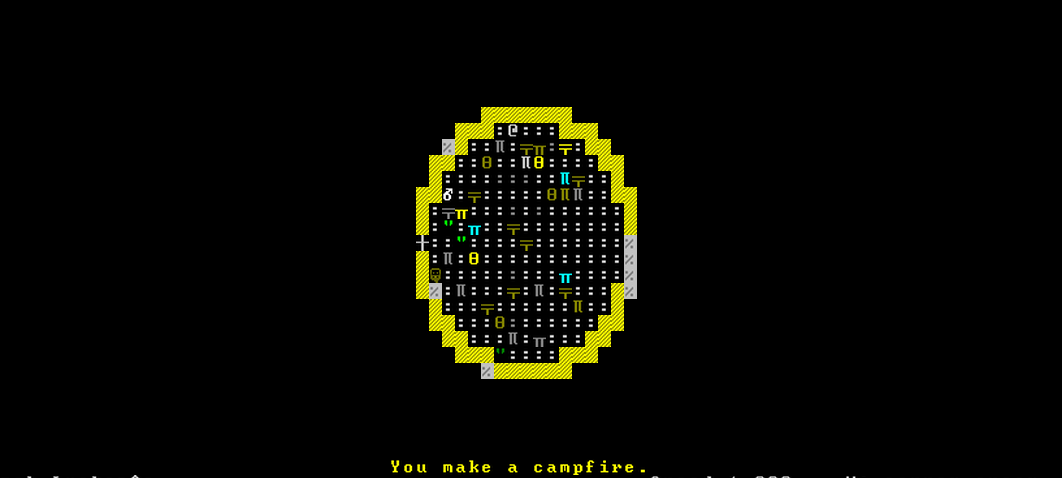
I took a fairly reckless approach to playing the game. If all roads lead to failure, it’s easy to feel very free in experimenting. Do I want to eat with a large copper dagger, or a spear? Large copper dagger, sure, why not? The game tells me that I lick the large copper spear. Fine! Make a campfire? Don’t mind if I do. I’m just a human outsider having an adventure.

Screen Shot 2015-10-14 at 10.33.05 PM

This is not the most meaningful way in which I can engage with this game, but as I find the game wildly overwhelming, simply wandering around and observing the virtual environment feels productive. The game requires interaction at every level; in initially opting to go into the init.txt file to enlarge the text, I felt immediately involved in this world through even this tedious administrative action. Within the game screen, through a combination of pressing random keys (which is how I came to build my fire, tbh) and consulting the wiki, I played Dwarf Fortress by treating it less as a game with defined objectives and more as an interactive fiction, absolutely. It is hard to read some of the text, like the following description of my human character, without seeing it as such.

Screen Shot 2015-10-14 at 10.43.56 PM

Even after my several hours of reading about and exploring the game, I feel that I have barely skimmed the surface of what it is and how it works. Initially I was inclined to think that this might be a game I could enjoy reading about in the abstract, or appreciating visually as a work of art, but bit by bit, I am increasingly inclined to continue playing and to see how much more I can learn. I don’t know that I have any idea what is happening or where I am, but I think I like it in here.

God is dead, long live procedurality?

I’m glad that Amiga pointed out the statement on the wiki about DF’s worlds being generated randomly and procedurally. It seems like a simple idea, but in fact, DF’s approach to generating worlds raises a lot of complicated questions about authorship.

Before going further, I’d like to compare DF to the Civilization series, a country simulator that is very similar in many respects, except that it’s winnable and much more polished, graphically and structurally. In Civ, you role-play a real civilization from history (e.g., the Maya or the French), and try to guide it to scientific/military dominance. In Civ as in DF, “the world that your game takes place in will always be procedurally randomly generated by you or someone else.” However, unlike DF, Civ also comes with a set of premade worlds and scenarios that are based on real geography and historical situations (e.g., Alexander the Great’s conquests or the settlement of North America). Scenario play is considered an ancillary way to play Civ, and most casual players don’t seem to mess around much with the scenarios. That said, each scenario comes with a clear author—usually the developer, Firaxis, but sometimes a fan who has modded the game and sold their mod to Firaxis, who ships it as part of an update or expansion pack. In a Civ scenario, you always start out in the same world. If I play as Churchill, my cities will always be in the same places, my NPC opponent will always use the same strategies, and I’ll always have 3 fewer submarines than I need to beat Hitler. A Civ scenario has a clear stamp of authorship, in that it reflects one developer’s approach to representing a historical narrative within a playable simulation.

On the other hand, DF’s user-made challenges (which I haven’t gotten around to trying yet) seem to defy the conventional understanding of authorship. A creator might define some parameters for her challenge, but the actual world the user plays in is different each time, thanks to DF’s insistence on always generating the world randomly and procedurally. (Civ’s default mode also uses random world generation, but the user has the option to override it. DF has no such option.) Who, then, is the author of the world the user is given to play in? The developer? The game? The user who sets the parameters? Some combination thereof? This is a great case study for some of the thorny authorship problems in Brown and Maher’s articles from two weeks ago.

This fuzziness around authorship seems to manifest in DF fan culture. In the most comprehensive list of challenges that I’ve found, none of the challenges are associated with authors. On the other hand, people who make good Civ mods become celebrities within this very niche subculture. Modders develop distinctive styles and become auteurs, to borrow a term from film studies. However, I have a lot of trouble applying auteur theory to DF, because it seems impossible for a developer to have a distinct style or identity when the gameplay’s rhetoric is so aggressively procedural. What do you guys think – who is the auteur of the aquifier-infested world that I’m grappling with in DF?