I’ll take a dwarf shed or outhouse at this point

So, my experience has been very similar to Amiga’s. Much of my time was spent figuring out how to actually play the game (literally, how to physically push buttons and do things) and also reading up on some dwarf profiles and what not. The tutorials from the wiki helped me at first. I could figure out a decent place to settle (though I decided later this area sucked) and then I just got completely sidetracked on how to actually do any damn mining. Was it happening? Shouldn’t there be some kind of walls being set up at some point? I unpaused the game for several minutes and nothing seemed to be happening. But I was getting nervous. My dwarves needed me and I did not want my incompetency to lead to their demise. So like any good political leader, I relied on some good old fashioned stasis in my decision making. I spent many moments yelling at the wiki to be more clear about how to get these dwarves to work. The wiki, I suppose, does not respond well to this kind of treatment. It returned no answer. That’s my fault. I apologized, but still, the cold shoulder is what I received.

Simula’s link to this was really helpful. Things began to, at least, make a little more sense to me because it is loaded with screenshots. Still, no mining was happening. I did note that much of my land was covered in snow, and thought, well, maybe it’s just too cold to mine. Or something. So, despite my earlier devotion to my beloved dwarves’ welfare, I abandoned them to their fate and created a new world to hopefully pick a better spot, figure out how to make a fortress so I could say I fully experienced both words in the title of the game, and start from scratch with Simula’s link instead of the wiki.

Ok, so things are making a little more sense. There’s trees, and plants, and not a bunch of white wavy lines (i.e., snow) all over the place. I want to make the fortress, but the wordpress person wants me to gather plants, so maybe that matters (I guess stuff to make the fortress?). I’m ready to gather some plants as the wordpress person tells me. I’m trying to designate an area for this to happen. No dice. I try again, and I think I get it. You have to hit enter in kind of a diagonal fashion? I’m not sure. Either way, something happened. Shapes changed over after hitting enter for designation in this diagonal move. I unpaused, some dwarf moved around. I think something happened?  I just can’t say for sure. I’m also not sure how much plant gathering should go down before doing something else. Arbitrarily, I decide to pause and move on.

I’m down to the end of my Dwarf Fortress endurance, and now that I am feeling slightly more confident, why not try to make the fortress again? I designate just like the plant gathering only this time I select “mining.” But nothing seems to be happening. Why does the game refuse to report to you what the hell is going on? Who am I? Aren’t I a dwarf deity of some kind? If so, why am I not omniscient? I certainly seem to have some kind of great power, maybe not quite omnipotent. I certainly feel blind. I can see the little smiley faces moving around, but as far as what they’re doing, I have no clue. I also am pretty sure that zero mining is being done.

But hope enters (only to then quickly exit). Aha! Something. An announcement. What great wisdom to you bestow upon me oh mighty Dwarf Fortress? What’s that? You say, “It is now raining.” How insightful. Does that mean mining can’t be done in the rain? Like some part of a collective bargaining agreement between my dwarves and me? Have they unionized? I’ll bust their union you just wait!! Twelve hour work days for all; I won’t budge on it! Well, no fortress for me yet. Hopefully by the next go of it, some sort of dwelling will take shape, even if it’s some sort of dilapidated mess.
A fortress without walls…

In embarking on my first ever venture with Dwarf Fortress, I must admit that I relied heavily on the Wiki. Unlike Machine, I loath the music that accompanies the game- it is annoyingly simple and melodic (apparently played on a 6-string guitar by Tarn Adams himself) and seems to taunt me as I toil over the intricacies of the game itself. Indeed, I turned my laptop’s volume off and appreciated the early 2000s hip-hop issuing forth from the coffee shop’s speakers instead.

So vintage Jay-Z accompanied me into the Dwarf Fortress. I opted to follow the Fortress Mode tutorial step-by-step, as I’m a complete beginner, and this guide offered the basics for building a “minimal fortress”. I’ve not only never played DF, but have also never played a “construction and management simulation” type of game, like DF or SimCity. I’ve only ever played in worlds where the virtual structures were already present, and my main goal was to guide the protagonist through a series of riddles.

So I feel like a complete novice. To add an extra dose of anxiety to this experience, I read that Dwarf Fortress is unique because: “unlike many games, the world that your game takes place in will always be procedurally randomly generated by you or someone else.” Whoa! This game is already making me feel disoriented! (Is DF a type of “metanovel,” as Wardrip-Fruin defined it? A computer program that tells stories that only a computer can tell?). Is this why I feel like I have zero control and keep pressing the spacebar to pause the game?

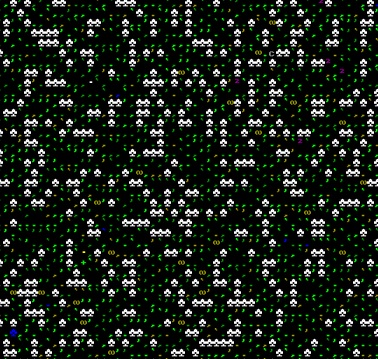
clubs

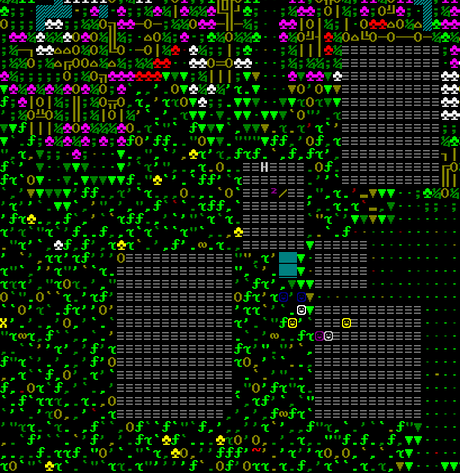
My sea of clubs…

Anyway, the Wiki provided helpful advice as I conjured up my first world– no aquifers and low savagery levels, please! I had to do a few searches before I found a suitable region, and then it took me an additional while to assign all of the tasks to my various dwarves (and avoid the useless stray cats and dogs and yaks). I could only find six dwarves in my virtual world, so I had to do my best with them. I’m not sure if the seventh was hiding somewhere, but I scoured the entire region and found no trace of him or her. With Ast, Tirist, Tulon, Urdim, Udib, and Rigòth as my faithful (sometimes) companions, I attempted to do some mining and channelling. The channeling seemed successful, as evidenced by a rectangle of upside down triangles. However, I couldn’t seem to successfully mine the area. Or, at least, there were no visual cues beyond the original blinking “+” signs to indicate that the area had been zoned for mining. Was the mining happening, and I just couldn’t see this process? After leaving the dwarves alone for five minutes to work on their invisible mining, I found that much of my region had been overtaken by white club symbols. It seems I must restart again…

Beyond being frustrated by the absence of visual queues to indicate certain processes (or being unaware of their presence because of my own stupidity), I was also annoyed by the fact that I couldn’t seem to successfully “save” my progress in the game. I had to restart my fort-building three times with three different sets of semi-cooperative dwarves because I had encountered obstacles or had had to temporarily shut down my computer because it was lunchtime and I had to walk home, etc.

I haven’t given up, but I also haven’t turned the volume back on.

Necrocrow the Crazed Beguiler and the Pigbushel Fortress

As a masochist, I don’t really mind Dwarf Fortress. I’m not proud of what I had to do to get it to run, but the deed is done. Now, after two days of unspeakable horrors, I am happily dwarfing.

Fortress 1: I’d Rather Not Talk About It

Right, so, because tutorials are for squares, I started out by poking around a pocket-sized dwarf map on my own. After fifteen minutes of texting screenshots to my friends with the caption “Look what I have to do for homework!” while my dwarves, presumably, drank themselves into oblivion, I grew antsy. Another fifteen minutes passed. The dwarves continued to mill about (pun not intended). Fine – tutorial it was.

In terms of gameplay, I found the following sites quite useful:

http://dwarffortresswiki.org/index.php/Main_Page

https://dftutorial.wordpress.com/

Using these sites, I more or less got the hang of the basic operations of the game. I chopped trees, gathered plants, carved out a couple of caves, and constructed a carpenter’s workshop. Unfortunately farming was beyond me. Since there was no rhyme or reason to my digging, the map looked very unappealing after an hour, and, being a creature of high aesthetic taste, I grew disgusted with my dwarves, the game, and myself. I abandoned my travesty of a fortress to ruin. The dwarves are still there drinking, I imagine.

Fortress 2: Pigbushel

Apparently, in my first go, I had completely missed the preparation screen. Not so this time around. I named my group Necrocrow the Crazed Beguiler and my fortress Pigbushel. I surveyed my dwarves’ skillsets, and I used up all my points on starting goods and creatures. While playing, I was able to successfully mine to create a fortress with separate rooms, workshops, a kitchen, etc. For a while, however, farming was still beyond me. Eventually, I figured out the 3D aspect of the map and reasoned out that I had to dig in some semblance of soil to grow subterranean crops. By the time I cottoned on, however, it was past midnight, I had run out of food, and my dwarves grown in number and looked murderous, so – like a cruel and distant god – I abandoned them to their fates yet again.

Fortress 3: Pigbushel Returns 

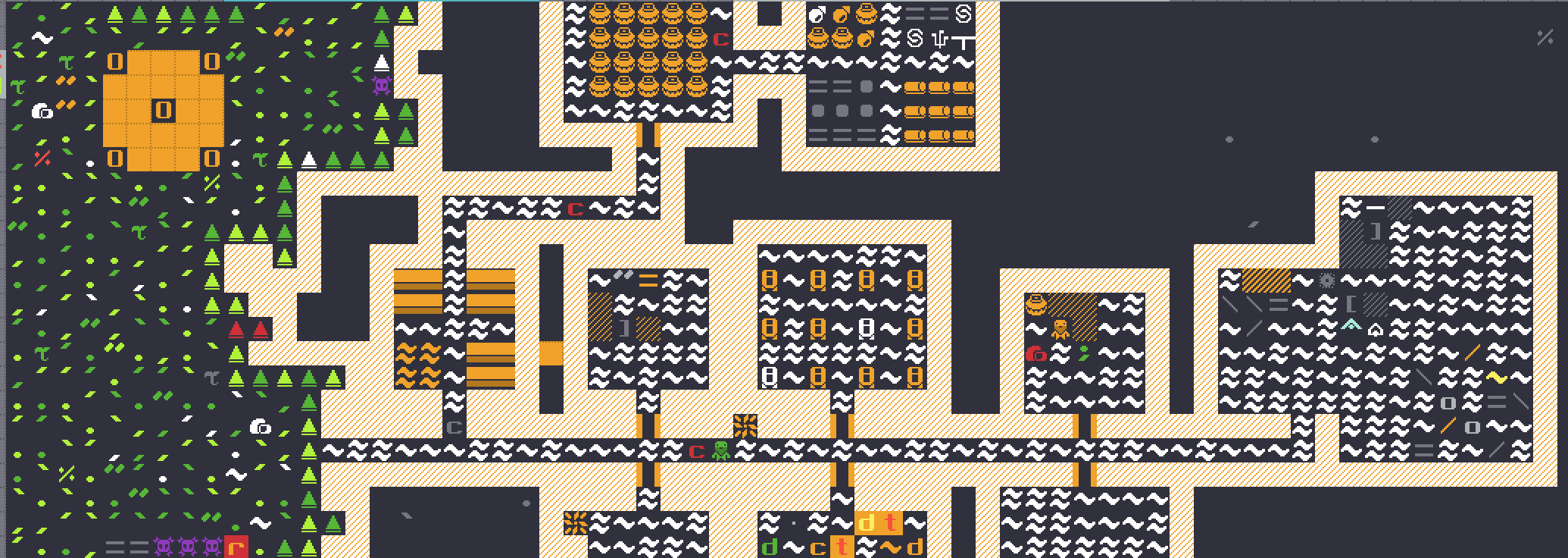
At this point, I can comfortably say that I have a basic understanding of the sustenance portion of the game. I created a pretty nifty fortress complete with four farms, multiple storerooms, a dormitory, separate bedrooms for each dwarf, a meeting hall/dining room, a still, a kitchen, a carpentry workshop, a mason workshop, and several other workshops (fig. 1). Two or three seasons have passed, though, and I haven’t noticed any immigration. I’m hesitant to start a military until I have more than seven dwarves, and I’m a bit concerned that I might have screwed something up in my starting settings. Since nothing appears to be happening apart from buzzards stealing my food (fig. 2) and the occasional haunted cloud of dust floating by, I’m considering retiring this guy and starting another fortress for next week.

Screen Shot 2015-10-14 at 11.35.57 AM

Fig.1: Pigbushel


DF Buzzard

Fig. 2: Filthy Buzzards

Fortress (n): a fortified place

DFZones

This is my Dwarf Fortress area. I have made some zones, and I made a burrow and had my people meet there. They have yet to do any of their jobs, but at least they are in a burrow.

I downloaded Dwarf Fortress fine and it ran immediately. I chose the version with music, and I’m glad I did. It is lovely music. It is just about the only thing that is calming with this whole process. Here’s a recreated dialogue between my beau and I, he-who-used-to-be-a-programmer-and-plays-Dwarf-Fortress:

Me: “I understand that each of these symbols means something in terms of the terrain and what is underground.”

Tim: “Mmm hmm.”

Me: “I understand that I cannot ask my dwarves to do anything, I have to designate jobs for them and then they’ll do things in their own time. I understand that I have a wagon and a cat.”

Tim: “These seem like good things to understand.”

This is going to be difficult. Conceptually I think I get it — you set up some tasks and you let it run. I like city-building sandbox games, and parts of this are like that. You need people to do certain jobs and places for them to do them. There are unpredictable events that are outside of your control. My issue is that it’s just overwhelming — there seems to be an options menu for everything and those menus are not intuitive. Sometimes I use the arrow keys and sometimes I use the + or – and these are the keys on my number pad not the same ones above my qwerty keys. Sometimes I have to use shift to get to the capitalized version of a letter. Red letters tell me I need a manager, but when I assign a manager I still cannot assign jobs. Three hours in and my people still aren’t doing the jobs they’re capable of doing. I’ve zoned some things, and I’ve made a burrow (see above… my dwarves are hanging out in the burrow because I assigned it as a meeting place… at least, I think that’s why they’re all there). I can’t remember what I marked the other zones for.

My favorite part of the game so far, apart from the music, is the complex biographies for each character. Under some menu (view unit?) I found an option for “Thoughts and Preferences” and there is the individual story that read somewhat like a terrible online dating profile. Uzol Bertorad, coined “Uzol Earthbodies” is 88 and “always tense and jittery” but he “doesn’t mind wearing something special now and again” and, sadly, “needs alcohol to get through the working day” (I’m not sure I’m even gathering berries let alone making ale). When reading the “Dwarven Epitaphs” piece by Boluk and LeMieux I was struck by the narrative complexity of the program that is just simply invisible from first glance. I “played” for about two hours  and then went to the readings, hoping they’d give me the inspiration to return and try out some other options. The game they are describing sounds amazing! Based on the fantasy short stories of Zach Adams and moved into game mechanics, the way the game writes a history is absolutely fascinating, and the failed narratives by players are told as dramatic encapsulations of the inevitably epic and odd deaths of their dwarves sounds like an ideal form of potential literature. But for the moment I’m overwhelmed by the attention to detail (is that what it is?) of the mechanics accounting for geographical details and world situations. It’s exceptional, but near un-game-able. Because I know Tim enjoys the update notes, I found them in the Release Notes file in the download folder.  “Stopped random creature proboscis from sometimes messing up poison attacks” and “Made removal of trees check building/bridge/machine stability” are a couple of my favorites.

Boluk and LeMieux describe Dwarf Fortress as the game version of future historical models recreating our lives, “dwarves live within us, around us, and without us–in vaccines and antibiotics, in mechanical and computational systems, and in the geological and cosmological happenings of the universe. The role of the human, then, is not to play videogames but to produce metagames” (150). I’m excited to find out what history my game will tell… if I can ever get my dwarves to do anything in the first place. Maybe not doing anything is what is keeping my six dwarves alive (I have no idea what happened to the 7th… I missed that plot point, or can’t recover it because I’m not sure what menu it lives under…). Is Dwarf Fortress the game an impenetrable fortress itself? To be determined.

p.s. This post ended up longer than intended… I had been thinking this was my week for a substantive post but we’re all blogging this week — so I guess I’ve just been thinking about it too much for a quick update!

Citizenship in the Digital Age

My contribution into this weeks reading, Expressive Processing: Digital Fictions, Computer Games, and Software Studies by Noah Wardrip-Fruin, centers around the concepts of digital media, citizenship, technical expertise, and simulation. My concern is pseudo germane to the work itself, but more of an indictment of articulating better citizenship as the output of the work on computational literature. For example, Wardrip-Fruin argues, “Learning to understand the ideologies encoded in models and processes, especially when unacknowledged by system authors, is an important future pursuit for software studies… to be better citizens we need to understand software critically” (pp. 422-424). There are a few problems I would like to address here. First and foremost, citizenship itself is an ever fluid concept that hardly seems conceivable in lieu of recent debate and discussion. Second, the simulated citizen is always/already operative within simulation when addressing “politics”. Finally, every act of identification is an act of division (Burke) causing new (in)humanness to occur, and as Wardrip-Fruin argues, “our ability to identify with human characters is closely tied to their graphical representation” (414).


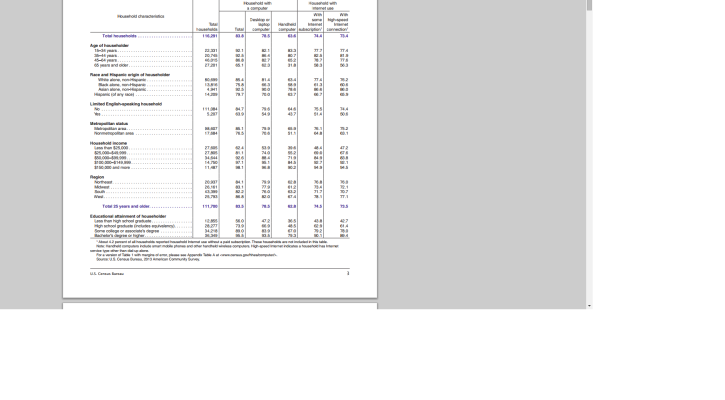
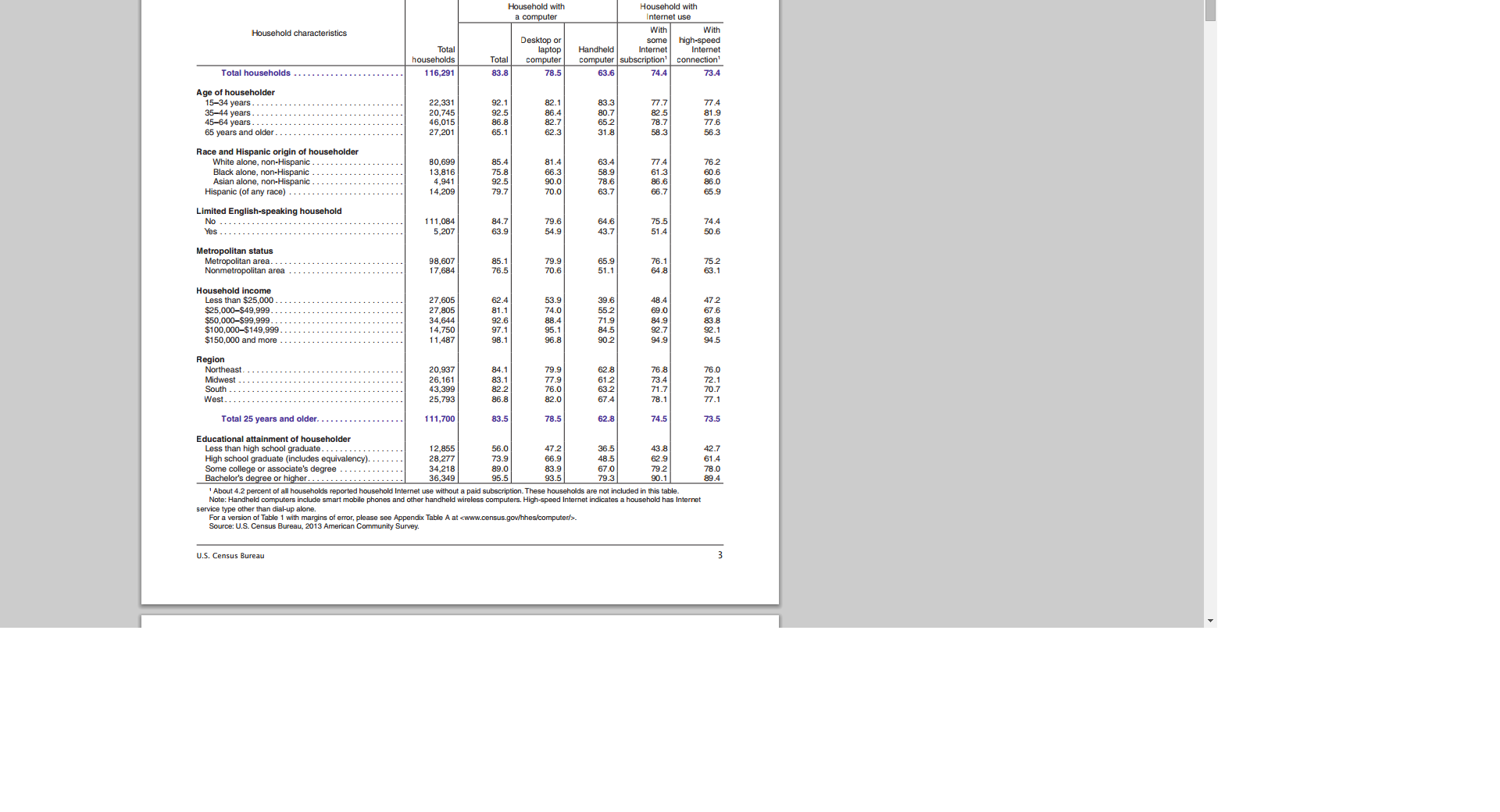
My first interjection is at the point of a Marxist critique of media and citizenship. Tying concerns of computational literary to machines that costs thousands of dollars (at the cutting edge), directly equates into a new form of academic elitism that may have negative effects. When I finished this book I could remember the aspects pertaining to ideology but couldn’t remember much in relationship to economy, I searched for the use of economic value in its relationship to ideology and found something surprising. Each time the book utilized the term, “ideology”, it was always/already devoid of material conditions and focused purely on the symbolic, social, and political ideologies that need not be divorced from economic analysis. If a central tenant of the works justification resides in the fact that it is a precursor for citizenship, then we need to careful reanalyze who gets to be a semi-citizen in the first place. The total of households in 2013 that owned a computer was 83% and in poor households the statistics of owning a computer were approximately 60 percent (Census.Gov).


https://www.census.gov/history/pdf/acs-internet2013.pdf


Bringing me to my second point. Was there ever a notion of citizenship devoid of simulation? Politics itself seems to be the bridge where ideas are circulated, simulated, and voted upon to make into actuality. At the representational and naive level, our congresspeople directly simulate our responsitivity whenever they case a vote for/against a particular piece of legislation due to what is articulated. If I gave you the next passage from the book without explanation (and removing The Sims from it), you might be convinced that this quote directly supports politics in tune with its people, “Not only should we aim for engaging expression but also for expression that communicates the evolving state of the underlying system. We should strive for the closeness of surface and simulation achieved by the Sims, but while moving both forward and sideways toward elements of human life other than the most basic” (pp. 415-416). Which brings me to another thought, where does the line between simulation and real actually exist? There are many times where people think, “this isn’t the real me”, well what exactly does that proposition mean? In a world where we are rhetorically sound and repudiate higher truth’s, isn’t the “real you” just a serious of communicative exchanges in the creation of identity? If so, how does this differ from simulation itself? Just to make fun of myself for a terrible question:


Finally and most importantly, digital citizenship seems to be here to stay, what does that mean for our current geo-political situation? If most individuals lack the technical expertise to even understand that our climate is at risk from anthropomorphic activity, how is it possible to get individuals to think critically about simulation, which goal is self-erasure (a simulation is good when it denounces itself as simulation) and obfuscates the very processes at hand (seriously can’t I just play Grand Theft Auto, Sim City, etc., in peace)? Isn’t this going to get harder as, “Today’s authors are increasingly defining rules for system behavior” with greater technical capacity (p.3).


Ps. Just to show everyone that I’m very bad with fundamentals of a computer, here is an imagine of me trying to show a chart.


Untitled


I rest my case:


or


Computational Media and Modernist Aesthetics

One of the quirks we have harped on, in relation to Ian Bogost’s work, is the way he seems to endlessly reference his own games in order to prove a given point. To be kinder to Bogost, he also references games produced by other theorists who have similar didactic designs for their aesthetic products. Reading across Bogost, this begins to feel very silly, for example in this moment in the “Persuasive Games” article:

Crawford refers to his own game Balance of Power as a contrasting, desirable, high process intensity specimen. The game simulates Cold War geopolitics by algorithmically analyzing data like insurgency, economics, might, and prestige across many nations in relation to user actions like sending aid, escalating conflict, and backing down.

Good for Crawford, I wanted to say after reading this. I found this seemingly unquestioned habit of citing programmer/theorists, rather than just theorists, sort of nauseating — what could be worse, and more conspicuously tautological, than a theorist who thinks their own work is one of the best, and/or one of the only examples of a game that they want to exist more broadly within the culture?

At the same time, I am above all other things a relativist, and realize that the particularity of the discourse community we are moving through must be considered as a factor in how we interpret its rhetorical gestures. In considering my own experiences moving through other “canons” in the academy, big or small, I have begun to realize how much this habit of self-aggrandizement is part of what we often define as a Modernist sensibility. In the field of poetry studies, there is a term deployed to describe makers like Ian Bogost–poet-critic. Within the field of poetry studies, being a poet-critic, having a foot in both creative and critical practice, is the most-respected position possible. Authors like Ezra Pound and Gertrude Stein continue to be appraised as greats partially because of their hybrid practice, and often these two authors’ work involves a self-appraisal of greatness within the extra-poetic work, a self-appraisal that we question little today. Perhaps, then, it would be best to think of Bogost and company as a vanguard of sorts, though I’m apprehensive to attempt to map a radical politics onto anything that involves computing. Pound and Stein were fascists anyway.

Across his career, Pound develops his own processes towards producing an ideal poem that “contains history” — at first, this can be seen in his attendance to verbs and nouns over all other forms of speech, then he turns to the Chinese ideogram, which he believes better-refers to an object or concept than any other form of writing. Eventually, he turns to patchwriting and “translation” that can often be read as plagiarism of others’ work. As one moves through the work, one can see Pound amassing more and more processes to write the Cantos. I would argue that the Cantos are almost all “process” pieces whose surface refers back to everything underneath. From the very first Canto, the process of translating from different sources, and of intervening within this translation, is foregrounded in the surface of the text. The historically-real Pound seems to speak directly to Andreas Divus, whose translation of Homer he translates into English, then ends the poem with a colon that ought to signify continuation:

And Anticlea came, whom I beat off, and then Tiresias Theban,

Holding his golden wand, knew me, and spoke first:

“A second time? why? man of ill star,

“Facing the sunless dead and this joyless region?

“Stand from the fosse, leave me my bloody bever

“For soothsay.”

And I stepped back,

And he strong with the blood, said then: “Odysseus

“Shalt return through spiteful Neptune, over dark seas,

“Lose all companions.”  And then Anticlea came.

Lie quiet Divus. I mean, that is Andreas Divus,

In officina Wecheli, 1538, out of Homer.

And he sailed, by Sirens and thence outward and away

And unto Circe.

Venerandam,

In the Cretan’s phrase, with the golden crown, Aphrodite,

Cypri munimenta sortita est, mirthful, orichalchi, with golden

Girdles and breast bands, thou with dark eyelids

Bearing the golden bough of Argicida. So that:

(bolding mine)

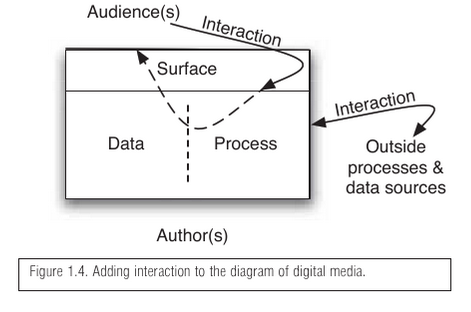
Wardrip-Fruin, in his citation of Tristan Tzara in his book’s introduction, seems invested in the idea of vanguardism relating to his project. I would argue that Pound’s vanguardism reflects a sophisticated, explicit understanding of one of the diagrams in Wardrip-Fruin’s book, figure 1.4:

Screen 1
The reader of Pound’s Canto, if they become dissatisfied with its irregular surfaces, is forced to move through Pound’s process- and data-oriented writing practice–if I understand Wardrip-Fruin’s diagram correctly, the reader of The Cantos must consider their movement through them in relation to all of the parts of this diagram. Surface and process are difficult to distinguish, something considered part and parcel of the poems’ construction.

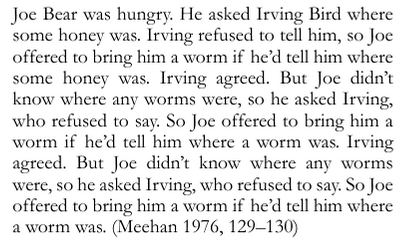
To elaborate upon this, my experience reading the chapter on Tale-Spin also mirrored some forays into Modernism. One “error” passage reads like a computerized Gertrude Stein:

Screen 2
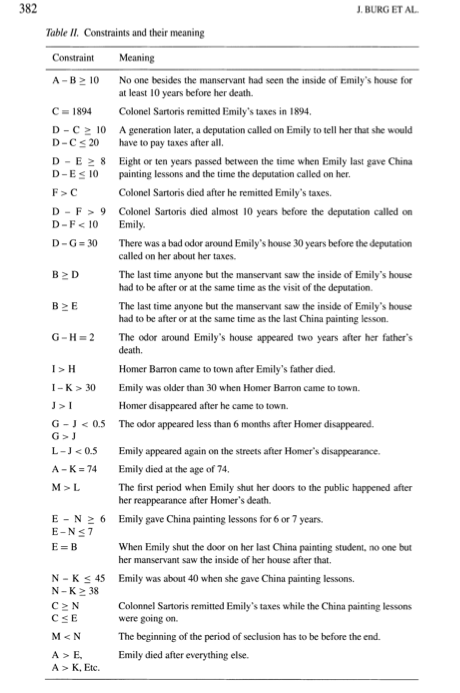
Beyond Modernist poets, Wardrip-Fruin’s elaboration of Tale-Spin also reminds me of a favorite, bizarre, critical article — one on William Faulkner’s “A Rose for Emily,” by Jennifer Burg, Anne Boyle and Sheau-Dong Lang published in Computers and the Humanities in 2000 (if anyone is interested, the article is available on JSTOR). In their article, Burg, Boyle, and Lang develop a computerized methodology to track the temporal movements and activities of the characters in that story, reducing them to a set of variable-coordinates, only to find that the variables can never possibly line up:

Screen 3
It seems to me that the academic procedure involved in the Faulkner article is a kind of reverse-engineering of the types of processes that produce the texts in Tale-Spin, which leads me to a final question. If we want to emphasize process-intensity in computer-generated texts, why not turn to the Modernist strategy of self-reference in order to foreground this? It seems to me that a more- “broken” version of Tale-Spin would draw attention to its processes in a way that would invite inquiry beyond the surface and allow those who interact with the text to do so in a dynamic way.

snack.py

# This is a coded version of a blog post, written in python.
# In it, I have authored some basic processes to help myself
# bring in a snack for class. Please feel free to comment
# with any analysis you might have of what I've chosen to
# include/exclude, as well as any additional suggestions.
# Here goes nothing! - Java


# And yes, as long as WordPress hasn't messed up my spacing, this all runs!


# Import the datetime library

from datetime import datetime


# Set some time variables that we'll need

snack_day = 1
snack_month = 10                      # Date I was supposed to bring snacks: October 1st
now = datetime.now()
this_day = now.day
this_month = now.month
class_hour = 18 # 6 pm
this_hour = now.hour
this_minute = now.minute


# And the functions to check those variables

def checkDate():                      # Check if it's the day you're supposed to bring snacks
    if snack_day == this_day and snack_month == this_month:
        print("You need to get snacks today.")
        return True                   # Returning booleans to let me know if I need to proceed
    else:
        print("You don't need to get snacks today.")
        return False

def checkTime():                      # Check how many hours you have left to get snacks
    hours = class_hour - this_hour - 1
    minutes = 60 - this_minute
    if this_hour < class_hour:
        print("You have " + str(hours) + " hours and " + str(minutes) + " minutes to get snacks.")
        return True
    else:
        print("You didn't bring snacks. Shaaaaaame...")
        return False


# Ok, now that we can check our date and time, let's make a Food object with useful attributes

class Food(object):
    def __init__(self, name, temperature, hasMeat, hasDairy, hasGluten, isTasty, hasBeenDone):
        self.name = name               # Give the food a name
        self.temperature = temperature # Hot, Cold, or RoomTemp
        self.hasMeat = hasMeat         # True or False
        self.hasDairy = hasDairy       # True or False
        self.hasGluten = hasGluten     # True or False
        self.isTasty = isTasty         # True or False
        self.hasBeenDone = hasBeenDone # True or False

    def check(self):
        if self.hasBeenDone:          # First things first, check if that snack's been used already
            print(self.name + " has been done before!")
            return False              # I'm returning booleans to make my looping easy later on
        elif not self.isTasty:        # Next, check if it's tasty
            print("Nobody would want to eat " + self.name + "!")
            return False
        elif self.hasMeat:            # Make sure that it meets peoples' dietary restrictions
            print("Vegetarians can't eat " + self.name + "!")
            return False
        elif self.hasDairy:
            print("Vegans can't eat " + self.name + "!")
            return False
        elif self.hasGluten:
            print("Individuals with gluten intolerance can't eat " + self.name + "!")
            return False
        elif self.temperature != "RoomTemp": # Finally, check if it needs to be kept hot/cold
            print("You would have to keep " + self.name + " " + self.temperature + "!")
            return False
        else:                            # Eureka!
            print("OH MY GOD " + self.name + " WILL PROBABLY WORK!!!")
            return True


# Now let's come up with some different food items...

chocolate = Food("Chocolate", "RoomTemp", False, True, False, True, True)
broccoli = Food("Broccoli", "Hot", False, False, False, False, False)
pitaChips = Food("Pita Chips", "RoomTemp", False, False, True, True, False)
pepperoniPizza = Food("Pepperoni Pizza", "Hot", True, True, True, True, False)
cake = Food("Cake", "RoomTemp", False, True, True, True, False)
sorbet = Food("Sorbet", "Cold", False, False, False, True, False)
tortillaChips = Food("Tortilla Chips", "RoomTemp", False, False, False, True, False)
cheeseburger = Food("Cheeseburger", "Hot", True, True, True, True, False)


# ...and put them in an ideas list

ideas = [chocolate, broccoli, pitaChips, pepperoniPizza, cake, sorbet, tortillaChips, cheeseburger]


# This last part is where the magic happens. Since my checkDate()
# and checkTime() functions return booleans as well as printing
# out their result, I can use them to run an if statement. Then I
# can iterate through my ideas list and run my check function, and
# once that returns True, exit the loop. This means I don't actually
# check the cheeseburger because I stop at tortillaChips.

if checkDate() and checkTime():
    for idea in ideas:
        if idea.check():
            break

What is an Author?

I recently finished chapter seven of Expressive Processing, so I have yet to read anything about the “Sim City Effect” or the conclusion to Wardrin-Fruip’s argument. However, the discussions of Brutus really started me thinking about authoring systems. I was in a small group last class that specifically talked about whether or not computers or machines could potentially be authors, so I’ve been thinking about this topic the past couple of days. Last class, my response to the general question of computer programs being authors was that I thought “in terms of copyright, the program’s creator would be considered the author,” which continues to strike me as a strange response to the question. Maybe I’ve just been reading too much Foucault lately…

However, my other two group members’ ideas were much more fascinating to me. One was adamant that computers would never be able to truly embody creativity and have authorship of their outputs. The other group member was perfectly willing to accept that AI would one day be capable of creative authoring, but that the processes used to do that would no longer fall under the umbrella of computation.

In response to the first position, I’d like to think more about Brutus. First, I was astounded when I read the “Dave Striver loved the university” story because it seemed so literary (245). There was nuance in the syntax and drama in the structure. I tried to imagine a very complicated underlying structure that somehow was able to create a story from isolated or hierarchical fragments, potentially using a question-input system like Tale-Spin and Terminal Time. As I read on, I saw that the system was a more elaborate love letter generator. Then, I was struck that Wardrip-Fruin continued his discussion and analysis of Brutus as an authoring system. It was so clear to me, personally, that its creators were the authors of the stories it output since they authored both the sentence components and the system for selecting those components. It takes until the section “Author of Brutus‘s Stories” for Wardrip-Fruin to give a hint as to why he participated in this illusion/game for several pages, the reason being that he suspects that even the creators were drawn into the illusion (258). I think that is super fascinating, but I don’t have anything concrete to say about it. Tale-Spin and Minstrel seem more like proto-authoring systems, but their tendency to break down when exposed to larger sets of possibilities is so opposite from how human authors are supposed to write, that is they’re supposed to become better with each scrap of knowledge they get, and I don’t want to be too generous when thinking about their potential. Universe and Brutus for me are authored works with the potential for varied outcomes, and in this way I think of them as being similar to Terminal Time in actuality, even if that is not how they’re conceived or perceived by the public. I guess that there still is no computer system I’ve come across that I would consider as serving as an author. Perhaps we really will never see that happen. Universe, Brutus, and Terminal Time all seem like procedural translators of authored texts at most.

In response to the second position, that a creative, autonomous, authoring machine would cease to be computational, I’m stuck. Perhaps I am just resistant to that idea because I’ve spent all this time and energy into learning some code, expanding my knowledge of computation, and understanding computers as procedural. I think I prefer to think about this as a blending of computation and creativity. From my limited understanding of this discipline, a good example of the two coming together is mathematics. Math we are taught as children is purely computational stuff (2+2=4), and later we are taught that computational math has some intersection with usefulness (namely money calculations and statistical biology, from my own experience). Personally, this is where I am with code; I see it as a tool that can let me arrive at a solution to a pre-conceived problem.

http://www.math.ttu.edu/FacultyStaff/research.shtml

However, higher-level math and mathematical research is super creative.At a certain point, you stop using real numbers at all and work exclusively with concepts. Maybe this is why the idea that you need to be great at math to be really good at code, something we all came across in the Paul Ford piece at least, is so pervasive. Thinking about code as writing is easy, but actually writing code may have more in common with the way mathematicians creatively think of problem-solving than it does with how fiction writers creatively think of problem-solving. Perhaps, then, it would indeed be possible to have a computer that authored ideas, if not linguistically sound stories, and the solution to this problem lies in the path math walks between computation and creativity.

Facade

For awhile now we have been reading various mentions of the interactive drama Facade, though we have yet to get such an in-depth analysis of the game as we do in Expressive Programming.  I was really interested by the explanation of it offered by the book, so I decided that it was time to try the game out for myself and see how well it succeeded at doing that which the book claims it does. Even in just the first few minutes, as evidenced by my multiple times playing through, you can see the amount of variance possible from minor changes in action taken by the actor.

I played through Facade many times.  The first time I didn’t quite understand what I was doing, and therefore had a difficult time interacting with the characters and the environment.  I waited outside the door and listened to Tripp and Grace argue, wondering if / how I could do something to assuage their argument.  Eventually Tripp notices that I am at the door and he opens it.  He is happy to see me, but Grace is yelling at him from the bedroom.  She is uncomfortable with my presence immediately, and her responses show this.

The second time through I realized that I could interact with objects in the world, so when the game started I made the choice to knock on the door and throw off their argument.  Tripp responds by telling Grace that I am there and opening the door.  Grace, now aware that I am there, is not as hostile towards Tripp in the opening exchange and is, therefore, more welcoming towards me.  Rather than spend time criticizing her interior decorating, Tripp instead offers me a beer and their argument over fancy drinks ensues.  In the first time through, this argument unfolded in a similar way, but Grace’s remarks were more hostile and were directed at me.  The conversation also took place after I had insulted her interior decorating, so she was already pissed.

The game, overall, is interesting.  Expressive Processing has a very strong view of the game, and a lot of the discussion of Facade that we have read talks about it as a great model for interactive gameplay, though I found the user-interfacing to be difficult.  I think it is interesting to look at it in contrast to the Sims franchise, also observed in Expressive Processing.  The Sims games, as explained in the book, explain the process by which the game operates in a clear and accessible way, and this is, theoretically, what makes the game enjoyable.  Users are able to manipulate the system in order to achieve the desired results, and the confines of their operations are made clear to them right from the start.

In Facade, you are given very little information about the interfacing process.  You are told that you can move, interact with various objects, and speak to Tripp and Grace.  What you say, how you say it, when you say it, when you do something, what you choose to interact with, are all up to you.  In this way the game is both complicated and straightforward.  Straightforward in the sense that the interaction is very similar to real world interaction, and so choosing what to say, when to say it, how to say it, etc. comes very naturally.  However, the game doesn’t respond as easily as it could, often having the characters ignore the comment and continue on with their dialogue, or functioning sort of as a redirection tactic and leading the characters down a different but still fundamentally similar argument.  In this sense it is frustrating.  It is hard to know if the actions you are taking are having any real effect on Tripp, Grace, their marriage, their feelings toward you as their friend, etc.

I think that what makes a game like the Sims fun for people is that it is a goal and result based game, even if the results are not what are normally found in games.  And while Facade does in fact have an end and specific results and goals, your progress towards these goals is not easily recognizable, and it is easy to become uninterested because of this problem.  So while both games are goal-driven, in the Sims games, the progress can be seen, therefore making the game more interesting and making the interaction with the characters more intriguing.  Facade is, perhaps, too close to a realistic interaction to be as entertaining, at least in my opinion.  Though it is odd to consider two games that are life simulations and chart the difference in entertainment factor as something so simple as real-time result indicators vs. results with no easily discernible indicator.

I am going to continue to play and will hopefully figure out how to screenshot so that I may include a few images and a bit more discussion of the gameplay.

**Edit: I have been able to play a bit more this morning, and managed to successfully get Tripp and Grace to decide to talk about their marriage and see if they can work out their issues.  Unfortunately, this was not done by any skillful or masterful playing of the game or knowledge of the human condition.  It was by sheer insistence.  Anytime they would say something to one another, I would interrupt them and say that I thought they should stay focused on their relationship issues.  Over and over again I said this when they would try to move on, and eventually they stopped arguing and agreed with me.  It is, at its core, very similar to a condition satisfier in a game such as the Sims.  Their “we need to talk about our marriage” bar was low, and I filled it.

What is interesting to me, then, is the limits that games such as this, with free language interaction, have imposed on them.  All the time while playing it seemed as if it would search for certain “buzz” words in my sentences and then respond to it the way it is conditioned to, just as Expressive Processing describes it.  They basically have 5 loaded responses to any certain sentence, and when they get a certain response from me they just unload the response tree they have prepared.  There is very little “learning” going on, instead progression through a tree, similar to how a game such as Fallout would process.  By selecting dialogue from a list, you choose the way people will perceive you and treat you.  The only difference between Facade and Fallout is that in Facade you get to choose what you want to say, giving you the illusion of agency.  Games like Sims or Fallout, where the system of interaction is more easily discernible, ends up being more enjoyable because there is less guessing involved in the same type of output.

Second Living

When I began my Library and Information Science masters program in 2010, the use of Second Life in libraries was a popular topic among some of my fellow classmates, and was frequently cited as an example of an innovated “Library 2.0” outreach tool, and often, as a means of reaching library users who may not be able to physically visit a library. I was never sufficiently convinced that it provided a unique public service, beyond perhaps novelty, and as a result, never took the initiative to test the experience out. (I was also deterred by the game’s explanatory one-liner: “Second Life is a 3D world where everyone you see is a real person and every place you visit is built by people just like you,” which is also arguably a way that one could describe actual life.)

Though the enthusiasm for library services administered through Second Life seems to have quieted, for a period of time it was used often enough to receive some attention in professional literature and at conferences, and studies were conducted on the ways in which libraries employed the virtual world as an outreach or communication tool, and the ways in which users interact with libraries in Second Life.

In reading Noah Wardrip-Fruin’s Expressive Processing, I found myself occasionally thinking of Second Life and its utility as a library services tool. By the time I got to the chapter on the SimCity Effect, I was curious enough to download Second Life to learn more firsthand. There are some comparisons to be drawn between Second Life and SimCity – perhaps namely in the realistic terrain and processes enacted by users. Indeed, a significant component of gameplay seems to be in enacting processes in an attempt to better understand the game’s operations. In the game’s heyday, the play may have been focused more centrally on interacting with the avatars of other real-life members of this virtual world. In 2015, most of the libraries I visited looked like ghost towns.

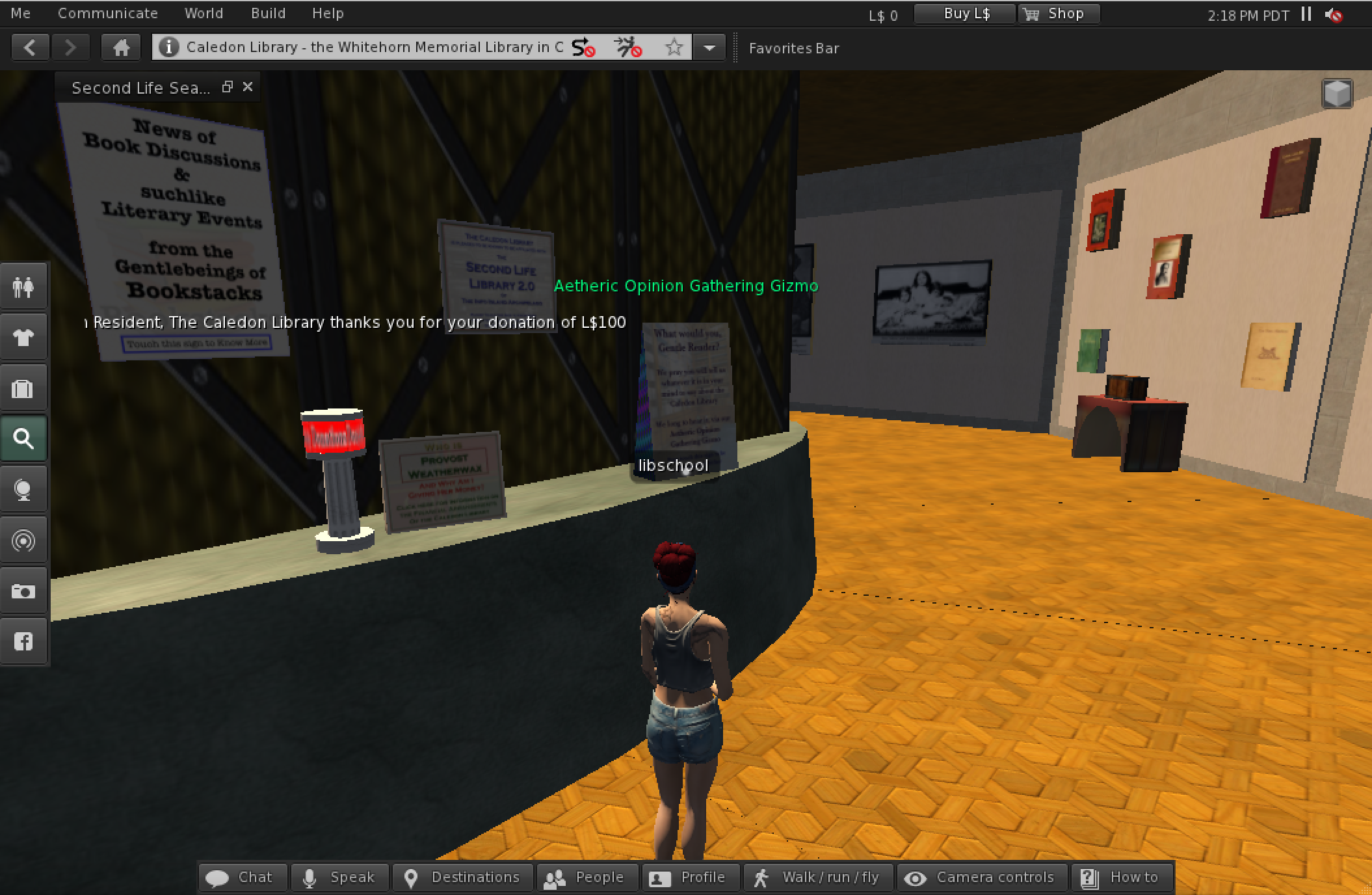
secondreferencedesk

One can imagine that, in years past, there may have been a librarian avatar at this Caledon Library desk, ready to answer reference questions and direct the visitor to resources (either resources modeled within the virtual library, or through hyperlinks to electronic resources elsewhere).

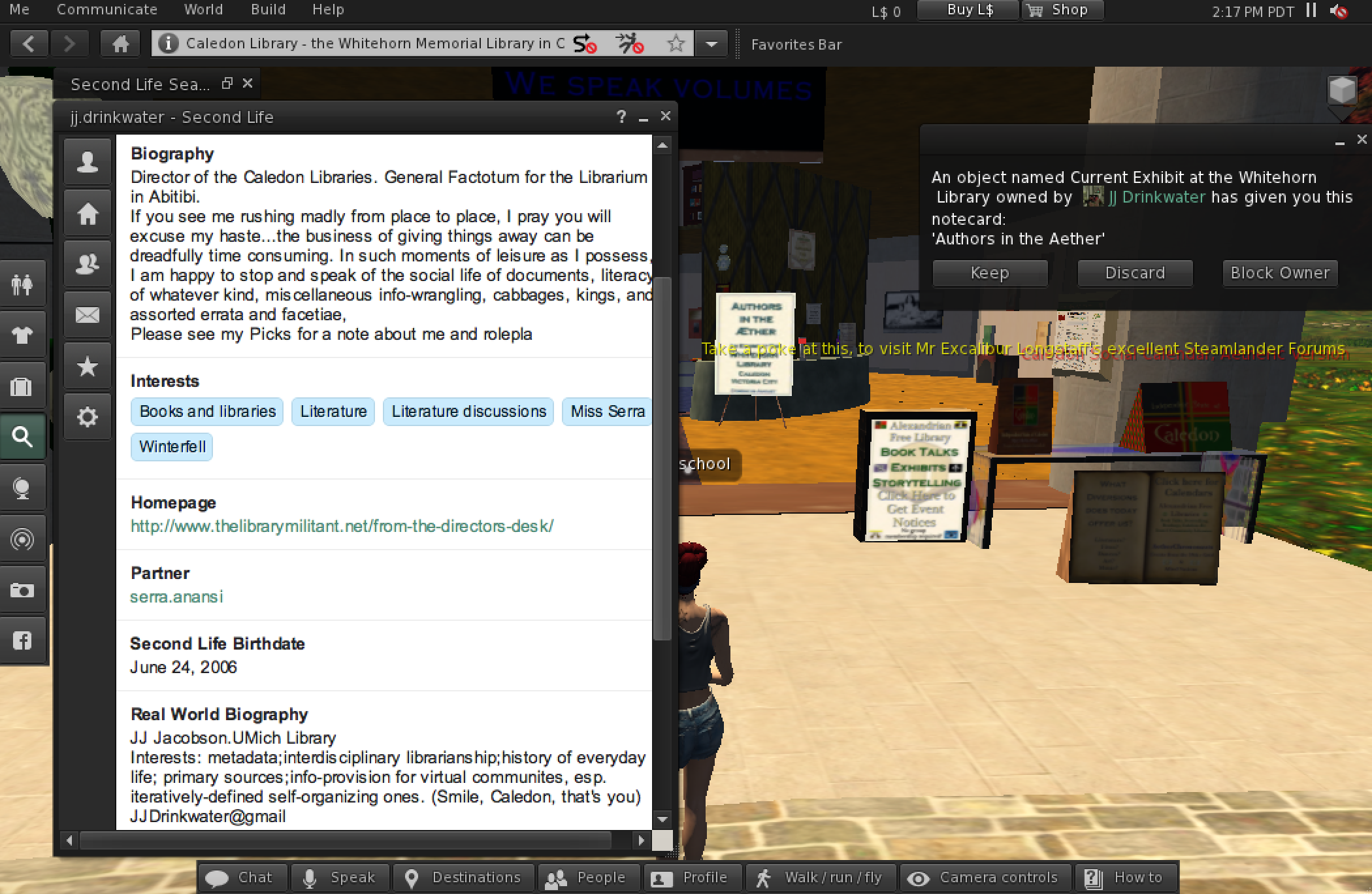
Further proof of life in the library comes in the form of looking at the profile of one of the library’s staff, last active three years ago:

secondstaff

Beyond modeling physical library spaces, users could hold virtual parties, lectures, or reading groups, attended in real time by real users, in avatar form. In forums and on blogs, I found several mentions of an anticipated Caledon archive, comprised of content from users of the fictional library.

My specific interest in the use of Second Life by real-life libraries is most connected to Wardrip-Fruin’s discussion of the ideological systems that inform simulated games. While I have not spent nearly enough time in Second Life to make a strong assessment of the values that may inform its processes, as a librarian, it would seem imperative to compare these with the professional values of librarianship as a field, or at very least the policies and procedures of a specific library system. Beyond mimicking the appearance and basic functions of a library (the surface with which the audience interacts), I am curious as to whether the operational logics of Second Life represent those of an actual library? A number of articles on the subject of library representation in Second Life note that libraries that exist only in Second Life are often more successful than representations of physical libraries, which suggests the possibility of a disconnect between systems.

The value system of the creators of the game is arguably most evident in the case of Woodbury University, which was banned twice from Second Life. In a Chronicle of Higher Education article on the subject, Edward Clift, dean of the university’s School of Media, Culture & Design, said that “he felt that the virtual campus did not conform to what Linden Lab wanted a campus to be—with buildings and virtual lecture halls” [emphasis mine]. Though in this case the restriction was not imposed by computational processes, but by administrative action, it does serve as a reminder that the virtual world doesn’t go unmoderated, and reminded me of Wardrip-Fruin’s statement that “any simulation is actually an encoding of a set of choices…[and] whatever the motivation behind the choices, there is inevitably a politics to how the world is simulated.” If a value assessment of what a university should be is implicit in the story of Woodbury, I wonder if there are similar assumptions of what a library should be, and how that may have been considered or reflected in the processes of creating, staffing, and using a library within the Second Life world.