Procedural Wonders

“[T]he essential features of all games: symmetry, arbitrary rules, tedium.” 

– Jorge Luis Borges, “An Examination of the Work of Herbert Quain”

I’d been reading video game/critic Ian Bogost’s Persuasive Games off and on for a few days when I played board game designer Antoine Bauza’s 7 Wonders with some people at a Eurogames Meetup. 7 Wonders is an accessible game, one they trot out with ‘nubes (like myself), or when time is a bit short. By then I’d heard Bogost’s take on about a hundred video games both obscure and familiar, and I found myself thinking about 7 Wonders in light of his work. Procedural rhetoric and literacy certainly seem to apply to rule-based artifacts of all sorts.

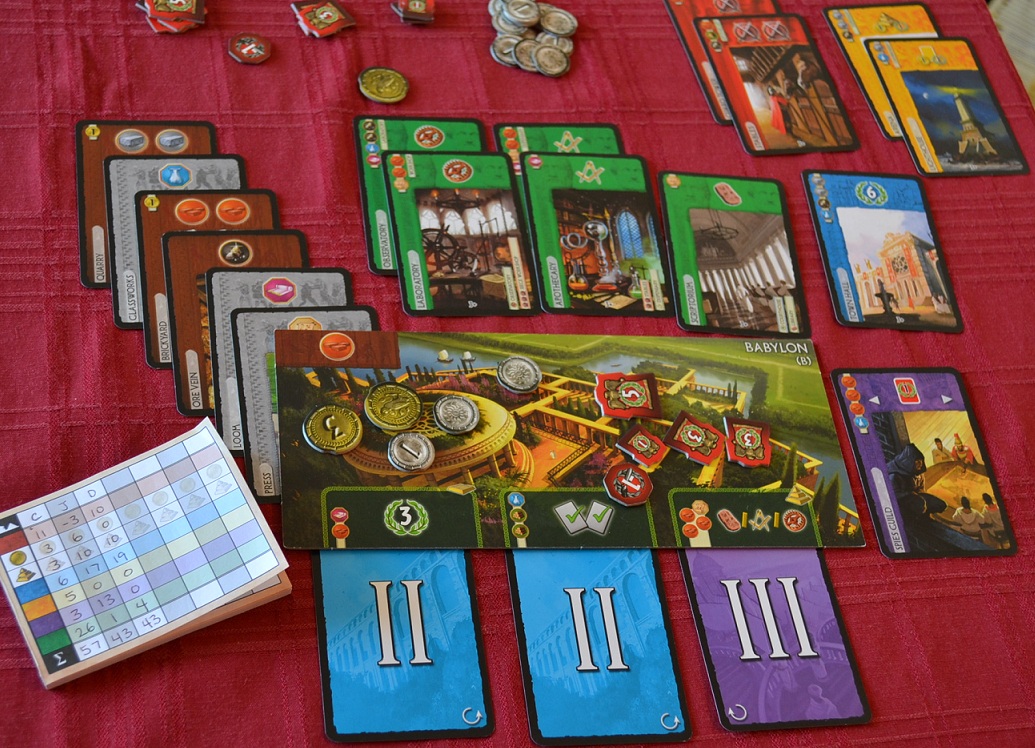
The conceit of 7 Wonders is that you are guiding, in a sort of undefined, god-like way, the growth of an ancient civilization amid a field of rivals.played Babylon most recently.There is no geographic game board, which is unusual in empire building games. Instead, everyone has a kind of place mat (“wonder board,” I think) that lists some basic information about your empire and serves as a baseline for you to set up cards you accrue as the game goes on. I Here is a more official description:

“You are the leader of one of the 7 great cities of the Ancient World. Gather resources, develop commercial routes, and affirm your military supremacy. Build your city and erect an architectural wonder which will transcend future times” (more of this at boardgamegeek.com).
But back to Bogost. In Chapter 8, “Procedural Literacy,” we find this definition: “Procedural rhetoric is a type of procedural literacy that advances and challenges the logics that underlie behavior, how and why such logics work. Procedural literacy entails the ability to read and write procedural rhetorics – to craft and understand arguments mounted through unit operations represented in code” (258).

I mention this passage because it clarifies the relationship between these two slippery terms. Procedural rhetoric is presented here a subset or style of application of procedural literacy. [Perhaps less helpful is the end of the sentence, which alludes to Bogost’s Unit Operations.] Bogost follows up with a list of question one asks when engaged in the “type of ‘reading’ and ‘writing’ that form procedural rhetorics”:

  • What are the rules of the system?
  • What is the significance of these rules (over other rules)?
  • What claims about the world do these rules make?
  • How do I respond to those claims? (258)

I’ll take these questions as a procedure, of sorts, and apply them as a heuristic to 7 Wonders:

  • What are the rules of the system?

You are dealt a hand of cards. You choose one to play, and pass your discards to a player to one side. You can select resources or, if you have enough of them, buildings. The buildings you create can offer you victory points, cash, or more obscure benefits. If you grab a few resources early on, you’ll have better luck building later. The cards get passed around the table in successive hands. (If you really want to get a sense of the mechanics, here’s a video made by a guy who sounds inspired by the majesty of the game.)

  • What is the significance of these rules (over other rules)?

In the situation, the rules mean that you have a very particular relationship to the opponents to either side of you, because they get the cards you don’t play. So occasionally you’ll consider to yourself points like, “Ah if I don’t build this Fortress, they might, and then I’ll be at a military advantage.” Oh, I neglected to mention the game goes in three rounds, after each of which is a quick comparison of military power. It’s not a big deal, but you earn points. (For the sake of brevity, I’ll punt on the “over other rules” element.)

  • What claims about the world do these rules make?

Well, the military conflict is inevitable, its just part of the ancient world. Another claim is that it pays to focus without become too specialized: if you build several science cards, for example, you’ll start a cascade effect in which its easier to build more cards of the same time. But you also want to play enough cards to build your Wonder. It’s the name of the game, after all, and serious points tend are involved.

More generally, I think the game claims that history is the stuff of fertile representation. Think back to Bogost’s fascination with Guns, Germs, and Steel. He notes, “Jared Diamond attempts to expose the underlying patterns that determine why history plays out in the way it does.” 7 Wonders is a bit like that insomuch as its mechanics presume a commonplace understanding of ancient history. There is a material basis for everything you build, and specific cultures have different aptitudes.

But of course 7 Wonders takes the whole thing less seriously. It’s somewhere between Civilization (Bogost: “In Civilization, material and technological innovation enables civic and military dominance”) and Settlers of Catan (which is now being released as just “Catan” to mute the colonial trope). Like these games, though, individuals are basically not on the board. Only aggregates are of consequence, so there again is a bit of historiographic resonance with Guns, Germs, and Steel.

  • How do I respond to those claims?

Well, for my purpose here it seems apt to respond to those claims through a bit of the lens Bogost creates for us in Chapter 8, “Procedural Literacy.” Bogost simplifies the field of educational theory in this chapter, presenting behavioralism as invested in linear, 1:1 correspondence between teaching/game environments and the world, and constructivism as using specific activities to suggest more general, abstract principles. This is a short summary, but Bogost’s opening moves boil it down to pretty much this opposition: specific versus abstract theories of educational payoff. He plots his vision of procedural literacy as a middle path between these poles.

Both specific and abstract. This assertion that specificity matters seems to be one of Bogost’s main innovations. After all, he accepts Mateas’s earlier definition of Procedural Literacy as “the ability to read and write processes, to engage procedural representations and aesthetics, to understand the interplay between the culturally-embedded practice of human meaning-making and technically-mediated processes” (qtd. in Bogost 245).

Ian Bogost reading this.

Do I grasp the connection between meaning-making and technical mediation in 7 Wonders? I think so: The rules are the set of constraints defining the game and the coding of the cards with numbers and interrelationships sets up its algorithmic process. Each card is pretty straightforward, but when you get seven players passing around a half a dozen cards, you introduce a great deal of variation. Just enough, really —you don’t want a game to be so complex that each turn feels like doing math homework, yet you also don’t want the mechanics to be so simple the likely outcomes are utterly transparent. We’re not going for Go, or Chess. While elegant, such pastimes lack the mystery of a more complex algorithmic procedure.

Although to be entirely fair about the math point, 7 Wonders provides a little pad to help with the chore of figuring out who wins the game, which requires detailed tallying after the last cards are played. Which is the great thing about video games: the machine is doing the algorithmic work that turns the hurdy-gurdy of semi-intellectual play. But if you could understand the code, and had access to it, perhaps you’d have as much fun reading it as I might a phone-book sized set of rules for the mother-of-all board games.

But, to keep Bogost in play a bit longer, I’m still looking for the specific import as it relates to the abstract take-away here. The (specific) procedures that run 7 Wonders imply a world of material and social interdependence (abstract), but the game play does very, very little to urge players to think with any seriousness about the ancient civilizations represented in any specificity. It would take a discursive context, a community of interest, a roomful of history buffs, or even a class to push beyond this underlying message —history is ours to ransack for our pleasure; traces of times past are the playthings of our distraction, and surface detail is more than adequate.

There is absolutely no reason that 7 Wonders couldn’t be digitized. Yet such a platform might distance the procedurally rhetorical pleasure of seeing how 7 Wonders allows a group of people to engage in “the art of persuasion through rule-based representations and interactions” (Bogost ix). A game is always an argument, at least insomuch as it is taken as fun. That is, the game has to let you and your fellow travelers in ludic diversion convince each other that leisure happened, that it was indeed fun. It’s much easier to make that argument in the company of others, though a community of videogame players surely accomplishes much the same feat, as I believe James Gee discusses in work of his What Videogames Have to Teach us About Learning and Literacy-era.

Either way, I’m not sure Bogost adequately engages the sociality of games as specific instances of literate practices —social practices in which the pleasure of diversion may be understood to be embodied, rhetorical, and procedural.
The Fault in The Code

Well, I’ll admit before getting too far into this post that I’m perhaps not as far into the reading as many of you, but in a way I’m glad for that because I think if I’d read too much further it would be difficult for me to respond to so much of what Bogost is saying. What I want to do here is provide my understanding of what Bogost means when he says “procedural rhetoric,” and dwell on some of the questions I have at this point in the reading–having just finished the introductory quarter of the book. So here goes:

I think I understand plainly enough what Bogost means by “rhetoric.” He’s using the term broadly to mean intentional expression that is geared at persuasion, which he opposes to “compulsion.” In other words, a rhetorical text should win over the reader, convincing her of the validity of its claims, as opposed to simply compelling her to buy a product or drop more coins into a machine. Significantly, Bogost links rhetoric to dialectical relations. The type of rhetoric he describes engages the reader in an exchange, to which the text is able to respond in a meaningful way. I think I’m clear on that.

It’s the “procedural” portion that I’m either fuzzy about or perhaps unconvinced of. Bogost says that many people mistakenly think of “procedures” as strict, external rules that are inflexible, as opposed to human interaction. He points out that humans operate based upon procedures themselves, but that computers texts (I lack a better word right now–procedural texts seems not-quite-right, too general) “represent process with process,” and that “The inscription of procedural representations on the computer takes place in code,” which is procedural (14). So far, I’m on board. He’s saying (I think) that texts designed for computers–we’ll use the example of video games, since that’s the focus of his book, though he is careful to point out that numerous pieces of software fit into this category as well–require the reader to go through procedures in order to “read” the text, and that the form of which the text is composed, computer code, is also procedural in nature. I’m intrigued by this parallel and curious to get at what it means to play a game, to follow a set of procedures in the interest of an end goal, when the text is dictated by its own underlying, invisible set of rules and procedures that express representations of movement, gravity, etc. I’m even interested in the types of games Bogost proposes in which the player is invited into dialogue with the text and asked to respond to the procedures that compose the game–the choices that are allowed vs. those that are excluded, the consequences of those choices, etc.

Over the summer I read John Greene’s The Fault in Our Stars, a young adult novel about a young woman and young man with cancer. In it, Agustus and his friend play a first-person shooter, and Agustus is very bad at it because instead of maximizing his kill-to-death ratio, he instead makes it his goal to save as many civilians and comrades as possible. In Greene’s novel, this tendency is meant to exemplify Agustus’s refusal to adhere to the rules that govern reality–rules that tell him that he cannot save anyone, including his ex-girlfriend or himself. I’m oversimplifying, but the novel isn’t my focus here. Greene’s argument would be, arguably, that Agustus’s refusal to adhere to the rules/procedures of the game represents not a direct dialogue with the game in which he constructs his own competing argument about war, life and death, etc., but instead that Agustus simply is railing against the inflexible rules of the game the same way he rails against the unfair and equally unyielding rules of his own abilities within the world. For Bogost, though, perhaps Agustus’s alternative gameplay might represent a counterargument, and Agustus should respond by creating an alternative text, his own game with more flexible rules, or perhaps rules that reward different behaviors. Bogost has already explained that “[d]ialectics…function in a broader media ecology…they merely require the interlocutor to construct a new claim in another context–for example, in a responding TV spot or software program” (38).

All of this was very intriguing, especially since I’m trying to connect my Python experience (sad and limited though it is) to Bogost’s argument. I can make procedural arguments about the world and compel readers to follow my logic through following their own set of procedures (in theory)!? Exciting! How does the product reflect the code? Tell me, please, how can I create procedures in code that are reflected in the play of the text I design?

And then I read this: “The player can see how the simulation runs: this is, in no trivial way, what it means to play the game.” and “Understanding the simulation at the level of code does not necessarily solve this problem…does not guarantee an understanding of making and interacting with arguments as processes rather than words. Rather than addressing this problem from the bottom up through code literacy, we need to address it from the top down through procedural literacy” (63-64). So he seems to be downplaying the significance of code–now the text seems to be what the reader/viewer/player sees/experiences and not the underlying code, of which he says “demanding access to a computer program’s code might be akin to asking for direct access to an author’s or filmmaker’s expressive intentions” (64). I’m not a game designer, and I’ll admit I was skeptical that code would be procedural in the same way that a video game’s gameplay is. But it seemed to me that the linchpin of Bogost’s argument was that what made video games a special kind of text was that they were procedures built from procedure, that the code was part of, if not the essential part of, the text. Now, he seems to be stepping back from that, and in a way that seems kind of bogus to me. He’s already complained of other theorists doing the same thing (27). Code is equated with intention? I’m skeptical of such a claim. After reading Turing talk about how he is surprised by machines every day, it’s hard to believe that code is closer to/identical with intention as opposed to the text. Still, it’s hard for me to think of where the code would fall if mapped on to writing–an outline, maybe? Something more like that–the logical frame onto which the actual text is built? Definitely a part of the text, but deducible rather than obvious, visible.

One last remark, though I know this post is getting SUPER long–I’m interested in the arguments that computer code as a genre makes about the world. I mentioned this briefly in my last post, and I don’t have a whole lot more to add, since I don’t know jack about coding. But I do know–at least I think I know–that the fundamental argument that computer programing makes about the world seems to be that a task is the sum of parts–mini-tasks into which it can be broken down. When all of the mini-tasks are carried out, the overarching goal is achieved. Except it isn’t, I don’t think. The goal is something human, the goal that the code achieves is something different–a reflection of that goal in the red-blue-yellow-green that the computer can produce. Round edges become pixelated, however subtly, on a screen. I don’t know that this isn’t a valid way of reading the world–as replaceable, representable. After all, texts, paintings, films all do the same thing. But I do want to investigate how computer programs go about representing the world via procedures, logical structures, etc. What is to be said of that?

That last remark isn’t really fully formed or super well thought out. Again, I don’t know enough about code, software, and hardware for that matter, to really make an argument abbot the way computer programs (re)structure reality in their representations, but I’m very curious to see what you all think and to investigate this problem further. Bogost seems uninterested, but perhaps I haven’t read far enough. I’ll remedy that soon!

See you all in class Thursday. Please comment if you have insights for me!

Mechanics (n): the procedural or operational details (of something)

2015-09-15_18.36.39

In another Bogost work, Alien Phenomenology (2012) he presents the notion of philosophical making as what could be akin to Carpentry “to do carpentry is to make anything, but to make it in earnest, with one’s own hands… carpentry entails making things that explain how things make their world. Like scientific experiments and engineering prototypes, the stuffs produced by carpentry are not mere accidents, waypoints on the way to something else. Instead, they are themselves earnest entries into philosophical discourse” (93). This prior argument from Persuasive Games (2007) emphasizes the gamer, interactor, critic, and reader of the video game in order to elevate games to the level of expressive and persuasive power of literary and other media, but I couldn’t help but feel the maker decidedly left out in this reading of Persuasive Games (it’s the second time around for me). If in the Aristotelian sense rhetoric is related to our capacity to percieve the “available means of persuasion” then Bogost is putting games on the table as an available means of persuasion, and rightly so. As Bogost posits, “procedural rhetoric is a subdomain of procedural authorship; its arguments are made not through the construction of words or images, but through the authorship of rules of behavior, the construction of dynamic models. In computation, those rules are authored in code, through the practice of programming” (29). Rather than focus on the programmer, however, Bogost reads via the lens of the gamer or the critic, which he more than once acknowledges. “Procedural rhetorics,” he writes in his concluding chapter, “expose the way things work, but reflection creates and prolongs this process. Criticism is one aspect of the reflective process. But criticism requires formal discourse, often limiting itself to the academic and cultural elite. More generally, persuasive games can produce discourse in the general sense, like the blog conversations that crop up around the Dean game” (334).

I figured that today I’d think somewhere between Bogost’s two arguments, between critic and maker, where individuals who have a certain level of “procedural literacy” (re: Chapter 8) turn the rhetorical tools of the game toward their own uses, often to subvert the dominant expressive narrative of the base game. It’s procedural rhetoric by appropriation — and I think why I was tempted to add “mechanics” to our list in discussion of code and programming last week, because such work necessitates an understanding of the code at the level of exploiting game mechanics created through the code. This is perhaps especially possible in sand-box style games, like The Sims, which Ada described in an earlier post today. Just search in YouTube for any emotional challenge and you’ll find a Sims animated narrative telling that story, like the results for “bullying” demonstrate, for example. There are also narrative videos of players picking up prostitutes in the various versions of Grand Theft Auto (a component of the procedural rhetoric left out by Bogost, as he chose instead to focus on fast food and health in GTA San Andreas… ugh), either as chosen Let’s Play video headings or in montages (I implore you not to read the comments section on these GTA videos).

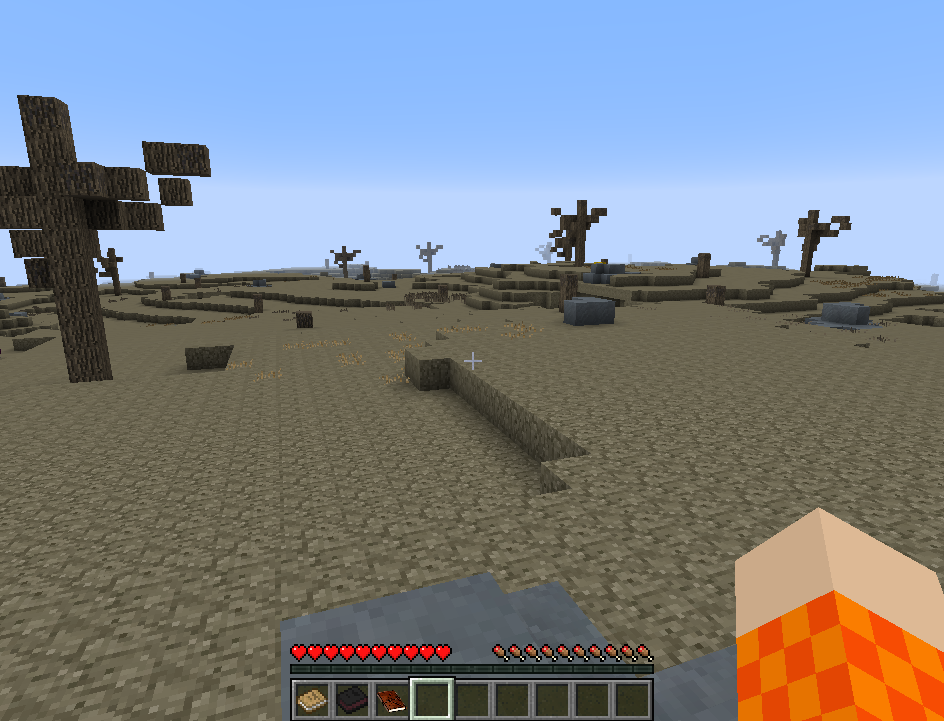
Games with simple mechanics like Minecraft leave it open to the player to create his or her own narrative, deciding what kind of world to build and how sinister or kind that world might be (toward the environment, for example). This kind of openness leaves room for modding (game modification), where programmers can edit or add portions of game code to alter those mechanics or add new interactions, which is especially vibrant with games like Minecraft. Game packs with certain selections of mods are also often put together with the mod “Hardcore-Quest-Mode” which uses a quest book to set up a narrative and guide the player through the use of the mods. Many of these questing packs start with some type of dystopic setting, changing world-gen to create desolate worlds that players have to rebuild with plant-based resources, or build consequences into a game without much consequence in its base game (have a gander of some of these packs). The persuasion then comes not from the game’s original programmers, but with those who can read and make new mechanics from existing capability of the games, which can then be interacted with by other players.

As I continue to think about programming literacy I feel a personal and intellectual tension. On the one hand, I want to learn how to code so I can make academic work with and through digital means, but on the other hand appropriating and exploiting existing program mechanics can generate productive and expressive avenues for users and thinkers, which requires procedural literacy but doesn’t necessitate programming knowledge, per se. I wonder what’s more important for the general population — being able to read and understand how code is impacting the ways in which we interact with programs on the web and otherwise enough to make/appropriate/exploit those mechanics for one’s own expressive purposes, or learning enough code to invent from the ground up? In many ways I think the appropriative version is more exciting — just give people discursive tools and they’ll act with them. It also takes away (perhaps) some of the intimidation factor of learning and keeping up with ever-evolving programming languages and tools, which is a good thing, no?


Bogost Plays The Sims: Procedural Rhetoric, Object-Oriented Gameplay, and Consumerist Learning

Hello class,

I can’t wait to discuss the Bogost reading in class, but until then, I’d like to think a bit about the relationship between consumerism and rule-based representations. In the section on advertising—and to a lesser extent, the rest of the book—Bogost discusses how procedural rhetoric has been used to persuade players to consume particular products. However, I wish he had gone into more depth on how videogames’ procedural rhetoric can be used not just to sell individual products, but to inculcate a more general consumerist ethic. In fact, I would argue that the procedural rhetoric of today’s open-world videogames is inherently consumerist, and escaping from that state would require designers to radically rethink game mechanics.

At the risk of choosing an obvious example, I’m going to focus on how this works in one particular videogame—The Sims. This is because as the bestselling PC game in history, I’m assuming that many of you have played it before, or are at least familiar with its premise. (Also, it’s one of the few videogames I’ve played enough to feel comfortable critiquing.) The Sims is a ‘sandbox’-style game that markets itself as a ‘life simulator’ or a ‘people simulator.’ It’s been released in 4 versions since 2000, and the creator, Electronic Arts (EA) supplements the game’s content every few months with ‘expansion’ or ‘stuff’ packs that include new game mechanics and objects. (Fun fact: EA has released more than 50 of these ancillary expansion/stuff packs, in addition to the base games. At $20-$50 a pop, it’s not uncommon for enthusiasts to spend hundreds of dollars augmenting their games. It should be no surprise, then, that EA’s procedural rhetoric promotes voracious consumption of material products.)

Representing human life in a video game is no easy task, and although The Sims was hailed as revolutionary when it was released, its procedural rhetoric is very similar to that of early open-world games like Myst. In both Myst and The Sims, players can navigate the game world with nearly complete freedom, but the actual gameplay happens only through interacting with objects. Your Sim is hungry? Click on the fridge to feed her, or the phone to order a pizza. Is she tired? Click on a bed or sofa to put her to sleep. With the exception of interpersonal interactions, it is only possible to command your Sims through objects, and the cost of an object matters a great deal if you want your gameplay to be efficient. Your Sim will finish her business faster on an expensive toilet (no, I’m not kidding), and become more fit by running on a treadmill than she will by jogging outside. Although it purports to be a sandbox, The Sims’ procedural rhetoric forcefully pushes the player toward a particular type of play that focuses on earning money to buy the best objects.

Try to live off the land or play as a homeless Sim, and you quickly run into the sandbox’s walls. Your character will collapse from fatigue at inconvenient times, effectively freezing the game, because it is impossible to sleep without a bed. If her ‘fun’ metric (which can only be boosted by interacting with objects—the pricier, the better) falls below a certain level, she’ll throw a tantrum and refuse to obey the player’s commands. This critique of The Sims is in no way new, either in academia or in the popular media.

Despite my earlier dig at EA, I don’t believe this is a conspiracy to brainwash people into buying more expansion packs. Videogames need to be programmed, and programming requires rules. Object-oriented game mechanics (NOT to be confused with object-oriented programming) are an easy way to create a cohesive set of rules while giving players the impression of a truly open world. Selecting an object opens a menu; the player chooses an option, the game responds. The Sims makes players think they’re in an open world by offering them an apparently limitless array of objects and interactions*.

I’d like to extrapolate Bogost’s argument about procedural rhetoric in advertising to propose that object-oriented game mechanics are inherently materialist and consumerist. The Sims’ consumerist ethic, then, is primarily a product of its mechanics, not American culture or its programmers’ ideology. Given the limitations of current technology, it is not surprising that programmers gravitate toward object-oriented mechanics; as discussed above, they provide an illusion of depth for the player while keeping the programming work manageable. However, when it is only possible to play the game by interacting with objects, material consumption becomes the most fundamental driver for both the player and her character. This is a little frustrating for me because open-world simulations are often heralded as a more benign alternative to violent fighting-based games. But just as first-person shooters generally don’t allow the player to put her hands up and sing kum-ba-ya with her adversary, open worlds confine the player to an existence where her only agency is in how she interacts with material objects.

So, back to the Bogost reading – hopefully that wasn’t too much of a digression! The object-oriented mechanics I’ve described above don’t fit easily into any single part of Bogost’s taxonomy of advertising. The Sims instructs players on how to use objects, but it also associates more expensive objects with greater happiness. In this sense, the procedural rhetoric combines Bogost’s different types of advertising, in order to persuade users to adopt broad consumption paradigms. I believe that games like Myst, which are less overtly consumerist, inculcate the same values because the only way the player can assume agency is through ‘stuff.’

What, then, might a non-materialistic, open-world game look like? Perhaps the gameplay would be driven more by characters than objects. (To be fair, character interactions are a component of The Sims, Myst, and many other open-world games, but they generally aren’t the main mechanic by which the player interacts with the world). A less materialistic open-world game might rely more on logic and puzzle solving—think Civilization or other strategy games, but without the rigid victory conditions. What do you guys think?


* Although the array is actually quite limited – e.g., the game offers several different fridges in various price ranges, but they all come with the same set of possible interactions. You can get a snack, cook dinner for your family, or put away your leftovers, but you can’t rearrange the shelves or destroy the fridge with a sledgehammer. The only difference between fridge skins is how efficiently they fulfill the Sim’s needs, and this is what I mean when I say that the vast range of options is an illusion.

Persuasion through Spectacle?

As I read Ian Bogost’s book, Persuasive Games, I found myself subconsciously substituting “coding” for “gaming” quite frequently. So, for example, I read that “It is common…to equate videogame playing [CODING] with idle time” or that CODING (and gaming) are “easily denigrated as trivial” (Preface, vii). It seems that since coding has not yet found its place in my average “work day,” I often perceive it as belonging to those stolen moments in between one activity and the next. Is this how others view coding and gaming?

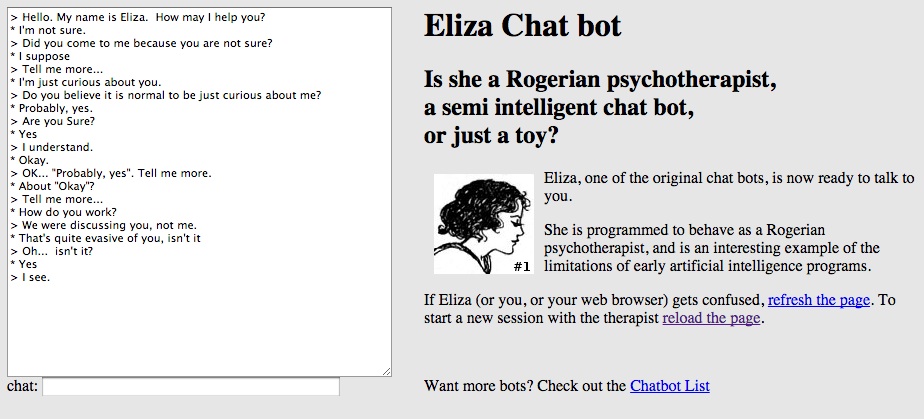
Eliza Chat bot

The Eliza Chat bot: a disappointing therapy session

In addition to drawing these parallels, I attempted to embrace Bogost’s thesis of persuasion as accomplished through procedurality. When Bogost described ELIZA, an early example of Natural Language Processing (I believe “her” program was written in 1973), I opted to try the Eliza Chat bot to get some sense of how these conversations ran on procedures (see image). My session with Eliza quickly revealed why she was/is called a “Rogerian psychotherapist,” as she expressed an unnerving degree of empathy and was constantly reaffirming my feelings by regurgitating phrases I’d previously entered. Of course, this type of therapy “logic” aligns well with the way subroutines in code are established, and the façade of language fluency quickly disappeared from this interaction. I had a few “conversations” with Eliza, and they all left me feeling frustrated and, in some way, inadequate.

Progressing beyond ELIZA and to the games themselves, I found Chapter 4: Digital Democracy, incredibly compelling. Looking for a form of effective expression and a “desirable possibility space for interpretation” (28), as described early in Bogost’s tome, I was intrigued by the macabre games simulating such events as JFK’s assassination, the September 11th terrorist attacks, and the Waco siege of 1993. These games require players to embody the roles of victim or assassin subjected to randomly-assigned circumstances. So, during one session, a player might escape the World Trade Center, but on another they may be forced to jump to their death. Although these games may create a type of “meaningful engagement with procedurality” (124), I’m still unsure of the purpose of this type of engagement. Are these games attempting to generate an even greater degree of empathy for the victims? Or are they satisfying some strange curiosity about these events, and feeding our somewhat disturbing appetite for spectacle? Speaking of which…Bogost writes about the spectacularity of JFK’s death in JFK Reloaded.

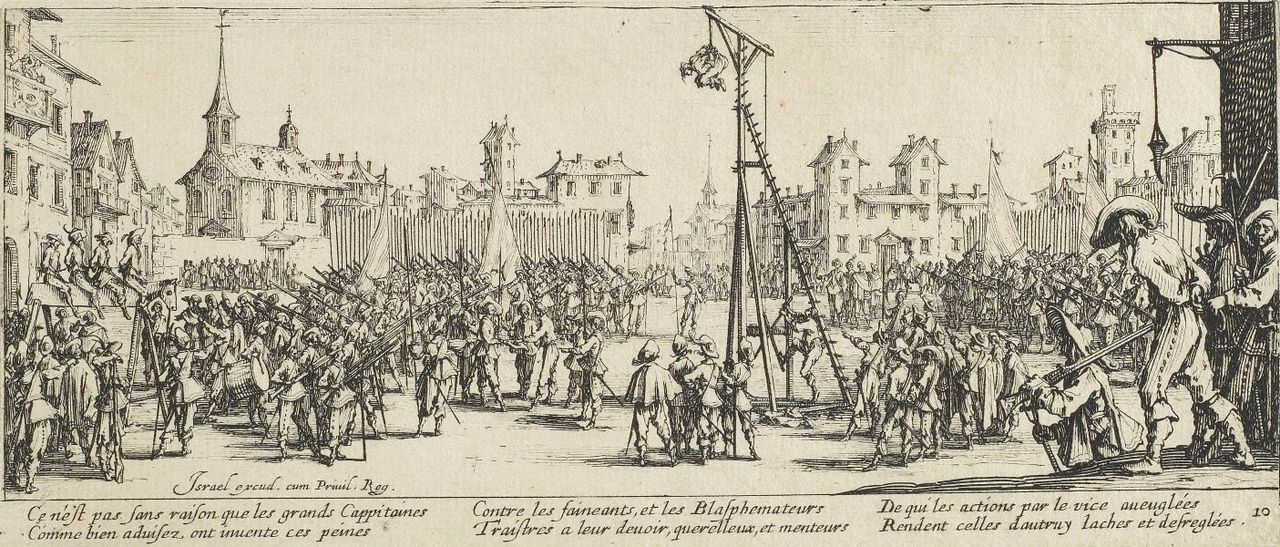
The Strappado. Courtesy of Wikipedia.

The Strappado. Courtesy of Wikipedia.

This immediately transported me to Michelle Foucault’s Discipline and Punish, and his descriptions of punishment as public spectacle. This, in turn, brought me to Francisco Goya’s etchings, Los Desastres de la Guerra or The Disasters of War, and Jacques Callot’s Les misères et les malheurs de la guerre or The Miseries and Misfortunes of the War. Both of these series are unique in their unapologetic depiction of war as horrific spectacle. What is the difference between Callot’s 17th-century engravings and Goya’s 19th-century etchings and Waco Resurrection, for instance? The game and Callot’s series are:

  • staged,
  • they place the viewer in the midst of the action and the various gruesome procedures of war,
  • and they adhere to a pre-defined sequence controlled by the creator.

Perhaps I’m oversimplifying things in order to make my argument work!

I’ll leave you with a couple of additional questions:

  • How can political campaigns incorporate “meaningful engagement with procedurality” when the outcomes are unknown? The examples provided in the book are of historical events defined by their outcomes…but how could Bernie Sanders, for example, incorporate procedurality in his current campaign tactics? Bogost’s examples (including Howard Dean) all pre-date Twitter and seem *somewhat* outdated, so I’m wondering what a game might look like now?
  • This is a reference back to the beginning of the book, but Bogost describes a videogame as a “medium,” in the sense that film and radio are media. Is “code” a medium?

What is code?

Thanks for the great discussion last night! I wanted to share the links for the things I brought up in class. First, the document with your definitions of code. And the visualization (thanks to Aisling for the reference to Voyant!):


WhatIsCodeVisualization


Here’s the video of Why the Lucky Stiff explaining how programming should be fun and easy, like games:

He references this short piece he wrote, “The Little Coder’s Predicament.” And if you’re curious about _why, then you can read his Wikipedia page, or this interesting article in Slate that covered his disappearance (referencing a lot of Pittsburgh connections, incidentally), or his this article in Daily Dot on his slight return, when he put out a novel in printer command language.

And finally, some summary snippets of your blog posts from last week, which I meant to distribute in class, but forgot:

PrintLikeFordBlogPost

The contemporary computer seems to be the most extreme example of a media that erases itself, or hides its true core. Introducing someone to the most “basic” ways of interacting with a computer like word processing or Google actually seems to dull or blunt the basic skills and instincts useful to programming.

the efficiency and simplicity of the language (once attuned) mixed with a determined infrastructure is giving me hope that there might be a computational critical method that can be excavated onto rhetorical criticism at large (not just semantically)

Well, supposedly Python is named after Monty Python, who are some of my favorite Englishmen, but putting jokes aside, it’s a language, right?

It is not about the beauty of the writing, but simply about the speed and accuracy of its results.

It strikes me as odd that the infrastructure available does not seem to comply with the general stated goals of programming literacy.

I felt that I was acquiring a set of skills that would allow me to navigate a breadth of ideas and content and, eventually, with practice, express my own original content, or a point of view, to communicate with others and contribute to a larger dialogue…. For all the rules, and all the value of the rules, I suspect that code is more malleable than it feels when we are learning it, in the way that language is not as rigid as rules of grammar and sentence structure could make it seem. Once you learn what you are working with, you build on it and test the boundaries of what you can do outside the rules.

I’m thinking about coding as a language that alters the way we think.

There’s a tendency when coding to develop your own style and throw best practices out the window, but as I’ve mentioned, keeping up with those practices makes it easier to transition between languages while also making your code easier for others to read and, therefore, modify.

code in Python, like the traditional sonnet, has a series of beats and lines that must be filled according to protocol; I will not be able to Berriganize my code, despite a desire to, by the end of this class, produce some kind of aesthetic object that eludes fixity.

I got the result I wanted to move forward (“done enough“), but it’s not the way it “should” look (and I don’t mean “perfect,” but rather, more acceptable or conventional, or maybe, more “precise” is the way to put it).

we in the humanities like nuanced, complex definitions and are fully willing to let them shift and evolve as we encounter and construct new information. In the world of computer sciences, this is not at all the case. Definitions are agreed upon and clear. In the world of coding, I learned, we can make anything equal anything, so long as what was presented and what was equalled makes sense in the language of the code.

I hope to help bridge the gap between theory and lived experience.

I was forced to figure out the mistake on my own, and it was much more liberating and empowering than simply referring to a troubleshooting manual.

I have found that coding, or doing work in the digital humanities, has consistently required a level of concision and efficiency that I hadn’t previously encountered using the tools of pen and paper or Microsoft Office.

Strangled by Python

Learning to code in Python was both a challenging and frustrating experience. It really showcased the gap between what computers seem to “do” in society and the economy at large and what they “are.” Another way of saying this s that I began to appreciate that the gap between an experienced computer user and power user is really a yawning chasm. Recent years of doing all my thinking and writing on computers has made me into the exact kind of human-computer symbiote we were discussing last week—I generally type in all lowercase, don’t need to spell words or use proper punctuation and don’t bother remembering or recording the exact names of things because I know auto correct or google suggestions will correct it for me. These habits may allow me to work faster and perhaps augment my thinking in various ways. Ironically however, these skillsets that the computer has encouraged me to develop made my coding instincts a complete disaster.

I kept getting stuck in the Python tutorial for the silliest reasons such as misspelling my variables and especially forget to capitalize “True” or punctuate things appropriately. As simple as it might sound, it took me awhile to really grasp the fact that this wonderful machine that corrects all of my spelling and punctuation errors (when running the appropriate software) at its core demands the highest level of accuracy and precision to interact with. Addressing this in the context of some of the parallels between literacy and coding leads to some interesting conclusions. The contemporary computer seems to be the most extreme example of a media that erases itself, or hides its true core. Introducing someone to the most “basic” ways of interacting with a computer like word processing or Google actually seems to dull or blunt the basic skills and instincts useful to programming. The Code Academy tutorials try to address this gap someone by including achievements that pop up periodically, making me feel a bit like I was playing another game on Steam.

Coding til the lights turn off or: Does Not Compute

As the title suggests, currently finishing my two hour run on Code Academy (1.5 hours, but the Cathedral of Learning is very creepy at night and they seemed to have switched the lights outside off our computer lab office off) with some bittersweet feelings:

Cathedral Is Creepy


Attempting to learn the language of basic codes was a harder task than previously anticipated. Most of the time I found myself staring at a page, attempting to recall the early lessons that I flew by, finally culminating in the realization that I should start again from the beginning (utilizing repetition as a means to get a better understanding of the computational language that certainly seems foreign). My ego certainly got checked as I overtly anticipated my ability to just “jump in and succeed”. I quickly realized that all my academic weaknesses (lack of attention to detail, lack of patience, and struggles to remember mathematical signs) are the sine qua non for quickly learning the linguistic structure and trade. After the initial shock wore off, the repetition of trail and error eventually got to the point where some of the commands were beginning to make sense, which quickly shot some optimism back into the fold.


As I’m writing this, I’m currently excited again about the computational and technical aspects of this course. First and foremost, the efficiency and simplicity of the language (once attuned) mixed with a determined infrastructure is giving me hope that there might be a computational critical method that can be excavated onto rhetorical criticism at large (not just semantically), and while this thought is still nascent, I’m definitely going to be thinking about it as I move forward. Second, and selfishly, I hope that continuation with technical computation can help me resolve some issues with how I approach text in general (whether it be word efficiency or better attention to detail). Finally, I hope that (as the reading suggests) I become pseudo-competent over the next few months of the course and literate enough to understand what’s beyond “the black box”.

Python doesn’t care about silly associations.

“Dot[ted] notation” right?

Wrong. But kind of.”my_problem”.Upper()

images
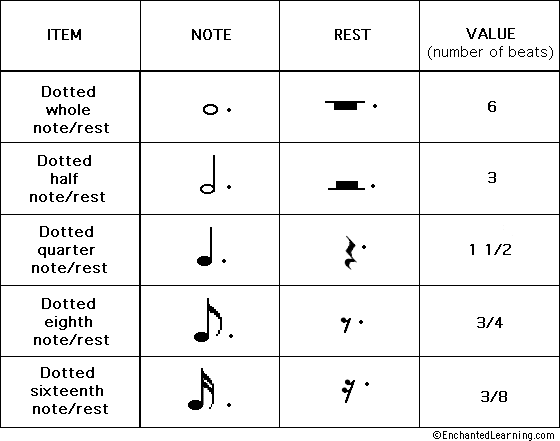
The imagined precision of musical notation is spatial, temporal. When played, the proficient listener can deliver immediate feedback, like that wretched awesome console thing. 


“Great work! Now that we know how to store strings, let’s see how we can change them using string methods” (Weinstein).

 A framing command “turns strings into non strings.” But I can’t reduce Python to a spatialized system in which each command occupies a unique niche in a synchronic field, like the notes of keyboard. It is “calculators that just stick to numbers,” while Python’s string formatting opens up avenues of authorial choice.When you want to print a variable with a string, there is a better method than concatenating strings together (Weinstein). Comparing and selecting from among methods, making authorial choices. You could consider it style (Vee). Like having more than one way to say something. Or more than way to play the same note.


No, no. It’s “raw input” that let’s you really do stuff with python. It establishes a real-time relationship between the code being manipulated within the editor and the output of the console.
Like a draft that displays chances of publication as you write.
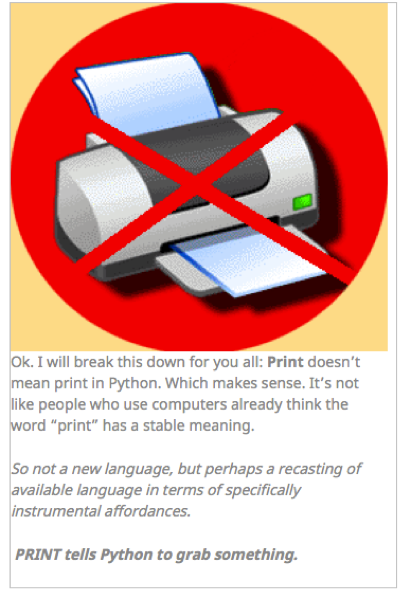
Ok. I will break this down for you all: Print doesn’t mean print in Python. Which makes sense. It’s not like people who use computers already think the word “print” has a stable meaning.
So not a new language, but perhaps a recasting of available language in terms of specifically instrumental affordances.
 PRINT tells Python to grab something.
Very low.

“That’s great honey. I bet you’ll do fine. You always were so good with poetry, scansion and the like. So what’s the programmy thing called again?”                                                                                                                                                                                                                    …..                                            “Why?


Code coils back upon itself. Recursive. Uncanny. But not as scary.


Tips. Or: let there be light?

At the time of writing this, I am only an hour into the Python tutorial and (I fear) rather far behind (so I’m taking a break to enter a post). I might have stared at the screen for so long trying to decipher the final lesson of “Tip Calculator” that the computer lab’s motion sensor lights went out on me. It turns out where I kept trying to enter number values, I was simply supposed to repeat the text (“meal + meal = etc.”). Duh. 

I am prone to overthinking and have cultivated an unfortunate learned helplessness in math (blame childhood rebellions against my math-enthusiast engineer father). This combination of traits makes this sort of activity especially fraught for me. Glancing at other posts, I take it I’m not the only one filled with (perhaps unnecessary) anxiety over this supposedly low-stakes exercise — to the extent that I’m stepping away from it to talk it out. This sort of blogging about my feelings is now giving me flashbacks to my middle school LiveJournal, so I’ll turn outwards to the second prompt of the entry: relevance to English studies.

Well, supposedly Python is named after Monty Python, who are some of my favorite Englishmen, but putting jokes aside, it’s a language, right? English studies is concerned with the art of language. In addition to being a language itself, the language that is used around Python (and other coding langues) are worth noting. Rhetoricians are certainly interested in discourse communities and disciplinary terminology, etc. (I, for one, always get so excited when I encounter the term “Boolean,” which may be a commonplace term for engineers but always feel novel to find in traditional English studies). This feels like another Duh sort of answer, but I will use this as a placeholder and perhaps update more thoughtfully when I finish my full two-hour foray and also take a nap.

(In the meantime, via clearly trusty fact-checking on Wikipedia, I’ve found an appropriate bird anecdote: “Additionally, a 2001 April Fool’s Day joke by van Rossum and Larry Wall involving the merger of Python with Perl was dubbed “Parrot” after the Dead Parrot sketch. The name “Parrot” was later used for a project to develop a virtual machine for running bytecode for interpreted languages such as Perl and Python.”)